Fill out academic forms
with AI.
Academic forms are the essential administrative building blocks of the educational journey, ensuring that students, faculty, and institutions remain aligned on program requirements and progress. This category covers a wide range of documentation, from enrollment and course registration to specialized academic planning. These forms are critical because they serve as the official record of a student’s intent and achievements, often determining eligibility for graduation, financial aid, or specific career-track certifications.
By continuing, you acknowledge Instafill's Privacy Policy and agree to get occasional product update and promotional emails.
About academic forms
Students typically encounter these forms during major transitions, such as declaring a major, transferring credits, or participating in specialized programs like the ROTC. For instance, the USACC Form 104-R and other cadet academic plans are vital for mapping out degree progress and ensuring that a student’s coursework satisfies both institutional standards and external program requirements. Faculty advisors and registrars also rely on these documents to verify that a student is on track to meet their goals within the authorized timelines.
Navigating the fine details of credit hours and term-by-term schedules can be time-consuming and prone to error. Tools like Instafill.ai use AI to fill these forms in under 30 seconds, handling the data accurately and securely to simplify the administrative process. By streamlining the paperwork, students can spend less time on manual data entry and more time focusing on their academic and professional development.
Every form on this page can be completed without typing. Instafill is form filling software that reads a PDF and fills it for you — including flat and scanned documents that carry no fillable fields at all.
Forms in This Category
The forms in this category have a median Form Complexity Index of 72/100 (Complex), measured across 3 forms by field count, input difficulty, length, conditional logic and structure. See how it is calculated.
| Form Name | Pages | FCI | |
|---|---|---|---|
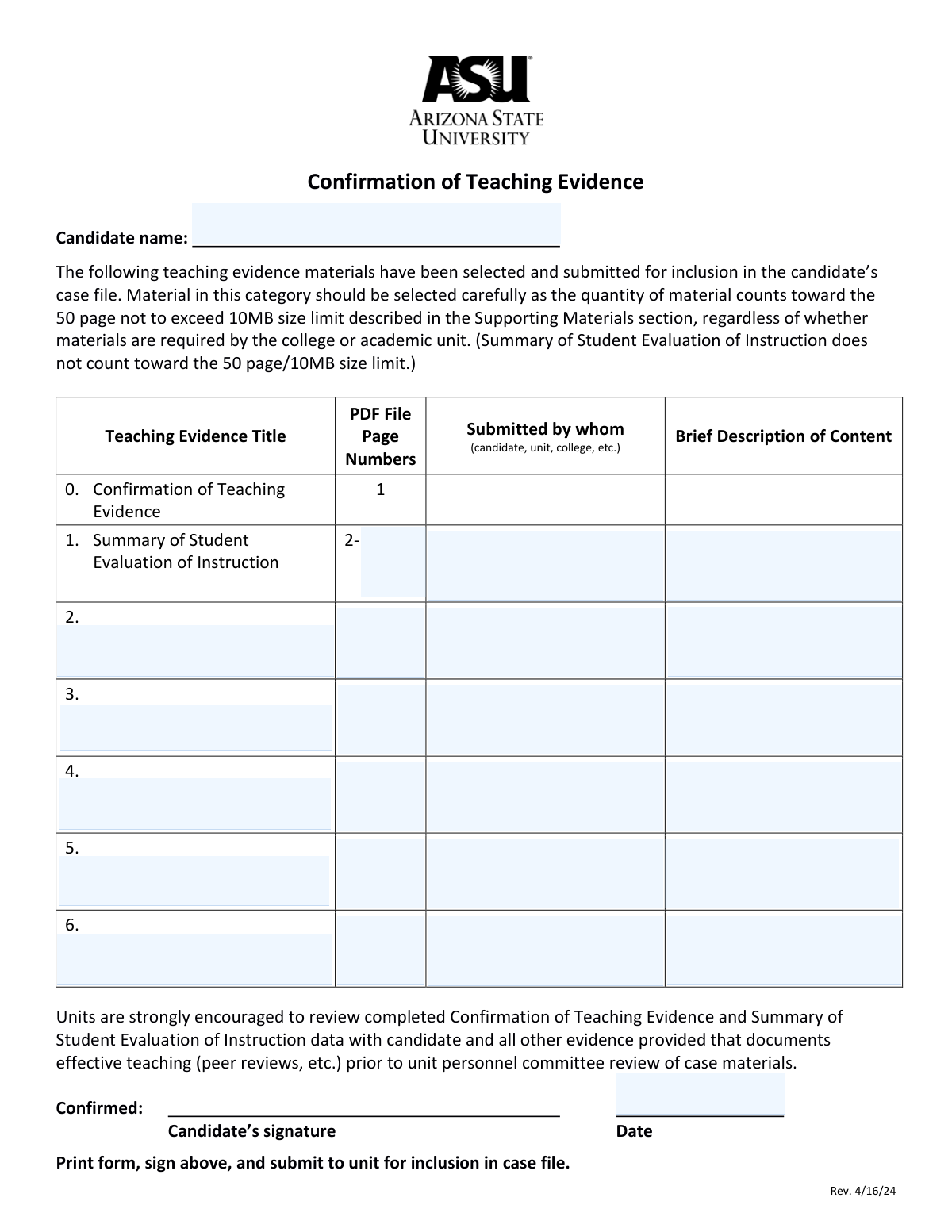
| 1. | Confirmation of Teaching Evidence | 1 | Basic 38 |
| 2. | ROTC Cadet Academic Plan / Degree and Credit Hour Worksheet (Student Identification, Term-by-Term Courses, GPA Summary, and Completion Certification) | 3 | Very Complex 80 |
| 3. | USACC Form 104-R, Planned Academic Program Worksheet | 3 | Complex 72 |
- Enterprise-grade security & data encryption
- 99%+ accuracy powered by AI
- 1,000+ forms from all industries
- Complete forms in under 60 seconds
How to Choose the Right Form
Selecting the correct academic documentation is crucial for ROTC cadets to ensure their coursework aligns with both university degree requirements and military commissioning timelines. While both forms in this category serve the purpose of degree planning, your choice depends on the specific requirements of your program or the Professor of Military Science (PMS).
Official USACC Requirements
If you have been instructed to provide the standard Army Cadet Command documentation, you should select the USACC Form 104-R, Planned Academic Program Worksheet. This is the primary document used to verify that a cadet can meet scholarship or commissioning timelines within the authorized number of terms. It includes a specific Statement of Understanding regarding responsibilities and degree changes, and it requires formal signatures from both the cadet and school officials to confirm the path toward graduation.
Detailed Degree Audits
For a granular look at academic progress and credit hour verification, the ROTC Cadet Academic Plan / Degree and Credit Hour Worksheet is often the preferred choice. This form is particularly useful for documenting:
- Term-by-Term Schedules: A clear breakdown of every course planned for each semester.
- GPA Summaries: Tracking cumulative and term-specific GPAs to ensure eligibility.
- Credit Hour Totals: Verifying that the cadet meets the minimum credit requirements for their specific degree track.
- Institutional Certification: Providing a space for a registrar or academic advisor to certify that the plan meets all university standards.
Quick Summary
In many cases, these forms are used in tandem. However, if you are filling out your initial scholarship paperwork or updating your official file with the Army, the USACC Form 104-R is generally the required standard. If your department requires a more detailed worksheet specifically for a degree audit or credit-hour verification, the ROTC Cadet Academic Plan provides the necessary structure to ensure every requirement is accounted for.
Form Comparison
| Form | Primary Focus | Key Requirements | Required Signatures |
|---|---|---|---|
| ROTC Cadet Academic Plan / Degree and Credit Hour Worksheet | Tracks term-by-term course schedules and verifies degree progress for ROTC cadets. | Monitors GPA summaries, total credit hours, and distance learning course indicators. | Requires signatures from the cadet and a registrar, advisor, or official. |
| USACC Form 104-R, Planned Academic Program Worksheet | Official Army worksheet used to verify scholarship eligibility and commissioning timelines. | Includes a Statement of Understanding and verifies compliance with public law requirements. | Requires signatures from the cadet and a designated school or ROTC official. |
Tips for academic forms
AI-powered tools like Instafill.ai can complete these complex academic forms in under 30 seconds with high accuracy. Your sensitive educational data stays secure during the process, providing a massive time-saving advantage for cadets and students managing multiple registration documents.
Ensure that every credit hour listed on your worksheet matches your official university transcript or degree audit exactly. Discrepancies between your planned academic program and your actual record can delay scholarship approvals or commissioning timelines.
When filling out ROTC-specific worksheets, provide a clear breakdown of every course planned for future semesters. This helps your Professor of Military Science confirm that you are on track to graduate within the authorized number of terms for your program.
Many academic forms require you to specify if a course is taken via distance learning or in a traditional classroom setting. Be sure to mark these correctly, as there are often specific limits on how many remote credits can count toward your specific academic requirements.
These forms typically require certification from both a university official and an ROTC officer. Schedule a meeting with your academic advisor early to review your degree audit and obtain their signature before submitting the final document to your unit.
Since these forms often include a Statement of Understanding regarding curriculum changes, always save a copy of your approved worksheet. If you switch majors or adjust your graduation date, you will need to submit an updated form immediately to remain compliant.
Frequently Asked Questions
These forms are designed to track a cadet's progress toward their degree while ensuring they meet the military's requirements for commissioning. They provide a roadmap of every course needed for graduation, allowing both university and military officials to verify that the student is on track to graduate within the authorized timeframe.
The student or cadet is typically responsible for drafting the plan based on their university's curriculum and major requirements. Once the draft is completed, it must be reviewed and certified by a university academic advisor and an ROTC official to ensure all data is accurate.
Yes, complex academic documents can be completed efficiently using AI-powered tools. Services like Instafill.ai can accurately extract data from your transcripts or degree audits and place it into the correct fields on the form, which helps prevent manual entry errors.
A term-by-term breakdown allows the Army Cadet Command to monitor credit hour loads and GPA requirements for each semester. This level of detail is necessary to ensure the cadet maintains scholarship eligibility and meets the public law requirements for commissioning.
To ensure accuracy, you should have your current college transcripts, a list of your remaining degree requirements, and your planned schedule for all future semesters. Having these source documents ready allows for a smoother verification process with your academic advisor.
While manually entering every course and credit hour can be time-consuming, using AI tools like Instafill.ai allows you to fill these forms in under 30 seconds. The AI quickly extracts data from your source documents and places it directly into the PDF fields.
Any significant change to your degree path usually requires a new academic plan to be submitted and approved. Most forms include a Statement of Understanding that outlines the responsibilities for reporting changes to ensure you remain in compliance with your ROTC contract.
Completed and signed forms are generally submitted to your local ROTC battalion's administrative office or your Professor of Military Science. You should also keep a personal copy and ensure your university academic advisor has one for your student file.
In addition to the cadet's signature, these forms typically require a signature from a university official, such as a registrar or academic advisor, to certify the academic data. A final approval signature is then required from an ROTC official, such as the Professor of Military Science.
Yes, academic planning worksheets are often a critical component of the scholarship application and maintenance process. They prove to the military that the student is pursuing a valid degree and is making satisfactory progress toward graduation.
Glossary
- Form Complexity Index
- Instafill’s 0–100 measure of how much effort a form takes to complete, calculated deterministically from the form’s own structure rather than estimated. It combines the number of fillable fields (the largest factor), how difficult those fields are to complete based on their type, the number of pages that contain fields, the amount of conditional “fill-only-if” logic, and how many sections the form is divided into, then adds modifiers for tables and repeating lists, bundled instruction pages, and dense page layouts. A higher score means the form is harder to fill out by hand. The forms in this category have a median Form Complexity Index of 72/100 (Complex). See exactly how it is calculated.
- USACC
- The United States Army Cadet Command, the organization responsible for overseeing the Army ROTC program and officer training.
- 104-R
- A specific Army ROTC form used as a planned academic program worksheet to ensure a cadet is on track to graduate and commission on time.
- PMS (Professor of Military Science)
- The lead military officer and department head of a university's ROTC program, responsible for approving a cadet's academic and military progress.
- Commissioning
- The official process of being appointed as a second lieutenant in the military after successfully completing a degree and ROTC requirements.
- Degree Audit
- An official evaluation of a student's academic progress that confirms which requirements have been met and which courses are still needed to graduate.
- Statement of Understanding (SOU)
- A formal agreement within a form where the student acknowledges they understand the rules, requirements, and consequences associated with their academic plan.
- Distance Learning (DL)
- Refers to courses taken online or through correspondence rather than in a physical classroom, which may have specific reporting requirements for ROTC cadets.
- Credit Hour
- A standard unit used to measure the amount of academic work completed, typically corresponding to one hour of instruction per week during a semester.