Fill out annuity fund forms
with AI.
Annuity fund forms are essential documents for managing retirement benefits, specifically within union-based or specialized public service annuity plans. These forms govern how assets move into or out of a fund, ensuring that your retirement savings are handled according to federal regulations and specific plan rules. Whether you are adjusting your investment strategy, consolidating accounts, or preparing for a major life transition, these documents serve as the official record for your financial instructions and beneficiary designations.
By continuing, you acknowledge Instafill's Privacy Policy and agree to get occasional product update and promotional emails.
About annuity fund forms
These forms are typically used by union members—such as those in the Elevator Constructors Union or the NYPD Superior Officers Council—as well as their spouses and legal beneficiaries. Common situations requiring this paperwork include requesting a distribution after the death of a spouse, executing a rollover to consolidate savings into a single trust, or processing payments mandated by a Qualified Domestic Relations Order (QDRO). Because these transactions often involve significant tax implications and strict eligibility requirements, completing the paperwork accurately is vital to avoid processing delays or financial penalties.
Managing these complex documents can be time-consuming, but tools like Instafill.ai use AI to fill these forms in under 30 seconds while ensuring data accuracy and security. This allows members and their families to focus on their long-term financial planning rather than the nuances of administrative paperwork.
Every form on this page can be completed without typing. Instafill is form filling software that reads a PDF and fills it for you — including flat and scanned documents that carry no fillable fields at all.
Forms in This Category
The forms in this category have a median Form Complexity Index of 37/100 (Basic), measured across 3 forms by field count, input difficulty, length, conditional logic and structure. See how it is calculated.
- Enterprise-grade security & data encryption
- 99%+ accuracy powered by AI
- 1,000+ forms from all industries
- Complete forms in under 60 seconds
How to Choose the Right Form
Navigating annuity fund paperwork depends primarily on your specific union membership and the life event triggering the request. These forms facilitate the movement of retirement assets, whether you are receiving a distribution or consolidating your savings.
Elevator Constructors Union Local No. 1
If you are a member or beneficiary of the Elevator Constructors Union Local No. 1 Annuity and 401(k) Fund, your choice depends on the legal reason for the asset transfer:
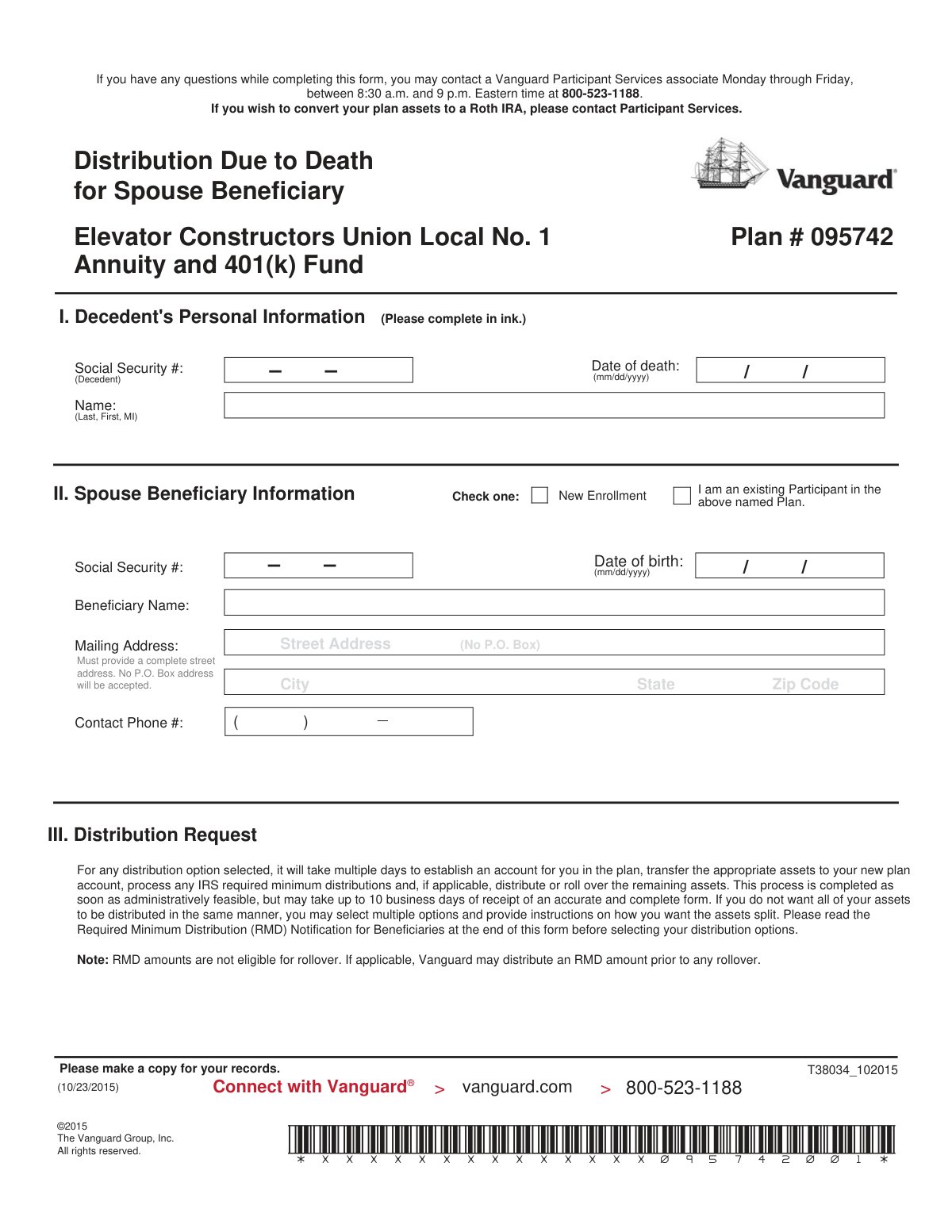
- For Surviving Spouses: Use the Distribution Due to Death for Spouse Beneficiary - Elevator Constructors Union Local No. 1 Annuity and 401(k) Fund if you are the spouse of a deceased member. This form allows you to choose between a lump-sum payment, a direct rollover to your own IRA, or deferring the payout.
- For Legal Settlements (QDRO): If a court has issued a Qualified Domestic Relations Order (typically during a divorce or legal separation), use the Elevator Constructors Union Local No.1 Annuity and 401(k) Fund Distribution Request Due to Qualified Domestic Relations Order. This allows the "alternate payee" to specify how they wish to receive their allocated portion of the assets.
NYPD Superior Officers Council
If you are an active or retired member of the NYPD looking to streamline your retirement portfolio, you will likely need the following:
- Consolidating Assets: Use the NYPD Superior Officers Council Annuity Trust Fund Plan Rollover Form to move funds from external accounts—such as the Police Pension Fund or a private 401(k)—into your Superior Officers Council Annuity Trust Fund Plan serviced by Principal. This is the correct choice for members looking to centralize their retirement savings under one plan.
Key Considerations
- Tax Withholding: Both distribution forms for the Elevator Constructors Union require you to specify tax preferences to avoid unexpected IRS liabilities.
- Rollover Eligibility: Before using the NYPD Rollover Form, ensure your source funds are from an eligible retirement account to maintain the tax-deferred status of your savings.
Form Comparison
| Form | Purpose | Who Files It | Primary Action |
|---|---|---|---|
| Distribution Due to Death for Spouse Beneficiary - Elevator Constructors Union Local No. 1 Annuity and 401(k) Fund | Request distribution of assets from a deceased participant's account | Surviving spouse of the deceased plan member | Outbound distribution or rollover of inherited funds |
| Elevator Constructors Union Local No.1 Annuity and 401(k) Fund Distribution Request Due to Qualified Domestic Relations Order | Withdraw funds allocated by a court-mandated domestic relations order | Alternate payee or former spouse designated via QDRO | Legal settlement distribution or rollover |
| NYPD Superior Officers Council Annuity Trust Fund Plan Rollover Form | Consolidate retirement savings from external plans into the SOC trust | Members of the NYPD Superior Officers Council | Inbound rollover to consolidate retirement assets |
Tips for annuity fund forms
Even a single digit error in your Social Security number or account ID can lead to an immediate rejection by plan administrators like Vanguard or Principal. Ensure all beneficiary names match legal identification exactly to avoid administrative holds or delays in fund disbursement.
Managing complex annuity paperwork can be time-consuming, but AI-powered tools like Instafill.ai can complete these forms in under 30 seconds with high accuracy. Your data stays secure during the process, providing a practical and efficient solution for those handling multiple distribution or rollover requests.
Forms involving death benefits or Qualified Domestic Relations Orders (QDRO) almost always require supplemental legal documents such as death certificates or court-certified orders. Having these documents scanned and ready will prevent you from having to pause the process to search for physical files.
When moving funds into the NYPD Superior Officers Council Annuity Trust, confirm with your current institution that the funds are originating from a compatible retirement plan. Utilizing a direct rollover instead of receiving a personal check helps you avoid mandatory 20% federal tax withholding.
Annuity distributions are generally considered taxable income, and failing to specify your withholding preference can lead to unexpected tax liabilities. Take a moment to determine if the default withholding rate is sufficient for your specific financial bracket before finalizing the form.
Once you submit a distribution or rollover request, save a copy of the completed form and any submission receipts for your annual tax records. These documents are vital for resolving discrepancies between your account statements and your reported income to the IRS.
Frequently Asked Questions
Annuity fund forms are legal documents used to manage, distribute, or transfer assets held within a retirement or annuity account. These forms are typically required when a participant retires, passes away, or needs to move funds between different retirement vehicles to ensure the plan administrator processes the request according to fund rules and tax laws.
These forms are used by union members, public service employees like the NYPD, and their beneficiaries or legal alternates. Whether you are a surviving spouse, a former spouse receiving funds via a court order, or an active member consolidating accounts, these forms provide the necessary authorization for the fund to move money.
The correct form depends on your specific life event or financial goal. For example, use a distribution form if you are a beneficiary or an alternate payee under a Qualified Domestic Relations Order (QDRO), while a rollover form is appropriate if you are moving funds from an outside retirement account into your current annuity trust fund.
You should submit these forms as soon as the qualifying event occurs, such as after a legal judgment is finalized or when you decide to consolidate your retirement savings. Timely submission helps prevent delays in asset transfers and ensures you meet any internal deadlines set by the plan administrator or trustee.
Most annuity fund forms require supporting documentation such as a certified death certificate for beneficiary claims or a court-certified copy of a Qualified Domestic Relations Order. Additionally, you may need to provide tax identification numbers and banking information for direct deposits or rollovers.
Yes, you can use AI tools like Instafill.ai to complete these forms quickly and accurately. The AI can extract relevant data from your source documents and automatically place it into the correct fields on the PDF, ensuring all required sections are addressed.
Manually filling out complex annuity forms can take a significant amount of time, but using an automated tool simplifies the process. With Instafill.ai, the AI-powered system can populate the necessary fields in under 30 seconds, significantly reducing the time spent on manual data entry.
Completed forms are generally submitted to the specific plan administrator or financial institution managing the fund, such as Vanguard or Principal. Be sure to check the instructions on the form itself, as some may require physical mailing to a specific PO Box while others allow electronic submission or faxing.
Most annuity fund distributions have tax implications, which is why these forms often include sections for federal and state tax withholding. Choosing a direct rollover to another qualified plan or IRA can often defer taxes, while a lump-sum payment may be subject to immediate taxation and potential penalties.
Many annuity and retirement fund forms require a notary signature or a witness signature to verify the identity of the person signing the document. This is especially common for distribution requests and beneficiary designations to prevent fraud and ensure the legal validity of the request.
Glossary
- Form Complexity Index
- Instafill’s 0–100 measure of how much effort a form takes to complete, calculated deterministically from the form’s own structure rather than estimated. It combines the number of fillable fields (the largest factor), how difficult those fields are to complete based on their type, the number of pages that contain fields, the amount of conditional “fill-only-if” logic, and how many sections the form is divided into, then adds modifiers for tables and repeating lists, bundled instruction pages, and dense page layouts. A higher score means the form is harder to fill out by hand. The forms in this category have a median Form Complexity Index of 37/100 (Basic). See exactly how it is calculated.
- Direct Rollover
- The transfer of retirement assets directly from one qualified plan to another or to an IRA, which avoids immediate income tax and potential early withdrawal penalties.
- QDRO (Qualified Domestic Relations Order)
- A legal order, typically issued during a divorce, that grants a spouse or former spouse the right to receive a portion of a participant's retirement plan benefits.
- Alternate Payee
- A person designated by a QDRO, such as a former spouse or child, who has a legal right to receive a portion of the retirement benefits belonging to a plan participant.
- Annuity Trust Fund
- A pool of assets, often managed by a union or organization, designed to provide participants with regular income payments or a lump-sum benefit upon retirement or disability.
- Lump-Sum Distribution
- A single payment representing the entire balance of a retirement account, as opposed to receiving the funds through periodic installments.
- Beneficiary
- The person or entity designated to receive the remaining assets in a retirement or annuity account after the death of the original account holder.
- Tax Withholding
- The portion of a distribution that the plan administrator sends directly to the IRS or state tax authorities as a payment toward the recipient's income tax liability.
- Plan Administrator
- The third-party company or internal department responsible for managing the retirement fund's operations, processing distributions, and maintaining records.