Fill out business expense forms
with AI.
Business expense forms are IRS tax documents used to report and deduct legitimate costs incurred while earning income — whether you're an employee covering out-of-pocket work expenses or a self-employed professional running a home office. These forms play a critical role in reducing taxable income by ensuring that allowable expenses are properly documented and claimed. Getting them right matters: errors or omissions can mean leaving money on the table or triggering issues with the IRS.
By continuing, you acknowledge Instafill's Privacy Policy and agree to get occasional product update and promotional emails.
About business expense forms
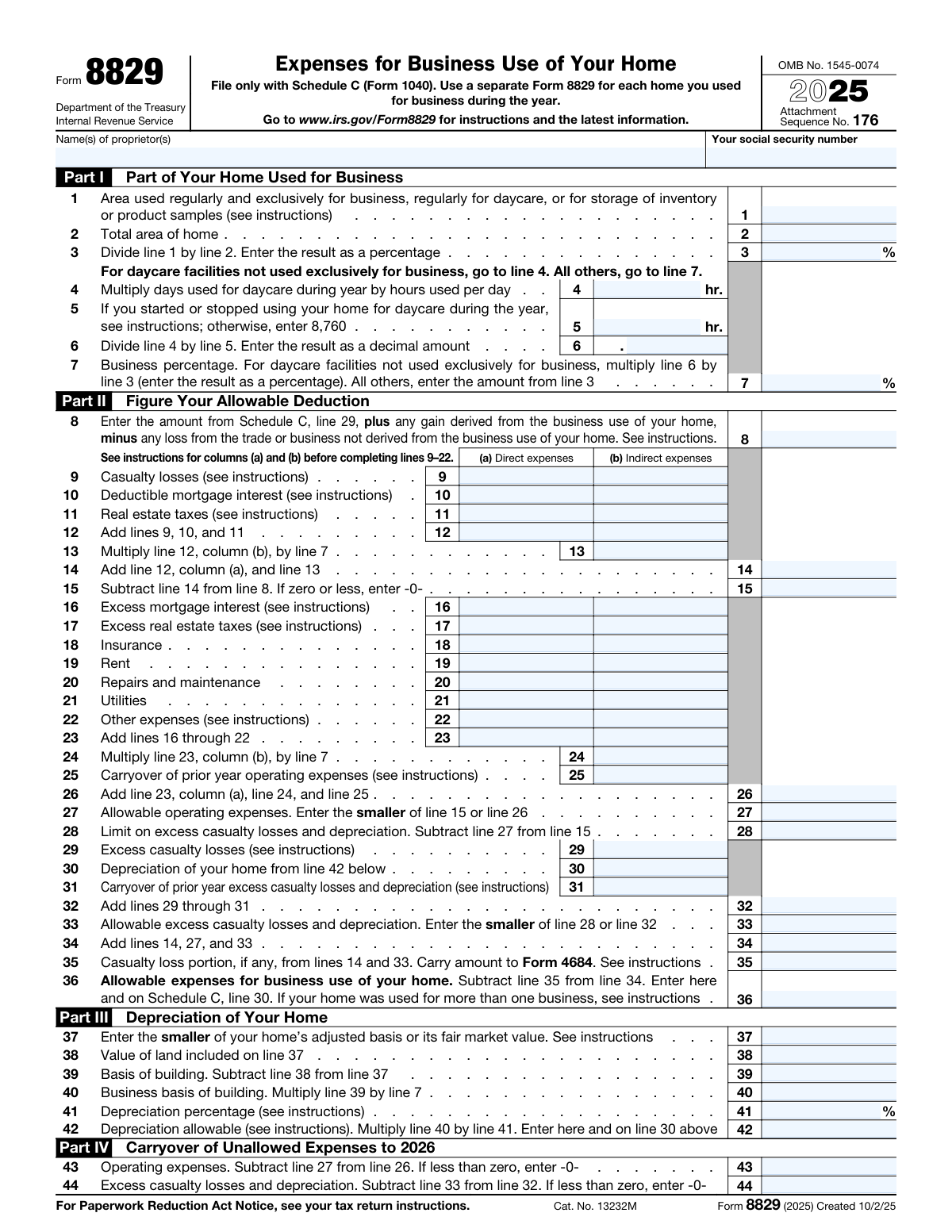
The forms in this category are relevant to a wide range of filers. Employees who pay for work-related travel, meals, or vehicle use out of pocket may need Form 2106, though eligibility is now limited to specific groups such as Armed Forces reservists, performing artists, and fee-basis government officials. Homeowners who use part of their residence for business purposes will likely need Form 8829 to calculate their allowable home office deduction. These forms are typically filed alongside your federal income tax return each year.
Because these forms involve detailed calculations and specific IRS requirements, accuracy is essential. Tools like Instafill.ai use AI to fill these forms in under 30 seconds, handling the data carefully and securely — a practical option for anyone who wants to avoid the tedium of manual form entry while staying confident the information is entered correctly.
Every form on this page can be completed without typing. Instafill is form filling software that reads a PDF and fills it for you — including flat and scanned documents that carry no fillable fields at all.
Forms in This Category
The forms in this category have a median Form Complexity Index of 63/100 (Complex), measured across 4 forms by field count, input difficulty, length, conditional logic and structure. See how it is calculated.
| Form Name | Pages | FCI | |
|---|---|---|---|
| 1. | Form 8829, Expenses for Business Use of Your Home | 1 | Complex 64 |
| 2. | ACORD 810, Business Income / Extra Expense / Rental Value | 2 | Moderate 53 |
| 3. | Form 2106, Employee Business Expenses (2023) | 2 | Moderate 57 |
| 4. | Form 2106, Employee Business Expenses (2025) | 2 | Complex 63 |
- Enterprise-grade security & data encryption
- 99%+ accuracy powered by AI
- 1,000+ forms from all industries
- Complete forms in under 60 seconds
How to Choose the Right Form
Not sure which business expense form you need? Here's a quick breakdown to point you in the right direction.
Claiming Employee Business Expenses
Form 2106, Employee Business Expenses is the go-to form if you're an employee looking to deduct work-related costs like vehicle use, travel, and meals. However, it's important to note that this form is only available to specific groups:
- Armed Forces reservists
- Qualified performing artists
- Fee-basis state or local government officials
- Employees with impairment-related work expenses
If you fall into one of these categories, Form 2106 lets you calculate deductions that flow through to Schedule 1 (Form 1040). Most other employees can no longer claim these deductions under current tax law.
Deducting a Home Office
If you run a business or work from home and want to claim a deduction for that space, Form 8829, Expenses for Business Use of Your Home is what you need. This form helps you calculate the allowable portion of home expenses — such as mortgage interest, utilities, and repairs — based on the percentage of your home used for business.
> Use Form 8829 if you're self-employed or a business owner with a dedicated home office. Use Form 2106 only if you're an eligible employee with unreimbursed work expenses.
Quick Decision Summary
- Eligible employee with unreimbursed travel, vehicle, or work expenses? → Form 2106
- Self-employed or business owner deducting home office costs? → Form 8829
- Unsure if you qualify for Form 2106? Review the eligible groups above — if you don't fit one, Form 8829 may still apply if you work from home.
All three forms can be filled out quickly and accurately using Instafill.ai's AI-powered tools.
Form Comparison
| Form | Purpose | Who Files It | When to Use |
|---|---|---|---|
| Form 2106, Employee Business Expenses | Deduct ordinary and necessary employee business expenses | Reservists, performing artists, government officials, disabled employees | When claiming unreimbursed work-related expense deductions |
| Form 8829, Expenses for Business Use of Your Home | Calculate and claim home office expense deductions | Self-employed taxpayers using home for business | When a portion of your home is used regularly for business |
Tips for business expense forms
Not every employee can claim business expense deductions — Form 2106 is now limited to specific groups such as Armed Forces reservists, qualified performing artists, fee-basis government officials, and employees with impairment-related work expenses. Before you start filling out any form in this category, confirm your eligibility to avoid wasted effort or an incorrect return.
Business expense forms require detailed breakdowns of costs like vehicle mileage, travel, meals, and home office use — and the IRS may ask for documentation. Gather and organize all receipts, logs, and records by category before you begin filling out any form to ensure accuracy and completeness.
Form 8829 requires you to determine the percentage of your home used exclusively and regularly for business, which directly affects the size of your deduction. Measure your dedicated workspace accurately and compare it to your home's total square footage — even small errors here can lead to an over- or under-reported deduction.
Forms like 2106 and 8829 don't stand alone — their results flow into Schedule 1 (Form 1040) or other parts of your tax return. Always double-check that the deduction amounts from these forms are correctly carried over to the appropriate lines on your main return before filing.
If you're claiming vehicle expenses on Form 2106, you'll need to choose between the standard mileage rate and actual expenses — and both methods require consistent recordkeeping throughout the year. Maintain a mileage log that includes dates, destinations, and business purposes for every trip to support your claim.
AI-powered tools like Instafill.ai can complete business expense forms like Form 2106 and Form 8829 in under 30 seconds with high accuracy, saving you significant time — especially if you're handling multiple forms at once. Your data stays secure throughout the process, making it a practical and reliable option for tax season.
One of the most common mistakes on business expense forms is including personal costs that don't qualify as ordinary and necessary business expenses. Review IRS guidelines on what counts as a deductible business expense before entering any figures to avoid triggering an audit or having deductions disallowed.
Business expense forms like Form 2106 and Form 8829 must be attached to your Form 1040, 1040-SR, or 1040-NR when you file — they cannot be submitted on their own. Make sure all forms are complete and consistent with each other before submitting your full federal tax return.
Frequently Asked Questions
Business expense forms are IRS tax forms used to report and deduct work-related costs incurred by employees or self-employed individuals. They help reduce taxable income by ensuring eligible expenses — such as travel, meals, vehicle use, and home office costs — are accurately documented and claimed.
This category includes Form 2106 (Employee Business Expenses) and Form 8829 (Expenses for Business Use of Your Home). Form 2106 covers employee-related costs like travel and vehicle expenses, while Form 8829 is specifically for taxpayers who use part of their home for business purposes.
Form 2106 is only available to a limited group of filers, including Armed Forces reservists, qualified performing artists, fee-basis state or local government officials, and employees with impairment-related work expenses. Most other employees lost the ability to deduct unreimbursed business expenses following the 2017 Tax Cuts and Jobs Act.
Form 8829 is intended for self-employed individuals and business owners who use a portion of their home regularly and exclusively for business. It allows them to calculate and claim deductions for expenses like mortgage interest, utilities, and depreciation proportional to the business-use area of the home.
Business expense forms like Form 2106 and Form 8829 are filed as part of your annual federal income tax return, generally due by mid-April each year. They are attached to your Form 1040, 1040-SR, or 1040-NR when submitting to the IRS.
These forms are not submitted separately — they are attached to your federal income tax return (Form 1040 or its variants) and filed with the IRS either electronically through tax software or by mailing a paper return. Your tax preparer or e-filing platform will include them as part of your complete return.
Yes — AI-powered tools like Instafill.ai can fill out forms such as Form 2106 and Form 8829 in under 30 seconds by accurately extracting and placing data from your source documents. This reduces manual entry errors and makes the process significantly faster, even for non-fillable PDF versions of these forms.
Form 2106 covers a range of employee business expenses including vehicle expenses, travel costs, meals, and other ordinary and necessary expenses required for your job. Only the specific eligible groups who qualify to use the form can claim these deductions on their federal tax return.
Form 8829 uses the percentage of your home's square footage dedicated exclusively to business to calculate allowable deductions for related home expenses. Alternatively, the IRS offers a simplified method that allows a standard deduction per square foot of business-use space, which some filers may find easier to apply.
Yes, the IRS generally requires that you maintain records and receipts to substantiate any business expense deductions you claim. Good recordkeeping — including mileage logs, receipts, and invoices — is important in case your return is audited.
Filling out these forms manually can take anywhere from 15 minutes to over an hour depending on the complexity of your expenses. However, using AI-powered services like Instafill.ai, the data extraction and form-filling process can be completed in under 30 seconds, saving significant time and reducing errors.
Form 2106 is specifically for qualifying employees, while Form 8829 is primarily used by self-employed individuals reporting home office expenses on Schedule C. It's important to choose the correct form based on your employment status and the type of expenses you're claiming.
Glossary
- Form Complexity Index
- Instafill’s 0–100 measure of how much effort a form takes to complete, calculated deterministically from the form’s own structure rather than estimated. It combines the number of fillable fields (the largest factor), how difficult those fields are to complete based on their type, the number of pages that contain fields, the amount of conditional “fill-only-if” logic, and how many sections the form is divided into, then adds modifiers for tables and repeating lists, bundled instruction pages, and dense page layouts. A higher score means the form is harder to fill out by hand. The forms in this category have a median Form Complexity Index of 63/100 (Complex). See exactly how it is calculated.
- Ordinary and Necessary Expenses
- A standard IRS requirement meaning the expense must be common in your trade or business (ordinary) and helpful and appropriate for your work (necessary). Only expenses meeting both criteria qualify for deduction on business expense forms.
- Schedule 1 (Form 1040)
- An attachment to your main federal tax return (Form 1040) used to report additional income and deductions, including employee business expense deductions calculated on Form 2106.
- Above-the-Line Deduction
- A deduction subtracted from your gross income before calculating adjusted gross income (AGI), which can reduce your tax bill regardless of whether you itemize. Form 2106 deductions are only available as above-the-line deductions for specific eligible groups.
- Home Office Deduction
- A tax deduction for the portion of your home used regularly and exclusively for business purposes, calculated using Form 8829. The space must be your principal place of business or where you meet clients.
- Regular and Exclusive Use
- An IRS requirement for the home office deduction meaning the designated workspace must be used only for business on a consistent basis. Personal use of the same space disqualifies it from the deduction.
- Fee-Basis Government Official
- A state or local government employee who is compensated based on fees paid directly by the public rather than a fixed government salary. This group is one of the few eligible to claim deductions using Form 2106 under current tax law.
- Impairment-Related Work Expenses
- Costs paid by a disabled employee for attendant care or other items needed to perform their job, which qualify for deduction on Form 2106. These are expenses directly related to a physical or mental disability that enables the person to work.
- Qualified Performing Artist
- An IRS-defined category of performing artist who meets specific income and expense thresholds, allowing them to deduct work-related expenses on Form 2106. Requirements include having at least two employers and performance-related expenses exceeding 10% of gross income from performing.
- Standard Mileage Rate
- An IRS-set cents-per-mile rate used to calculate vehicle expense deductions instead of tracking all actual car costs. Taxpayers can choose this simplified method when reporting vehicle expenses on Form 2106.
- Adjusted Gross Income (AGI)
- Your total gross income minus specific deductions, used as the basis for calculating many tax credits and deductions. AGI is a key figure on your Form 1040 that can be reduced by eligible business expense deductions.