Fill out civil procedure forms
with AI.
Civil procedure forms serve as the essential framework for navigating the legal system in non-criminal matters. These documents ensure that litigation follows a standardized process, providing the necessary structure for filing claims, responding to motions, and recording final judgments. By using standardized legal claim forms, parties can clearly communicate their demands and evidence to the court, ensuring that the rules of civil procedure are upheld for a fair and orderly resolution of disputes.
By continuing, you acknowledge Instafill's Privacy Policy and agree to get occasional product update and promotional emails.
About civil procedure forms
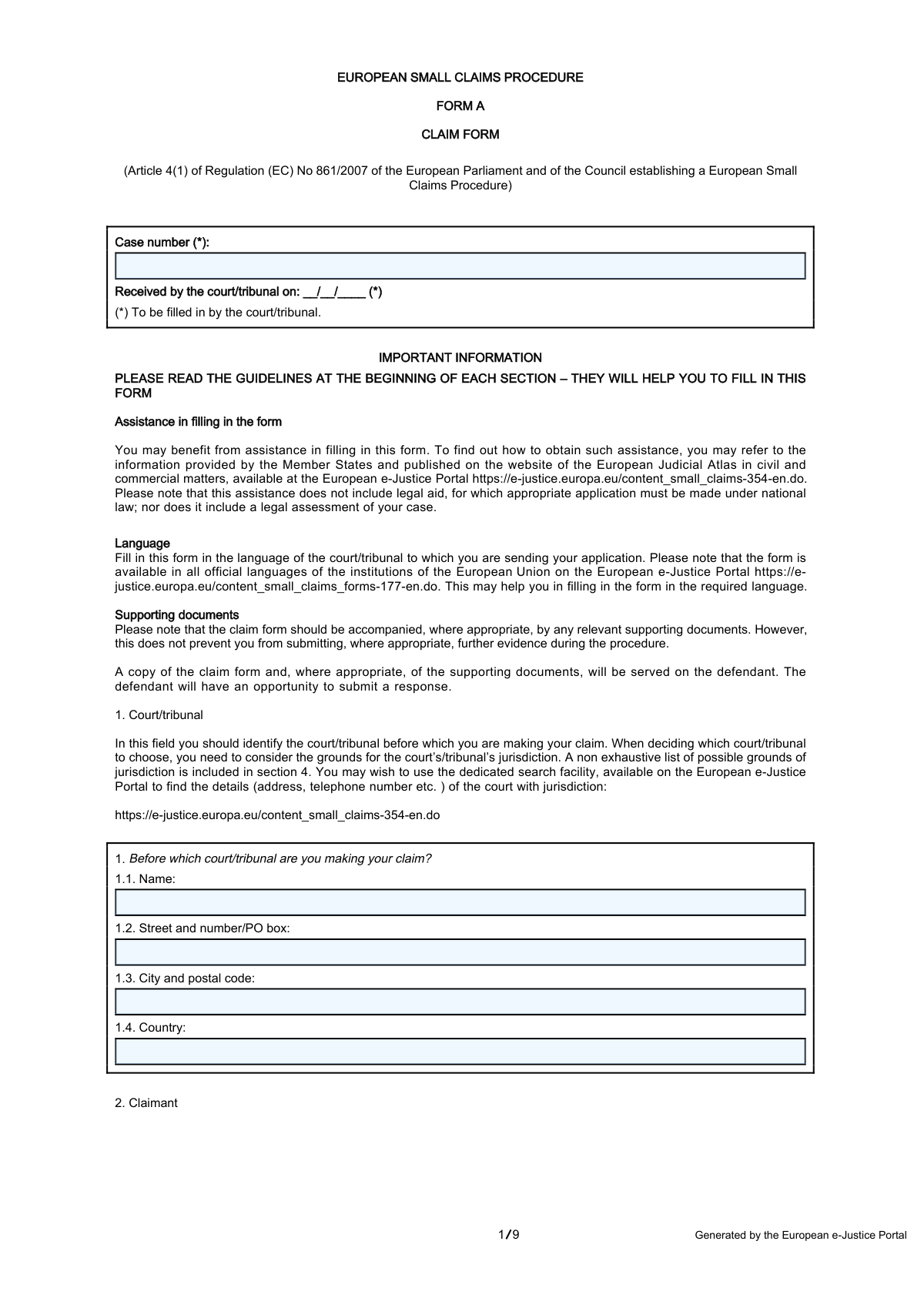
This category is particularly relevant for individuals, small business owners, and legal practitioners who need to manage the complexities of the court system without unnecessary delays. Whether you are initiating a cross-border dispute through the European Small Claims Procedure (Form A) or finalizing a case in the California Superior Court using a Judgment form (JUD-100), having the correct paperwork is critical for protecting your legal rights. These forms are used in a variety of contexts, from recovering small debts to formalizing court-ordered settlements and damages.
Completing these documents accurately is vital, as errors can lead to procedural delays or the dismissal of a case. Tools like Instafill.ai use AI to fill these forms in under 30 seconds, handling sensitive data accurately and securely to streamline the administrative side of legal proceedings.
Every form on this page can be completed without typing. Instafill is form filling software that reads a PDF and fills it for you — including flat and scanned documents that carry no fillable fields at all.
Forms in This Category
The forms in this category have a median Form Complexity Index of 38/100 (Basic), measured across 10 forms by field count, input difficulty, length, conditional logic and structure. See how it is calculated.
- Enterprise-grade security & data encryption
- 99%+ accuracy powered by AI
- 1,000+ forms from all industries
- Complete forms in under 60 seconds
How to Choose the Right Form
Selecting the correct civil procedure form depends entirely on the jurisdiction of your legal matter and the current stage of your proceedings. The forms in this category serve distinct roles—one for initiating a claim in the European Union and the other for finalizing a judgment in California.
Starting a Cross-Border Claim in the EU
If you are looking to recover a debt or resolve a civil dispute within the European Union, you will likely need Form A, Claim Form, European Small Claims Procedure. This form is specifically designed for:
- Cross-border disputes: Use this when at least one party is located in a different EU member state than the court.
- Small claims: This procedure is restricted to commercial or civil matters where the total value of the claim does not exceed €5,000.
- Initiating litigation: This is the primary document used to start the legal process and officially notify the court of your claim.
Finalizing a Case in California
If your legal matter is located in the United States, specifically within the California Superior Court system, and the case has already been decided or settled, you require Judicial Council of California Form JUD-100, Judgment (Code of Civil Procedure, §§ 585, 664.6). This form is used to:
- Record the final decision: It memorializes the court’s ruling, whether the judgment was reached by default, by stipulation, or after a full court trial.
- Detail awards: It provides a standardized format to specify the exact amounts for damages, interest, attorney fees, and other relief.
- Enable enforcement: Once entered by the clerk or judge, this form becomes the official order used for collection and post-judgment procedures.
Quick Comparison
- Choose Form A if you are at the beginning of a small legal dispute involving parties in different EU countries.
- Choose Form JUD-100 if you are at the end of a civil case in California and need an official record of the court's final judgment to begin the collection process.
Form Comparison
| Form | Purpose | Jurisdiction | Procedural Stage | Key Detail |
|---|---|---|---|---|
| Form A, Claim Form, European Small Claims Procedure | Initiates a legal claim for cross-border civil or commercial disputes. | European Union member states for cross-border litigation. | Beginning of the case to start the legal process. | Applicable only to claims with a value up to €5,000. |
| Judicial Council of California Form JUD-100, Judgment (Code of Civil Procedure, §§ 585, 664.6) | Records the official final decision and award in a civil case. | California Superior Court system in the United States. | End of the case to memorialize the court's final ruling. | Includes specific details on damages, interest, and attorney fees. |
Tips for civil procedure forms
Ensure all names match legal identification or business registrations exactly before submitting your civil procedure forms. Errors in party names can lead to significant delays or even dismissal of your claim when attempting to serve or enforce a final judgment.
Before filing small claims forms, confirm that your dispute falls within specific monetary thresholds, such as the €5,000 limit for EU cross-border claims. Filing in the wrong jurisdiction or exceeding these limits can result in your case being rejected or transferred to a more complex court track.
Gather all relevant contracts, invoices, and correspondence prior to filling out your legal claim forms. Having these documents organized allows you to accurately reference specific dates and amounts, which is essential for forms like the JUD-100 that memorialize final awards.
AI-powered tools like Instafill.ai can complete these forms in under 30 seconds with high accuracy, ensuring that the data stays secure during the process. This is a real time-saver for people dealing with multiple civil procedure forms that require repetitive data entry.
When completing judgment forms, ensure that interest rates and legal costs are calculated precisely according to the relevant statutes. Inaccurate figures on a final judgment form can complicate the enforcement process and may require you to file amended paperwork later.
Filing the form is only the first step in a legal claim; you must also follow specific rules for serving the documents to the opposing party. Familiarize yourself with the required methods of service for your specific jurisdiction to ensure the court recognizes the claim as legally active.
Frequently Asked Questions
Civil procedure forms are standardized legal documents used to initiate, manage, or conclude lawsuits in a court of law. They ensure that all necessary information is presented to the court in a format that complies with specific jurisdictional rules and regulations.
These forms are used by plaintiffs, defendants, and legal professionals involved in civil litigation. Whether you are an individual representing yourself in small claims or an attorney finalizing a judgment, these documents provide the structure needed for official legal proceedings.
Small claims forms are generally used for lower-value disputes, often with simplified rules and no requirement for an attorney. Standard civil procedure forms, such as judgment forms, are used in broader litigation to record the final decision of the court after a trial, stipulation, or default.
Yes, you can use AI tools to streamline the process of completing these complex documents. Services like Instafill.ai can fill out civil procedure forms in under 30 seconds by accurately extracting data from your source documents and placing it directly into the correct fields.
Generally, these forms must be filed with the clerk of the court where the case is being heard or where the dispute originated. For cross-border EU claims, forms are typically sent to the competent court in the member state where the defendant resides or where the incident occurred.
Form A is the standardized document used to start a legal claim in cross-border civil or commercial matters within the EU where the value does not exceed €5,000. It is designed to make legal recourse more accessible and less costly for parties located in different member states.
A judgment form is required at the end of a legal case to officially memorialize the court's final decision and the relief granted. It serves as the enforceable order that allows the winning party to begin post-judgment actions, such as the collection of awarded damages.
While manual entry can be time-consuming, using AI-powered tools significantly reduces the effort. Instafill.ai allows users to complete these forms in less than 30 seconds, ensuring high accuracy while even converting non-fillable PDF versions into interactive documents.
Most civil procedure filings require supporting evidence, such as contracts, receipts, or correspondence related to the dispute. It is important to review the specific local court rules to ensure all necessary attachments are included to avoid the filing being rejected.
Errors in legal forms can lead to processing delays, the rejection of your filing, or potentially adverse legal consequences. Accuracy is critical for enforceability, which is why many users rely on automated tools to ensure data is transferred correctly from their source files to the official form.
Yes, specific forms like the European Small Claims Form A are designed specifically for cross-border matters between different jurisdictions. These standardized documents help bridge the gap between different legal systems by providing a common framework for resolving international claims.
Glossary
- Form Complexity Index
- Instafill’s 0–100 measure of how much effort a form takes to complete, calculated deterministically from the form’s own structure rather than estimated. It combines the number of fillable fields (the largest factor), how difficult those fields are to complete based on their type, the number of pages that contain fields, the amount of conditional “fill-only-if” logic, and how many sections the form is divided into, then adds modifiers for tables and repeating lists, bundled instruction pages, and dense page layouts. A higher score means the form is harder to fill out by hand. The forms in this category have a median Form Complexity Index of 38/100 (Basic). See exactly how it is calculated.
- Judgment
- The final official decision rendered by a court that determines the rights and obligations of the parties involved in a lawsuit.
- Default
- A ruling made in favor of the plaintiff when a defendant fails to respond to a claim or appear in court within the required timeframe.
- Stipulation
- A formal agreement between opposing parties to settle a case or agree on specific facts to avoid further litigation.
- Cross-Border Matter
- A legal dispute where at least one party is domiciled or habitually resident in a country or member state other than the one where the court is located.
- Damages
- The amount of money awarded by a court to a party as compensation for loss, injury, or breach of contract caused by another party.
- Service of Process
- The formal delivery of legal documents, such as a claim form or summons, to a defendant to ensure they are legally notified of the action against them.
- Litigation
- The process of resolving a dispute through the court system, starting from the initial claim until a final judgment is reached.
- Jurisdiction
- The legal authority of a specific court to hear a case and make binding decisions based on geographic location or the type of legal issue.