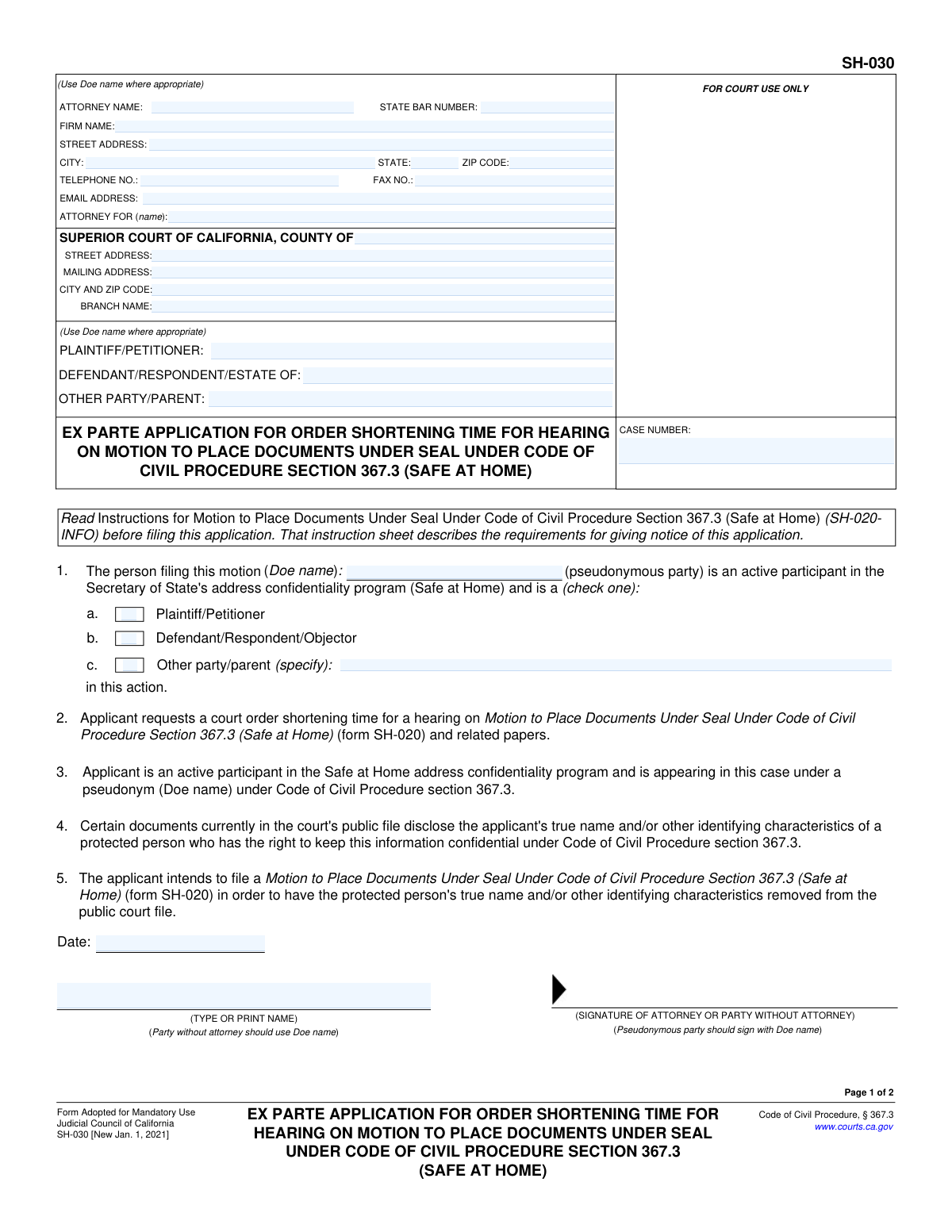
Yes! You can use AI to fill out Form SH-030, Ex Parte Application for Order Shortening Time for Hearing on Motion to Place Documents Under Seal Under Code of Civil Procedure Section 367.3 (Safe at Home)

California Form SH-030, the Ex Parte Application for Order Shortening Time, is filed by participants in the 'Safe at Home' address confidentiality program who are using a pseudonym in a court case. Its purpose is to urgently request that the court schedule a hearing sooner than usual on a motion to seal documents that could expose their confidential identity. This expedited process is critical for protecting the safety and privacy of individuals whose information is protected under state law. Today, this form can be filled out quickly and accurately using AI-powered services like Instafill.ai, which can also convert non-fillable PDF versions into interactive fillable forms.
SH-030 is part of the California court forms, civil court forms and civil procedure forms categories on Instafill.
Our AI automatically handles information lookup, data retrieval, formatting, and form filling.
It takes less than a minute to fill out SH-030 using our AI form filling.
Securely upload your data. Information is encrypted in transit and deleted immediately after the form is filled out.

Form specifications

Form name: Form SH-030, Ex Parte Application for Order Shortening Time for Hearing on Motion to Place Documents Under Seal Under Code of Civil Procedure Section 367.3 (Safe at Home)
Number of fields: 37
Number of pages: 1
Language: English
main-image

Instafill Demo: How to fill out PDF forms in seconds with AI

How to Fill Out SH-030 Online for Free in 2026

Are you looking to fill out a SH-030 form online quickly and accurately? Instafill.ai offers the #1 AI-powered PDF filling software of 2026, allowing you to complete your SH-030 form in just 37 seconds or less.
Follow these steps to fill out your SH-030 form online using Instafill.ai:
  1. 1 Navigate to Instafill.ai and upload or select the SH-030 form.
  2. 2 Enter the court and case information at the top of the form, using your Doe name where appropriate.
  3. 3 Provide your attorney's details or your own contact information if you are self-represented.
  4. 4 In Section 1, check the box that corresponds to your role in the legal action (e.g., Plaintiff/Petitioner, Defendant/Respondent).
  5. 5 Carefully review the pre-written statements in sections 2 through 5, which outline the basis for your request.
  6. 6 Date and sign the application on page 1 using your Doe name, then complete the declaration on page 2 with the date and your Doe name and signature.
  7. 7 Download the completed form to print and file with the court, following the notice requirements described in form SH-020-INFO.

Our AI-powered system ensures each field is filled out correctly, reducing errors and saving you time.

Why Choose Instafill.ai for Your Fillable SH-030 Form?

Speed

Complete your SH-030 in as little as 37 seconds.

Up-to-Date

Always use the latest 2026 SH-030 form version.

Cost-effective

No need to hire expensive lawyers.

Accuracy

Our AI performs 10 compliance checks to ensure your form is error-free.

Security

Your personal information is protected with bank-level encryption.

Frequently Asked Questions About Form SH-030

This form is used to ask the court for an urgent, earlier hearing date on your main request (Motion SH-020) to seal documents containing your confidential information as a participant in the Safe at Home program.

You should fill out this form if you are an active participant in California's "Safe at Home" address confidentiality program and need to quickly schedule a court hearing to protect your identity in court records.

An 'ex parte' application is an urgent request made to a judge without the usual notice period required for other parties in the case. It's used when immediate court action is needed to prevent harm, such as the disclosure of your confidential information.

You would request an order shortening time to get a hearing date sooner than the law typically requires. This is crucial when your confidential information is already exposed or at risk of being exposed in the public court file.

Safe at Home is a confidential address program provided by the California Secretary of State for survivors of domestic violence, stalking, or sexual assault, allowing them to use a substitute address to keep their actual location private.

Using a pseudonym, or 'Doe name,' is a key protection that allows you to participate in a lawsuit without revealing your true identity in public records. You must use your assigned Doe name when filling out and signing the form.

Form SH-030 is an application to get a fast hearing date for your motion. Form SH-020 is the actual motion where you ask the judge to seal your confidential information. You often file them together to expedite the process.

The form explicitly states that you should read the 'Instructions for Motion to Place Documents Under Seal' (Form SH-020-INFO) before you begin, as it contains important information about the process and notice requirements.

You will need your case number, the court information, your role in the case (e.g., Plaintiff), and your assigned 'Doe name' as a Safe at Home participant. If you have an attorney, you will also need their contact and State Bar information.

If you are representing yourself, you must sign on page 1 and also sign the declaration on page 2. In both places, you must sign using your assigned 'Doe name,' not your true name.

Yes, services like Instafill.ai use AI to accurately auto-fill form fields with your case and personal information, which can save you time and help reduce errors.

You can use a service like Instafill.ai to upload the form, fill it out interactively online, and then download the completed document for printing and filing with the court.

If you have a non-fillable PDF, you can use a tool like Instafill.ai to convert it into an interactive, fillable form that you can complete on your computer.

Compliance SH-030
Validation Checks by Instafill.ai

1
Case Number Consistency Across Pages
This check ensures that the 'CASE NUMBER' entered on page 1 is identical to the 'CASE NUMBER' entered on page 2. Maintaining consistency is critical for ensuring that all pages of the document are correctly associated with the same legal case file upon submission. A mismatch could lead to filing errors, delays, or the document being rejected by the court clerk.
2
Party Information Consistency
Validates that the names listed for 'PLAINTIFF/PETITIONER', 'DEFENDANT/RESPONDENT/ESTATE OF', and 'OTHER PARTY/PARENT' are identical on both page 1 and page 2. This ensures the document is internally consistent and correctly identifies the parties to the action throughout. Discrepancies can cause confusion and potential rejection of the filing.
3
Mandatory Pseudonymous Party Role Selection
Verifies that exactly one of the checkboxes in section 1 ('Plaintiff/Petitioner', 'Defendant/Respondent/Objector', or 'Other party/parent') is selected. This is a required field to establish the filer's role in the case. Failure to select one and only one option makes the application incomplete and ambiguous.
4
Conditional 'Other Party' Specification
Ensures that the text field next to 'Other party/parent (specify)' in section 1 is filled out if and only if that specific checkbox is selected. This provides necessary clarification when the filer's role is not one of the primary categories. An empty specification for a selected 'Other' option makes the filing incomplete.
5
Declaration Doe Name Consistency
This check confirms that the 'TYPE OR PRINT DOE NAME' in the declaration section on page 2 matches the 'Doe name' provided in section 1 on page 1. This is a critical integrity check to ensure the person declaring under penalty of perjury is the same pseudonymous party identified at the beginning of the application. A mismatch invalidates the declaration.
6
State Bar Number Format and Requirement
Validates that if an 'ATTORNEY NAME' is provided, the 'STATE BAR NUMBER' field is also filled and contains only numeric digits. This ensures that a licensed attorney is properly identified. Submitting an attorney's name without a valid bar number can lead to the form being rejected for improper representation.
7
Valid Date and No Future Dating
Checks that all date fields on the form are completed with a valid date in a recognized format (e.g., MM/DD/YYYY) and that the date is not in the future. Legal documents must be dated on or before the day of signing and submission. A future date would invalidate the signature and the document itself.
8
Email Address Format Validation
Verifies that the value entered in the 'EMAIL ADDRESS' field follows the standard format for an email address (e.g., [email protected]). This is important for ensuring the court and other parties have a valid means of electronic communication and service. An invalid format could lead to missed notifications.
9
ZIP Code Format Validation
Ensures that the 'ZIP CODE' field for the attorney's address contains a valid 5-digit or 9-digit (ZIP+4) numeric format. Correct formatting is essential for mail delivery and accurate record-keeping. An incorrect ZIP code can result in returned mail and communication delays.
10
Mandatory Court County Identification
This check ensures that the 'SUPERIOR COURT OF CALIFORNIA, COUNTY OF' field is filled out. Specifying the county is fundamental to jurisdiction and determines which court will hear the case. Omitting the county makes it impossible to file the document correctly.
11
Signature Name Logic for Attorney vs. Pro Se Filer
Validates the printed name field on page 1. If an attorney is listed, this field should contain the attorney's name. If no attorney is listed, it must contain the party's Doe name as instructed. This ensures the signature block correctly reflects who is signing the document, which is a core legal requirement.
12
Mandatory Doe Name in Section 1
Verifies that the '(Doe name)' field in section 1 is filled out. This field is crucial as it establishes the pseudonym under which the Safe at Home participant is appearing in the case. Without this information, the entire basis for the application is missing.

Common Mistakes in Completing SH-030

Using a Real Name Instead of the 'Doe' Pseudonym

The most critical error is entering the participant's real name in the party name fields (e.g., Plaintiff/Petitioner) instead of the court-approved pseudonym. This mistake completely defeats the purpose of the Safe at Home program and this motion, placing the protected party's confidential information on the public record. To avoid this, filers must meticulously use their 'Doe name' in all appropriate fields. AI-powered tools like Instafill.ai can help manage and consistently apply pseudonyms across all case documents to prevent accidental disclosure.

Improper Signature Using a Real Name

The signature blocks on both page 1 and page 2 explicitly instruct the party to sign using their 'Doe name.' Out of habit, individuals often sign with their legal signature, which compromises their confidentiality and undermines the very protection being sought. This error is difficult to remedy once the document is filed. To prevent this, filers should consciously remember that for this legal action, the 'Doe' signature is the legally binding one.

Inconsistent Case Information Across Pages

This form requires the Case Number and party names to be entered on both page 1 and page 2. A common oversight is filling out this information on the first page but leaving it blank on the second, or entering conflicting information. This can cause the court clerk to reject the document or misfile pages, leading to significant delays. Always double-check that the header information is identical on all pages before filing.

Incorrectly Completing the Attorney/Party Information Section

A self-represented litigant may mistakenly enter their confidential home address in the address fields, which must be protected. The correct procedure is to use the designated Safe at Home mailing address provided by the Secretary of State's program. This error can inadvertently disclose protected information and cause filing rejections. If the form is a non-fillable PDF, tools like Instafill.ai can convert it to a fillable version, making it easier to enter the correct, non-confidential address information.

Failing to Specify Party Role in Section 1

Section 1 requires the applicant to identify their role in the case by checking a box for Plaintiff, Defendant, or Other. Applicants sometimes overlook this section or, if they check 'Other party/parent,' forget to provide the required specification. This omission leaves the court unclear about the applicant's standing, which can delay the processing of the application or lead to its rejection pending clarification.

Omitting the Case Number

The Case Number is the primary identifier that links a document to the correct legal proceeding. Forgetting to enter the case number on one or both pages is a frequent error that results in immediate rejection by the court clerk. This delays the urgent request to shorten time and seal records. It is crucial to copy the case number accurately and completely from previous court documents onto both pages of this form.

Leaving Signature Dates Blank

The form includes date fields next to the signature lines on both page 1 and page 2, which are required to validate the declaration. Forgetting to date a signature is a common administrative error that can render the filing incomplete. A court clerk will likely reject the form for being incomplete, forcing the applicant to refile and lose valuable time in a sensitive matter.

Typing or Printing Real Name Instead of Doe Name

In addition to the signature, the form requires the applicant to type or print their name below the signature line, specifying that the 'Doe name' should be used. Habit can lead people to type their legal name, creating another instance of confidential information appearing on the public record. It is essential to proofread every field before filing, ensuring only the pseudonym is used where instructed. AI form-filling tools can help prevent this by automatically populating these fields with the correct pseudonym.

Entering Incorrect Superior Court Information

Filers may be unsure of the exact details of the court, such as the specific branch name or the difference between the mailing and street address. Entering incorrect information can cause the document to be sent to the wrong location or rejected by the filing clerk, causing critical delays. Before filing, verify the correct County, Street Address, and Branch Name on the court's official website. Advanced form-filling tools can help by automatically populating correct court information based on the case number or county.

Confusing the Application with the Full Motion

This form (SH-030) is only an 'Ex Parte Application for Order Shortening Time,' not the actual 'Motion to Place Documents Under Seal' (form SH-020). A filer might mistakenly believe this form is all that is needed, failing to prepare and file the main motion. This procedural misunderstanding results in wasted time and no progress on sealing the confidential records. It's crucial to read the referenced instruction sheet (SH-020-INFO) to understand all required steps.
Saved over 80 hours a year

“I was never sure if my IRS forms like W-9 were filled correctly. Now, I can complete the forms accurately without any external help.”

Kevin Martin Green

Your data stays secure with advanced protection from Instafill and our subprocessors

Robust compliance program

Transparent business model

You’re not the product. You always know where your data is and what it is processed for.

ISO 27001, HIPAA, and GDPR

Our subprocesses adhere to multiple compliance standards, including but not limited to ISO 27001, HIPAA, and GDPR.

Security & privacy by design

We consider security and privacy from the initial design phase of any new service or functionality. It’s not an afterthought, it’s built-in, including support for two-factor authentication (2FA) to further protect your account.

Fill out SH-030 with Instafill.ai

Worried about filling PDFs wrong? Instafill securely fills form-sh-030-ex-parte-application-for-order-shortening-time-for-hearing-on-motion-to-place-documents-under-seal-under forms, ensuring each field is accurate.

Related forms by category

California court forms Judicial Council of California Form SC-105, Request for Court Order and Answer (Small Claims), Judicial Council of California Form SC-120, Defendant’s Claim and ORDER to Go to Small Claims Court (Small Claims), Judicial Council of California Form SER-001, Request for Sheriff to Serve Court Papers, Judicial Council of California Form SER-001, Request for Sheriff to Serve Court Papers, Affidavit for Collection of Personal Property California Probate Code Section 13100, Form POS-040, Proof of Service—Civil, Declaration of Facts of Death (California Superior Court), declaration-of-marriage-for-court-proceeding-california-family-law, ADOPT-200, Adoption Request, ADOPT-200, Stepparent Adoption Request, ADOPT-210, Adoption Agreement, ADOPT-310, Contact After Adoption Agreement, Judicial Council of California Form ADOPT-200, Adoption Request, Form ADR-107, Mediation Attendance Sheet, Form ADR-110, Order Appointing Referee, Form ADR-109, Stipulation or Motion for Order Appointing Referee, Form ADR-102, Request for Trial De Novo After Judicial Arbitration, Form ADR-108, Referee's Report (Code Civ. Proc., §§ 638, 639), Form ADR-106, Petition to Confirm, Correct, or Vacate Contractual Arbitration Award, Form ADR-104, Rejection of Award and Request for Trial After Attorney-Client Fee Arbitration · + 557 more →
civil court forms Petition for Leave to Proceed In Forma Pauperis (Court of Common Pleas of Lehigh County, Pennsylvania, Civil Division), Designation of Record on Appeal (Civil) (Maricopa County Justice Courts, Arizona) (Form APP 8150-702), Certificate of Service (Civil Court Claim), Pfändungs- und Überweisungsbeschluss (Garnishment and Transfer Order) – German Civil Enforcement Court Form, AOPC 308A, Civil Complaint, Form MC 03, Answer, Civil, Form POS-040, Proof of Service—Civil, ONTARIO Form 8: Application (General), Form ATJ 601.9, Application for Waiver of Court Fees (Civil), Nevada Justice / Municipal Civil Court Cover Sheet, Form MC 01, Summons, Form MC 10, Judgment, Civil, Form MC 99, Motion and Affidavit to Set Aside Default (Civil), Form MC 281a, Civil Mediator Application, Ex Parte Motion and Order to Renew Civil Judgment, AO 88B, Subpoena to Produce Documents, Information, or Objects or to Permit Inspection of Premises in a Civil Action, Form APP-031A, Application for Extension of Time to File Brief (Civil Case), Civil Appeal Case Information Statement, Form APP-014, Appellant's Proposed Statement on Appeal (Unlimited Civil Case), form-app-015-respondents-proposed-corrections-toadditions-to-appellants-proposed-settled-statement-unlimited-civil-case · + 75 more →
civil procedure forms Form A, Claim Form, European Small Claims Procedure, Judicial Council of California Form JUD-100, Judgment (Code of Civil Procedure, §§ 585, 664.6), Form CIV-090, Offer to Compromise and Acceptance Under Code of Civil Procedure Section 998, Form SH-020, Motion to Place Documents Under Seal Under Code of Civil Procedure Section 367.3 (Safe at Home), Form SH-022, Declaration in Support of Motion to Place Documents Under Seal Under Code of Civil Procedure Section 367.3 (Safe at Home), Form SH-035, Order on Ex Parte Application for Order Shortening Time for Hearing on Motion to Place Documents Under Seal Under Code of Civil Procedure Section 367.3 (SAFE AT HOME), Judicial Council of California, Form SH-025, Order on Motion to Place Documents Under Seal Under Code of Civil Procedure Section 367.3 (Safe at Home), Form SH-032, Declaration Regarding Notice and Service of Ex Parte Application for Order Shortening Time for Hearing on Motion to Place Documents Under Seal Under Code of Civil Procedure Section 367.3 (Safe at Home), form-sh-001-confidential-information-form-under-code-of-civil-procedure-section-3673