Fill out OREA forms
with AI.
OREA forms serve as the standardized legal foundation for real estate transactions across Ontario, ensuring that all agreements are clear, consistent, and legally sound. These documents cover a wide range of scenarios, from establishing a formal relationship between a seller and a brokerage to outlining the specific terms of a residential lease. By using these industry-standard forms, all parties involved can move forward with confidence, knowing that their rights and obligations are properly documented and protected under provincial guidelines.
By continuing, you acknowledge Instafill's Privacy Policy and agree to get occasional product update and promotional emails.
About OREA forms
Typically, these forms are utilized by real estate agents, property managers, landlords, and individuals looking to buy or rent a home. For example, a homeowner might use a Listing Agreement to authorize a brokerage to market their property, while a prospective tenant would complete a Residential Rental Application to share their employment and credit history with a potential landlord. In a fast-paced market, having the right paperwork ready is crucial for securing a property or closing a sale.
Managing these documents can be a repetitive task, but tools like Instafill.ai use AI to fill these OREA forms in under 30 seconds while ensuring that all data is handled accurately and securely. This practical approach saves time and reduces the risk of manual entry errors during the closing process.
Every form on this page can be completed without typing. Instafill is form filling software that reads a PDF and fills it for you — including flat and scanned documents that carry no fillable fields at all.
Forms in This Category
The forms in this category have a median Form Complexity Index of 58/100 (Moderate), measured across 6 forms by field count, input difficulty, length, conditional logic and structure. See how it is calculated.
| Form Name | Pages | FCI | |
|---|---|---|---|
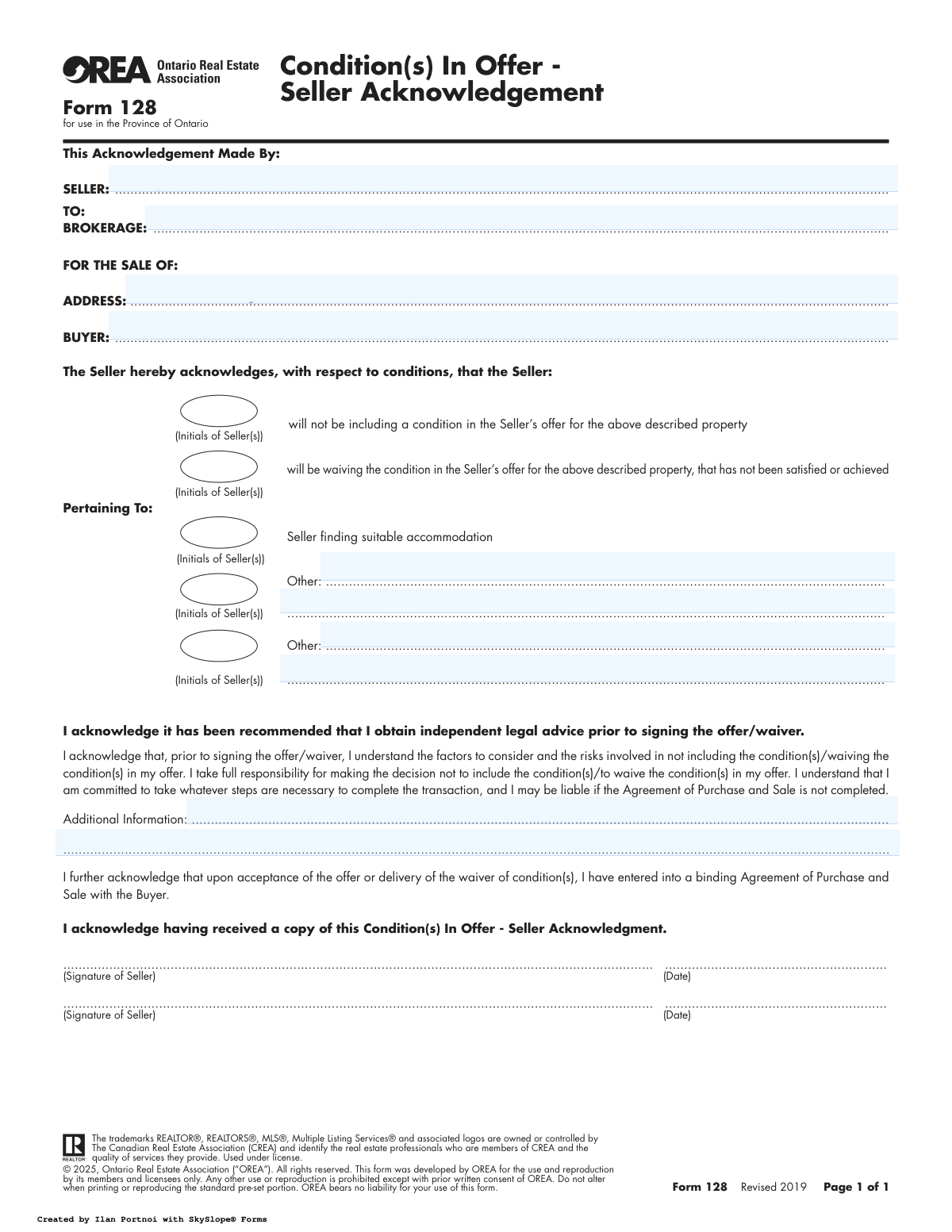
| 1. | OREA Form 128, Condition(s) In Offer - Seller Acknowledgement | 1 | Basic 31 |
| 2. | OREA Form 200, Listing Agreement Seller Representation Agreement Authority to Offer for Sale | 4 | Moderate 57 |
| 3. | OREA Form 200 (Revised 2025) — Listing Agreement / Seller Representation Agreement / Authority to Offer for Sale (Ontario) | 4 | Moderate 58 |
| 4. | OREA Form 210, Listing Agreement Landlord Representation Agreement, Authority to Offer for Lease | 4 | Moderate 61 |
| 5. | OREA Form 320, Confirmation of Co-operation and Representation | 2 | Moderate 58 |
| 6. | OREA Form 410, Rental Application Residential | 2 | Complex 76 |
- Enterprise-grade security & data encryption
- 99%+ accuracy powered by AI
- 1,000+ forms from all industries
- Complete forms in under 60 seconds
How to Choose the Right Form
Choosing the right Ontario Real Estate Association (OREA) form is essential for ensuring your property transaction is legally sound and clearly documented. Depending on whether you are selling a home or applying for a lease, you will need a specific standardized document to protect your interests.
For Sellers and Real Estate Agents
If you are a homeowner ready to put your property on the market or an agent representing a seller, you will need OREA Form 200 (Listing Agreement / Seller Representation Agreement). This is the primary contract that authorizes a brokerage to act on the seller's behalf. It outlines the listing price, the duration of the listing period, and commission structures. It also includes important disclosures regarding multiple representation and marketing permissions for the MLS® system.
For Landlords and Prospective Tenants
For residential leasing, the most common starting point is OREA Form 410 (Rental Application Residential).
- For Tenants: Use this form to provide landlords with your residency history, employment details, and financial references.
- For Landlords: Use this form to screen applicants and gather the necessary data to perform credit checks and background verifications.
Medical and Disability Documentation
Note that this category also includes the Elbow and Forearm Conditions Disability Benefits Questionnaire (DBQ). Unlike the OREA forms, this is a specialized VA medical document. You should choose this form only if you are a healthcare provider or a Veteran seeking to document a disability claim related to arm conditions. It is not used for real estate or rental transactions.
By using Instafill.ai, you can quickly turn these documents into interactive, fillable PDFs, ensuring that all fields—from OREA commission holdover provisions to VA medical diagnoses—are completed accurately and professionally.
Form Comparison
| Form | Purpose | Primary User | Key Information Required |
|---|---|---|---|
| Elbow and Forearm Conditions Disability Benefits Questionnaire | Provides medical evidence for VA disability claims regarding arm impairments. | Qualified healthcare providers and veterans seeking disability benefits. | Diagnoses, range-of-motion measurements, imaging results, and occupational impact. |
| OREA Form 200 (Revised 2025) | Establishes a formal agreement for a brokerage to sell a property. | Property sellers and real estate agents in Ontario. | Commission rates, listing price, representation disclosures, and listing period. |
| OREA Form 410, Rental Application Residential | Collects background information to evaluate prospective tenants for residential rentals. | Potential tenants and landlords or property managers. | Employment history, financial background, residence history, and personal references. |
Tips for OREA forms
Ensure that all names match government-issued identification and that property addresses are exact. Even minor typos in OREA forms can cause significant delays in the listing process or lead to errors in legal representation agreements.
Managing multiple real estate documents can be overwhelming. AI-powered tools like Instafill.ai can complete these forms in under 30 seconds with high accuracy, ensuring your data stays secure while saving you valuable time during a move or sale.
When filling out a Listing Agreement like Form 200, pay close attention to the holdover period and commission rates. Understanding these terms before signing prevents future disputes regarding payments after the listing period officially ends.
For residential rental applications, landlords prioritize stability. Include complete contact information for previous landlords and current employers to help the property manager verify your background quickly and move your application to the top of the pile.
OREA forms often include disclosures regarding multiple representation, which occurs when one brokerage represents both parties. Review these sections to understand how your interests are managed and ensure you are comfortable with the arrangement before proceeding.
Many OREA agreements rely on 'Schedule A' to detail specific services or custom conditions. Ensure these attachments are clearly referenced within the main body of the form to maintain a cohesive and legally sound agreement.
Always save a finalized digital copy of every form you submit or sign. Having these records easily accessible is essential for tracking your contractual obligations and provides a necessary reference during the closing or move-in phase.
Frequently Asked Questions
OREA forms are standardized legal documents created by the Ontario Real Estate Association for use in real estate transactions across Ontario. These forms ensure consistency and legal compliance for common tasks such as listing a property, making an offer, or processing rental applications.
These forms are primarily used by licensed real estate professionals, landlords, and property managers in Ontario. While some forms like the Rental Application are used by prospective tenants, most OREA documents facilitate the professional relationship between a brokerage and their clients.
To establish a formal relationship with a brokerage to sell your property, you would use OREA Form 200, the Listing Agreement. This document grants the brokerage authority to market the property and outlines the terms of the commission and the listing duration.
Yes, you can use AI tools like Instafill.ai to complete OREA forms in under 30 seconds. These tools can accurately extract data from your source documents and place it directly into the correct fields on the PDF form.
While manual entry can be time-consuming, using an AI-powered service allows you to complete complex real estate forms almost instantly. By automating the data placement process, these tools ensure accuracy while saving significant time during the paperwork phase of a transaction.
OREA Form 410 is the standard Residential Rental Application used by landlords to screen potential tenants. It collects essential information including residence history, employment details, and financial references to help evaluate an applicant's suitability for a lease.
Yes, once these forms are completed and signed by the relevant parties, they become legally binding contracts or authorizations. It is important to ensure all information is accurate and that you understand the terms, such as commission holdover periods or representation disclosures, before signing.
OREA frequently updates their forms to stay compliant with the Trust in Real Estate Services Act (TRESA) and other Ontario regulations. Using a digital platform that hosts a current library ensures you are using the latest revisions, such as the 2025 version of the Listing Agreement.
No, OREA forms are specifically designed to comply with the laws and regulations of the province of Ontario. Real estate transactions in other provinces or countries require documentation specific to those jurisdictions' legal requirements.
Applicants typically need to provide their full legal name, current employment and income details, and contact information for previous landlords. The form also requests consent for credit checks and personal references to verify the applicant's background.
While OREA forms are the industry standard for registered real estate professionals, they are specifically designed for transactions involving a brokerage. Private sellers may use them as a template, but they should ensure the clauses regarding brokerage representation are handled correctly or consult a lawyer.
A holdover provision is a clause found in OREA Form 200 that protects the brokerage's commission for a set period after the agreement expires. If the property is sold to a buyer who was introduced to the property during the listing term, the seller may still be obligated to pay the agreed-upon commission.
Glossary
- Form Complexity Index
- Instafill’s 0–100 measure of how much effort a form takes to complete, calculated deterministically from the form’s own structure rather than estimated. It combines the number of fillable fields (the largest factor), how difficult those fields are to complete based on their type, the number of pages that contain fields, the amount of conditional “fill-only-if” logic, and how many sections the form is divided into, then adds modifiers for tables and repeating lists, bundled instruction pages, and dense page layouts. A higher score means the form is harder to fill out by hand. The forms in this category have a median Form Complexity Index of 58/100 (Moderate). See exactly how it is calculated.
- Multiple Representation
- A situation where a single real estate brokerage represents both the buyer and the seller (or landlord and tenant) in the same transaction, requiring informed written consent from all parties.
- Holdover Period
- A specific timeframe after a listing agreement expires during which the seller must still pay a commission to the original brokerage if the property is sold to a buyer who was introduced during the listing term.
- MLS® (Multiple Listing Service)
- A professional cooperative system used by real estate agents to share information about properties for sale or lease, ensuring broad market exposure for listings.
- Irrevocable
- A legal designation meaning that an offer or agreement is binding and cannot be withdrawn or cancelled by the person who signed it until a specific expiry time has passed.
- Schedule A
- An attachment to standard OREA forms used to add custom clauses, specific conditions, or additional details that are not included in the pre-printed sections of the standard contract.
- Listing Brokerage
- The real estate company that has been officially hired and authorized by a property owner to market their property and represent their interests.
- Co-operating Brokerage
- The real estate company that represents the buyer or tenant and works in conjunction with the listing brokerage to facilitate a successful transaction.
- Guarantor
- A third party who signs a rental application or lease agreement, promising to pay the rent or cover damages if the primary tenant fails to meet their financial obligations.