Fill out Prudential insurance forms
with AI.
Prudential insurance forms cover a range of documentation required throughout the life of an insurance policy or claim. This category focuses primarily on Group Disability Insurance forms — paperwork that Prudential and its Disability Management Services use to evaluate, process, and continue disability claims. These forms are an essential part of the claims process, helping Prudential assess a claimant's occupational background, functional limitations, and eligibility for ongoing benefits.
By continuing, you acknowledge Instafill's Privacy Policy and agree to get occasional product update and promotional emails.
About Prudential insurance forms
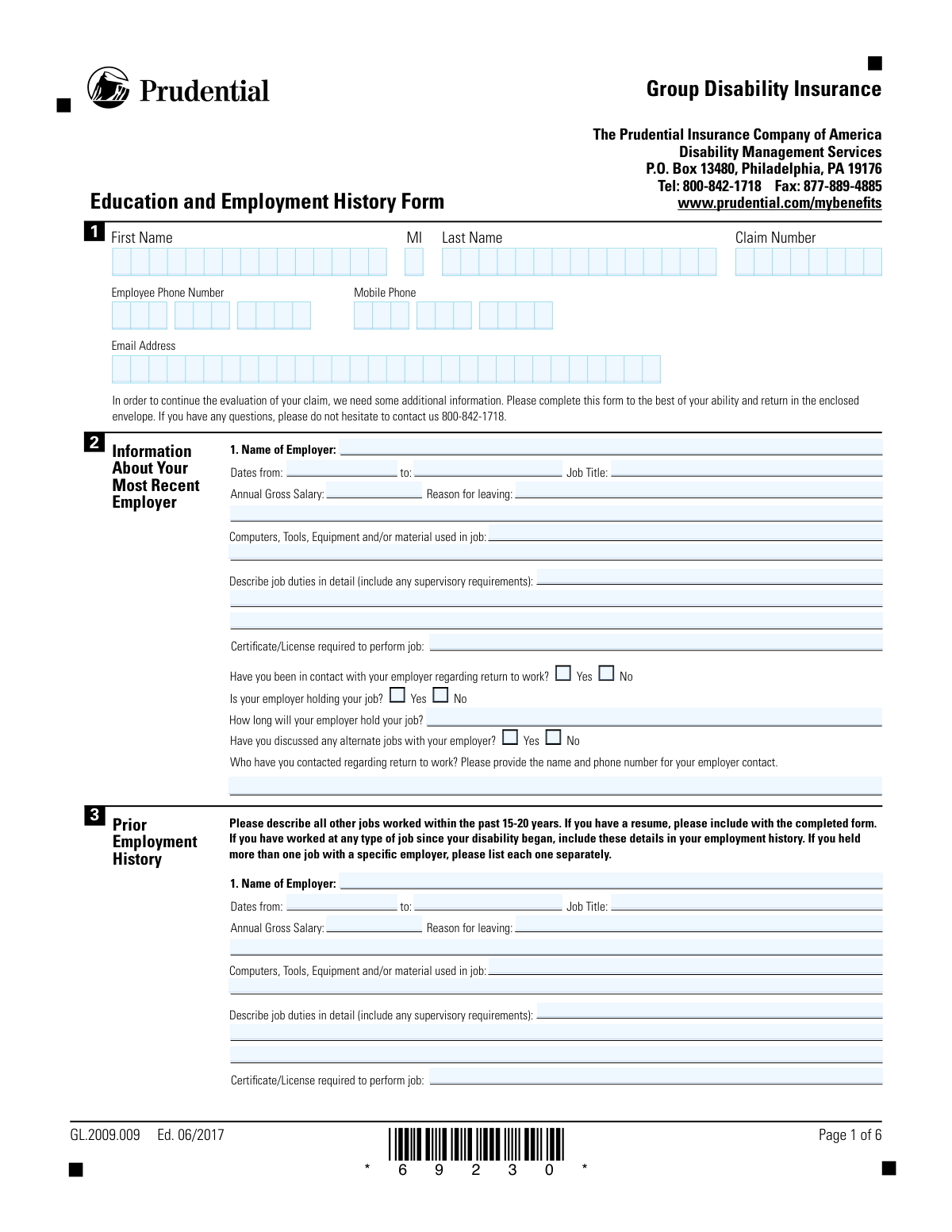
The forms here are most commonly needed by individuals who are currently receiving or applying for group disability benefits through an employer-sponsored Prudential plan. A key example is the Education and Employment History Form (GL.2009.009), which asks claimants to document their most recent employer, work history spanning the past 15–20 years, educational credentials, and any return-to-work efforts. Because these forms include fraud notices and require a certified signature, accuracy and completeness are critical — errors or omissions can delay a claim or affect benefit eligibility.
Filling out these forms carefully takes time, especially when recalling detailed employment history. Tools like Instafill.ai use AI to complete these forms in under 30 seconds, handling the data accurately and securely, which can be a practical relief during an already stressful claims process.
Every form on this page can be completed without typing. Instafill is form filling software that reads a PDF and fills it for you — including flat and scanned documents that carry no fillable fields at all.
Forms in This Category
The forms in this category have a median Form Complexity Index of 74/100 (Complex), measured across 3 forms by field count, input difficulty, length, conditional logic and structure. See how it is calculated.
- Enterprise-grade security & data encryption
- 99%+ accuracy powered by AI
- 1,000+ forms from all industries
- Complete forms in under 60 seconds
How to Choose the Right Form
Navigating Prudential Disability Claim Forms
When managing a claim with Prudential, providing accurate background information is essential for maintaining your benefits. The forms in this category center around the Prudential Group Disability Insurance – Education and Employment History Form (GL.2009.009). While there may be slight variations in how the titles are listed, they all serve the same critical purpose in the disability management process.
When to Use Form GL.2009.009
You should select this form if you have been requested by Prudential Disability Management Services to provide a comprehensive overview of your professional and educational background. This is typically required during:
- Initial Claim Evaluation: To help the insurer understand your functional job requirements and occupational duties.
- Ongoing Disability Reviews: To assess if your condition still prevents you from performing your current or alternative roles.
- Vocational Planning: To identify transferable skills and explore potential return-to-work options or job-seeking efforts.
Key Information You Will Need
To complete the Education and Employment History Form (GL.2009.009, Ed. 06/2017) accurately, ensure you have the following details ready before you begin:
- Employment History: Detailed information regarding your most recent employer and a summary of prior positions held over the last 15–20 years.
- Education and Training: Your highest level of education, specific degrees, and any specialized training or certifications.
- Technical Skills: A list of your computer skills and proficiency with specific software or tools relevant to your industry.
- Functional Requirements: An explanation of the physical and mental demands of your previous roles to help assessors understand your vocational background.
By using an AI-powered tool like Instafill.ai, you can quickly complete these Prudential insurance forms, ensuring all fields—including the fraud notice and claimant certification—are handled correctly to avoid administrative delays in your claim decision.
Tips for Prudential insurance forms
Prudential disability forms often require a deep dive into your professional past to assess transferable skills. Ensure you list all relevant positions, including dates and specific duties, to help the claims adjuster understand your vocational background fully.
When describing your most recent role, be specific about the physical and mental tasks involved. Highlighting requirements like lifting limits, standing duration, or complex cognitive tasks helps Prudential accurately compare your current abilities against your job's demands.
Do not limit your education section to just degrees; include specialized training, professional licenses, and computer proficiency. These details are crucial for vocational assessments and determining potential return-to-work or alternative employment options.
Review your initial disability claim and medical records before submitting your history form to ensure all dates and job titles align. Discrepancies between different forms can lead to additional inquiries or unnecessary delays in your claim evaluation process.
Prudential forms typically include a mandatory fraud notice and require a formal certification signature. Forgetting to sign or date the document is a common reason for forms being returned, which can pause your benefit payments or claim review.
AI-powered tools like Instafill.ai can complete these complex insurance forms in under 30 seconds with high accuracy. Your sensitive data stays secure during the process, providing a practical and time-saving solution for managing multiple claim-related documents.
Frequently Asked Questions
These forms are essential tools used by Prudential to evaluate a claimant's eligibility for benefits and to understand their professional background. They help the insurer assess your functional job requirements, transferable skills, and potential for future return-to-work options.
This form is usually requested during the initial claim process or during a periodic review of an ongoing disability claim. It allows Prudential Disability Management Services to gather a comprehensive view of your career history and educational qualifications to make informed benefit decisions.
Prudential typically asks for detailed information regarding your prior employment over the last 15 to 20 years. This long-term perspective helps them identify transferable skills and vocational factors that might influence your claim or return-to-work planning.
Understanding your technical skills and specialized training helps Prudential determine if you are capable of performing other types of work despite your disability. This assessment of transferable skills is a standard part of evaluating long-term disability claims.
Yes, AI-powered tools like Instafill.ai can be used to fill out these forms in under 30 seconds. These systems accurately extract data from your existing documents and place it into the correct fields, ensuring the form is completed efficiently.
Manually filling out detailed employment histories can take an hour or more, but using AI tools can reduce this time significantly. Services like Instafill.ai allow you to complete these complex questionnaires in a fraction of the time by automating the data entry process.
It is important to be as accurate as possible, but if exact dates are unavailable, providing your best estimate is generally recommended. You may also want to check old tax records or social security statements to ensure the information is as complete as possible before signing the certification.
Completed forms should generally be submitted directly to Prudential Disability Management Services via the method specified in your claim instructions, such as mail, fax, or an online portal. Always keep a copy of the signed and dated form for your personal records.
Yes, these forms include a certification section and a fraud notice that require your formal signature and date. By signing, you are legally testifying that the information regarding your education and work history is true and accurate to the best of your knowledge.
Yes, Prudential requires education and training details regardless of your tenure at your most recent employer. This information is used to evaluate your overall vocational profile and your ability to transition to different roles if your disability prevents you from returning to your previous position.
Glossary
- Form Complexity Index
- Instafill’s 0–100 measure of how much effort a form takes to complete, calculated deterministically from the form’s own structure rather than estimated. It combines the number of fillable fields (the largest factor), how difficult those fields are to complete based on their type, the number of pages that contain fields, the amount of conditional “fill-only-if” logic, and how many sections the form is divided into, then adds modifiers for tables and repeating lists, bundled instruction pages, and dense page layouts. A higher score means the form is harder to fill out by hand. The forms in this category have a median Form Complexity Index of 74/100 (Complex). See exactly how it is calculated.
- Group Disability Insurance
- A type of insurance policy provided by an employer or organization that replaces a portion of an individual's income if they become unable to work due to a covered illness or injury.
- Claimant
- The person who is applying for or currently receiving disability benefits and is responsible for providing updated medical and vocational information to the insurer.
- Vocational Assessment
- An evaluation conducted by insurance specialists to determine how a person's education and work history influence their ability to perform their current job or alternative roles.
- Transferable Skills
- Capabilities and knowledge acquired through prior jobs or education that can be used in different occupations, even if the claimant has physical or mental restrictions.
- Functional Job Requirements
- The specific physical and mental tasks, such as lifting, sitting, or problem-solving, that are essential to performing a particular job's duties.
- Disability Management Services
- The internal department at Prudential that oversees the administration, clinical review, and decision-making process for disability insurance claims.
- Fraud Notice
- A mandatory legal statement on insurance documents warning that intentionally providing false information to claim benefits is illegal and subject to prosecution.
- Return-to-Work (RTW) Options
- Potential modifications, accommodations, or alternative positions identified by the insurer to help a claimant transition back into the workforce safely.