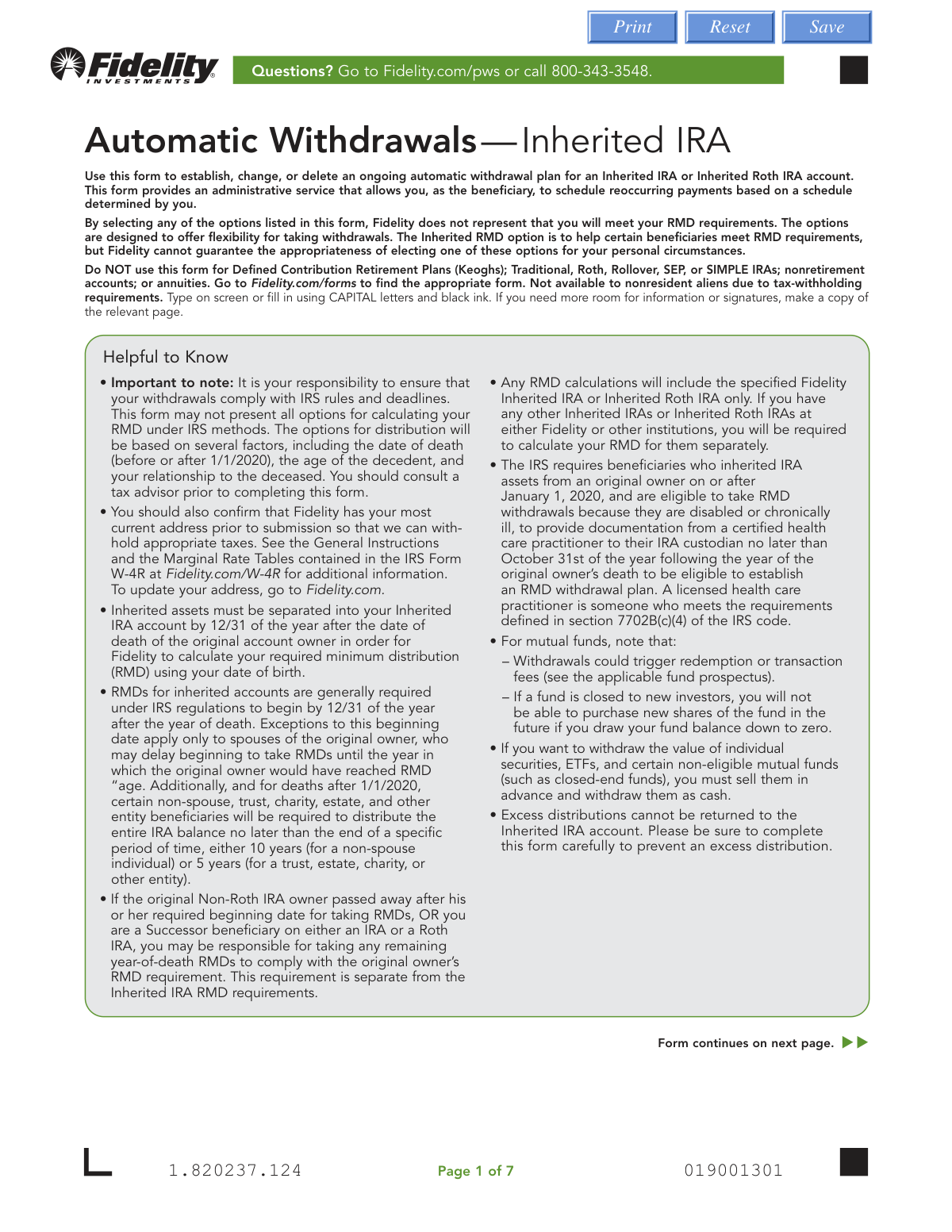
Yes! You can use AI to fill out Automatic Withdrawals — Inherited IRA - Fidelity Investments
This Fidelity Investments form is used by beneficiaries of an Inherited IRA or Inherited Roth IRA to manage their distributions. It allows them to establish, change, or delete an automatic withdrawal plan, providing flexibility in scheduling recurring payments to meet personal needs or Required Minimum Distribution (RMD) requirements. Today, this form can be filled out quickly and accurately using AI-powered services like Instafill.ai, which can also convert non-fillable PDF versions into interactive fillable forms.
Our AI automatically handles information lookup, data retrieval, formatting, and form filling.
It takes less than a minute to fill out Fidelity Automatic Withdrawals - Inherited IRA using our AI form filling.
Securely upload your data. Information is encrypted in transit and deleted immediately after the form is filled out.
Form specifications
| Form name: | Automatic Withdrawals — Inherited IRA - Fidelity Investments |
| Number of pages: | 1 |
| Language: | English |
| Categories: | investment forms, IRA forms, withdrawal forms, Fidelity forms |
Instafill Demo: How to fill out PDF forms in seconds with AI
How to Fill Out Fidelity Automatic Withdrawals - Inherited IRA Online for Free in 2026
Are you looking to fill out a FIDELITY AUTOMATIC WITHDRAWALS - INHERITED IRA form online quickly and accurately? Instafill.ai offers the #1 AI-powered PDF filling software of 2026, allowing you to complete your FIDELITY AUTOMATIC WITHDRAWALS - INHERITED IRA form in just 37 seconds or less.
Follow these steps to fill out your FIDELITY AUTOMATIC WITHDRAWALS - INHERITED IRA form online using Instafill.ai:
- 1 Navigate to Instafill.ai and upload or select the Fidelity Automatic Withdrawals — Inherited IRA form.
- 2 Provide the original IRA owner's information in Section 1, including their name, SSN, and dates of birth and death.
- 3 Enter your personal information as the beneficiary in Section 2, including your account number and relationship to the original owner.
- 4 In Section 3, indicate whether you are establishing, changing, or deleting a plan, then select the appropriate withdrawal plan type in Section 4 based on the original owner's date of death.
- 5 Specify the distribution schedule, including frequency and start date, in Section 6, and detail how the withdrawal should be funded in Section 7.
- 6 Choose your distribution method (e.g., EFT, check) in Section 8 and set your federal and state tax withholding preferences in Section 9.
- 7 Review all the information you've provided for accuracy, then securely e-sign and submit the completed form directly through the platform.
Our AI-powered system ensures each field is filled out correctly, reducing errors and saving you time.
Why Choose Instafill.ai for Your Fillable Fidelity Automatic Withdrawals - Inherited IRA Form?
Speed
Complete your Fidelity Automatic Withdrawals - Inherited IRA in as little as 37 seconds.
Up-to-Date
Always use the latest 2026 Fidelity Automatic Withdrawals - Inherited IRA form version.
Cost-effective
No need to hire expensive lawyers.
Accuracy
Our AI performs 10 compliance checks to ensure your form is error-free.
Security
Your personal information is protected with bank-level encryption.
Frequently Asked Questions About Form Fidelity Automatic Withdrawals - Inherited IRA
This form is used to establish, change, or delete an ongoing automatic withdrawal plan for a Fidelity Inherited IRA or Inherited Roth IRA account. It allows you, as the beneficiary, to schedule recurring payments from the account.
This form should be used by beneficiaries of a Fidelity Inherited IRA or Inherited Roth IRA. Do not use this form for other account types like Traditional IRAs, SEP IRAs, or nonretirement accounts.
The rules for inherited IRA distributions changed based on the date of the original owner's death. You must complete Section 4a if the owner passed away in 2019 or before, and Section 4b if they passed away in 2020 or later.
No, Fidelity does not represent that your chosen withdrawal plan will meet your IRS RMD requirements. It is your responsibility to ensure your withdrawals comply with IRS rules, and you should consult a tax advisor.
The Ten-Year Rule, for deaths in 2020 or later, requires the account to be fully withdrawn by the end of the 10th year after the owner's death. The Five-Year Rule, for certain beneficiaries where the owner died before starting RMDs, requires full withdrawal by the end of the 5th year.
To set up a new electronic funds transfer (EFT), you must attach a voided check, deposit slip, or a bank statement that has the account number and all owner names preprinted on it.
A Medallion signature guarantee is needed if you are setting up withdrawals to a third-party bank account, if a single payment is over $100,000, or if your address on the account was changed within the past 10 days.
The default federal tax withholding rate is 10% on distributions from a non-Roth IRA. In Section 9, you can elect to have no taxes withheld or choose a specific percentage rate for both federal and state taxes.
You can mail the entire completed form and any required attachments to Fidelity Investments using either the regular mail or overnight mail address provided on the final page of the form.
You must complete and submit a separate 'Automatic Withdrawals — Inherited IRA' form for each individual account for which you want to establish a withdrawal plan.
To stop a plan, check the 'DELETE' box in Section 3, specify the type of plan you are deleting, and then skip to Section 10 to provide your signature.
Yes, services like Instafill.ai use AI to accurately auto-fill form fields with your information. This can save you time and help reduce the chance of errors.
Simply upload the PDF form to the Instafill.ai platform. The AI will make the document interactive, allowing you to provide your information once and have it automatically and accurately placed in all the correct fields.
If you have a non-fillable or 'flat' PDF, you can use a service like Instafill.ai. It can convert the document into an interactive, fillable form that you can easily complete on your computer before printing.
Compliance Fidelity Automatic Withdrawals - Inherited IRA
Validation Checks by Instafill.ai
1
SSN/TIN Format Validation
This check verifies that the Social Security Number or Taxpayer ID Number fields in both Section 1 (Original Owner) and Section 2 (Your Information) adhere to the standard 9-digit format (XXX-XX-XXXX or XX-XXXXXXX). This is crucial for correct tax reporting and identity verification. A failure would prevent the form from being processed until a valid number is provided.
2
Date of Death and Birth Logical Consistency
This validation ensures that the 'Original Owner’s Date of Death' entered in Section 1 is chronologically after the 'Original Owner’s Date of Birth'. This is a fundamental logic check to prevent data entry errors. If the date of death is before the date of birth, the submission is invalid and must be corrected.
3
Conditional Plan Selection Based on Date of Death
This check enforces the form's primary branching logic based on the SECURE Act. It verifies that if the 'Original Owner's Date of Death' (Section 1) is before January 1, 2020, only Section 4a is completed. Conversely, if the death occurred on or after that date, it ensures only Section 4b is completed. This is critical for applying the correct IRS distribution rules, and failure would lead to an invalid plan selection.
4
Request Type Completeness
This validation ensures that if 'ESTABLISH' or 'CHANGE' is selected in Section 3, the 'Type of Plan' field is filled out. Similarly, if 'DELETE' is selected, the corresponding 'Type of Plan to be Deleted' field must be completed. This prevents ambiguous requests and ensures the system knows which specific plan to act upon or modify.
5
Beneficiary and Plan Type Consistency
This check cross-references the beneficiary type selected in Section 2 (e.g., Spouse, Minor child) with the withdrawal plan chosen in Section 4. For example, it would flag an error if a beneficiary who is not a minor child selects the 'Minor child of the original IRA owner' RMD option. This ensures the selected withdrawal plan is legally permissible for the specific type of inheritor.
6
Fixed Dollar Amount Plan Cohesion
If 'Fixed Dollar Amount' is chosen in Section 4, this check validates two things: that a valid positive dollar amount is entered, and that if 'Fixed Amount/Percentage Distributions' is chosen in Section 7, the sum of the individual fund amounts equals the total distribution amount from Section 4. This ensures the funding instructions precisely match the withdrawal request, preventing partial or incorrect distributions.
7
Fixed Percentage Distribution Total
When a user selects 'Fixed Amount/Percentage Distributions' in Section 7 for any plan other than 'Fixed Dollar Amount', this validation confirms that the percentages listed for each position sum to exactly 100%. This is essential to ensure the entire distribution is funded correctly across the specified assets. Submissions with a total other than 100% would be rejected to prevent ambiguity or incomplete funding.
8
Combined Tax Withholding Limit
This check validates that the sum of the 'Federal' and 'State' tax withholding percentages entered in Section 9 does not exceed 99%. This rule is explicitly stated on the form and prevents invalid withholding instructions. If the total exceeds the limit, the form submission will be rejected, requiring the user to adjust the withholding rates.
9
Distribution Method Completeness
This validation ensures that when a distribution method is selected in Section 8, all associated required fields are populated. For instance, if 'Electronic funds transfer (EFT)' is chosen with new bank details, the system must verify that the bank name, routing number, and account number are all provided. Incomplete information would cause the payment to fail, so the submission is blocked until all necessary details are present.
10
Bank Routing Number Format
If a user provides new bank information for an EFT in Section 8, this check verifies that the 'Bank Routing/ABA Number' is exactly nine digits long. This is a standard format for all U.S. bank routing numbers and is critical for ensuring electronic payments are sent to the correct financial institution. An invalid format would result in a failed transaction.
11
Medallion Signature Guarantee Requirement Flag
This check automatically flags a submission for manual review if it meets conditions requiring a Medallion signature guarantee. These conditions include a per-payment amount over $100,000, a 3rd Party EFT request, or a direct deposit to a Fidelity account with no common owner. This ensures compliance with security procedures designed to prevent fraudulent transfers, and a submission lacking the required guarantee would be halted.
12
Distribution Start Date Validity
This validation confirms that the 'Start Date' provided in Section 6 is a valid calendar date and is not in the past. This prevents users from scheduling withdrawals for a time that has already occurred, which would be impossible to process. The check ensures all new withdrawal plans are set for a future date, allowing for proper setup and execution.
Common Mistakes in Completing Fidelity Automatic Withdrawals - Inherited IRA
The form has two distinct sections for withdrawal plans based on whether the original owner passed away before or after January 1, 2020. Applicants often overlook this critical distinction and fill out the incorrect section, leading to an invalid request. This causes processing delays and requires the form to be resubmitted correctly. To avoid this, carefully check the original owner's date of death in Section 1 before proceeding to Section 4 and only complete the corresponding subsection (4a or 4b).
In Section 2, selecting the correct beneficiary type (e.g., Spouse, Non-spouse individual, Trust) is fundamental as it dictates the available distribution options and rules. A mistake here can lead to selecting an invalid withdrawal plan and potential non-compliance with IRS regulations. Beneficiaries should carefully review their relationship to the deceased and the account documentation to ensure they check the correct box. Consulting a tax advisor is recommended for complex situations like trusts.
The form requires a Medallion signature guarantee in Section 10 for specific high-risk transactions, such as payments over $100,000 or setting up EFT to a third-party bank account. Applicants frequently miss this requirement or confuse it with a standard notary stamp, causing the form to be rejected. To prevent this, review Section 8 carefully; if your request meets the criteria, you must visit a bank or financial institution that offers this specific guarantee before submitting the form.
Applicants often choose the 'Fixed Dollar Amount' option for its simplicity without fully understanding the consequences. By selecting this, they assume full responsibility for ensuring their withdrawals meet the IRS Required Minimum Distribution (RMD) rules, which can be complex. This can lead to insufficient withdrawals and significant tax penalties. Before choosing this option, you should calculate your RMD separately or consult a tax advisor to ensure the fixed amount will satisfy the requirement.
In several sections (1, 4a, and 4b), the form requires the date of birth for the original owner or the oldest trust beneficiary to calculate life-expectancy-based RMDs. People often leave these fields blank, especially if they don't have the information readily available. This omission prevents Fidelity from calculating the RMD, leading to processing delays or an inability to establish the desired plan. Always gather all necessary dates before starting the form.
In Section 9, when specifying a custom tax withholding rate, users must enter a whole number percentage (e.g., '15' for 15%). Common errors include entering a decimal, a dollar amount, or a number outside the allowed range, which invalidates the instruction. This results in the default 10% federal withholding being applied, which may not be appropriate for the individual's tax situation. AI-powered tools like Instafill.ai can help prevent this by validating that the input is a whole number within the correct range.
When setting up a new Electronic Funds Transfer (EFT) in Section 8, applicants must provide full bank details and attach a voided check or bank statement. People often forget to attach the required document or enter an incorrect account or routing number. If the EFT cannot be established for any reason, the distribution defaults to a check mailed to the address of record, causing payment delays. Using a tool like Instafill.ai can help ensure all required fields are completed before submission.
This section is for reporting prior-year-end asset values that were in transit or distributions already taken in the current year. Many applicants overlook this section, assuming Fidelity has all the information. Failing to provide these adjustments can cause Fidelity to calculate an incorrect RMD amount for the year, potentially leading to an excess distribution that cannot be returned or an insufficient one resulting in penalties. Always review if these special circumstances apply to your account for the current year.
The form's header clearly states it is only for Inherited IRA or Inherited Roth IRA accounts. However, individuals often mistakenly use it for other accounts like their own Traditional IRA, a 401(k), or a non-retirement account. This error leads to immediate rejection and wasted time. It is crucial to read the instructions on the first page and use Fidelity.com/forms to find the correct form for your specific account type.
In Section 7, when choosing to liquidate specific funds, the percentages listed must total 100%. A common data entry error is miscalculating the percentages, which causes the instruction to be rejected and defaults to a proportional distribution from all eligible positions. This may not align with the applicant's investment strategy, potentially liquidating funds they wished to keep. Since this form is a non-fillable PDF, using a service like Instafill.ai can convert it to a smart, fillable version that can automatically perform such calculations to prevent errors.
Saved over 80 hours a year
“I was never sure if my IRS forms like W-9 were filled correctly. Now, I can complete the forms accurately without any external help.”
Kevin Martin Green
Your data stays secure with advanced protection from Instafill and our subprocessors

Robust compliance program
Transparent business model
You’re not the product. You always know where your data is and what it is processed for.
ISO 27001, HIPAA, and GDPR
Our subprocesses adhere to multiple compliance standards, including but not limited to ISO 27001, HIPAA, and GDPR.
Security & privacy by design
We consider security and privacy from the initial design phase of any new service or functionality. It’s not an afterthought, it’s built-in, including support for two-factor authentication (2FA) to further protect your account.
Fill out Fidelity Automatic Withdrawals - Inherited IRA with Instafill.ai
Worried about filling PDFs wrong? Instafill securely fills automatic-withdrawals-inherited-ira-fidelity-investments forms, ensuring each field is accurate.