Yes! You can use AI to fill out Fidelity Investments Beneficiaries — Term Life Insurance
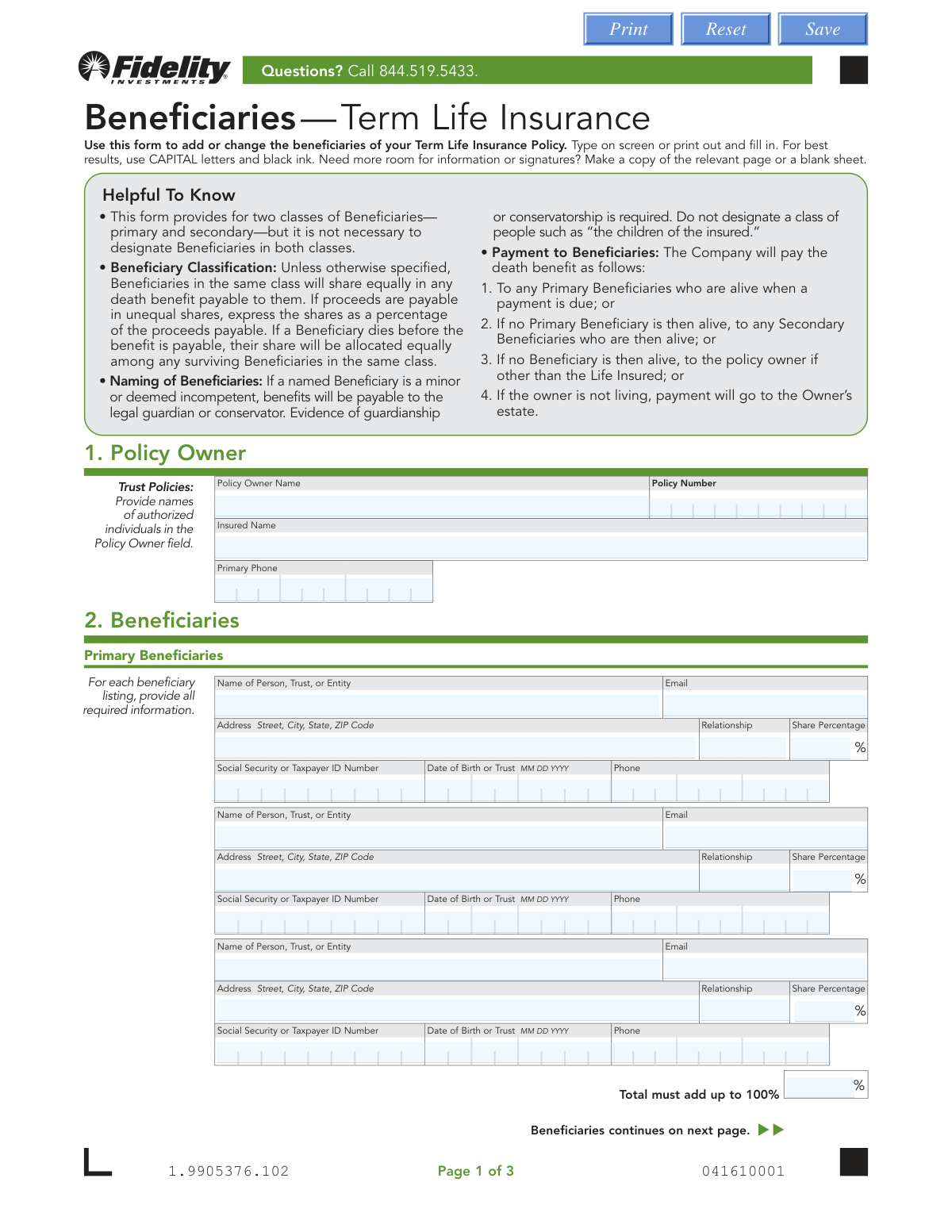
This form, officially titled 'Beneficiaries — Term Life Insurance' from Fidelity Investments, is a crucial document for policyholders to legally specify or modify who will receive the proceeds from their term life insurance policy. Properly completing this form ensures that your assets are distributed according to your wishes, avoiding potential legal complications for your heirs. Today, this form can be filled out quickly and accurately using AI-powered services like Instafill.ai, which can also convert non-fillable PDF versions into interactive fillable forms.
1.9905376.102 is part of the
insurance forms, beneficiary forms, life insurance forms, investment forms, Fidelity forms, insurance designation forms and ERM forms categories on Instafill.
Rather not fill this in by hand? Instafill is an online form filler that completes PDF forms automatically — upload the blank form, answer a few questions, and the AI fills every field.
Form specifications
| Form name: | Fidelity Investments Beneficiaries — Term Life Insurance |
| Number of pages: | 1 |
| Language: | English |
Our AI automatically handles information lookup, data retrieval, formatting, and form filling.
It takes less than a minute to fill out 1.9905376.102 using our AI form filling.
Securely upload your data. Information is encrypted in transit and deleted immediately after the form is filled out.
Instafill Demo: How to fill out PDF forms in seconds with AI
How to Fill Out 1.9905376.102 Online for Free in 2026
Are you looking to fill out a 1.9905376.102 form online quickly and accurately? Instafill.ai offers the #1 AI-powered PDF filling software of 2026, allowing you to complete your 1.9905376.102 form in just 37 seconds or less.
Follow these steps to fill out your 1.9905376.102 form online using Instafill.ai:
- 1 Navigate to Instafill.ai and upload or select the Fidelity Beneficiary Designation form.
- 2 Provide the policy owner's information, including name, policy number, and contact details.
- 3 Enter the required information for each primary beneficiary, such as name, address, relationship, and the specific share percentage they will receive. Ensure the total percentage equals 100%.
- 4 If desired, repeat the process to add secondary beneficiaries in the appropriate section, providing all their details.
- 5 Carefully review all entered information for accuracy, paying close attention to names, Social Security numbers, and share percentages.
- 6 The policy owner must sign and date the form in the presence of a witness, who must also sign. Note that a beneficiary cannot act as a witness.
- 7 Submit the completed and signed form to Fidelity Investments using the regular or overnight mail addresses provided on the form.
Our AI-powered system ensures each field is filled out correctly, reducing errors and saving you time.
Why Choose Instafill.ai for Your Fillable 1.9905376.102 Form?
Speed
Complete your 1.9905376.102 in as little as 37 seconds.
Up-to-Date
Always use the latest 2026 1.9905376.102 form version.
Cost-effective
No need to hire expensive lawyers.
Accuracy
Our AI performs 10 compliance checks to ensure your form is error-free.
Security
Your personal information is protected with bank-level encryption.
Frequently Asked Questions About 1.9905376.102
This form is used to add, change, or update the beneficiaries for your Term Life Insurance Policy with Fidelity Investments.
Primary beneficiaries are the first to receive the policy proceeds. Secondary beneficiaries only receive proceeds if no primary beneficiaries are alive when the benefit is paid.
You must provide their full name, address, relationship to you, share percentage, Social Security or Taxpayer ID Number, and date of birth.
Yes, the total share percentages for your primary beneficiaries must add up to 100%. If you designate secondary beneficiaries, their shares must also total 100% separately.
If a beneficiary passes away before the benefit is payable, their share will be divided equally among the other surviving beneficiaries in the same class (e.g., other primary beneficiaries).
Yes, but if a benefit is paid while the beneficiary is a minor, it will be payable to their legal guardian or conservator, and proof of guardianship will be required.
If you need more room for additional beneficiaries, you can make a copy of the beneficiaries page or attach a separate sheet with all the required information.
All policy owners must sign and date the form. The signature must be witnessed by someone who is not a named beneficiary on the form.
No, the form explicitly states that a named beneficiary cannot act as a witness. You must choose a different individual to witness your signature.
You can send the entire signed form via regular mail to the Annuity Service Center in Cincinnati, OH, or by overnight mail to Fidelity Investments in Covington, KY. The full addresses are on the last page of the form.
After your form is processed, Fidelity will send you a Revised Policy Profile to confirm that the beneficiary changes have been registered.
Yes, services like Instafill.ai use AI to accurately auto-fill form fields, which can save you time and help you avoid mistakes.
You can upload the PDF to the Instafill.ai platform. The AI will make the fields interactive, allowing you to easily type in your information before printing the completed form for signature.
If you have a flat or non-fillable PDF, you can use a service like Instafill.ai. It can convert the document into an interactive, fillable form that you can complete on your computer.
Compliance 1.9905376.102
Validation Checks by Instafill.ai
1
Primary Beneficiary Share Percentage Summation
This check verifies that the sum of all 'Share Percentage' values for the listed Primary Beneficiaries equals exactly 100%. This is critical to ensure the entire death benefit is allocated without ambiguity. If the total is not 100%, the form submission will be rejected, and the user will be prompted to correct the percentages.
2
Secondary Beneficiary Share Percentage Summation
This validation ensures the 'Share Percentage' values for all designated Secondary Beneficiaries sum to exactly 100%. This rule applies independently of the primary beneficiaries and is necessary for the proper distribution of proceeds if no primary beneficiaries are alive. A failure will require the user to adjust the percentages before the form can be processed.
3
Policy Owner Information Completeness
This check confirms that the 'Policy Owner Name', 'Policy Number', and 'Primary Phone' fields are all filled out. This information is essential for identifying the specific policy and policyholder to which the beneficiary changes apply. An incomplete owner section will prevent the form from being submitted, as the request cannot be associated with an account.
4
Beneficiary Entry Completeness
For any beneficiary row where a name has been entered, this validation ensures all other required fields for that beneficiary are also complete, including Address, Relationship, Share Percentage, SSN/TIN, and Date of Birth. This prevents incomplete beneficiary records, which can cause significant legal and processing issues later. The system should highlight the specific missing fields for the user to complete.
5
SSN and TIN Format Validation
This check validates that the 'Social Security or Taxpayer ID Number' for each beneficiary is in a valid format (e.g., 9 digits for an SSN, often formatted as XXX-XX-XXXX, or a valid TIN format). Correct identification numbers are legally required for payment and tax reporting purposes. An invalid format will trigger an error, requiring the user to re-enter the number correctly.
6
Date of Birth and Trust Date Validity
This validation ensures that the 'Date of Birth or Trust' field is in the correct MM DD YYYY format and represents a logical, past date. For a person, the date cannot be in the future, and for a trust, it must be a valid calendar date. This is important for identity verification and for determining if a beneficiary is a minor, which has legal implications for payment.
7
Witness Independence from Beneficiaries
This check cross-references the 'Witness Name' against all names listed in the Primary and Secondary Beneficiary sections. The witness cannot be a named beneficiary to avoid a conflict of interest and ensure the signature's legal validity. If a match is found, the submission is blocked, and an error message explains that a non-beneficiary must act as the witness.
8
Minimum Beneficiary Designation
This validation ensures that at least one Primary or one Secondary beneficiary has been fully and correctly designated on the form. A policy change request that removes all beneficiaries without adding new ones is typically invalid. If no beneficiaries are listed, the form will be rejected with a message indicating that at least one must be specified.
9
Unique Beneficiary Role Assignment
This check ensures that the same person, trust, or entity is not listed as both a Primary and a Secondary beneficiary. Designating a party in both categories creates a logical contradiction in the payment waterfall. If a duplicate is detected, the user will be required to remove the beneficiary from one of the sections.
10
Valid Share Percentage Value
This validation confirms that each 'Share Percentage' field contains only positive numerical values greater than zero. The percentage cannot be negative, zero, or contain text, as this would make benefit calculation impossible. The system should reject non-compliant entries and guide the user to enter a valid number.
11
Signature Date Logical Check
This check verifies that the signature date is provided in a valid MM/DD/YYYY format and is not a date in the future. The date must be the current date or a recent past date to be considered valid. This ensures the signature attests to the beneficiary designations as of a specific, reasonable point in time.
12
Policy Number Structure Validation
This validation checks if the 'Policy Number' field entry matches the expected format and structure for Fidelity life insurance policies. This acts as a first-pass check to catch typos and ensure the number is plausible before it is looked up in the system. An invalid format would prompt the user to double-check and re-enter the policy number.
13
Email Address Format Validation
For any beneficiary where an email address is provided, this check ensures it conforms to a standard email format (e.g., [email protected]). While often optional, a valid email is useful for communication. An invalid format would result in a warning, prompting the user to correct it or leave it blank.
Common Mistakes in Completing 1.9905376.102
The form requires that the share percentages for all primary beneficiaries add up to exactly 100%, and the same for all secondary beneficiaries. People often make simple arithmetic errors, causing the total to be over or under 100%. This will cause the form to be rejected, delaying the update to your policy. To avoid this, use a calculator to double-check your math before finalizing the percentages for each beneficiary class.
Each beneficiary entry requires extensive details, including full name, address, Social Security Number (SSN), and date of birth. It's common for people to leave fields blank because they don't have the information readily available. Missing data will delay processing and can create significant hurdles for your beneficiaries when they need to claim the policy benefits. Before you start, gather all required information for every person or entity you plan to list.
The form explicitly states that a witness cannot be a named beneficiary on the policy. For convenience, people may ask a spouse or child who is also a beneficiary to witness their signature. This invalidates the signature section and will lead to the form being rejected, as it violates a key legal requirement for a neutral witness. Always choose a witness who has no financial interest in the policy, such as a neighbor or coworker.
A specific instruction notes that if a Trust owns the policy, all trustees must sign the form. This detail is easily overlooked, and often only one trustee signs. This makes the request unauthorized and incomplete, causing it to be rejected. To prevent this, confirm who all the current trustees are and ensure every one of them provides a signature, making copies of the signature page if necessary.
The instructions warn against designating a class of people, such as “the children of the insured.” Some people still use general terms like “my children” or “my heirs” instead of listing each person individually. This creates ambiguity that can lead to legal disputes and significant delays in payment. Always list each beneficiary by their full legal name and provide all other requested details to ensure your wishes are clear.
Although the form recommends using capital letters, handwritten submissions can often be difficult to read, especially for critical data like names, addresses, and SSNs. Illegible information can be entered incorrectly into the system, potentially causing a beneficiary's identity to be recorded wrong and creating major problems during a future claim. To avoid this, use the 'Type on screen' feature or a tool like Instafill.ai, which can make non-fillable PDFs fillable, ensuring all information is clear and legible.
The form specifies different date formats, such as 'MM DD YYYY' for birth dates and 'MM/DD/YYYY' for the signature date. Users often enter dates in a different format out of habit, such as DD-MM-YYYY. This can cause data entry errors or require the processing agent to seek clarification, delaying the update. Pay close attention to the required format for each date field to ensure accuracy.
The policy number is the primary identifier used by Fidelity to locate your account. Leaving this field blank or making a typographical error is a frequent mistake. Without the correct policy number, the company cannot process your request, and the form will be returned without any changes being made. To prevent this, find your policy number on a previous statement and double-check it for accuracy before submitting.
The policy owner's signature and the date are what legally authorize the beneficiary change. It's a simple but common oversight to forget to sign or date the form, especially when rushing to complete it. An unsigned or undated form is invalid and will be rejected immediately, meaning your beneficiary designations will not be updated. Always perform a final review of the form before sending, paying special attention to the signature block.
The form requires both the 'Policy Owner Name' and the 'Insured Name,' which may not be the same person. The policy owner is the only individual with the authority to sign and make changes. A common error is for the insured person to sign as the owner when they are not. This invalidates the request, as it was not authorized by the legal owner. Always verify who the policy owner is and ensure that person is the one who signs the form.
The instructions at the end of the form state to 'Send the ENTIRE form to Fidelity Investments.' People sometimes only mail the pages they filled out, omitting blank pages like the secondary beneficiary section if it wasn't used. Processing centers often require the complete document packet for compliance, so a partial submission may be considered incomplete and rejected. To avoid this, ensure all pages of the form are included when you mail it.
Saved over 80 hours a year
“I was never sure if my IRS forms like W-9 were filled correctly. Now, I can complete the forms accurately without any external help.”
Kevin Martin Green
Your data stays secure with advanced protection from Instafill and our subprocessors




Robust compliance program
Transparent business model
You’re not the product. You always know where your data is and what it is processed for.
ISO 27001, HIPAA, and GDPR
Our subprocesses adhere to multiple compliance standards, including but not limited to ISO 27001, HIPAA, and GDPR.
Security & privacy by design
We consider security and privacy from the initial design phase of any new service or functionality. It’s not an afterthought, it’s built-in, including support for two-factor authentication (2FA) to further protect your account.
Fill out 1.9905376.102 with Instafill.ai
Worried about filling PDFs wrong? Instafill securely fills fidelity-investments-beneficiaries-term-life-insurance forms, ensuring each field is accurate.
