
Instafill.ai
7 days free
AI form filling · 44 fields · 2 pages · done in seconds

Yes! You can use AI to fill out Form ADOPT-215, Findings and Order Regarding Hague Convention on Intercountry Adoption

Don't type 44 fields by hand. Tell our AI about yourself, or upload a document you already have, and it fills every field in seconds. You check it, then download, print or sign.
7 days free, then $19.99/month · Cancel anytime
AI fills it, no typingEncrypted, never used to train AICancel in two clicks
Form ADOPT-215, Findings and Order Regarding Hague Convention on Intercountry Adoption, page 1
Moderate · 50/100Form Complexity Index

The AI does the filling. You just check it.

No typing into boxes, nothing to install.

Tell the AI about youAnswer a few questions in plain words, or upload a document you already have. That is all the typing there is.
AI fills every field in secondsIt puts each answer in the right box on every page, checkboxes included.
Check it and downloadReview every field, change anything, then download, print or sign the PDF.

What this form asks for

The AI fills all of it, from your answers or your documents.

Form ADOPT-215 is a legal document used by the Superior Court of California to make official findings and issue an order in cases of intercountry adoption where a child is emigrating from the U.S. It ensures that the adoption process complies with the requirements of the Hague Convention on Intercountry Adoption and related U.S. federal regulations, making it a critical step for finalizing the adoption. Today, this form can be filled out quickly and accurately using AI-powered services like Instafill.ai, which can also convert non-fillable PDF versions into interactive fillable forms.
Fillable fields44
Pages2
Sections20
Questions that depend on earlier answers29
Form Complexity IndexModerate, 50/100

Let AI fill out your ADOPT-215

No typing. Every field filled in seconds, checked, ready to sign.

7 days free, then $19.99/month · Cancel anytime

How to Fill Out ADOPT-215 Online for Free in 2026

What the AI walks you through.

  1. Navigate to Instafill.ai and upload your ADOPT-215 form or select it from their template library.
  2. Provide the court and case information, including the county and case number, in the designated fields.
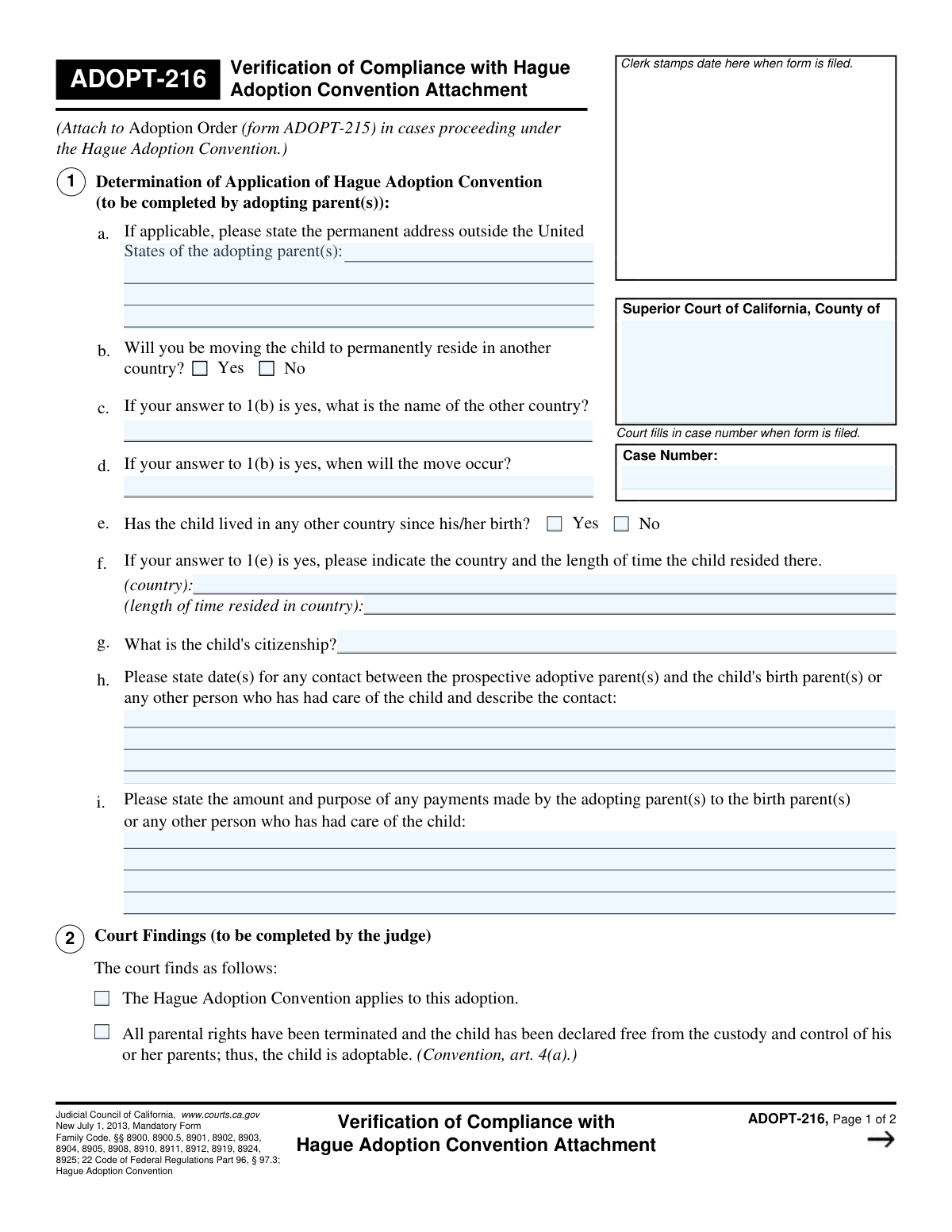
  3. Answer the questions regarding the child's past and future residence, specifying details if the child will be moving to another country.
  4. Enter information about the child's citizenship, contact between parties, and any payments made in connection with the adoption.
  5. Complete the detailed court findings and verification sections, checking the boxes that apply to confirm compliance with Hague Convention requirements.
  6. Review all the information populated by the AI for accuracy and completeness before finalizing the document.
  7. Download the completed form to print and file with the Superior Court of California as part of the adoption proceedings.

Common Mistakes in Completing ADOPT-215

The ones the AI is built to catch.

Incomplete Conditional Section for Future Residence
A large portion of the form is conditional, only required if the user answers 'Yes' to moving the child to another country. A common mistake is checking 'Yes' but then failing to fill out all the subsequent required declarations, verifications, and consent details. This results in an incomplete application, causing significant delays and potential rejection by the court. To avoid this, carefully review all sections that become mandatory after selecting 'Yes', or use a tool like Instafill.ai which can dynamically reveal and highlight required fields based on your answers.
Contradictory Yes/No Answers
Users frequently make contradictory entries, such as checking 'No' for the 'Child's Past Residence Question' but then providing details in the 'Country of Residence' and 'Duration of Stay' fields. This confusion often arises from misreading the question or changing an answer without clearing the dependent fields. Such inconsistencies can lead the court to question the accuracy of the entire submission, requiring clarification and resubmission. Always double-check that you only fill out fields corresponding to your 'Yes' answers.
Vague Contact and Payment Descriptions
The 'Contact Description' and 'Payment Details' fields require specific, detailed information, but people often provide overly brief summaries like 'spoke to the mother' or 'paid for expenses.' These are insufficient for legal review, which requires exact dates, descriptions of interactions, and itemized payments with their precise purpose to ensure transparency. Failing to provide this detail can halt the adoption process until a complete and thorough narrative is submitted.
Incorrectly Handling Conditional Sub-fields
Several sections, like 'Guardian/Parent Counseling and Consent,' have a primary checkbox and a secondary text field for details. A frequent error is checking the box but leaving the corresponding details field blank, or vice-versa. This leaves the court without the necessary context or confirmation, rendering the attestation incomplete. To prevent this, ensure that for every checkbox you tick that has a related detail field, you provide a complete and thorough explanation as required.
Misunderstanding Legal and Regulatory Checkboxes
The form includes checkboxes referencing complex legal standards like 'Hague Adoption Convention,' '22 C.F.R. part 96,' and 'best interest of the child.' Filers may check these boxes without fully understanding their legal implications or whether the conditions have actually been met. Incorrectly affirming these statements can have severe legal consequences, including invalidating the adoption. It is crucial to consult with an adoption agency or legal counsel to ensure you accurately understand and meet these requirements before checking these boxes.
Inconsistent or Missing Case Number
The form asks for the 'Case Number' in two separate locations, one at the top and another within the conditional section for an outgoing adoption. Users may enter different numbers, leave one blank, or miscopy the number, creating confusion and processing errors. The case number is the primary identifier for the legal proceedings, and any inconsistency can lead to misfiling or rejection. To avoid this, carefully enter the exact same court-assigned case number in both fields where it is required.
Improper International Address Formatting
When filling out the 'Permanent Address Outside the US,' applicants often use a US-centric format (Street, City, State, ZIP). However, international address formats vary significantly by country, and using the wrong format can cause critical mail to be lost or delayed. This can impact notifications and further steps in the adoption process. Always research the correct postal format for the specific destination country and enter the address exactly as it should appear on an envelope for that location.
Ambiguous 'Duration of Stay' Entry
The 'Duration of Stay' field lacks a specified format, leading to inconsistent entries like '3 years,' '36 months,' or 'from 2019 to 2022.' This ambiguity can make it difficult for court officials to quickly and accurately assess the child's residency history. To ensure clarity, it is best to use a consistent and precise format, such as 'X years, Y months,' or provide specific start and end dates (e.g., 'Jan 2019 - Dec 2021').
Failing to Complete All 'Court Findings'
The 'Court Findings' section contains critical checkboxes like 'Hague Adoption Convention Applies' and 'Parental Rights Terminated.' Applicants sometimes leave them blank, assuming they are for court use only, but they may be required to be checked based on the case's status. This omission can render the form invalid, as the court needs these affirmations to proceed. It's essential to understand if you are attesting to these facts for the court's confirmation and check them if all legal prerequisites have been met.
Overlooking the 'Child's Citizenship' Field
Amidst the complex questions about residence and legal proceedings, the straightforward 'Child's Citizenship' field can be easily overlooked. This information is fundamental for an intercountry adoption, as it determines which laws and treaties apply. Forgetting to enter the child's citizenship can cause immediate rejection of the form, as it's a critical piece of data for jurisdiction and processing. AI-powered tools like Instafill.ai can help by flagging mandatory fields that have been left empty.

Frequently Asked Questions About ADOPT-215


Is it really free for 7 days?
Yes. You pay $0 today. Cancel before Nov 18 and you are never charged. Keep it, and it is $19.99 a month for 5 fills of your ADOPT-215.
Can I fill other forms too?
This plan is for your ADOPT-215: your own AI agent fills it as often as 5 times a month. To fill other forms and upload your own, choose a Professional plan from your account.
How do I cancel?
From your account, in two clicks, any time. No email, no call.
How does the AI fill out ADOPT-215?
You answer a few questions in plain words, or upload a document you already have. The AI reads what you give it and puts each answer into the right field of ADOPT-215, on every page, in seconds. It checks the answers against the form's own rules, and you review and change anything before you download, print or sign.
What happens to my information?
It is encrypted in transit and at rest, and it is never used to train AI.
How complex is ADOPT-215 to fill out?
ADOPT-215 has a Form Complexity Index of 50 out of 100, in the moderate tier: 44 fillable fields across 2 pages. Instafill.ai's AI fills it in under a minute, with every field there for you to review before you download.
What is the purpose of this form?
This form is used in adoption proceedings within the Superior Court of California to declare information about a child's background and the circumstances of the adoption, with a specific focus on intercountry adoptions governed by the Hague Convention.
Who needs to fill out this form?
Prospective adoptive parents or their legal representatives are typically responsible for completing this form for submission to the court as part of their adoption case.
Why are so many fields only required if the child is moving to another country?
These sections are for adoptions where the child is leaving the U.S., which fall under specific international and federal regulations. The detailed checklist ensures the court verifies that all legal requirements for an outgoing Hague Convention adoption have been met.
What information do I need for the 'Contact Description' section?
You should provide a summary of all contact, including dates of meetings or communication, between the prospective adoptive parent(s) and the child's birth parent(s) or any other person who previously had legal care of the child.
What should I include in the 'Payment Details' section?
In this section, you must state the amount and purpose of any payments or gifts of value that you, as the adopting parent, have provided to the child's birth parent(s) or former caregivers.
What is the difference between the 'Child's Past Residence' and 'Child's Future Residence' questions?
The 'Past Residence' question asks if the child has ever lived in a country other than the U.S. since birth. The 'Future Residence' question asks if you plan to move the child to live permanently in another country after the adoption is finalized.
What documents might I need to complete the court verification sections?
To complete the detailed verification checklists, you will likely need access to the child's background study, your completed home study, and agreements with your adoption service provider.
Where do I submit this form?
This form must be filed with the Superior Court of California in the county where your adoption case is being heard. Be sure to include the correct case number on the form.
What happens after the court reviews the 'Court Findings' section?
After verifying that all legal and regulatory requirements have been met, the court can make its findings and grant a final adoption order or a final custody decree, as indicated in the 'Court Orders Granted' section.
What if the child has lived in multiple other countries?
The form provides space for one country. If the child has resided in multiple other countries, you should attach a separate page detailing the required information for each country and note the attachment on the form.
Can AI tools help me fill out this form?
Yes, services like Instafill.ai use AI to help you accurately auto-fill form fields with your saved information, which can save significant time and help prevent errors.
How can I fill this form out online using Instafill.ai?
You can upload the form's PDF to the Instafill.ai platform. The service will make the document interactive, allowing you to easily click and type in each field or use the AI to help populate the information for you.
What should I do if my copy of the form is a non-fillable PDF?
If you have a flat or non-fillable PDF, you can use a service like Instafill.ai. It can convert the document into an interactive, fillable form that you can complete and sign online.
Encrypted in transit and at restNever used to train AIDelete your forms any time

Get your ADOPT-215 filled out by AI

$0 today. Cancel before Nov 18 and you pay nothing.

Other forms like this one

California court forms: Judicial Council of California Form SC-105, Request for Court Order and Answer (Small Claims), Judicial Council of California Form SC-120, Defendant’s Claim and ORDER to Go to Small Claims Court (Small Claims), Judicial Council of California Form SER-001, Request for Sheriff to Serve Court Papers, Judicial Council of California Form SER-001, Request for Sheriff to Serve Court Papers, Affidavit for Collection of Personal Property California Probate Code Section 13100, Form POS-040, Proof of Service—Civil, Declaration of Facts of Death (California Superior Court), declaration-of-marriage-for-court-proceeding-california-family-law, ADOPT-200, Adoption Request, ADOPT-200, Stepparent Adoption Request, ADOPT-210, Adoption Agreement, ADOPT-310, Contact After Adoption Agreement, Judicial Council of California Form ADOPT-200, Adoption Request, Form ADR-107, Mediation Attendance Sheet, Form ADR-110, Order Appointing Referee, Form ADR-109, Stipulation or Motion for Order Appointing Referee, Form ADR-102, Request for Trial De Novo After Judicial Arbitration, Form ADR-108, Referee's Report (Code Civ. Proc., §§ 638, 639), Form ADR-106, Petition to Confirm, Correct, or Vacate Contractual Arbitration Award, Form ADR-104, Rejection of Award and Request for Trial After Attorney-Client Fee Arbitration

adoption forms: Judicial Council of California Form ADOPT-210, Adoption Agreement, Judicial Council of California Form ADOPT-210, Adoption Agreement, Vanguard Direct Rollover IRA Adoption Agreement, Voya Investment Management Traditional, Roth, Rollover, and SEP Individual Retirement Account (IRA) Application and Adoption Agreement, ICPC 100B, Interstate Compact on the Placement of Children Report on Child’s Placement Status, AAP 2, Reassessment Information - Adoption Assistance Program, Adoption Assistance Program Nonrecurring Adoption Expense Agreement and Claim, Statement of Acknowledgment - Adoption Implications, Form AAP 3, Adoption Assistance Program (AAP) Notice of Action, Adoption Assistance Program (AAP) - Request for Benefits, Form AAP 3, Adoption Assistance Program (AAP) Negotiation Agreement, Adoption Assistance Program (AAP) Eligibility Certification, Consent to Adoption by Parent, Adoption Request (Stepparent), Petition for Stepparent Adoption, Consent to Stepparent Adoption by Parent in Military, Adoption Assistance Program (AAP) Rate Questionnaire, ADOPT-210, Adoption Agreement, Declaration Confirming Parentage in Stepparent Adoption: Gestational Surrogacy, Form ADOPT-215, Adoption Order

7 days free, then $19.99/month · Cancel anytime