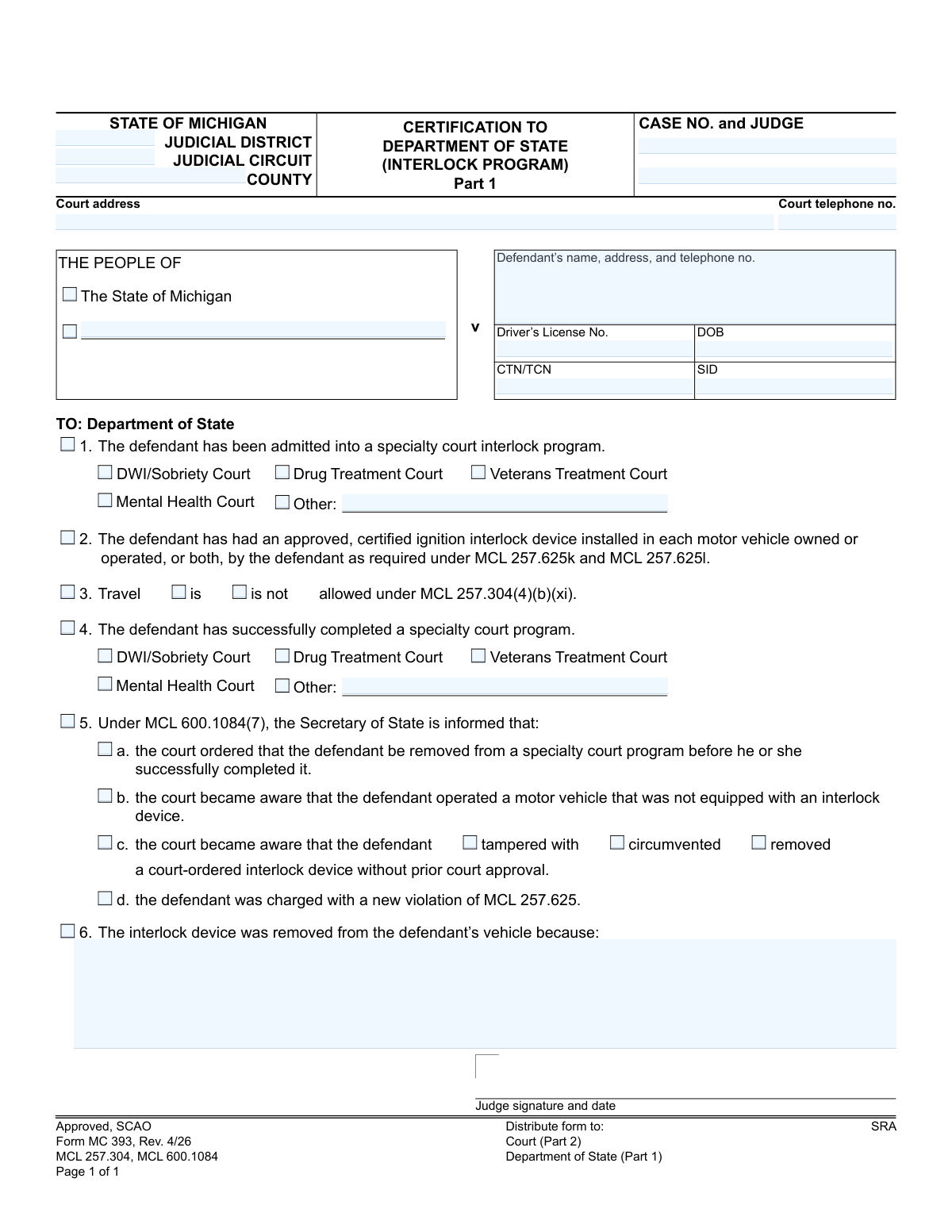
Yes! You can use AI to fill out Form MC 393, Certification to Department of State (Interlock Program)
Form MC 393 is a legal document used in the State of Michigan for courts to communicate with the Department of State regarding a defendant's participation in a specialty court's ignition interlock program. It certifies key events such as admission into the program, successful completion, or violations like tampering with a device or driving an unequipped vehicle. Today, this form can be filled out quickly and accurately using AI-powered services like Instafill.ai, which can also convert non-fillable PDF versions into interactive fillable forms.
Our AI automatically handles information lookup, data retrieval, formatting, and form filling.
It takes less than a minute to fill out MC 393 using our AI form filling.
Securely upload your data. Information is encrypted in transit and deleted immediately after the form is filled out.
Form specifications
| Form name: | Form MC 393, Certification to Department of State (Interlock Program) |
| Number of fields: | 84 |
| Number of pages: | 1 |
| Language: | English |
More forms in Michigan court forms
Instafill Demo: How to fill out PDF forms in seconds with AI
How to Fill Out MC 393 Online for Free in 2026
Are you looking to fill out a MC 393 form online quickly and accurately? Instafill.ai offers the #1 AI-powered PDF filling software of 2026, allowing you to complete your MC 393 form in just 37 seconds or less.
Follow these steps to fill out your MC 393 form online using Instafill.ai:
- 1 Navigate to Instafill.ai and upload or select the MC 393 form.
- 2 Provide the court and case information, including the judicial district/circuit, county, case number, and judge's name.
- 3 Enter the defendant's personal information, such as their full name, address, driver's license number, and date of birth.
- 4 Select the appropriate checkboxes to certify the defendant's current status, such as admission to the program, successful completion, or any violations.
- 5 Indicate the specific type of specialty court program the defendant is enrolled in (e.g., DWI/Sobriety Court, Veterans Treatment Court).
- 6 Review all the information populated by the AI for accuracy and completeness before the judge's signature.
- 7 Once signed and dated by the judge, distribute the completed form to the Department of State and retain a copy for court records as indicated.
Our AI-powered system ensures each field is filled out correctly, reducing errors and saving you time.
Why Choose Instafill.ai for Your Fillable MC 393 Form?
Speed
Complete your MC 393 in as little as 37 seconds.
Up-to-Date
Always use the latest 2026 MC 393 form version.
Cost-effective
No need to hire expensive lawyers.
Accuracy
Our AI performs 10 compliance checks to ensure your form is error-free.
Security
Your personal information is protected with bank-level encryption.
Frequently Asked Questions About Form MC 393
This form is used by a Michigan court to officially notify the Department of State about a defendant's status in a specialty court ignition interlock program, including admission, violations, and successful completion.
No, this is an official court document. The court completes, signs, and sends this form to the Michigan Department of State to update your driving record accordingly.
It is a court-supervised program, such as a DWI/Sobriety Court or Veterans Treatment Court, that allows certain offenders to have driving privileges with a vehicle equipped with an ignition interlock device.
This indicates whether the court has granted you permission to travel outside of Michigan while participating in the interlock program, as specified under state law MCL 257.304.
This notifies the Department of State that you have met all program requirements. This is a critical step toward having your full driving privileges restored.
Reporting a violation, like tampering with the device or driving a car without one, can lead to your removal from the specialty court program and the reinstatement of your original driver's license suspension or revocation.
Part 1 is the official copy sent to the Department of State to update their records. Part 2 is a copy retained by the court for its own case file.
The court is responsible for completing this form and distributing Part 1 to the Department of State. You, the defendant, are not responsible for its submission.
The form requires the defendant's personal details like name, DOB, and driver's license number, as well as court case information and the specific status being certified.
This is a serious notification to the Secretary of State that you have violated the terms of the program, which will likely result in negative consequences for your driving privileges and program status.
Yes, services like Instafill.ai can use AI to accurately auto-fill form fields with defendant and case information, which saves time and reduces the risk of manual data entry errors for court personnel.
Court staff can use a service like Instafill.ai to upload the PDF. The platform makes the form interactive and fillable online, allowing for easy completion, saving, and printing.
If you have a non-fillable or 'flat' PDF, a tool like Instafill.ai can convert it into an interactive, fillable form online, making it easy to complete digitally before printing for the judge's signature.
The judge's signature is required to legally validate the certification. It confirms that the information is accurate and that the notification to the Department of State is an official action of the court.
Compliance MC 393
Validation Checks by Instafill.ai
1
Validates Driver's License Number Format
This check ensures the 'Driver's License No.' (dlno) field conforms to the specific format required by the State of Michigan. It verifies the correct combination of characters and digits. This is critical for accurately identifying the defendant in the Department of State's records, and failure to match the format could lead to record-keeping errors or rejection of the form.
2
Ensures Date of Birth is a Valid Date
This validation confirms that the 'DOB' field contains a legitimate date in a valid format (e.g., MM/DD/YYYY). It also checks that the date is in the past and represents a plausible age for a licensed driver. An invalid or nonsensical date would prevent proper identification of the defendant and could halt the processing of the certification.
3
Mandatory Case Number and Judge
This check verifies that the 'CASE NO.' and 'JUDGE' fields are not empty. These fields are essential for linking the certification to a specific legal proceeding and the presiding judicial authority. Without this information, the form lacks legal context and cannot be processed by the Department of State.
4
Mutually Exclusive Travel Authorization
This validation ensures that for item 3 regarding travel, only one of the 'is' or 'is not' checkboxes is selected. Selecting both creates a logical contradiction, making the defendant's travel authorization unclear. The form must be corrected to reflect a single, unambiguous status to be considered valid.
5
Requires 'Other' Specialty Court Specification
If the 'Other' checkbox is selected for the specialty court program, this check ensures the corresponding text field is filled in. This is important for clarifying which specific, unlisted program the defendant is involved with. A failure to specify the 'Other' court type makes the certification incomplete and requires clarification.
6
Requires at Least One Primary Certification Reason
This validation ensures that at least one of the main numbered checkboxes (1, 2, 4, 5, or 6) is selected. The purpose of the form is to certify a specific event or status to the Department of State. If no reason is selected, the form has no purpose and cannot be processed.
7
Logical Consistency of Certification Reasons
This check prevents the selection of logically contradictory certification reasons, such as checking both 'admitted into a specialty court' (item 1) and 'successfully completed a specialty court' (item 4) on the same form. Such combinations are impossible for a single point-in-time certification. The form must be submitted with a single, coherent status update to be valid.
8
Conditional Requirement for SOS Notification Details
If checkbox 5 ('Under MCL 600.1084(7), the Secretary of State is informed that:') is selected, this validation requires that at least one of its sub-options (a, b, c, or d) must also be checked. This ensures that the specific reason for the negative report is clearly communicated. A general notification without specific details is insufficient for the Department of State to take appropriate action.
9
Conditional Requirement for Tampering Specification
When checkbox 5c is selected, indicating the defendant tampered with, circumvented, or removed a device, this check ensures at least one of the three specific action checkboxes is marked. This provides necessary detail about the nature of the violation. Failing to specify the action leaves the report ambiguous and may require follow-up from the court.
10
Conditional Requirement for Interlock Removal Reason
If checkbox 6 ('The interlock device was removed from the defendant’s vehicle because:') is selected, this validation ensures the corresponding text field is filled out. The reason for removal is critical information for the Department of State to update the defendant's record correctly. An empty reason field makes the certification incomplete and will cause processing delays.
11
Ensures Defendant's Name is Provided
This check verifies that the 'Defendant’s name' field is not empty. The defendant's name is the most fundamental piece of identifying information on the form. Without it, the form is useless as it cannot be associated with any individual.
12
Validates Court Telephone Number Format
This validation ensures the 'Court telephone no.' field contains a valid, 10-digit phone number. A correctly formatted number is essential in case the Department of State needs to contact the court for clarification. An invalid number would hinder communication and could delay processing.
13
Requires Specialty Court Type Selection
If the form certifies admission (item 1) or completion (item 4) of a program, this check ensures a specialty court type (e.g., DWI/Sobriety Court, Veterans Treatment Court) is selected. This links the defendant's status change to a specific program. This information is vital for tracking program outcomes and ensuring compliance.
14
Prevents Contradictory Completion and Violation Reporting
This validation prevents the simultaneous selection of 'successfully completed a specialty court program' (item 4) and any negative report under item 5. A defendant cannot have both successfully completed a program and be reported for a violation like being removed from it on the same certification. This check maintains the logical integrity of the report to the Department of State.
Common Mistakes in Completing MC 393
Users often enter the wrong Case Number, Judicial District, or Judicial Circuit. This mistake typically happens when dealing with multiple cases or by confusing district and circuit court jurisdictions. An incorrect identifier can lead to the certification being rejected, delayed, or misfiled, potentially impacting the defendant's legal standing and driving privileges.
Mistakes in the defendant's personal data, such as transposing numbers in the Driver's License Number or entering the Date of Birth in an incorrect format (e.g., MM-DD-YY instead of MM/DD/YYYY), are frequent. These errors can cause the form to be rejected by the Department of State's automated systems, leading to significant processing delays. Double-checking this information against official records is crucial.
The form confusingly presents two identical sets of checkboxes for specialty court programs (DWI/Sobriety, Veterans, etc.). A common error is filling out the wrong section, checking boxes in both sections, or checking a main box like #1 or #4 without selecting the specific court type. This ambiguity can lead to incorrect record-keeping about the defendant's program status.
In section 3, users must select either 'is' or 'is not' to clarify travel permissions. People frequently forget to select one, or worse, circle both options, rendering the authorization unclear. This ambiguity can cause legal complications for the defendant if they are stopped by law enforcement, as their exact driving permissions are not clearly certified.
A logical error occurs when users check boxes that are mutually exclusive, such as checking both box 1 ('admitted into a specialty court program') and box 4 ('has successfully completed a specialty court program') on the same form. This indicates a misunderstanding of the form's purpose, which is to certify a specific status at a single point in time, and will likely result in the form being returned for correction.
When reporting a violation under section 5, particularly 5c, users often check the main box but fail to specify the exact nature of the tampering. It is essential to check the specific sub-box for 'tampered with,' 'circumvented,' or 'removed' to provide the Department of State with the precise details needed for enforcement. A lack of specificity can weaken the report and delay appropriate action.
For section 6, which requires an explanation for why an interlock device was removed, users often provide brief or unclear reasons. The description must be detailed and legally sufficient to justify the removal. A vague entry like 'Court order' without citing the order's date or purpose can lead to follow-up inquiries and processing delays.
A form of this legal importance is invalid without the judge's signature and the corresponding date. Forgetting to secure the signature or date is a critical oversight that immediately halts the certification process. The Department of State will reject any unsigned or undated form, requiring it to be resubmitted from the beginning.
The form explicitly states that Part 1 is for the Department of State and Part 2 is for the Court's records. A common procedural error is failing to separate the parts or sending the wrong part to the state agency. This mistake disrupts the official record-keeping process for both the court and the state, causing significant administrative delays.
This official form is often filled out by hand on a non-fillable PDF printout. Illegible handwriting, especially for critical data like the Case Number, CTN/TCN, or defendant's name, can make the form impossible to process. This leads to data entry errors on the receiving end or outright rejection. Using an AI-powered tool like Instafill.ai can convert such documents into fillable forms, ensuring all entries are typed and legible.
Saved over 80 hours a year
“I was never sure if my IRS forms like W-9 were filled correctly. Now, I can complete the forms accurately without any external help.”
Kevin Martin Green
Your data stays secure with advanced protection from Instafill and our subprocessors

Robust compliance program
Transparent business model
You’re not the product. You always know where your data is and what it is processed for.
ISO 27001, HIPAA, and GDPR
Our subprocesses adhere to multiple compliance standards, including but not limited to ISO 27001, HIPAA, and GDPR.
Security & privacy by design
We consider security and privacy from the initial design phase of any new service or functionality. It’s not an afterthought, it’s built-in, including support for two-factor authentication (2FA) to further protect your account.
Fill out MC 393 with Instafill.ai
Worried about filling PDFs wrong? Instafill securely fills form-mc-393-certification-to-department-of-state-interlock-program forms, ensuring each field is accurate.