Yes! You can use AI to fill out Form SY061, Medical statement - Assistance for Isolated Children (AIC) Scheme
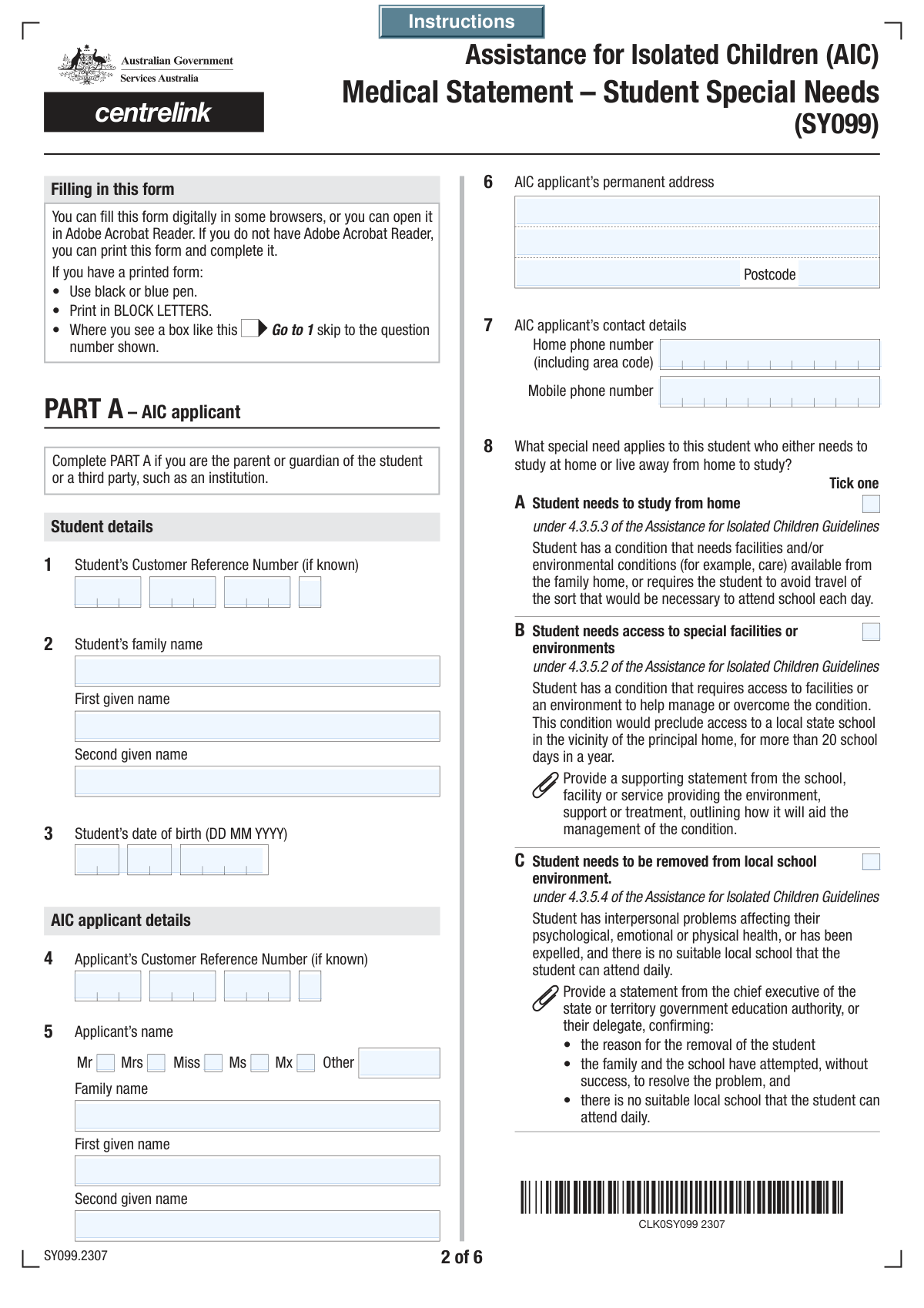
Form SY061 is the official Medical Statement for the Australian Government's Assistance for Isolated Children (AIC) Scheme. It is completed by a medical or allied health professional to document a student's health condition that prevents them from attending a local school, supporting a claim for financial assistance. This form is critical for verifying the medical grounds for needing alternative education arrangements, such as studying from home or living away from it. Today this form can be filled out quickly and accurately using AI-powered services like Instafill.ai, which can also convert non-fillable PDF versions into interactive fillable forms.
SY061 is part of the
Medi-Cal forms, medical assistance forms, medical forms, NJ state forms, PA state forms, state ID forms and VA medical forms categories on Instafill.
Our AI automatically handles information lookup, data retrieval, formatting, and form filling.
It takes less than a minute to fill out SY061 using our AI form filling.
Securely upload your data. Information is encrypted in transit and deleted immediately after the form is filled out.
Form specifications
| Form name: | Form SY061, Medical statement - Assistance for Isolated Children (AIC) Scheme |
| Number of fields: | 117 |
| Number of pages: | 6 |
| Filled form examples: | Form SY061 Examples |
| Language: | English |
Instafill Demo: How to fill out PDF forms in seconds with AI
How to Fill Out SY061 Online for Free in 2026
Are you looking to fill out a SY061 form online quickly and accurately? Instafill.ai offers the #1 AI-powered PDF filling software of 2026, allowing you to complete your SY061 form in just 37 seconds or less.
Follow these steps to fill out your SY061 form online using Instafill.ai:
- 1 Navigate to Instafill.ai and upload your SY061 PDF or find it in the form library.
- 2 The applicant provides their personal details and the student's information, including names, date of birth, and Customer Reference Numbers (CRN).
- 3 The designated medical practitioner or allied health professional enters their contact details, professional role, qualifications, and registration information.
- 4 The medical professional provides a detailed diagnosis, describes the condition's duration and treatment, and specifies the student's special educational needs.
- 5 The professional answers a series of questions to justify why the student cannot attend a local school, detailing the impact of the medical condition.
- 6 The applicant and the medical professional review all entered information for accuracy, sign the respective declarations, and date the form before submission.
Our AI-powered system ensures each field is filled out correctly, reducing errors and saving you time.
Why Choose Instafill.ai for Your Fillable SY061 Form?
Speed
Complete your SY061 in as little as 37 seconds.
Up-to-Date
Always use the latest 2026 SY061 form version.
Cost-effective
No need to hire expensive lawyers.
Accuracy
Our AI performs 10 compliance checks to ensure your form is error-free.
Security
Your personal information is protected with bank-level encryption.
Frequently Asked Questions About Form SY061
This form is used to gather information from an applicant and a medical professional about a student's special health needs. It helps determine if the student requires special educational arrangements, such as studying from home or living away from home to attend a suitable school.
The form is completed by two parties: the applicant (typically a parent or guardian) fills out their own and the student's details, and a medical professional (a doctor, specialist, or allied health professional) completes the detailed medical assessment sections.
A CRN is a unique identifier used by the processing authority. If you or the student do not have a CRN or do not know it, you can leave this section blank, as it is only required 'if known'.
The medical sections must be completed by a registered Medical Practitioner, Specialist, or a registered Allied Health Professional. They will need to provide their professional role, specialisation, and registration number.
Yes, a registered Allied Health Professional like a psychologist can complete the form. However, they will need to fill out the section explaining the 'exceptional circumstances' that led to the student being treated by them rather than a medical practitioner.
If the condition is temporary, the medical professional must indicate this and specify the initial expected duration of the condition. They also need to state the review period in months for when the student's condition will be reassessed.
This section is for the medical professional to note if any information in the report could be harmful to the student's well-being if released. If so, they must identify the specific information and justify why it should be withheld.
The 'Student' is the individual with the special need who requires the educational arrangement. The 'Applicant' is the person completing the application on their behalf, such as a parent or legal guardian.
The form itself does not specify required attachments, as the medical professional's detailed report serves as the primary evidence. However, you should be prepared to provide additional supporting documents if the reviewing authority requests them.
Yes, services like Instafill.ai use AI to auto-fill form fields accurately and save time. While AI can assist with applicant and student details, the medical diagnosis and professional opinion sections must be completed by the qualified medical professional.
You can upload the PDF of the form to the Instafill.ai website. The platform will make the form's fields fillable online, allowing you to type in your answers, save your progress, and easily share the form with the medical professional.
If you have a non-fillable or 'flat' PDF, you can use a service like Instafill.ai to convert it into an interactive, fillable form. This allows you to easily type your information directly into the fields on your computer.
Compliance SY061
Validation Checks by Instafill.ai
1
Applicant Name Completeness
Checks that the 'Family Name' and 'First Given Name' fields for the applicant are not empty. These fields are essential for identifying the person submitting the form and for official records. If this validation fails, the form submission should be blocked with an error message prompting the user to fill in the required name fields.
2
Student Date of Birth Validity
Validates that the 'Student's Date of Birth' is a real, past date in the correct format (e.g., DD/MM/YYYY). This prevents impossible dates, such as future dates or non-existent dates like February 30th, ensuring data accuracy for student records. A failed validation would require the user to correct the date before proceeding.
3
Applicant Title Selection Logic
Ensures that if a standard title ('Mr', 'Mrs', 'Miss', 'Ms', 'Mx') is selected, the 'Other Title' text field is empty, and vice-versa. This maintains data integrity by preventing contradictory information. If both a standard title and 'Other Title' are provided, an error should be displayed asking the user to choose only one option.
4
Applicant Declaration and Date Consistency
Verifies that if the 'I have read, understood and agree' checkbox is checked, the 'Declaration Date' field is also filled with a valid date. The date provided must be on or before the current submission date and not in the future. This is crucial for legal and compliance purposes, confirming when the declaration was made.
5
Medical Professional Phone Number Format
Checks that the phone number for the medical professional is exactly 10 digits and contains no spaces or special characters, as specified in the field instructions. This ensures the phone number is in a consistent, usable format for future contact. Submissions with incorrectly formatted numbers will be rejected until corrected.
6
Professional Role Exclusivity and Logic
Validates that only one of 'Medical Practitioner/Specialist' or 'Registered Allied Health Professional' is selected when a special need is indicated. This choice determines which subsequent sections of the form are relevant and required. Selecting both or neither would create ambiguity, so the form should halt and request the user to select only one role.
7
Conditional Specialisation Field Requirement
Ensures the 'Specialisation' field is filled out if the 'Medical Practitioner/Specialist' role is selected. This information is critical for understanding the professional's qualifications in relation to the student's condition. If the role is selected but the specialisation is missing, the form should prompt the user to provide this mandatory detail.
8
Temporary Condition Duration Details
Checks that if the 'Temporary' option is selected for the 'Expected Condition Duration', both the 'Initial Temporary Duration' and 'Review Period in Months' fields are filled. This ensures that temporary conditions have a clearly defined timeframe and review plan. The form will be considered incomplete if 'Temporary' is checked but these details are missing.
9
Exceptional Circumstances Justification
Validates that if 'Yes' is checked for 'Allied Health Professional Treatment Circumstances', the 'Details of Exceptional Circumstances' text area is not empty. This rule enforces the requirement to justify why an Allied Health Professional is involved instead of a medical specialist. The submission will be blocked without this required explanation.
10
Applicant Postcode Format
Validates that the 'Postcode' for the applicant's permanent address is in the correct local format (e.g., a 4-digit number). This ensures address data is accurate and can be used for mailing and location verification. An invalid format would trigger an error message asking for a valid postcode.
11
Withholding Medical Information Justification
Verifies that if 'Yes' is selected for 'Release of Medical Information', both the 'Information to Withhold Identifier' and 'Justification for Withholding Information' fields are completed. This is a critical privacy control to protect the student. The form must not be submitted without this explicit identification and justification if the user indicates information should be withheld.
12
Professional Declaration Requirement
Validates that if any 'Student's Special Need' is selected, the 'Professional Signature' and 'Declaration Date' in the Professional Declaration section are provided. This confirms that a qualified professional has reviewed and attested to the information regarding the student's condition. The form is invalid without this professional sign-off when a special need is claimed.
13
Student Name Completeness
Checks that the 'Family Name' and 'First Given Name' fields for the student are not empty. This is fundamental for identifying the student for whom the application is being made. If this validation fails, the form cannot be processed and an error will prompt the user for the required information.
14
Required Facilities Description Requirement
Ensures that if the 'Student needs access to special facilities or environments' special need is selected, the 'Required Facilities Description' field is not empty. This description is essential for the reviewing authority to understand the student's specific needs. The form submission should be blocked until this descriptive information is provided.
Common Mistakes in Completing SY061
The form distinctly asks for details for both the 'Student' and the 'Applicant'. A frequent error is for the applicant (e.g., a parent or guardian) to enter their own name, date of birth, or Customer Reference Number (CRN) in the fields designated for the student. This mistake causes identity confusion, leading to processing delays or rejection while the authorities request clarification. To avoid this, carefully read each field's label and double-check that student-specific information is entered in the 'Student' sections and applicant information is in the 'Applicant' sections.
This form contains complex conditional logic, with instructions like 'Fill only if...' or 'Go to Q22'. Users often miss these cues, either filling out sections that are irrelevant to their situation or skipping sections that are required. This results in an incomplete or confusing application that cannot be processed correctly. To prevent this, pay close attention to all instructions. AI-powered tools like Instafill.ai can make this easier by automatically showing or hiding relevant fields based on your answers, ensuring you complete the correct path through the form.
Many fields, such as 'Home Study Details' or 'Details of Exceptional Circumstances', require detailed explanations to justify the student's need for special arrangements. Applicants or medical professionals often provide brief, one-sentence answers that lack the specific detail required for assessment. This insufficiency forces evaluators to request more information, significantly delaying the application. Always provide thorough, specific, and comprehensive explanations in these narrative fields, directly addressing the question asked.
The form has separate, detailed sections for 'Medical Practitioner/Specialist' and 'Registered Allied Health Professional', each with its own set of questions. A common mistake is for the wrong type of professional to fill out the form, or for a professional to fill out the incorrect sections. For example, an Allied Health Professional might miss the requirement to justify why a medical specialist is not involved. This can invalidate the medical evidence provided. Ensure the correct professional completes the form and fills out only the sections relevant to their specific role.
The form requires specific formats for certain data, such as the Customer Reference Number (CRN) being split into four segments and the phone number being a '10 digit number with no spaces'. People often enter the full CRN in the first box or include spaces/hyphens in phone numbers. These formatting errors can cause data entry systems to reject the information, leading to processing failures. To avoid this, follow formatting instructions precisely. Using a tool like Instafill.ai can help by automatically formatting data into the correct structure as you type.
The form requires both an Applicant Declaration and a Professional Declaration, each with a checkbox, signature, and date. Forgetting to check the 'I have read, understood and agree' box or omitting a signature or date is one ofthe most common reasons for immediate rejection. An unsigned form is legally invalid. Always perform a final review of the entire form before submission, paying special attention to signature blocks and declaration sections to ensure they are fully completed.
The form uses numerous Yes/No questions that often require additional information if 'Yes' is selected. A frequent error is to check 'Yes' but then leave the corresponding detail field blank (e.g., checking 'Yes' for 'Exceptional Circumstances' but not explaining them). Another mistake is accidentally checking both 'Yes' and 'No' for the same question. Such inconsistencies make it impossible to process the application and will require follow-up. Carefully answer each question and ensure that if you select 'Yes', you provide the mandatory follow-up details.
Address fields are split into 'Address Line 1', 'Address Line 2', 'Suburb/Town and State', and 'Postcode'. Users often try to fit the entire address into the first line or incorrectly separate the suburb, state, and postcode. This can lead to failed mail delivery and communication breakdowns. To ensure accuracy, enter only the street number and name on Line 1, apartment or unit number on Line 2, and carefully separate the suburb/town, state, and postcode into their designated fields.
In the 'Release of Medical Information' section, a medical professional can indicate that releasing certain information may be harmful to the student. A critical mistake is checking 'Yes' to this question but then failing to clearly identify the specific information to be withheld and provide a compelling justification. Without this detail, the request to withhold is invalid and may be ignored, or it may halt the entire process pending clarification. The professional must be explicit in both identifying the sensitive data and explaining the potential harm.
The form's logic hinges on correctly identifying the student's primary special need (e.g., 'needs to study from home' vs. 'needs access to special facilities'). A common error is selecting one category but providing a justification that aligns with another, creating a logical conflict in the application. For instance, selecting 'needs to be removed from local school environment' but then only describing a medical condition that requires home-based equipment. Before filling out the detailed sections, carefully review the main categories to ensure your selection accurately reflects the student's core issue and that all subsequent answers support that choice.
Saved over 80 hours a year
“I was never sure if my IRS forms like W-9 were filled correctly. Now, I can complete the forms accurately without any external help.”
Kevin Martin Green
Your data stays secure with advanced protection from Instafill and our subprocessors

Robust compliance program
Transparent business model
You’re not the product. You always know where your data is and what it is processed for.
ISO 27001, HIPAA, and GDPR
Our subprocesses adhere to multiple compliance standards, including but not limited to ISO 27001, HIPAA, and GDPR.
Security & privacy by design
We consider security and privacy from the initial design phase of any new service or functionality. It’s not an afterthought, it’s built-in, including support for two-factor authentication (2FA) to further protect your account.
Fill out SY061 with Instafill.ai
Worried about filling PDFs wrong? Instafill securely fills form-sy061-medical-statement-assistance-for-isolated-children-aic-scheme forms, ensuring each field is accurate.



