
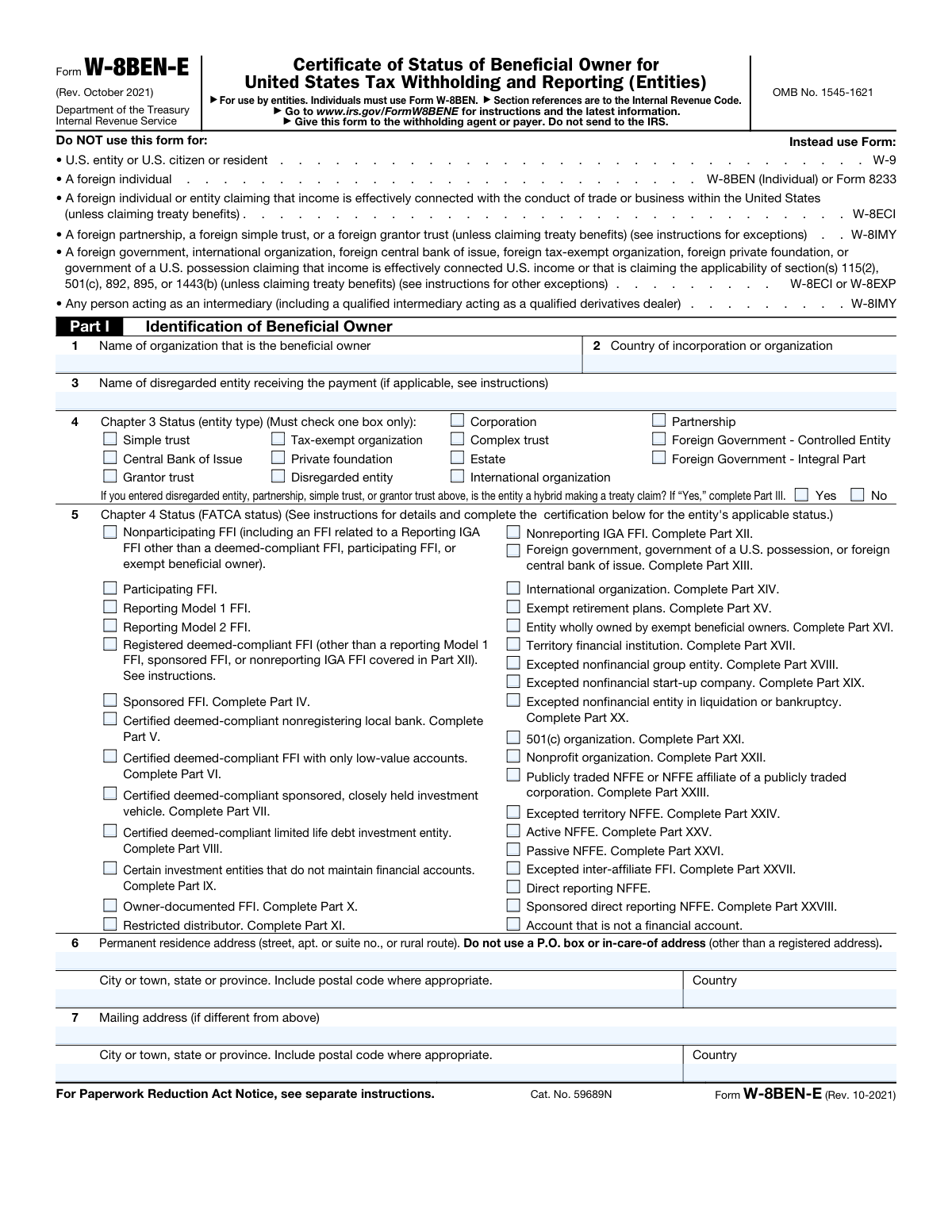
Yes! You can use AI to fill out Form W-8BEN-E, Certificate of Status of Beneficial Owner
Don't type 180 fields by hand. Tell our AI about yourself, or upload a document you already have, and it fills every field in seconds. You check it, then download, print or sign.
The AI does the filling. You just check it.
No typing into boxes, nothing to install.
What this form asks for
The AI fills all of it, from your answers or your documents.
The AI checks your answers before you download
18 checks built for this form, so a wrong date or a missing answer is caught before anyone else sees it.
Ensures that the 'Name of organization that is the beneficial owner' on line 1 is provided and accurately reflects the full legal name of the entity. This check is crucial to establish the identity of the beneficial owner and to prevent any discrepancies or legal issues that may arise from incorrect identification. The AI cross-references this information with official databases to confirm its validity and completeness. Any variations or abbreviations that do not match the legal name are flagged for review and correction.
Confirms that the 'Country of incorporation or organization' on line 2 is specified and corresponds to a recognized country. This validation is important for determining the jurisdiction and the applicable laws for the entity. The AI uses an up-to-date list of countries to ensure that the input is not only a real country but also correctly spelled and officially recognized. Any input that does not match a recognized country name is highlighted for further verification.
Verifies that the 'Name of disregarded entity receiving the payment' on line 3 is entered if applicable. This step is essential when a payment is made to an entity that is separate from the beneficial owner for tax purposes. The AI checks for the presence of this information when required and prompts for it if it is missing, ensuring compliance with tax regulations. If the disregarded entity is not applicable, the AI ensures that this field is left blank to avoid confusion.
Checks that one and only one 'Chapter 3 Status (entity type)' on line 4 is selected to indicate the entity's type for Chapter 3 purposes. This validation is key to determining the correct tax withholding and reporting obligations. The AI ensures that only one status is marked and that it is an appropriate selection for the entity in question. Any multiple selections or mismatches in entity type are flagged for correction.
Checks that one and only one 'Chapter 4 Status (FATCA status)' on line 5 is selected and the certification for the entity's applicable status is completed. This validation is integral to compliance with the Foreign Account Tax Compliance Act (FATCA) requirements. The AI ensures that the status chosen aligns with the entity's FATCA classification and that the corresponding certification section is duly filled out. Inconsistencies or incomplete certifications trigger an alert for further action.
Ensures that the 'Permanent residence address' on line 6 is a physical address. This validation check confirms that the address provided is not a P.O. box or an in-care-of address, which are not acceptable for the purposes of this form. It verifies the presence of a street name, number, city, and country to ensure completeness. The check is crucial for establishing the true residential status of the beneficial owner.
And 12 more checks
- Mailing address provision
- U.S. taxpayer identification number (TIN) accuracy
- Global Intermediary Identification Number (GIIN) entry
- Foreign TIN provision
- Reference Number Validation
- FATCA Status Verification
- Address Entry for Disregarded Entity or Branch
- GIIN Provision Check
- Tax Treaty Benefits Claim Validation
- Special rates and conditions validation
- FATCA status parts completion
- Certification signature verification
Let AI fill out your W-8BEN-E
No typing. Every field filled in seconds, checked, ready to sign.
How to Fill Out W-8BEN-E Online for Free in 2026
What the AI walks you through.
- Visit instafill.ai site and select W-8BEN-E.
- Enter the name of the organization.
- Provide country of incorporation.
- Fill in the address and taxpayer identification number.
- Complete the applicable status sections.
- Sign and date the form electronically.
- Check for accuracy and submit the form.
Common Mistakes in Completing W-8BEN-E
The ones the AI is built to catch.
Incomplete or incorrect name of the beneficial owner organization
Incorrect country of incorporation or organization
Leaving the field for the name of the disregarded entity receiving payment blank
Selecting more than one box for the entity type in Chapter 3 Status
Selecting more than one box for the entity's FATCA status in Chapter 4 Status
Incomplete or incorrect permanent residence address
Entering a P.O. box or in-care-of address as the permanent residence address
Failing to provide the U.S. taxpayer identification number (TIN) when required
Entering an incorrect or incomplete Global Intermediary Identification Number (GIIN)
Failing to complete the relevant parts according to the entity's FATCA status
Failure to sign and date the form by an authorized individual on behalf of the beneficial owner
Frequently Asked Questions About W-8BEN-E
Is it really free for 7 days?
Can I fill other forms too?
How do I cancel?
How does the AI fill out W-8BEN-E?
What happens to my information?
How complex is W-8BEN-E to fill out?
What is the purpose of the Certificate of Status of Beneficial Owner for United States Tax Withholding and Reporting (Entities) form (Form W-8BEN-E)?
Who should use Form W-8BEN-E?
What information is required in Part I of Form W-8BEN-E?
What is the difference between a participating FFI and a nonparticipating FFI?
What is the difference between a reporting Model 1 FFI and a reporting Model 2 FFI?
What is the difference between a registered deemed-compliant FFI and a certified deemed-compliant FFI?
What is the difference between a sponsored FFI and a certified deemed-compliant sponsored FFI?
What is the difference between a restricted distributor and a nonreporting IGA FFI?
What is the difference between a foreign government, government of a U.S. possession, or foreign central bank of issue and an international organization?
What is the difference between an exempt retirement plan and an entity wholly owned by exempt beneficial owners?
What is the difference between a territory financial institution and an excepted nonfinancial group entity?
What is the difference between an excepted nonfinancial start-up company and an excepted nonfinancial entity in liquidation or bankruptcy?
What is the difference between a 501(c) organization and a nonprofit organization?
What is the difference between a publicly traded NFFE or NFFE affiliate of a publicly traded corporation and an excepted territory NFFE?
What is the difference between an active NFFE and a passive NFFE?
What is the difference between a territory financial institution and an excepted nonfinancial entity?
What is the difference between an excepted inter-affiliate FFI and a sponsored direct reporting NFFE in the context of the Certificate of Status of Beneficial Owner (Form W-8BEN-E)?
What is the purpose of Part XXIX in Form W-8BEN-E?
What are the penalties for providing false information on Form W-8BEN-E?
Get your W-8BEN-E filled out by AI
$0 today. Cancel before Oct 31 and you pay nothing.
Other forms like this one
state tax forms: Form W-2, Wage and Tax Statement, Form W-8IMY (Rev. October 2021), Certificate of Foreign Intermediary, Foreign Flow-Through Entity, or Certain U.S. Branches for United States Tax Withholding and Reporting, Form W-2, Wage and Tax Statement (2025), Dealer’s Heavy Equipment Inventory Tax Statement (Form 50-266), Form W-8BEN-E, Certificate of Status of Beneficial Owner for United States Tax Withholding and Reporting (Entities), Colorado Form DR 0026, Tax Statement for Leased Motor Vehicle, Form W-2, Wage and Tax Statement, Form 706-NA, United States Estate (and Generation-Skipping Transfer) Tax Return Estate of Nonresident Not a Citizen of the United States, Form W-2, Wage and Tax Statement, Form 1310, Statement of Person Claiming Refund Due a Deceased Taxpayer, Form ST-120, New York State and Local Sales and Use Tax Resale Certificate, Form 1120-REIT, U.S. Income Tax Return for Real Estate Investment Trusts, State of Michigan, Form MC 52, Request and Writ for Garnishment (Income Tax Refund/Credit), Tax Court of New Jersey, State Tax Complaint, State Tax Case Information Statement (CIS-State), Form CN 10328, State Tax Complaint Packet, Tax Court of New Jersey Case Information Statement - Correction of Error in Assessment, Form 1041, U.S. Income Tax Return for Estates and Trusts (2023), Form 1041, U.S. Income Tax Return for Estates and Trusts (2025), Form 3911, Taxpayer Statement Regarding Refund (Rev. 10-2022)
PA state forms: Form 1095-A, Health Insurance Marketplace Statement, Form W-2, Wage and Tax Statement, Form 593, Real Estate Withholding, Form 8938, Statement of Specified Foreign Financial Assets, Form CMS-2567, Statement of Deficiencies, Form 1098, Mortgage Interest Statement, Form 1098-T, Tuition Statement, Form 1099-S, Proceeds From Real Estate Transactions, Form 1098-E, Student Loan Interest Statement, Form DS-3053, Statement of Consent, Form DS-86, Statement of Non-Receipt of a U.S. Passport, Form DS-86, Statement of Non-Receipt of a U.S. Passport, Form 108, Statement of Intention, Form 107, Statement of Financial Affairs, Form 121, Statement About Your SSNs, Form 122A-1, Chapter 7 Statement of Current Monthly Income, Center for Infertility & Reproductive Surgery – New Patient Questionnaire and Patient/Guarantor Statement (Brigham and Women’s Hospital, Department of Obstetrics and Gynecology), Adult Travel Document Application for Stateless and Protected Persons in Canada (16 years of age or over) (PPTC 190), Form W-8IMY (Rev. October 2021), Certificate of Foreign Intermediary, Foreign Flow-Through Entity, or Certain U.S. Branches for United States Tax Withholding and Reporting, Form W-2, Wage and Tax Statement (2025)
tax withholding forms: Form W-8BEN-E, Certificate of Status of Beneficial Owner for United States Tax Withholding and Reporting (Entities), Form 8288, U.S. Withholding Tax Return, Form W-8IMY (Rev. October 2021), Certificate of Foreign Intermediary, Foreign Flow-Through Entity, or Certain U.S. Branches for United States Tax Withholding and Reporting, Form W-4P (2026), Withholding Certificate for Periodic Pension or Annuity Payments, Form 8288, U.S. Withholding Tax Return for Certain Dispositions by Foreign Persons, Arizona Form A1-QRT, Arizona Quarterly Withholding Tax Return, Form SS-8, Determination of Worker Status, Form 4506-W, Request for Copy of Withholding Tax Forms
withholding forms: Excess Withdrawal Request and Form W-4R, Withholding Certificate for Nonperiodic Payments and Eligible Rollover Distributions, Form W-4, Employee's Withholding Certificate, Form 593, Real Estate Withholding, Form 8288, U.S. Withholding Tax Return, Form I-589, Application for Asylum and for Withholding of Removal, Form W-4P, Withholding Certificate, Form W-8IMY (Rev. October 2021), Certificate of Foreign Intermediary, Foreign Flow-Through Entity, or Certain U.S. Branches for United States Tax Withholding and Reporting, Form W-8BEN-E, Certificate of Status of Beneficial Owner for United States Tax Withholding and Reporting (Entities), Form W-4P (2026), Withholding Certificate for Periodic Pension or Annuity Payments, Form 8288, U.S. Withholding Tax Return for Certain Dispositions by Foreign Persons, Form W-4V, Voluntary Withholding Request, Arizona Form A1-QRT, Arizona Quarterly Withholding Tax Return, Form DE 4, Employee's Withholding Allowance Certificate, Form DE 4, Employee’s Withholding Allowance Certificate (Rev. 53), Form DE 4, Employee’s Withholding Allowance Certificate (Rev. 56), Form SS-8, Determination of Worker Status
NJ state forms: Form 1095-A, Health Insurance Marketplace Statement, Form W-2, Wage and Tax Statement, Form 593, Real Estate Withholding, Form 8938, Statement of Specified Foreign Financial Assets, Form CMS-2567, Statement of Deficiencies, Form 1098, Mortgage Interest Statement, Form 1098-T, Tuition Statement, Form 1099-S, Proceeds From Real Estate Transactions, Form 1098-E, Student Loan Interest Statement, Form DS-3053, Statement of Consent, Form DS-86, Statement of Non-Receipt of a U.S. Passport, Form DS-86, Statement of Non-Receipt of a U.S. Passport, Form 108, Statement of Intention, Form 107, Statement of Financial Affairs, Form 121, Statement About Your SSNs, Form 122A-1, Chapter 7 Statement of Current Monthly Income, Center for Infertility & Reproductive Surgery – New Patient Questionnaire and Patient/Guarantor Statement (Brigham and Women’s Hospital, Department of Obstetrics and Gynecology), Adult Travel Document Application for Stateless and Protected Persons in Canada (16 years of age or over) (PPTC 190), Form W-8IMY (Rev. October 2021), Certificate of Foreign Intermediary, Foreign Flow-Through Entity, or Certain U.S. Branches for United States Tax Withholding and Reporting, Form W-2, Wage and Tax Statement (2025)
state ID forms: Application for Renewal or Duplicate of Alabama Driver License or ID card, Form 1095-A, Health Insurance Marketplace Statement, Form W-2, Wage and Tax Statement, Form 593, Real Estate Withholding, Form 8938, Statement of Specified Foreign Financial Assets, Form CMS-2567, Statement of Deficiencies, Form 1098, Mortgage Interest Statement, Form 1098-T, Tuition Statement, Form 1099-S, Proceeds From Real Estate Transactions, Form 1098-E, Student Loan Interest Statement, Form DS-3053, Statement of Consent, Form DS-86, Statement of Non-Receipt of a U.S. Passport, Form 108, Statement of Intention, Form 107, Statement of Financial Affairs, Form 121, Statement About Your SSNs, Form 122A-1, Chapter 7 Statement of Current Monthly Income, Center for Infertility & Reproductive Surgery – New Patient Questionnaire and Patient/Guarantor Statement (Brigham and Women’s Hospital, Department of Obstetrics and Gynecology), Adult Travel Document Application for Stateless and Protected Persons in Canada (16 years of age or over) (PPTC 190), Form W-8IMY (Rev. October 2021), Certificate of Foreign Intermediary, Foreign Flow-Through Entity, or Certain U.S. Branches for United States Tax Withholding and Reporting, Form W-2, Wage and Tax Statement (2025)
reporting forms: Central Registry Reporting Form, Form W-8IMY (Rev. October 2021), Certificate of Foreign Intermediary, Foreign Flow-Through Entity, or Certain U.S. Branches for United States Tax Withholding and Reporting, Form W-8BEN-E, Certificate of Status of Beneficial Owner for United States Tax Withholding and Reporting (Entities), Fidelity NetBenefits Auditor's Guide: An Overview of Fidelity's 2024 Plan Year Reporting Package, Selbstauskunft für Unternehmen und Organisationen U.S. Foreign Account Tax Compliance Act (FATCA) und Common Reporting Standard (CRS) der OECD, DHCS 7107, Provider Preventable Conditions (PPC) Reporting Form, Toronto Hydro Data Request Form: Reporting Energy Consumption
Let AI fill out your W-8BEN-E
Your trial starts once a card is added. You pay nothing before Oct 31.
Our AI already knows this form, all 180 fields of it. Skip the typing: tell it about yourself, or upload what you have, and it fills the whole form in seconds.
- AI fills every field on all 8 pages, tables and checkboxes included
- No typing into boxes: answer a few questions, or upload a document you already have, an old copy of this form, a photo of a document
- The AI checks the answers; you review and change anything before you download
- Download the finished PDF, print it, or sign it online
- Encrypted, and never used to train AI
Cancel before Oct 31 and you pay nothing.
A card is needed to start the trial. Cancel in two clicks from your account.
Terms · Privacy