Yes! You can use AI to fill out Order on Claim of Interest on Vehicle Seized for Forfeiture
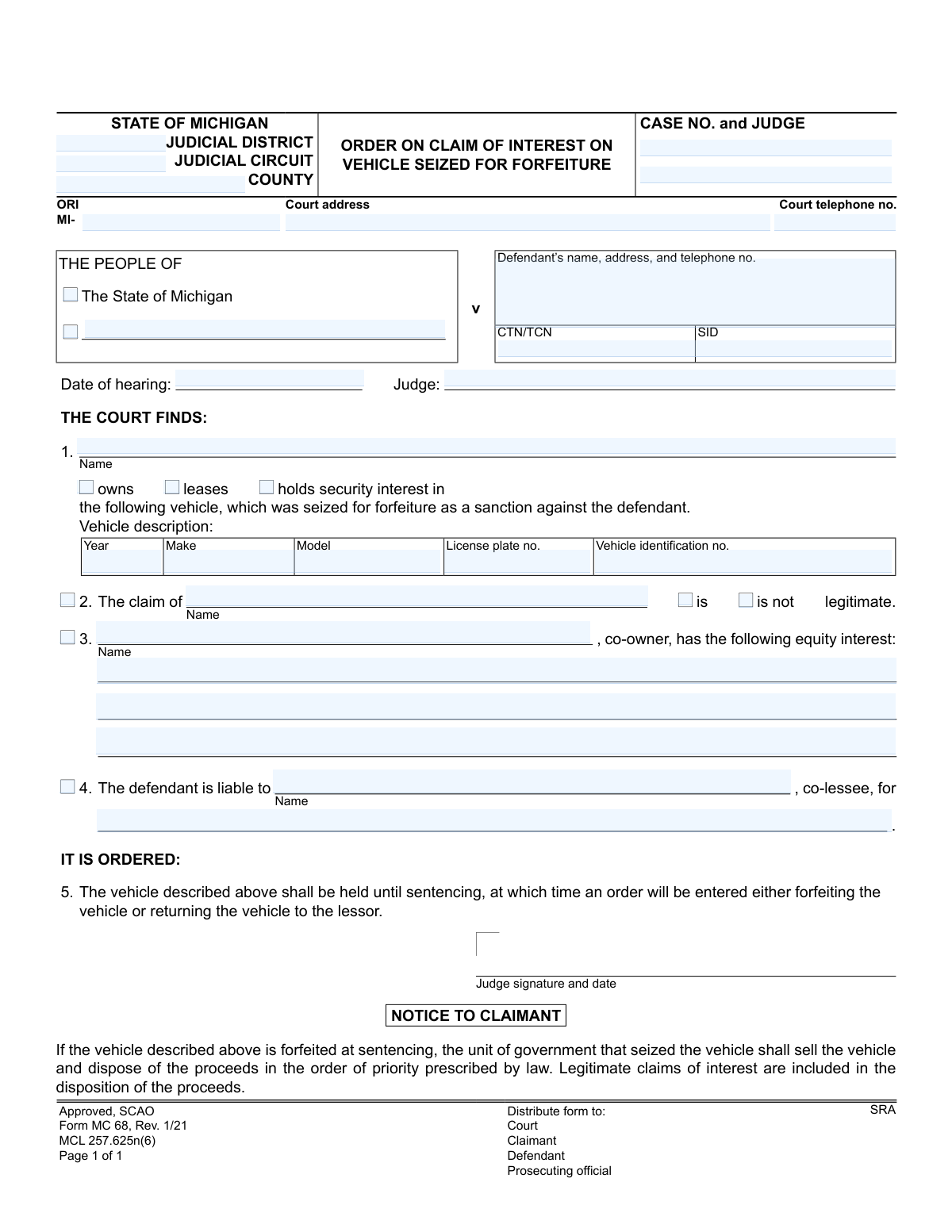
This is a judicial form from the State of Michigan, specifically Form MC 68, titled "Order on Claim of Interest on Vehicle Seized for Forfeiture." It is used by a judge to document a court's findings and ruling on a claim made by an individual or entity (the claimant) who has an ownership, lease, or security interest in a vehicle that has been seized from a defendant. The order determines the legitimacy of the claim and dictates the subsequent actions regarding the vehicle. Today, this form can be filled out quickly and accurately using AI-powered services like Instafill.ai, which can also convert non-fillable PDF versions into interactive fillable forms.
Our AI automatically handles information lookup, data retrieval, formatting, and form filling.
It takes less than a minute to fill out MC 68 using our AI form filling.
Securely upload your data. Information is encrypted in transit and deleted immediately after the form is filled out.
Form specifications
| Form name: | Order on Claim of Interest on Vehicle Seized for Forfeiture |
| Number of fields: | 37 |
| Number of pages: | 1 |
| Language: | English |
More forms in Court claim forms
Instafill Demo: How to fill out PDF forms in seconds with AI
How to Fill Out MC 68 Online for Free in 2026
Are you looking to fill out a MC 68 form online quickly and accurately? Instafill.ai offers the #1 AI-powered PDF filling software of 2026, allowing you to complete your MC 68 form in just 37 seconds or less.
Follow these steps to fill out your MC 68 form online using Instafill.ai:
- 1 Navigate to Instafill.ai and upload or select the MC 68 form.
- 2 Provide the court and case information, including the judicial district, county, case number, and judge's name.
- 3 Enter the defendant's information and identify the claimant and their type of interest in the vehicle (owner, lessor, or security interest holder).
- 4 Input the detailed description of the seized vehicle, including its year, make, model, license plate number, and VIN.
- 5 Use the AI assistant to accurately populate the court's findings, such as the legitimacy of the claim and any equity interest or liability amounts.
- 6 Review all the auto-filled information for correctness before the judge signs and dates the order.
- 7 Download the completed form for printing and distribution to the court, claimant, defendant, and prosecuting official as required.
Our AI-powered system ensures each field is filled out correctly, reducing errors and saving you time.
Why Choose Instafill.ai for Your Fillable MC 68 Form?
Speed
Complete your MC 68 in as little as 37 seconds.
Up-to-Date
Always use the latest 2026 MC 68 form version.
Cost-effective
No need to hire expensive lawyers.
Accuracy
Our AI performs 10 compliance checks to ensure your form is error-free.
Security
Your personal information is protected with bank-level encryption.
Frequently Asked Questions About Form MC 68
This document is a court order issued by a judge, not a form for you to fill out. It officially states the court's decision regarding a third party's claim of ownership or financial interest in a vehicle that was seized.
You likely received this because you are the claimant who asserted an interest, the defendant from whom the vehicle was seized, or a legal official involved in the case. The order informs all parties of the judge's ruling.
This form is an official court order that is completed and signed by a judge. It is the result of a hearing or a claim that was previously filed with the court.
This is a positive outcome, indicating that the court has formally recognized your legal ownership, lease, or financial stake (like a car loan) in the seized vehicle.
This means the vehicle will remain in the custody of the seizing government agency until the defendant's criminal case is resolved. The final decision to return or permanently forfeit the vehicle will be made at the sentencing hearing.
If forfeited, the government agency will sell the vehicle. The proceeds from the sale are then used to pay off any legitimate claims of interest, such as yours, according to the priority established by law.
This section details the specific financial value or percentage of ownership that the court recognizes as belonging to you. This figure is crucial for determining what compensation you may receive if the vehicle is sold.
The order must contain all relevant case details, including the court, case number, and judge, as well as a full description of the vehicle, the claimant's information, and the judge's specific findings.
Yes, for filling out the initial claim or other related legal documents, AI-powered services like Instafill.ai can be very useful. They help auto-fill form fields accurately, which saves time and helps prevent errors.
With Instafill.ai, you upload your form, and its AI technology identifies the fields for you to fill out. You can then complete the document online and save, print, or share the finished version.
Services like Instafill.ai can convert flat, non-fillable PDFs into interactive, fillable forms. This allows you to type your information directly into the fields on your computer, making the process much easier.
Read the order carefully to understand the judge's decision regarding your claim. Keep this document for your records and await the defendant's sentencing for the final outcome concerning the vehicle.
The claimant is the person, bank, or company that filed a legal claim with the court. They are asserting a right of ownership, a lease agreement, or a security interest in the vehicle that was seized from the defendant.
Compliance MC 68
Validation Checks by Instafill.ai
1
Case Number Format and Completeness
This check ensures the 'Case no.' field is not empty and conforms to the standard Michigan court case number format (e.g., YY-######-XX). This is critical for uniquely identifying the case within the judicial system and linking the order to the correct court file. A failure would prevent the document from being correctly filed and processed.
2
Vehicle Identification Number (VIN) Structure
Validates that the 'Vehicle identification no.' is a standard 17-character alphanumeric string, excluding the letters I, O, and Q. The VIN is a unique identifier for the vehicle, and an incorrect VIN could lead to ambiguity about the asset being forfeited. This check prevents data entry errors and ensures the correct vehicle is subject to the order.
3
Hearing Date Logicality
Ensures the 'Date of hearing' is a valid, non-future date. Since this is an order resulting from a hearing, the hearing must have already occurred. This prevents logical impossibilities in the court record and ensures the timeline of events is accurate. An invalid or future date would be rejected.
4
Claim Type Selection Requirement
This validation verifies that exactly one of the claim type checkboxes ('owns', 'leases', 'holds security interest') is selected in section 1. The nature of the claimant's interest is a fundamental finding required by the form. Failure to select a claim type would make the order incomplete and legally insufficient.
5
Claim Legitimacy Finding Selection
Ensures that one, and only one, of the mutually exclusive options ('is legitimate' or 'is not legitimate') is selected in section 2. This is the core finding of the court regarding the claim. An order without this determination is incomplete and cannot be executed, so the form submission would be blocked until a choice is made.
6
Claimant Name Consistency Across Sections
Verifies that the claimant's name entered in section 1 is consistent with the name referenced in sections 2, 3, and 4. This maintains the internal consistency and integrity of the legal document. Inconsistencies could create legal ambiguity about who the order applies to, requiring correction before processing.
7
Vehicle Year Validity
Checks that the 'Vehicle year' is a valid 4-digit number within a reasonable range (e.g., 1950 to the current year plus one). This simple check prevents typographical errors and ensures the vehicle description is accurate. An illogical year, such as '12' or '3000', would trigger an error and require correction.
8
ORI Number Format
Validates that the 'ORI MI-' field follows the expected format for a Michigan Originating Agency Identifier, which is typically 'MI' followed by a specific code. This identifier is crucial for routing information to the correct law enforcement agency. An improperly formatted ORI could cause processing delays or miscommunication between agencies.
9
Required Case Header Information
This check confirms that essential case identification fields, including 'Judicial District', 'County', and 'Judge', are not left blank. This information is mandatory for docketing the order and ensuring it is attributed to the correct jurisdiction and judicial officer. The form would be considered incomplete and rejected if this information is missing.
10
Conditional Equity Interest Details
If a 'Co-owner name' is entered in section 3, this validation ensures that the corresponding 'equity interest' text box is also filled with details. It prevents an incomplete entry where a co-owner is identified but their interest is not described. The system would prompt the user to provide the equity details before proceeding.
11
Conditional Co-Lessee Liability Details
If a 'Co-Lessee Name' is entered in section 4, this validation checks that the 'liable for' text box contains a description of the defendant's liability. This ensures that if a co-lessee is mentioned, the nature of the liability is also clearly documented as required by the form's structure. A warning or error would be shown if the liability description is missing.
12
Order Date and Judge Signature Validation
Confirms that the date next to the judge's signature is present and is on or after the specified 'Date of hearing'. This ensures a logical sequence of events, as the order cannot be signed before the hearing takes place. It also serves as a completeness check for the judge's final action on the document.
13
Completeness of Vehicle Description
Ensures all fields under 'Vehicle description' ('Year', 'Make', 'Model', 'License plate no.', 'VIN') are filled out. A complete and unambiguous description of the vehicle is paramount to the order's function. Missing any of these key identifiers could render the order unenforceable, so this check requires all fields to be completed.
14
Court Telephone Number Format
Validates that the 'Court telephone no.' field contains a number that conforms to a standard North American phone number format (e.g., 10 digits, with optional formatting). This ensures that the contact information for the court is usable and accurate. An invalid format would prompt the user for correction to ensure data quality.
Common Mistakes in Completing MC 68
The 17-character VIN is long and complex, making it easy to transpose numbers or letters during manual data entry. An incorrect VIN can lead to the wrong vehicle being identified, causing significant delays or even the dismissal of the claim, as it's the primary unique identifier. To avoid this, carefully double-check the VIN against the vehicle's title and registration; AI-powered tools like Instafill.ai can also validate the VIN format and checksum to catch errors instantly.
Fields like 'Case No.', 'Judicial District/Circuit', and 'Judge' are often filled incorrectly or left partially blank. This usually occurs when referencing other documents incorrectly or not having the precise information. Incorrect case information can cause the order to be misfiled, delayed, or rejected by the court clerk, preventing it from being associated with the correct legal proceeding.
Claimants may not understand the legal distinction between owning, leasing, or holding a security interest (like a bank loan) and may check the wrong box. This misrepresentation can weaken the claim's legitimacy and lead to its denial, as the legal remedy depends on the specific type of interest held. It's crucial to consult the vehicle's title, lease agreement, or loan documents to select the correct option.
People sometimes use nicknames, initials, or an incomplete version of their full legal name in the 'Name' fields. This creates a mismatch with official records like the vehicle title or loan agreement, which can jeopardize the claim. The court requires the full legal name of the individual or business entity to establish a clear chain of interest, so always use the exact name as it appears on legal documents.
In sections 3 and 4, claimants are asked to specify an 'equity interest' or the amount the defendant is 'liable for'. Many people write vague terms like 'half' or 'the remaining payments' instead of providing a precise dollar amount. This lack of specificity forces the court to guess or requires further hearings, delaying the outcome. To avoid this, provide a clear, calculated monetary value based on financial records.
Fields like 'ORI', 'CTN/TCN', and 'SID' are crucial for internal tracking by the court and law enforcement agencies. A claimant or their representative might not know what these numbers are and leave them blank. While the court clerk may be able to look them up, their absence can slow down processing and filing. These numbers should be copied carefully from the original seizure notice or other official case documents.
The form has separate sections for a 'co-owner' (Section 3) and a 'co-lessee' (Section 4). Claimants often get these terms mixed up, filling out the wrong section or misrepresenting their relationship to the defendant and the vehicle. This error can lead to an incorrect legal finding regarding liability and interest. Carefully review the vehicle's title or lease agreement to determine the correct status before filling out the form.
This form is often available as a flat PDF, leading people to print and fill it out by hand. Poor handwriting can make critical information like the VIN, case number, or names unreadable, leading to data entry errors by court staff and potential rejection. Using a tool like Instafill.ai can convert a non-fillable PDF into an interactive, fillable version, ensuring all entries are typed, legible, and properly formatted.
Beyond the VIN, fields like 'Year', 'Make', 'Model', and 'License plate no.' are sometimes left blank or filled with generic information. This can happen if the claimant doesn't have all the details readily available. An incomplete description can create ambiguity and slow down the process, as the court and seizing agency need to be certain they are dealing with the correct asset.
Saved over 80 hours a year
“I was never sure if my IRS forms like W-9 were filled correctly. Now, I can complete the forms accurately without any external help.”
Kevin Martin Green
Your data stays secure with advanced protection from Instafill and our subprocessors

Robust compliance program
Transparent business model
You’re not the product. You always know where your data is and what it is processed for.
ISO 27001, HIPAA, and GDPR
Our subprocesses adhere to multiple compliance standards, including but not limited to ISO 27001, HIPAA, and GDPR.
Security & privacy by design
We consider security and privacy from the initial design phase of any new service or functionality. It’s not an afterthought, it’s built-in, including support for two-factor authentication (2FA) to further protect your account.
Fill out MC 68 with Instafill.ai
Worried about filling PDFs wrong? Instafill securely fills order-on-claim-of-interest-on-vehicle-seized-for-forfeiture forms, ensuring each field is accurate.