Yes! You can use AI to fill out Selbstauskunft zur steuerlichen Ansässigkeit (Natürliche Person) / Self-declaration of Tax Residency (Natural Person)

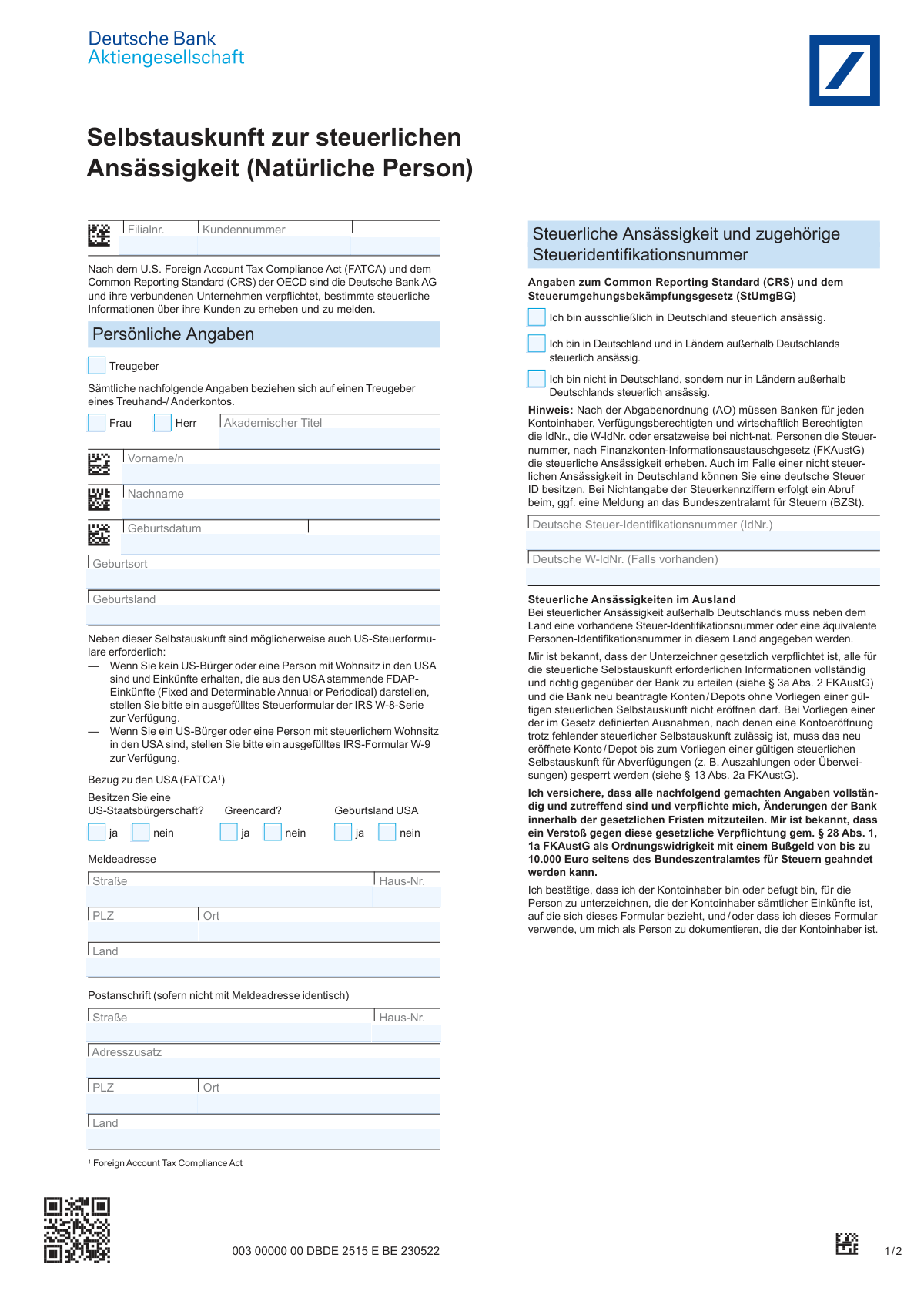
This form, the 'Self-declaration of Tax Residency (Natural Person)', is used by German banks like Deutsche Bank to collect tax residency information from individual clients. It is essential for complying with international tax information exchange agreements, such as the Common Reporting Standard (CRS) and the Foreign Account Tax Compliance Act (FATCA), to prevent tax evasion. Today, this form can be filled out quickly and accurately using AI-powered services like Instafill.ai, which can also convert non-fillable PDF versions into interactive fillable forms.
Our AI automatically handles information lookup, data retrieval, formatting, and form filling.
It takes less than a minute to fill out Deutsche Bank CRS Self-Certification using our AI form filling.
Securely upload your data. Information is encrypted in transit and deleted immediately after the form is filled out.

Form specifications

Form name: Selbstauskunft zur steuerlichen Ansässigkeit (Natürliche Person) / Self-declaration of Tax Residency (Natural Person)
Number of pages: 2
Language: English
main-image

Instafill Demo: How to fill out PDF forms in seconds with AI

How to Fill Out Deutsche Bank CRS Self-Certification Online for Free in 2026

Are you looking to fill out a DEUTSCHE BANK CRS SELF-CERTIFICATION form online quickly and accurately? Instafill.ai offers the #1 AI-powered PDF filling software of 2026, allowing you to complete your DEUTSCHE BANK CRS SELF-CERTIFICATION form in just 37 seconds or less.
Follow these steps to fill out your DEUTSCHE BANK CRS SELF-CERTIFICATION form online using Instafill.ai:
  1. 1 Navigate to Instafill.ai and upload or select the 'Selbstauskunft zur steuerlichen Ansässigkeit' form.
  2. 2 Provide your personal information, including your full name, academic title, date of birth, and place of birth.
  3. 3 Enter your complete registered address (Meldeadresse) and your mailing address (Postanschrift) if it is different.
  4. 4 Declare your tax residency status by checking the appropriate box (e.g., exclusively in Germany, in Germany and abroad, or only abroad) and provide your German Tax ID (IdNr.).
  5. 5 If you are a tax resident in countries other than Germany, list each country and your corresponding Taxpayer Identification Number (TIN) for that country.
  6. 6 Answer the questions regarding your connection to the USA for FATCA purposes, including U.S. citizenship, Green Card status, and U.S. birthplace.
  7. 7 Carefully review all the entered information for accuracy, then digitally or physically sign and date the form to certify your declaration.

Our AI-powered system ensures each field is filled out correctly, reducing errors and saving you time.

Why Choose Instafill.ai for Your Fillable Deutsche Bank CRS Self-Certification Form?

Speed

Complete your Deutsche Bank CRS Self-Certification in as little as 37 seconds.

Up-to-Date

Always use the latest 2026 Deutsche Bank CRS Self-Certification form version.

Cost-effective

No need to hire expensive lawyers.

Accuracy

Our AI performs 10 compliance checks to ensure your form is error-free.

Security

Your personal information is protected with bank-level encryption.

Frequently Asked Questions About Form Deutsche Bank CRS Self-Certification

This form is a self-declaration of your tax residency status, which banks are legally required to collect under international agreements like the Common Reporting Standard (CRS) and FATCA. It helps determine if your account information needs to be reported to tax authorities to prevent tax evasion.

Any individual who is an account holder, an authorized signatory, or a beneficial owner of an account must complete this form. It is necessary for both opening new accounts and for existing customers.

The 'IdNr.' is your unique 11-digit personal tax identification number in Germany. You can find it on your annual income tax assessment ('Einkommensteuerbescheid') or on the official letter you received from the Federal Central Tax Office (BZSt).

You must check the box indicating you are tax resident in Germany and/or countries outside Germany. Then, you need to list each country of tax residency and provide the corresponding Tax Identification Number (TIN) for each one.

A TIN is a Tax Identification Number issued by a country's tax authority. If you don't have a TIN for a specific country, the form allows you to select a reason (A, B, or C) explaining why, for example, if that country does not issue TINs.

The bank cannot open a new account for you without a valid self-declaration. For existing accounts, failure to provide this information may result in your account being reported to the tax authorities and potentially being blocked for withdrawals or transfers.

You must truthfully answer the questions regarding US citizenship, Greencard status, and US birthplace. Being born in the US may require you to provide additional US tax forms, like a W-9 or W-8, to the bank.

Yes, knowingly providing false or incomplete information is a regulatory offense in Germany. It can be punished with a fine of up to €10,000 by the Federal Central Tax Office (BZSt).

The 'Meldeadresse' is your official address registered with the local authorities. You only need to fill out the 'Postanschrift' (mailing address) section if you receive your mail at a different address.

You need this additional form if you are tax resident in one of the specific countries listed (e.g., UAE, Malta, Cyprus) but were not born there. These are countries identified by the OECD as having Citizenship/Residence by Investment (CBI/RBI) schemes.

Yes, services like Instafill.ai use AI to accurately auto-fill form fields with your saved personal data, which saves time and helps prevent errors. This is useful for filling in your name, address, and tax numbers.

Simply upload the PDF of the form to the Instafill.ai platform. The service will make the fields interactive, allowing you to type in your information, and then you can download the completed document to be signed and submitted.

You can use a tool like Instafill.ai, which is designed to convert non-fillable PDFs into interactive forms. This allows you to easily type your information into the correct fields on your computer instead of printing and writing by hand.

Compliance Deutsche Bank CRS Self-Certification
Validation Checks by Instafill.ai

1
Exclusive Tax Residency Status Selection
This check ensures that exactly one of the three tax residency options ('Exclusively in Germany', 'In Germany and abroad', 'Only abroad') is selected. This choice is fundamental as it determines which other fields, such as foreign tax information, become mandatory. If none or more than one option is selected, the form is ambiguous and cannot be processed correctly.
2
German Tax ID (IdNr.) Format and Structure
Validates that the provided German Tax Identification Number (IdNr.) consists of exactly 11 digits and adheres to the official structure, which includes a checksum. This is crucial for ensuring the number is structurally valid and can be successfully processed by the German Federal Central Tax Office (BZSt). An invalid IdNr. will lead to data rejection and reporting failures.
3
Conditional Requirement for Foreign Tax Residency Details
This check ensures that if the user declares tax residency outside of Germany (either in addition to or instead of German residency), they must provide details for at least one foreign country. This includes the country name and its corresponding Tax Identification Number (TIN) or a valid reason for its absence. Failure to provide this information renders the self-declaration incomplete under CRS regulations.
4
Ensures Foreign TIN or Valid Reason is Provided
For every foreign tax residency country listed, this validation verifies that the corresponding TIN field is not empty. The field must contain either the actual Tax Identification Number (TIN) or one of the permitted reason codes (A, B, or C) explaining its absence. This is a strict requirement of the CRS standard to ensure complete and actionable data is collected for international tax information exchange.
5
Date of Birth Plausibility and Format
Verifies that the 'Date of Birth' is a valid, correctly formatted date that occurs in the past. It should also perform a plausibility check to ensure the individual is of legal age to open an account, typically 18 years or older. An invalid or future date of birth would render the form invalid and prevent account opening, as age verification is a key legal requirement.
6
Completeness of Personal Identification Data
This check ensures that all mandatory personal identification fields—specifically First Name(s), Last Name, Date of Birth, Place of Birth, and Country of Birth—are completed. This information is fundamental for uniquely identifying the individual as required by Know Your Customer (KYC) and anti-money laundering (AML) regulations. Incomplete data will prevent the bank from establishing the customer's identity.
7
Registered Address (Meldeadresse) Completeness
Validates that all components of the registered address (Meldeadresse), including Street, House Number, Postal Code, City, and Country, are filled in. A complete and valid registered address is a legal requirement for customer identification and for sending official correspondence. Missing address components will result in an incomplete application and prevent the form from being processed.
8
Logical Consistency of FATCA Indicators
This validation checks for logical consistency between the answers to the FATCA-related questions. For instance, if the user indicates their 'Birth country is USA' is 'Yes', but 'US citizenship' is 'No', a warning should be triggered to prompt a review, as this is an uncommon scenario. This helps prevent accidental misstatements that could lead to incorrect FATCA classification and reporting.
9
Mandatory German Tax ID for German Residents
This rule enforces that the 'German Tax Identification Number (IdNr.)' field must be completed if the user selects 'Exclusively in Germany' or 'In Germany and in countries outside Germany' as their tax residency status. The IdNr. is the primary identifier for tax reporting to German authorities. Omitting it when declaring German tax residency would make the form non-compliant with the FKAustG.
10
Completeness of all FATCA Questions
This validation ensures that a 'Yes' or 'No' response is provided for all three FATCA-related questions: 'US citizenship', 'Greencard', and 'Birth country is USA'. A definitive answer to each question is mandatory for the bank to correctly determine the customer's US person status under FATCA regulations. Any missing answer makes the FATCA classification incomplete and non-compliant.
11
Country-Specific Postal Code Format
This check validates that the format of the 'PLZ' (Postal Code) is appropriate for the selected 'Land' (Country) in both the registered and mailing addresses. For example, if the country is Germany, the postal code must be a 5-digit number. This ensures address data is accurate and deliverable, which is critical for both communication and compliance with address verification rules.
12
Signature Date and Place Completion
Verifies that both the 'Datum' (Date) and 'Ort' (Place) fields in the signature section are completed. The signature date and place are legally required to attest to when and where the declaration was made. An unsigned or undated form is legally invalid and cannot be accepted by the bank.
13
CBI/RBI Scheme Additional Form Notification
This check identifies a specific high-risk scenario under CRS rules. If a user declares tax residency in a country known for a Citizenship/Residence by Investment (CBI/RBI) scheme (e.g., Malta, UAE, Cyprus) but their 'Country of Birth' is different, the system should trigger a notification. This informs the user or bank employee that the 'Erweiterte Sorgfaltspflichtprüfung CBI/RBI' form is also required, as mandated by OECD guidelines.

Common Mistakes in Completing Deutsche Bank CRS Self-Certification

Misinterpreting Tax Residency Status

Applicants often confuse tax residency with citizenship or physical presence, leading them to select the wrong checkbox (e.g., 'exclusively in Germany' when they have tax obligations elsewhere). Tax residency is a legal status determined by specific criteria in each country, such as the location of one's permanent home or center of vital interests. This mistake can lead to incorrect reporting to tax authorities, potential fines for the applicant, and significant delays in account opening. To avoid this, carefully evaluate your ties to all countries where you have lived or earned income, and consult a tax advisor if unsure.

Omitting or Mismatching the German Tax ID (IdNr.)

The 11-digit German Tax Identification Number (IdNr.) is frequently left blank, or an incorrect number like the old 'Steuernummer' is entered. The form explicitly states this number is mandatory for account holders. Failure to provide the correct IdNr. forces the bank to request it from the Federal Central Tax Office (BZSt), which delays the application process and can lead to the account being temporarily frozen. Always locate your IdNr. on official documents like a tax assessment notice ('Steuerbescheid') and double-check it for accuracy before entering.

Failing to Provide Foreign TINs

A very common error is checking the box for tax residency outside of Germany but then failing to provide the corresponding Tax Identification Number (TIN) for each country listed. The form is considered incomplete without this information. This will prevent the bank from opening the account or may result in the freezing of an existing account until a valid self-certification is provided. To prevent this, research the correct TIN for each country of tax residency before filling out the form. AI-powered tools like Instafill.ai can help by validating the format of TINs for many countries.

Incorrectly Answering US Status Questions (FATCA)

Applicants with ties to the United States, such as being born there or holding a Green Card, sometimes incorrectly answer 'no' to the FATCA questions. They may not realize that under US law, they are considered a 'US Person' for tax purposes, even if they live abroad and are citizens of another country. This is a serious error that can lead to non-compliance with FATCA, resulting in significant penalties. It's crucial to answer these questions accurately and, if applicable, provide the required IRS W-9 or W-8 form.

Improper Use of TIN Unavailability Reasons

When a foreign TIN is not provided, the form requires a reason (A, B, or C). Applicants often select a reason incorrectly, for example, choosing 'Reason C' (TIN not required) for a country that does, in fact, issue TINs. Using 'Reason B' (unable to obtain TIN) without providing the mandatory written explanation is also a frequent mistake. This leads to the form being rejected and requires clarification, delaying the entire process. These reasons should only be used after verifying the specific rules of the relevant tax authority.

Entering a Name That Doesn't Match Official ID

People sometimes enter a nickname, an abbreviated first name, or omit a middle name that is part of their legal name. The name on this form must exactly match the name on the official identification (e.g., passport, national ID card) that will be used for verification. Any discrepancy can cause the application to fail the bank's Know Your Customer (KYC) checks, leading to rejection and the need to resubmit the form. Always copy your full, legal name directly from your ID.

Confusing 'Meldeadresse' and 'Postanschrift'

Applicants may not understand the distinction between the 'Meldeadresse' (official registered address) and the 'Postanschrift' (mailing address). They might enter their current mailing address in the 'Meldeadresse' field or forget to fill out the 'Postanschrift' section when it differs from their registered address. This can cause official correspondence and sensitive documents to be sent to the wrong location. The 'Meldeadresse' must be the address registered with the local authorities ('Einwohnermeldeamt').

Forgetting to Sign and Date the Form

An unsigned or undated form is legally invalid. This simple but critical oversight is one of the most common reasons for a form to be immediately rejected. Applicants often focus on the complex details and forget to complete the signature block on the final page. This mistake requires the entire form to be sent back and resubmitted, causing significant and unnecessary delays in account opening or updates. Always perform a final check for the signature, date, and place of signature before submission.

Ignoring Conditional Form Requirements

The form contains several conditional requirements that are easily missed. For example, if you indicate US tax residency, you must also provide a W-9 form. If you are tax resident in certain 'CBI/RBI' countries (like Malta or the UAE) but not born there, you must submit an additional form. People often overlook these notes, leading to an incomplete application package. This results in follow-up requests from the bank and stalls the process. Reading all fine print and notes is essential to avoid this. Since this form is a non-fillable PDF, a tool like Instafill.ai can convert it into an interactive, fillable version that can guide users through these conditional steps.
Saved over 80 hours a year

“I was never sure if my IRS forms like W-9 were filled correctly. Now, I can complete the forms accurately without any external help.”

Kevin Martin Green

Your data stays secure with advanced protection from Instafill and our subprocessors

Robust compliance program

Transparent business model

You’re not the product. You always know where your data is and what it is processed for.

ISO 27001, HIPAA, and GDPR

Our subprocesses adhere to multiple compliance standards, including but not limited to ISO 27001, HIPAA, and GDPR.

Security & privacy by design

We consider security and privacy from the initial design phase of any new service or functionality. It’s not an afterthought, it’s built-in, including support for two-factor authentication (2FA) to further protect your account.

Fill out Deutsche Bank CRS Self-Certification with Instafill.ai

Worried about filling PDFs wrong? Instafill securely fills selbstauskunft-zur-steuerlichen-ansssigkeit-natrliche-person-self-declaration-of-tax-residency-natural-person forms, ensuring each field is accurate.