Fill out tax declaration forms
with AI.
Tax declaration forms are essential documents used by individuals and entities to report financial information, income, and residency status to tax authorities and financial institutions. These forms serve as the foundation for regulatory compliance, ensuring that taxes are assessed correctly and that international agreements, such as the Common Reporting Standard (CRS), are upheld. By accurately completing these declarations, taxpayers help prevent issues like double taxation or legal penalties while maintaining transparent financial records for government review.
By continuing, you acknowledge Instafill's Privacy Policy and agree to get occasional product update and promotional emails.
About tax declaration forms
This category encompasses a broad range of documentation, from local state tax forms used by departments like the SCDOR to specialized international documents such as the Self-declaration of Tax Residency for natural persons. You may find yourself needing these forms when opening a new bank account, moving between jurisdictions, or fulfilling annual filing requirements. Because these documents often require precise personal and financial data, they are a frequent requirement for both domestic residents and international clients seeking to clarify their tax obligations to prevent evasion.
Handling such detailed paperwork manually can be prone to errors, but modern tools like Instafill.ai use AI to fill these forms in under 30 seconds, processing the data accurately and securely. This approach simplifies the administrative burden of tax season and regulatory updates, allowing you to focus on your financial priorities rather than navigating complex PDF fields.
Every form on this page can be completed without typing. Instafill is form filling software that reads a PDF and fills it for you — including flat and scanned documents that carry no fillable fields at all.
Forms in This Category
The forms in this category have a median Form Complexity Index of 58/100 (Moderate), measured across 2 forms by field count, input difficulty, length, conditional logic and structure. See how it is calculated.
| Form Name | Pages | FCI | |
|---|---|---|---|
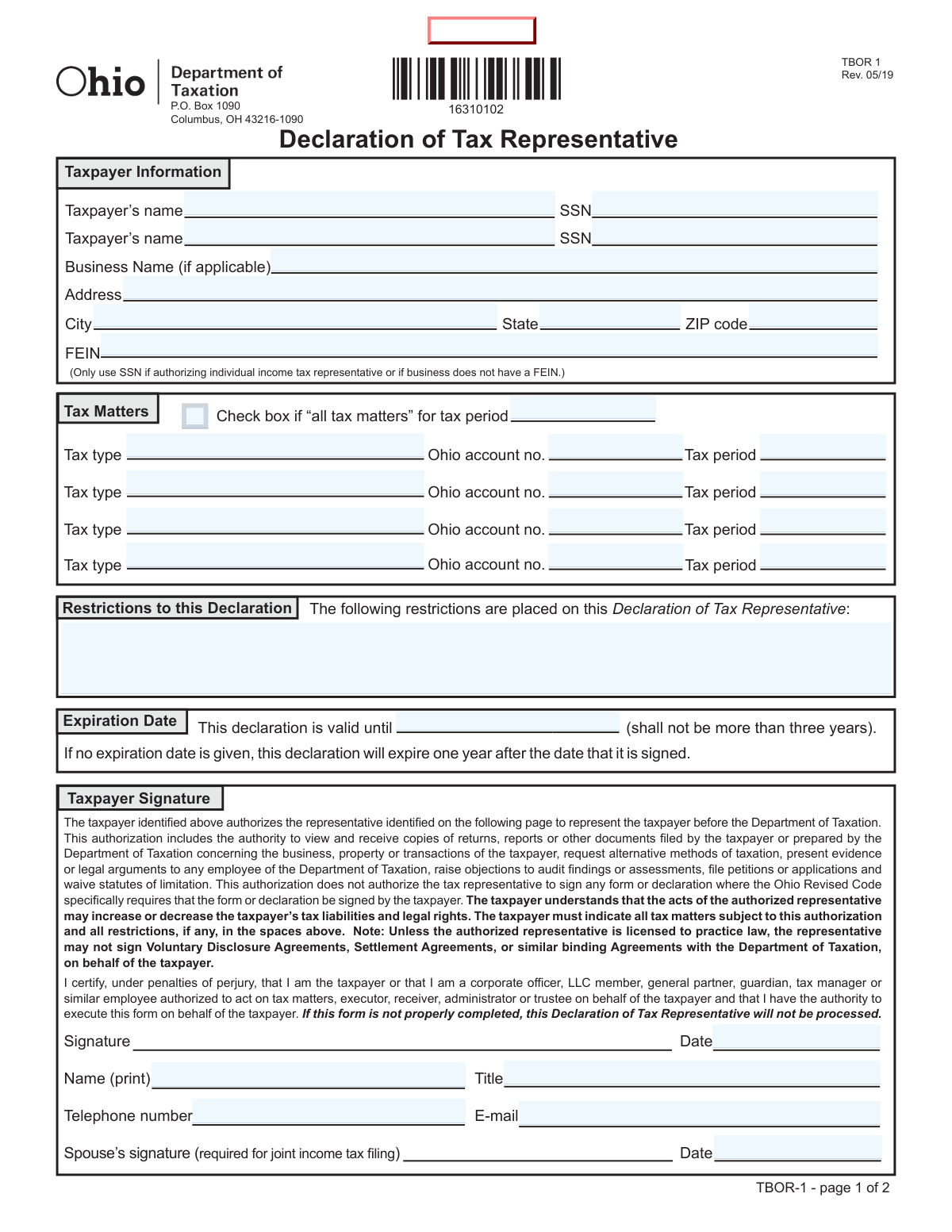
| 1. | Ohio Department of Taxation Declaration of Tax Representative (Form TBOR 1) | 2 | Moderate 58 |
| 2. | Selbstauskunft zur steuerlichen Ansässigkeit (Natürliche Person) / Self-declaration of Tax Residency (Natural Person) | 2 | Basic 45 |
- Enterprise-grade security & data encryption
- 99%+ accuracy powered by AI
- 1,000+ forms from all industries
- Complete forms in under 60 seconds
How to Choose the Right Form
Choosing the right tax declaration form depends on whether you are reporting annual income to a state authority or verifying your residency status for a financial institution. While many users search for state-specific documents like SCDOR forms for South Carolina, international compliance requires a different set of paperwork.
International Banking and Residency
If you are an individual opening an account or updating your profile with a German financial institution (such as Deutsche Bank), you likely need the Selbstauskunft zur steuerlichen Ansässigkeit (Natürliche Person) / Self-declaration of Tax Residency (Natural Person).
This form is the correct choice if you need to:
- Comply with CRS or FATCA: These are international standards (Common Reporting Standard and Foreign Account Tax Compliance Act) designed to prevent tax evasion.
- Verify Tax Jurisdiction: Formally declare which country has the right to tax your global income.
- Update Personal Banking Records: Ensure your bank has accurate data to apply relevant tax treaties to your interest or investment income.
State Tax Forms vs. Residency Declarations
It is important to distinguish between "tax declaration forms" used for filing and those used for identification:
- State Tax Forms (SCDOR): Choose these if you are filing a South Carolina state income tax return or property tax assessment.
- Tax Residency Declarations: Choose the Self-declaration of Tax Residency if a bank requires proof of where you are legally domiciled for tax purposes, particularly for accounts held in the EU or Germany.
Filling Out Your Form Efficiently
Tax documents are often provided as flat, non-interactive PDFs. Whether you are handling South Carolina state forms or international declarations, you can use Instafill.ai to convert these documents into fillable versions. For the Self-declaration of Tax Residency, our AI tools help ensure that complex fields regarding tax identification numbers (TIN) and residency status are completed accurately, reducing the risk of your bank rejecting the document.
Form Comparison
| Form | Purpose | Target Audience | Regulatory Compliance |
|---|---|---|---|
| Selbstauskunft zur steuerlichen Ansässigkeit (Natürliche Person) / Self-declaration of Tax Residency (Natural Person) | Declaring tax residency status to financial institutions for international reporting. | Individual bank account holders or natural persons opening new accounts. | Ensures adherence to CRS and FATCA international tax exchange agreements. |
Tips for tax declaration forms
Most tax residency forms require a valid TIN for every country where you are considered a resident for tax purposes. Double-check your local tax documents or identification cards to ensure the number is entered correctly, as errors can lead to significant delays in account verification.
If you live, work, or hold citizenship in multiple countries, you may have tax obligations in more than one jurisdiction. Ensure you list every relevant country to comply with international standards like CRS and FATCA, avoiding potential legal complications with banking institutions.
Tax residency is not always permanent; moving to a new country or changing your legal status can impact your filing requirements. You should proactively submit a new self-declaration form whenever a significant life event occurs to keep your financial records accurate and compliant.
Different jurisdictions have unique rules for what constitutes a tax resident, often based on the number of days spent in the country annually. Before filling out the form, verify the specific criteria for the countries involved to ensure you are selecting the correct residency status.
AI-powered tools like Instafill.ai can complete these tax declaration forms in under 30 seconds with high accuracy, ensuring all required fields are addressed. Your data stays secure during the process, making it a practical time-saver for those managing complex international paperwork.
Always save a completed copy of your self-declaration for your own files before submitting it to a bank or tax authority. Having these documents on hand makes it much easier to reconcile information during future audits or when opening accounts at different financial institutions.
It is a common mistake to assume that citizenship and tax residency are identical. While they often overlap, you must focus on where you are legally obligated to pay taxes based on physical presence or local laws rather than just the country of your passport.
Frequently Asked Questions
Tax declaration forms are used to provide financial institutions or government agencies with specific details about your tax status, residency, or income. These documents ensure that you are taxed correctly according to local and international laws, helping to prevent issues like double taxation or tax evasion.
This form is usually required for individuals opening or maintaining bank accounts, especially with international institutions. It applies to natural persons who need to certify where they are legally considered a resident for tax purposes under international agreements like CRS and FATCA.
Banks are legally obligated to collect this data to comply with global standards such as the Common Reporting Standard (CRS) and the Foreign Account Tax Compliance Act (FATCA). This information is shared with relevant tax authorities to ensure transparency and compliance with international tax treaties.
Yes, AI tools like Instafill.ai can be used to fill out these forms in under 30 seconds by accurately extracting data from your existing documents. The AI identifies the required fields and places your information precisely where it belongs, reducing the risk of manual entry errors.
While manual entry can take 15 to 20 minutes, using an AI-powered service allows you to complete the process almost instantly. These tools can process your source data and populate the tax declaration form in less than 30 seconds, making the administrative task much more efficient.
If you are a tax resident in multiple jurisdictions, you must typically disclose all of them on your declaration form. Most forms provide space for multiple Tax Identification Numbers (TINs) to ensure full compliance with international reporting requirements.
Generally, these forms should be submitted directly to the financial institution or organization that requested them. Many banks now allow for digital submission through their secure online portals once you have filled and signed the document.
A TIN is a unique number issued by your country of residence for tax purposes, such as a Social Security Number in the US or a Steuer-Identifikationsnummer in Germany. You will almost always need to provide this number on tax declaration forms to uniquely identify yourself to tax authorities.
No, these are different documents with different purposes. A self-declaration certifies your status and residency to a bank or third party, whereas an annual tax return is a detailed report of your income and expenses filed directly with a government tax agency.
If you move to a new country or your tax status changes, you are usually required to notify your financial institution and submit an updated declaration form within a specific timeframe. This ensures that the bank's records remain accurate for international reporting purposes.
Yes, modern AI services can take static or non-fillable PDF tax forms and convert them into interactive, fillable documents. This allows users to type directly into the fields and use automated data extraction tools to speed up the completion process.
While requirements vary by country, many jurisdictions now require these declarations for all new accounts to ensure they meet global transparency standards. Even if you only hold domestic accounts, your bank may still request this information to confirm you do not have tax obligations elsewhere.
Glossary
- Form Complexity Index
- Instafill’s 0–100 measure of how much effort a form takes to complete, calculated deterministically from the form’s own structure rather than estimated. It combines the number of fillable fields (the largest factor), how difficult those fields are to complete based on their type, the number of pages that contain fields, the amount of conditional “fill-only-if” logic, and how many sections the form is divided into, then adds modifiers for tables and repeating lists, bundled instruction pages, and dense page layouts. A higher score means the form is harder to fill out by hand. The forms in this category have a median Form Complexity Index of 58/100 (Moderate). See exactly how it is calculated.
- Tax Residency
- The status of being a resident of a specific country for tax purposes, which determines where an individual is legally required to report and pay taxes on their global income.
- TIN (Tax Identification Number)
- A unique identification number used by tax authorities to track individuals and entities for tax administration and reporting purposes.
- FATCA (Foreign Account Tax Compliance Act)
- A United States federal law that requires foreign financial institutions to report data about financial accounts held by U.S. taxpayers to the IRS.
- CRS (Common Reporting Standard)
- An international standard for the automatic exchange of financial account information between countries to help prevent global tax evasion.
- Natural Person
- A legal term referring to an individual human being, used to distinguish them from 'legal persons' such as corporations, trusts, or organizations.
- SCDOR (South Carolina Department of Revenue)
- The state agency responsible for the administration and collection of taxes within the state of South Carolina.
- Tax Nexus
- A sufficient connection between a taxpayer and a jurisdiction, such as a state, that allows that jurisdiction to impose tax obligations on the taxpayer.
- Double Taxation Agreement (DTA)
- A treaty between two countries designed to prevent the same income from being taxed twice by different jurisdictions.