Fill out tax residency forms
with AI.
Tax residency forms are essential documents used by financial institutions and government bodies to determine where an individual is legally obligated to pay taxes. These forms are a direct result of international efforts to increase transparency and prevent tax evasion, specifically through frameworks like the Common Reporting Standard (CRS) and the Foreign Account Tax Compliance Act (FATCA). By establishing your tax residency status, banks can ensure they are reporting financial information to the correct national authorities and complying with global regulatory standards.
By continuing, you acknowledge Instafill's Privacy Policy and agree to get occasional product update and promotional emails.
About tax residency forms
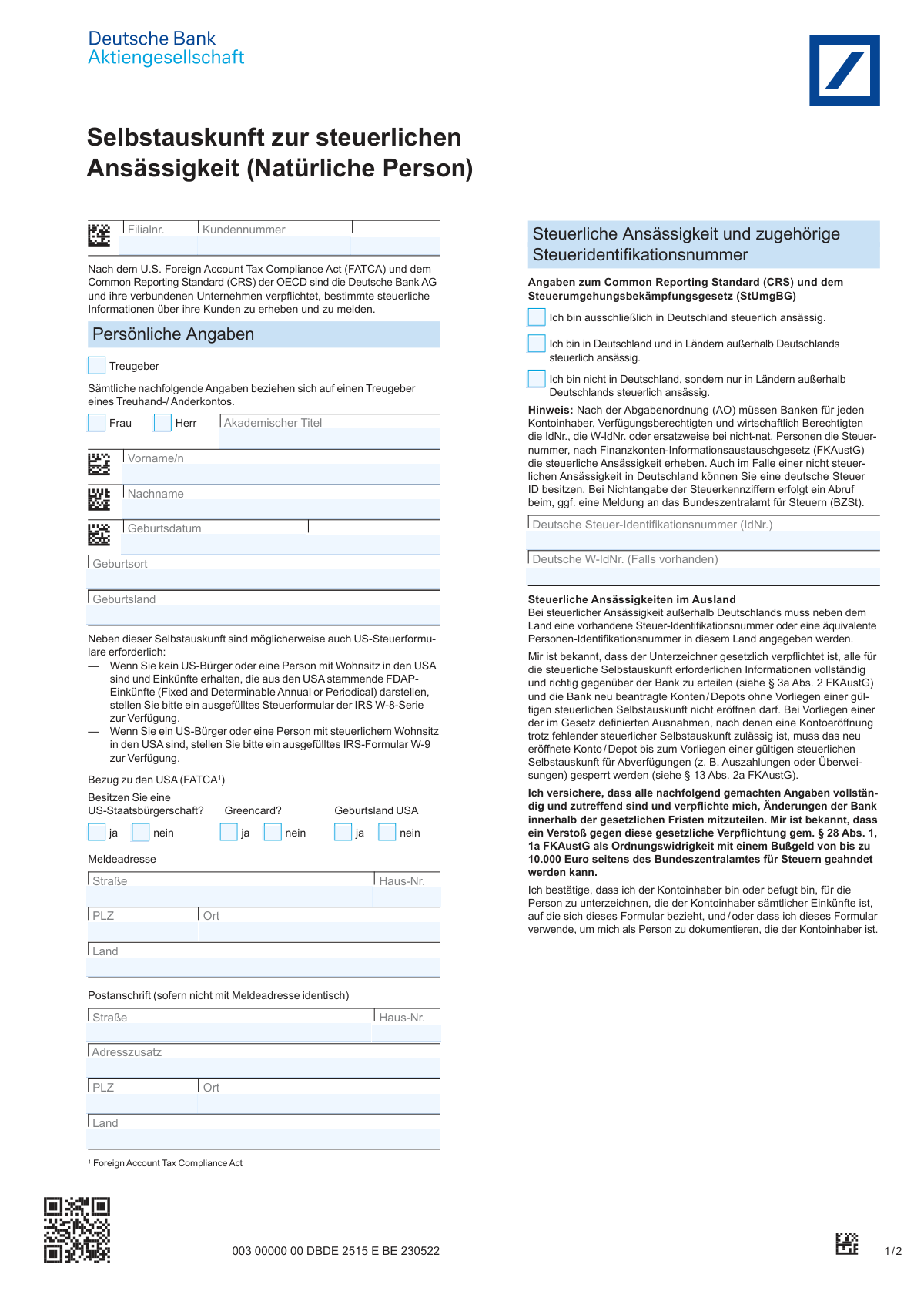
Most individuals encounter these documents when opening a new bank account, moving to a different country, or when their financial institution requires updated information to remain compliant. For example, forms like the Self-declaration of Tax Residency for natural persons are commonly used by major European banks to verify the status of individual clients. Providing accurate information is vital, as these declarations help prevent legal complications and ensure that your financial accounts remain in good standing across different jurisdictions.
Filling out these dense, regulatory documents manually can be tedious and prone to error. Tools like Instafill.ai use AI to complete these forms in under 30 seconds, ensuring that data is handled accurately and securely while saving you the hassle of manual data entry. This approach simplifies the compliance process, allowing you to finalize your documentation quickly and move on with your financial tasks.
Every form on this page can be completed without typing. Instafill is form filling software that reads a PDF and fills it for you — including flat and scanned documents that carry no fillable fields at all.
Forms in This Category
The forms in this category have a median Form Complexity Index of 45/100 (Basic), measured across 1 forms by field count, input difficulty, length, conditional logic and structure. See how it is calculated.
| Form Name | Pages | FCI | |
|---|---|---|---|
| 1. | Selbstauskunft zur steuerlichen Ansässigkeit (Natürliche Person) / Self-declaration of Tax Residency (Natural Person) | 2 | Basic 45 |
- Enterprise-grade security & data encryption
- 99%+ accuracy powered by AI
- 1,000+ forms from all industries
- Complete forms in under 60 seconds
How to Choose the Right Form
Navigating international tax regulations can be complex, especially when dealing with financial institutions in Germany. Most tax residency forms are designed to satisfy specific reporting requirements like the Common Reporting Standard (CRS) and the Foreign Account Tax Compliance Act (FATCA). To ensure you are filling out the correct documentation, consider the following guide.
Identifying the Correct Form
In this category, the primary document is the Selbstauskunft zur steuerlichen Ansässigkeit (Natürliche Person) / Self-declaration of Tax Residency (Natural Person). This form is specifically tailored for individuals—referred to as "Natural Persons"—rather than corporations, trusts, or other legal entities. If you are managing personal finances or a private bank account, this is the document you need.
When to Use This Form
You will likely need to complete the Self-declaration of Tax Residency if you meet any of the following criteria:
- Opening a New Account: When establishing a new relationship with a German bank (such as Deutsche Bank), you are legally required to declare where you are registered for tax purposes.
- Change of Circumstances: If you have recently moved to a new country or changed your primary residence, your financial institution may require an updated declaration to remain compliant.
- Regulatory Requests: Banks often reach out to existing customers to update their records to ensure they are meeting international tax exchange standards.
Key Information Required
To fill out this form accurately using Instafill.ai, ensure you have the following details ready:
- Personal Identifiers: Your full legal name, current residential address, and date/place of birth.
- Tax Identification Numbers (TIN): You must provide the TIN for every country where you are considered a tax resident.
- U.S. Status: You will need to confirm whether you are a U.S. citizen or resident to satisfy FATCA requirements.
By using our AI-powered tools, you can quickly convert these standard PDF forms into interactive documents, ensuring all mandatory fields are completed before submission.
Form Comparison
| Form | Purpose | Who Files It | Compliance Standards |
|---|---|---|---|
| Selbstauskunft zur steuerlichen Ansässigkeit (Natürliche Person) / Self-declaration of Tax Residency (Natural Person) | Declares tax residency status to financial institutions for international tax reporting. | Individual bank clients or natural persons opening or maintaining bank accounts. | Ensures compliance with global CRS and FATCA tax information exchange agreements. |
Tips for tax residency forms
Most tax residency forms require a valid Tax Identification Number for every country where you are considered a resident. Ensure you have these documents on hand to avoid delays, as banks cannot process your declaration without accurate tax IDs.
Tax residency is usually determined by where you live for more than 183 days a year or where your center of vital interests is located. If you are unsure, check your local tax laws or residency certificates before checking boxes on the form to ensure compliance with CRS and FATCA.
If you have financial ties or residences in multiple countries, you must list all of them on the form. Failing to disclose a secondary tax residency can lead to complications with international tax information exchange agreements and potential account freezes.
Ensure that your name, address, and date of birth exactly match the identification documents held by your financial institution. Any discrepancy between the self-declaration and your ID can result in the form being rejected or requiring an intensive manual review.
AI-powered tools like Instafill.ai can complete these tax residency forms in under 30 seconds with high accuracy, ensuring all fields are correctly mapped. Your sensitive financial data stays secure during the process, making it a reliable and fast way to handle complex paperwork.
If you move to a new country or your tax status changes, you are generally required to submit a new self-declaration to your bank. Proactively updating your status prevents issues with international tax reporting and ensures your account remains in good standing.
Always save a digital copy of your completed and signed tax residency declaration. This is helpful if your bank requests a re-certification in the future or if you need to provide proof of your reported residency status to other financial services.
Frequently Asked Questions
Tax residency forms are used by financial institutions to determine where an individual is legally obligated to pay taxes. This information helps banks comply with international regulations designed to prevent tax evasion and ensure correct reporting to national tax authorities.
Banks are required by law to identify the tax status of their account holders under frameworks like the Common Reporting Standard (CRS) and FATCA. By completing this form, you provide the necessary data for the bank to report your financial information to the relevant international tax bodies.
You will generally need to provide your full name, permanent residential address, date of birth, and your Tax Identification Number (TIN) for each country where you are a resident. In some cases, you may also need to specify your citizenship or place of birth to satisfy specific regulatory requirements.
In legal and financial terms, a "natural person" refers to an individual human being rather than a legal entity like a corporation, partnership, or trust. If you are opening a personal bank account or managing your own private finances, you should use the form designated for natural persons.
Yes, AI tools like Instafill.ai can significantly simplify the process by accurately extracting data from your identification documents and placing it into the correct fields. This technology ensures that complex forms are completed precisely, reducing the risk of manual entry errors that could lead to reporting issues.
When using automated tools, these forms can often be filled out in under 30 seconds. By uploading your source documents, the AI identifies the required information and populates the PDF instantly, making the process much faster than manual typing.
CRS (Common Reporting Standard) and FATCA (Foreign Account Tax Compliance Act) are international agreements for the automatic exchange of financial account information. They are designed to improve global tax transparency and ensure that individuals pay taxes in the jurisdictions where they are resident.
If you have tax obligations in multiple countries, you must disclose all of them on the self-declaration form. You will usually be asked to provide the Tax Identification Number (TIN) for each jurisdiction to ensure the bank can report your status accurately to all relevant authorities.
Yes, you are generally required to notify your financial institution if there is a change in your circumstances that affects your tax residency status. Moving to a new country or obtaining a new citizenship typically triggers the need to submit a updated self-declaration form.
If you do not provide the requested information, the bank may be legally required to report your account as undocumented or may even be forced to restrict your account access. In some jurisdictions, failing to provide this information can also result in financial penalties or the withholding of taxes on certain income.
Glossary
- Form Complexity Index
- Instafill’s 0–100 measure of how much effort a form takes to complete, calculated deterministically from the form’s own structure rather than estimated. It combines the number of fillable fields (the largest factor), how difficult those fields are to complete based on their type, the number of pages that contain fields, the amount of conditional “fill-only-if” logic, and how many sections the form is divided into, then adds modifiers for tables and repeating lists, bundled instruction pages, and dense page layouts. A higher score means the form is harder to fill out by hand. The forms in this category have a median Form Complexity Index of 45/100 (Basic). See exactly how it is calculated.
- Tax Residency
- The country where you are legally considered a resident for tax purposes, usually determined by where you live or spend most of your time.
- TIN (Tax Identification Number)
- A unique number issued by a government's tax authority to identify an individual for tax administration and reporting.
- CRS (Common Reporting Standard)
- A global standard for the automatic exchange of financial information between countries to help prevent international tax evasion.
- FATCA (Foreign Account Tax Compliance Act)
- A United States federal law that requires foreign financial institutions to report the financial assets of U.S. citizens to the IRS.
- Natural Person
- In legal and tax terms, this refers to an individual human being rather than a business entity, corporation, or organization.
- Self-Certification
- A formal declaration provided by an individual to a bank or financial institution stating their tax residency status and other required tax details.
- OECD (Organisation for Economic Co-operation and Development)
- The international organization that created the guidelines for tax information sharing that many countries follow today.
- Double Taxation Agreement (DTA)
- A treaty between two countries that ensures a person does not have to pay tax on the same income in both jurisdictions.