Fill out residency forms
with AI.
Residency forms serve a wide range of official purposes — from proving your legal residency status to foreign tax authorities to qualifying for in-state tuition rates at public colleges. While they vary significantly in scope and issuing authority, what these forms share is their role in formally documenting where a person lives or holds legal ties, which can have real financial and legal consequences if not handled correctly.
By continuing, you acknowledge Instafill's Privacy Policy and agree to get occasional product update and promotional emails.
About residency forms
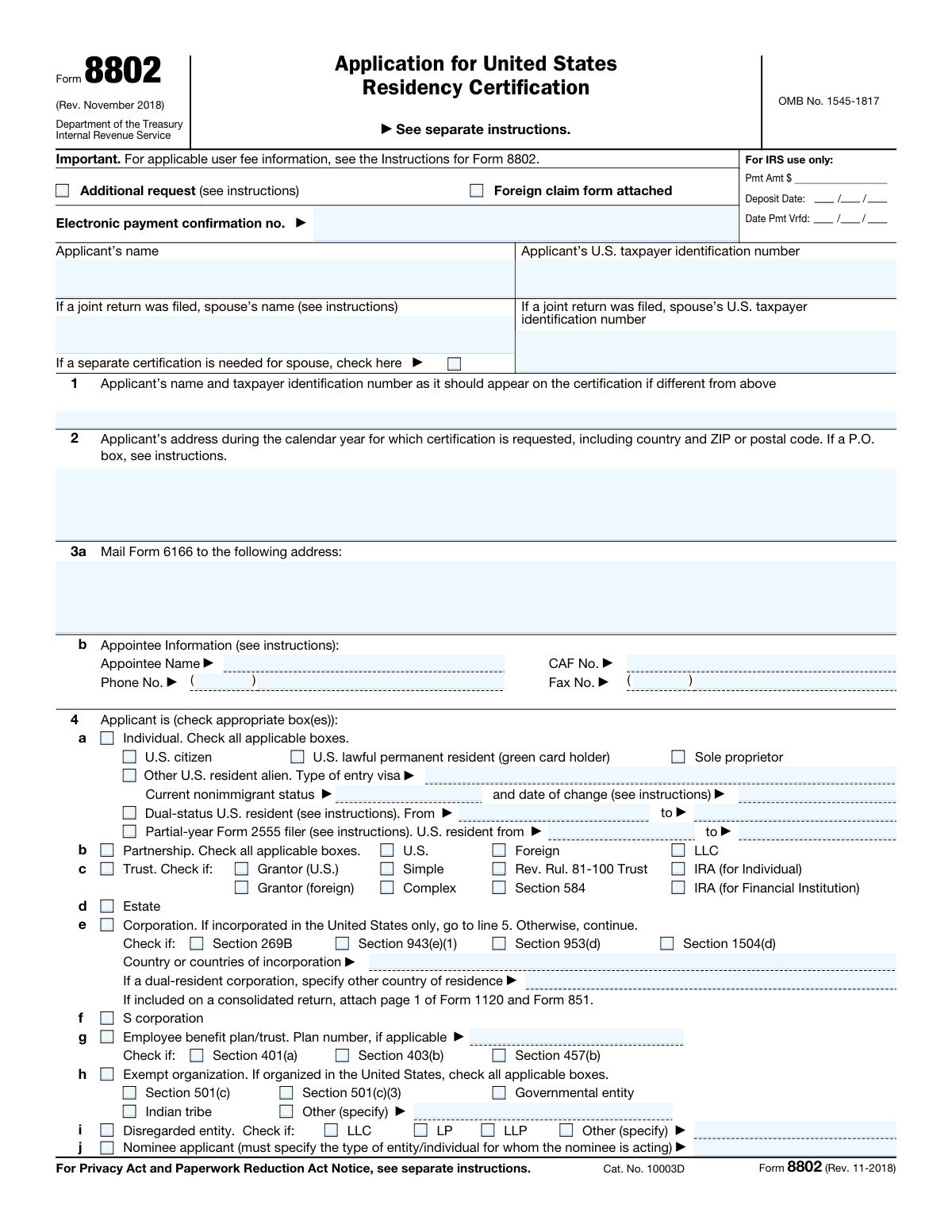
The people who need residency forms are equally diverse. A U.S. taxpayer doing business abroad may need IRS Form 8802 to certify their U.S. residency and claim benefits under an international tax treaty. Meanwhile, a student enrolled at a SUNY community college may need an Orange County Certificate of Residence to demonstrate they've lived in the county long enough to qualify for resident tuition rates — potentially saving thousands of dollars per year. In both cases, accuracy matters: errors or missing documentation can lead to delays, denials, or unexpected costs.
Because these forms often require pulling together personal details, dates, and supporting documentation, they can feel more time-consuming than they need to be. Tools like Instafill.ai use AI to fill out these forms in under 30 seconds, helping ensure the information is entered accurately so you can focus on gathering the right supporting documents rather than wrestling with the paperwork itself.
Every form on this page can be completed without typing. Instafill is form filling software that reads a PDF and fills it for you — including flat and scanned documents that carry no fillable fields at all.
Forms in This Category
The forms in this category have a median Form Complexity Index of 72/100 (Complex), measured across 3 forms by field count, input difficulty, length, conditional logic and structure. See how it is calculated.
| Form Name | Pages | FCI | |
|---|---|---|---|
| 1. | Form 8802, Application for U.S. Residency Certification | 3 | Complex 72 |
| 2. | Application for a Residency and Employment Rights Certificate | 12 | Very Complex 98 |
| 3. | Selbstauskunft zur steuerlichen Ansässigkeit (Natürliche Person) / Self-declaration of Tax Residency (Natural Person) | 2 | Basic 45 |
- Enterprise-grade security & data encryption
- 99%+ accuracy powered by AI
- 1,000+ forms from all industries
- Complete forms in under 60 seconds
How to Choose the Right Form
Choosing the right residency form depends primarily on whether you are proving your status to a government tax authority or a financial institution. While residency forms can cover everything from school district enrollment to local county requirements, the documents in this category focus heavily on international tax compliance.
For U.S. Residents Claiming Tax Treaty Benefits
If you are a U.S. citizen, resident, or entity doing business abroad, you may need to prove your tax status to avoid being taxed twice on the same income.
- Form 8802, Application for U.S. Residency Certification: Use this form to request a "Letter of Certification" (Form 6166) from the IRS. This is the official document required by foreign countries to verify that you are a U.S. resident for tax purposes, allowing you to claim benefits under an existing tax treaty.
For International Banking and Financial Compliance
Financial institutions are required by law to determine where their clients are tax residents to prevent tax evasion and comply with global transparency standards.
- Selbstauskunft zur steuerlichen Ansässigkeit (Self-declaration of Tax Residency): Choose this form if you are an individual client of a German financial institution (such as Deutsche Bank). This document is mandatory for complying with the Common Reporting Standard (CRS) and the Foreign Account Tax Compliance Act (FATCA). It ensures that your tax residency information is correctly reported to the relevant authorities.
Quick Selection Guide
- Are you dealing with the IRS to get a certificate for a foreign government? Select Form 8802.
- Are you opening or maintaining a bank account in Germany or the EU? Use the Self-declaration of Tax Residency (Natural Person).
If you are looking for local residency forms related to education, SUNY admissions, or Orange County requirements, ensure you verify the specific department requesting the documentation, as those typically require state-specific or institutional-specific affidavits.
Form Comparison
| Form | Primary Purpose | Target Audience | Regulatory Context |
|---|---|---|---|
| Form 8802, Application for U.S. Residency Certification | Obtain official certification of U.S. residency to claim foreign tax treaty benefits. | U.S. citizens, residents, and domestic entities with income from foreign sources. | Managed by the IRS to satisfy requirements of foreign tax authorities. |
| Selbstauskunft zur steuerlichen Ansässigkeit (Natürliche Person) / Self-declaration of Tax Residency (Natural Person) | Declare tax residency to banks for international tax information exchange compliance. | Individual account holders at German financial institutions like Deutsche Bank. | Required under Common Reporting Standard (CRS) and FATCA international regulations. |
Tips for residency forms
Accurate reporting of your Social Security Number (SSN) or Individual Taxpayer Identification Number (ITIN) is critical for residency certification. Errors in these numerical fields are the most common cause for rejection by tax authorities and financial institutions.
Many residency forms, such as Form 8802, are used specifically to claim tax treaty benefits in foreign countries. Research the specific requirements of the destination country to ensure you are requesting the correct certification for your unique tax situation.
AI-powered tools like Instafill.ai can complete these complex residency forms in under 30 seconds with high accuracy. Your sensitive data stays secure during the process, providing a reliable and practical way to manage multiple filings without manual data entry.
Ensure that the physical address provided matches the records held by your school, bank, or the IRS. Discrepancies between your current form and your official records can trigger additional verification steps or significant processing delays.
Residency certifications are often required annually or whenever you open a new international account. Saving a completed digital copy of your forms allows you to quickly reference previous data and speeds up the process for future renewals.
Be ready to provide secondary proof of residency, such as utility bills or lease agreements, if requested alongside the primary form. Having these documents scanned and organized can prevent delays if a bank or government agency asks for further evidence of your status.
Frequently Asked Questions
Residency forms are primarily used to establish an individual's or entity's tax status in a specific jurisdiction. This documentation allows taxpayers to claim benefits under international tax treaties, such as reduced withholding rates, and helps financial institutions comply with global reporting standards.
Individuals, corporations, and other entities that earn income abroad often need to prove they are U.S. residents to avoid double taxation. Form 8802 is the standard application used to request a formal certification from the IRS to prove this status to foreign tax authorities.
International banks use these forms to comply with the Common Reporting Standard (CRS) and the Foreign Account Tax Compliance Act (FATCA). The information collected helps tax authorities identify individuals who may have tax obligations in other countries, preventing cross-border tax evasion.
Yes, educational institutions, such as SUNY or schools in Orange County, often require residency forms to determine tuition rates. Providing proof of residency can qualify students for in-state tuition, which is typically significantly lower than out-of-state or international rates.
For federal tax residency certification, Form 8802 is generally submitted to the Internal Revenue Service (IRS) at a specific address in Philadelphia or through an authorized electronic channel. It is important to check the current IRS instructions for the most accurate mailing address or fax number before sending.
Failing to provide a requested tax residency self-declaration may result in the financial institution being required to withhold taxes on your account or report the account to tax authorities. It could also lead to delays in account opening or the restriction of certain banking services.
Yes, you can fill out residency forms using AI tools. Platforms like Instafill.ai use artificial intelligence to accurately extract data from your source documents and place it into the correct fields on residency forms in under 30 seconds.
Filling out these forms manually can take significant time, but using online AI tools reduces the process to less than a minute. AI-powered services can also convert non-fillable PDFs into interactive forms, making the data entry process much faster and more accurate than traditional methods.
You may need to file different forms depending on whether you are seeking certification for tax treaty benefits, banking compliance, or educational tuition rates. Each jurisdiction or institution usually has its own specific requirements and documentation procedures that must be followed independently.
Common requirements include government-issued identification, recent utility bills, tax returns, or lease agreements that show your name and address. For tax-specific forms like the 8802, you may also need to provide your Social Security Number or Employer Identification Number to verify your identity with the IRS.
Glossary
- Form Complexity Index
- Instafill’s 0–100 measure of how much effort a form takes to complete, calculated deterministically from the form’s own structure rather than estimated. It combines the number of fillable fields (the largest factor), how difficult those fields are to complete based on their type, the number of pages that contain fields, the amount of conditional “fill-only-if” logic, and how many sections the form is divided into, then adds modifiers for tables and repeating lists, bundled instruction pages, and dense page layouts. A higher score means the form is harder to fill out by hand. The forms in this category have a median Form Complexity Index of 72/100 (Complex). See exactly how it is calculated.
- Tax Residency
- The legal status that determines which country has the primary right to tax your worldwide income based on where you live or work.
- Tax Treaty
- An agreement between two nations that specifies how residents of one country are taxed in the other to avoid paying taxes twice on the same income.
- TIN (Taxpayer Identification Number)
- A unique identification number, such as a Social Security Number or Employer Identification Number, used by tax authorities to identify individuals and businesses.
- Domicile
- The place an individual considers their permanent home and intends to return to, which is a key factor in determining residency for state taxes and university tuition.
- FATCA (Foreign Account Tax Compliance Act)
- A U.S. law requiring foreign banks to report financial information about U.S. citizens' accounts to the IRS to prevent tax evasion.
- CRS (Common Reporting Standard)
- An international agreement where countries automatically exchange financial account information of non-residents with their home tax authorities.
- Natural Person
- A legal term for a human being, used on forms to distinguish individual applicants from business entities like corporations or trusts.
- Double Taxation
- The levying of tax by two or more jurisdictions on the same declared income, asset, or financial transaction.