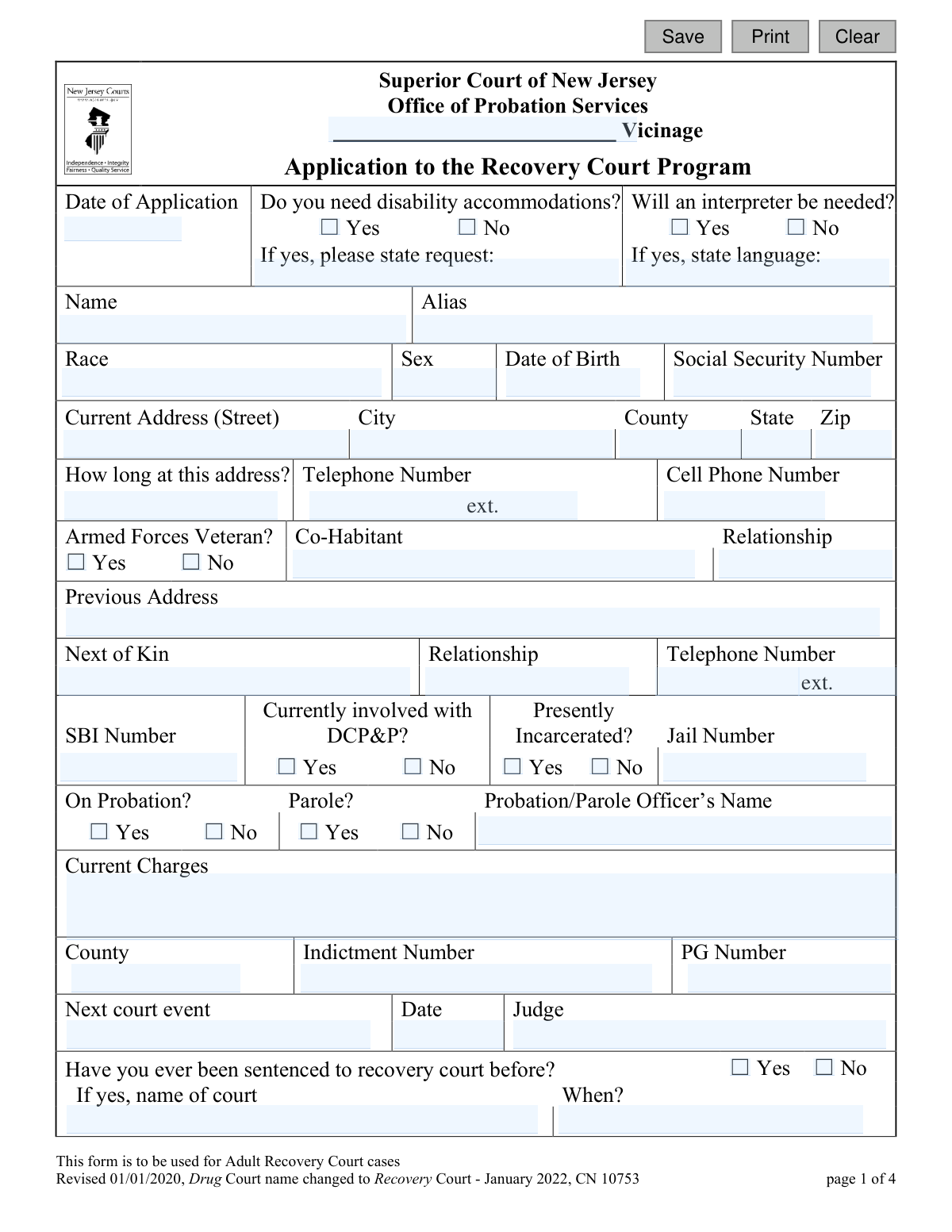
Yes! You can use AI to fill out Superior Court of New Jersey Application to the Recovery Court Program
This form is an application for admission into the New Jersey Superior Court's Recovery Court Program, formerly known as the Drug Court. It gathers personal, legal, and substance abuse history to determine an applicant's eligibility for this specialized program, which offers court-supervised treatment as an alternative to incarceration. Today, this form can be filled out quickly and accurately using AI-powered services like Instafill.ai, which can also convert non-fillable PDF versions into interactive fillable forms.
Our AI automatically handles information lookup, data retrieval, formatting, and form filling.
It takes less than a minute to fill out CN 10753 using our AI form filling.
Securely upload your data. Information is encrypted in transit and deleted immediately after the form is filled out.
Form specifications
| Form name: | Superior Court of New Jersey Application to the Recovery Court Program |
| Number of fields: | 82 |
| Number of pages: | 1 |
| Language: | English |
Instafill Demo: How to fill out PDF forms in seconds with AI
How to Fill Out CN 10753 Online for Free in 2026
Are you looking to fill out a CN 10753 form online quickly and accurately? Instafill.ai offers the #1 AI-powered PDF filling software of 2026, allowing you to complete your CN 10753 form in just 37 seconds or less.
Follow these steps to fill out your CN 10753 form online using Instafill.ai:
- 1 Navigate to Instafill.ai and upload or select the Recovery Court Application form.
- 2 Enter your personal details, including your full name, aliases, date of birth, Social Security Number, and current contact information.
- 3 Provide information about your legal status, such as whether you are currently incarcerated, on probation, or on parole, and list your probation/parole officer's name if applicable.
- 4 Detail your current charges, including the county, indictment number, and information about your next court event.
- 5 Disclose any previous participation in a recovery court program and any other pending legal matters in other courts.
- 6 Complete the 'Records Release Authorization' section to allow communication between the Recovery Court team and treatment providers.
- 7 Review all the information for accuracy, sign the application, and have your defense attorney sign as well before submission.
Our AI-powered system ensures each field is filled out correctly, reducing errors and saving you time.
Why Choose Instafill.ai for Your Fillable CN 10753 Form?
Speed
Complete your CN 10753 in as little as 37 seconds.
Up-to-Date
Always use the latest 2026 CN 10753 form version.
Cost-effective
No need to hire expensive lawyers.
Accuracy
Our AI performs 10 compliance checks to ensure your form is error-free.
Security
Your personal information is protected with bank-level encryption.
Frequently Asked Questions About Form CN 10753
This form is used to apply for the Superior Court of New Jersey's Recovery Court Program, which offers a path to treatment and recovery as an alternative to traditional incarceration for eligible adults.
This application is for adults with pending criminal charges in New Jersey who have a substance use disorder and wish to be considered for the Recovery Court Program.
An SBI (State Bureau of Identification) Number is a unique ID for individuals with a criminal record in New Jersey. Your defense attorney can help you find this number.
Signing this authorization permits the Recovery Court team, including the judge, attorneys, and treatment providers, to share information about your case and progress. This is essential for monitoring your compliance and supporting your recovery.
After submission, the Recovery Court team will review your application and conduct a legal and clinical assessment to determine your eligibility for the program. Your attorney will be notified of the decision.
Yes, you must disclose all pending legal matters. The form has a specific section to list charges, court names, and upcoming court dates for any cases in other jurisdictions.
Yes, you can still apply, but you must disclose your previous participation on the form. This information will be considered as part of the eligibility review process.
You will need personal details like your SSN, address history, information on your current charges including the indictment number, and your defense attorney's contact information.
Yes, the program's name was officially changed from Drug Court to Recovery Court in January 2022. The terms refer to the same program and its mission.
Both you and your defense attorney must sign the application. It is best to coordinate with your attorney to ensure the form is completed accurately and signed by both parties before submission.
Yes, services like Instafill.ai use AI to help you accurately auto-fill your information on forms like this. This can save you time and help prevent common errors.
You can use a service like Instafill.ai to complete the form digitally. Simply upload the PDF to the platform, and it will allow you to type your information directly into the fields before printing for signature.
If you have a non-fillable or 'flat' PDF, you can use a tool like Instafill.ai to convert it into an interactive, fillable form. This allows you to easily type your answers instead of filling it out by hand.
DCP&P stands for the Division of Child Protection and Permanency in New Jersey. You must indicate on the form if you have any current involvement with this agency.
Compliance CN 10753
Validation Checks by Instafill.ai
1
Validates Social Security Number Format
This check ensures the Social Security Number (SSN) is entered in the standard XXX-XX-XXXX format. A valid SSN is critical for accurate identification and background checks within the justice system. If the format is incorrect, the system will reject the entry and prompt the user to correct it before submission, preventing data entry errors and downstream processing issues.
2
Verifies Applicant's Date of Birth and Adult Status
This validation confirms that the Date of Birth is a valid date in the past and that the applicant is at least 18 years old, as this is an Adult Recovery Court application. This is crucial for determining program eligibility and legal standing. An invalid date or an underage applicant will result in a validation error, preventing the application from being processed for an ineligible individual.
3
Ensures Disability Accommodation Details are Provided When Needed
This check is a conditional validation that requires the 'If yes, please state request' field to be filled out if the applicant checks 'Yes' for needing disability accommodations. This ensures the court has the necessary information to comply with ADA requirements and provide appropriate support. Failure to provide details will trigger a prompt, preventing the form from being submitted with incomplete critical information.
4
Ensures Interpreter Language is Specified When Requested
This validation rule checks that if the 'Will an interpreter be needed?' box is marked 'Yes', the 'If yes, state language' field is not empty. This is essential for arranging the correct language interpreter for court proceedings, ensuring the applicant can fully understand and participate. If the language is not specified, the submission will be blocked until the required information is provided.
5
Requires Jail Number if Applicant is Currently Incarcerated
This check verifies that if the 'Presently Incarcerated?' box is checked 'Yes', the 'Jail Number' field is completed. The jail number is a key identifier for locating and managing the applicant within the correctional system. An incomplete submission would delay processing, so the system will return an error if the jail number is missing for an incarcerated applicant.
6
Requires Officer Name for Applicants on Probation or Parole
This validation ensures that if an applicant indicates they are on 'Probation' or 'Parole' by checking 'Yes', the 'Probation/Parole Officer’s Name' field is filled in. This information is vital for inter-agency communication and coordinating supervision efforts. The form cannot be submitted without this name if the applicant is under current supervision, as it's a required contact point.
7
Requires Details if Applicant has Prior Recovery Court History
This check confirms that if an applicant answers 'Yes' to 'Have you ever been sentenced to recovery court before?', the 'name of court' and 'When?' fields are completed. This history is critical for assessing the applicant's suitability and needs for the current program. The system will prevent submission if this conditional information is missing, ensuring a complete history is provided for evaluation.
8
Validates Format of All Phone Number Fields
This check ensures that all phone number fields (e.g., 'Cell Phone Number', 'Next of Kin Telephone Number') adhere to a standard 10-digit format. Correctly formatted phone numbers are essential for reliable communication with the applicant and related parties. An invalid format will trigger an error, requiring the user to correct the entry before the form can be saved or submitted.
9
Validates Applicant Signature Date
This validation ensures the 'Applicant Signature Date' is present and is not set to a future date. The signature date legally attests to the information's accuracy at a specific point in time and cannot be post-dated. An invalid or future date would render the signature invalid, so the system will reject the submission until a valid date is entered.
10
Ensures Name Consistency Between Application and Release Form
This check cross-references the 'Name of Client' on the 'Records Release Authorization' page with the 'Name' of the applicant on the first page. The names must match exactly to ensure the legal authorization to release records is for the correct individual. A mismatch will result in a validation failure, preventing a potentially serious legal and privacy breach.
11
Validates the Applicant's ZIP Code Format
This check verifies that the 'Zip' code field contains a valid 5-digit numeric value. A correct ZIP code is essential for mail correspondence, verifying jurisdiction, and ensuring accurate address records. The system will display an error if the entry is not a 5-digit number, forcing the user to correct it for data integrity.
12
Ensures 'Next court event Date' is Not in the Past
This validation checks that any date entered for a 'Next court event' is either today's date or a future date. A past date for a future event is a logical impossibility and indicates a data entry error. This check prevents inaccurate scheduling information from entering the system and will require the user to correct the date before proceeding.
13
Validates the 'Date of Application' is Present and Not in the Future
This check ensures the 'Date of Application' field is filled out with a valid date that is on or before the current day. This date establishes the official start of the application process and is used for tracking and legal purposes. A missing or future date would be invalid, so the system will block submission until a correct date is provided.
14
Requires Details for Other Pending Court Matters
This rule verifies that if an applicant answers 'Yes' to 'Do you have any matters pending in any other court?', the associated fields for court name, charges, and next court event are completed. This information is crucial for the Recovery Court to understand the applicant's full legal situation and potential conflicts. The form will be considered incomplete and rejected if these details are missing after a 'Yes' response.
Common Mistakes in Completing CN 10753
Applicants often leave fields like 'SBI Number,' 'Indictment Number,' or 'PG Number' blank because they do not have this information readily available. This omission is critical as these numbers are the primary way the court system identifies and tracks a specific case for eligibility review. To avoid this, applicants should consult their defense attorney or review their legal paperwork before filling out the form, as these documents will contain the required numbers.
In the 'Current Charges' section, individuals may write generic terms like 'drug possession' instead of the specific statutory offense code and degree of the crime. This lack of detail forces court staff to spend extra time looking up the case, delaying the application process. Applicants should ask their defense attorney for the precise legal citation of their charges to ensure their eligibility can be quickly and accurately determined.
Applicants sometimes focus only on the charge that prompted the Recovery Court application and fail to list other pending cases or detainers from other jurisdictions. This is a critical error, as unresolved legal matters can make a person ineligible for the program, and non-disclosure can lead to immediate rejection. It is crucial to list every pending matter, no matter how minor it seems, to provide a complete and honest legal history.
The form requires signatures and dates from both the applicant and their defense attorney, as well as on the Records Release Authorization page. These are frequently missed, especially when the form is filled out in a hurry, rendering the application legally incomplete and invalid. Applicants must carefully review every page to ensure all signature and date lines are filled, as an unsigned form cannot be processed.
The authorization on page 3 is a legal document that applicants often fill out incorrectly, for example, by forgetting to write their full name on the 'I, [Name of Client]' line or failing to have a witness sign. An incomplete authorization prevents the Recovery Court team from accessing necessary treatment and legal records, which is a core requirement for participation. If the form is a non-fillable PDF, a tool like Instafill.ai can convert it to a fillable version, making it easier to type information clearly and avoid illegible handwriting.
Errors in the applicant's own phone number or the defense attorney's contact details are common data entry mistakes that can severely hinder communication and delay the application. Applicants should double-check all phone numbers and addresses for accuracy before submitting. AI-powered form fillers like Instafill.ai can help prevent these errors by auto-populating information from a secure profile and validating formats, such as ensuring a phone number has the correct number of digits.
The questions 'Do you need disability accommodations?' and 'Will an interpreter be needed?' are located at the very top of the form and are easily overlooked. Failing to state these needs upfront can lead to significant challenges and delays in the legal process, as the court may not be prepared to provide necessary assistance. It is vital to answer these questions accurately to ensure fair and accessible proceedings.
Transposing digits or leaving the Social Security Number (SSN) field blank is a frequent and critical error. The SSN is a primary identifier used for background checks, and an incorrect number will cause these checks to fail. Applicants should carefully enter and then re-read their SSN to ensure its accuracy. Using a tool like Instafill.ai can help by validating the format of the SSN and flagging the field if it's left empty, reducing the likelihood of this common mistake.
Applicants may be hesitant to check 'Yes' for 'Currently involved with DCP&P?' (Division of Child Protection & Permanency) for fear of repercussions. However, non-disclosure is a serious issue that will be discovered during background checks and can lead to immediate disqualification from the program. It is essential to answer this question honestly to maintain credibility throughout the application process.
The form asks, 'Have you ever been sentenced to recovery court before?' and requires the court name and date if the answer is 'Yes.' Applicants may check 'Yes' but fail to provide the specific details, assuming the system already knows. This missing context is crucial for determining eligibility and suitability for re-entry into the program, and its absence requires extra research by court staff.
Saved over 80 hours a year
“I was never sure if my IRS forms like W-9 were filled correctly. Now, I can complete the forms accurately without any external help.”
Kevin Martin Green
Your data stays secure with advanced protection from Instafill and our subprocessors

Robust compliance program
Transparent business model
You’re not the product. You always know where your data is and what it is processed for.
ISO 27001, HIPAA, and GDPR
Our subprocesses adhere to multiple compliance standards, including but not limited to ISO 27001, HIPAA, and GDPR.
Security & privacy by design
We consider security and privacy from the initial design phase of any new service or functionality. It’s not an afterthought, it’s built-in, including support for two-factor authentication (2FA) to further protect your account.
Fill out CN 10753 with Instafill.ai
Worried about filling PDFs wrong? Instafill securely fills superior-court-of-new-jersey-application-to-the-recovery-court-program forms, ensuring each field is accurate.