Yes! You can use AI to fill out Superior Court of New Jersey, Chancery Division, Interim Provisional Settlement (IPS) Form

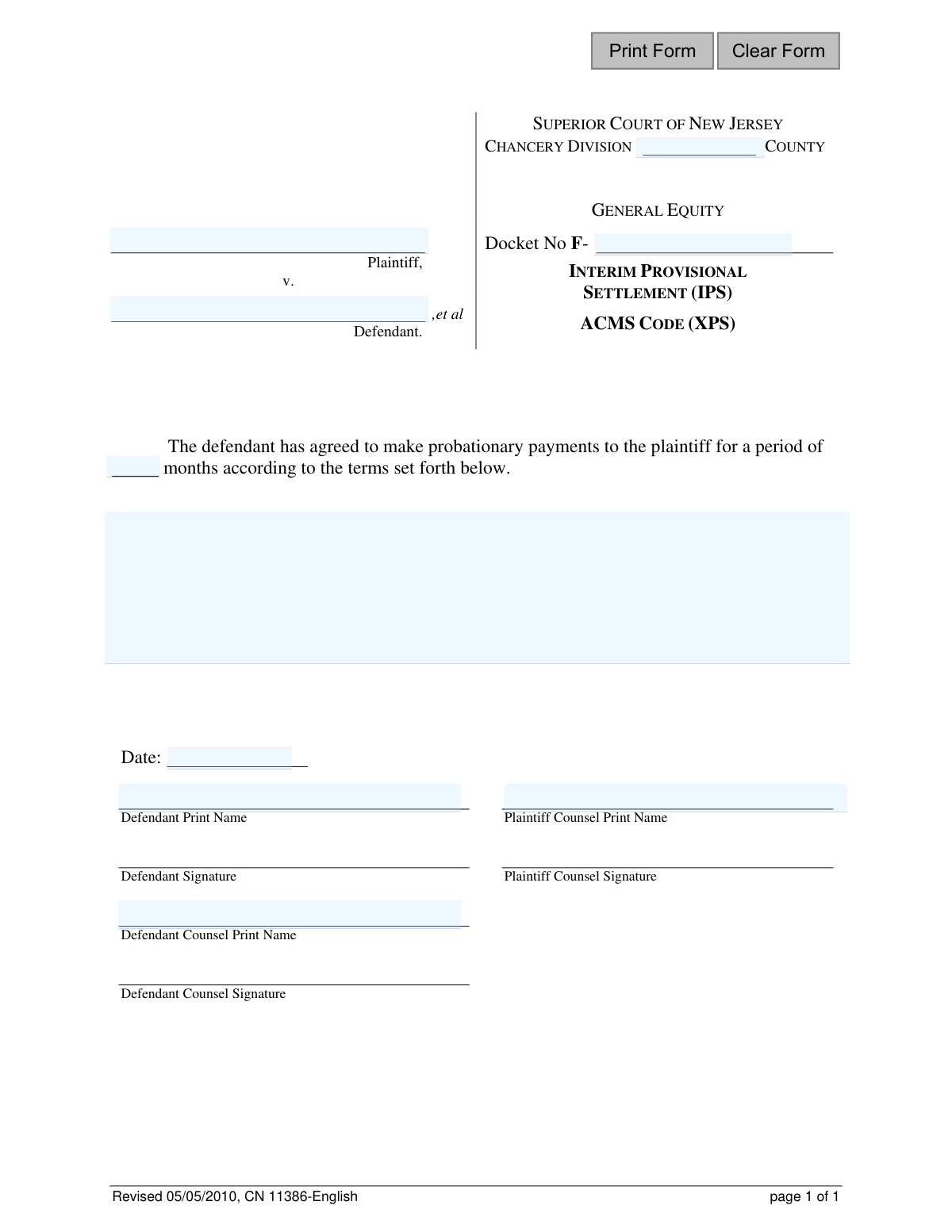
The Interim Provisional Settlement (IPS) Form is a legal document used in the Superior Court of New Jersey's Chancery Division. It formalizes an agreement where a defendant commits to making probationary payments to a plaintiff for a set period, often as part of a foreclosure or other civil case. This form is important as it allows for a temporary resolution and demonstrates the defendant's good faith in settling the matter. Today, this form can be filled out quickly and accurately using AI-powered services like Instafill.ai, which can also convert non-fillable PDF versions into interactive fillable forms.
Interim Provisional Settlement Form is part of the New Jersey forms and superior court forms categories on Instafill.
Our AI automatically handles information lookup, data retrieval, formatting, and form filling.
It takes less than a minute to fill out Interim Provisional Settlement Form using our AI form filling.
Securely upload your data. Information is encrypted in transit and deleted immediately after the form is filled out.

Form specifications

Form name: Superior Court of New Jersey, Chancery Division, Interim Provisional Settlement (IPS) Form
Number of fields: 12
Number of pages: 1
Language: English
main-image

Instafill Demo: How to fill out PDF forms in seconds with AI

How to Fill Out Interim Provisional Settlement Form Online for Free in 2026

Are you looking to fill out a INTERIM PROVISIONAL SETTLEMENT FORM form online quickly and accurately? Instafill.ai offers the #1 AI-powered PDF filling software of 2026, allowing you to complete your INTERIM PROVISIONAL SETTLEMENT FORM form in just 37 seconds or less.
Follow these steps to fill out your INTERIM PROVISIONAL SETTLEMENT FORM form online using Instafill.ai:
  1. 1 Navigate to Instafill.ai and upload or select the Interim Provisional Settlement Form.
  2. 2 Use the AI assistant to automatically identify and label all form fields, such as County, Plaintiff Name, and Docket Number.
  3. 3 Provide the case details, including the County, full Plaintiff and Defendant names, and the court Docket Number.
  4. 4 Enter the specific terms of the settlement, including the duration of the probationary payment period and a description of the payment terms.
  5. 5 Review all the information auto-filled by the AI for accuracy and completeness.
  6. 6 Electronically sign the form in the designated Defendant and Counsel signature fields, and provide the date.
  7. 7 Download, print, or securely share the completed Interim Provisional Settlement Form for filing with the court.

Our AI-powered system ensures each field is filled out correctly, reducing errors and saving you time.

Why Choose Instafill.ai for Your Fillable Interim Provisional Settlement Form Form?

Speed

Complete your Interim Provisional Settlement Form in as little as 37 seconds.

Up-to-Date

Always use the latest 2026 Interim Provisional Settlement Form form version.

Cost-effective

No need to hire expensive lawyers.

Accuracy

Our AI performs 10 compliance checks to ensure your form is error-free.

Security

Your personal information is protected with bank-level encryption.

Frequently Asked Questions About Form Interim Provisional Settlement Form

This form documents a temporary agreement in a New Jersey Superior Court case where a defendant agrees to make probationary payments to a plaintiff. It is often used to pause legal proceedings, such as a foreclosure, while the defendant demonstrates their ability to pay.

The form is a mutual agreement and must be signed by the defendant, the plaintiff's counsel, and the defendant's counsel (if applicable). It is typically prepared by one of the attorneys involved in the case.

This form is used in the Chancery Division, General Equity part of the New Jersey Superior Court. The 'F-' docket number prefix indicates it is most commonly used in foreclosure proceedings.

Probationary payments are a series of trial payments made by the defendant for a specified number of months. This arrangement tests the defendant's ability to meet financial obligations as a step toward a more permanent settlement.

You will need the County of the court, the full plaintiff and defendant names, the court docket number, and the specific terms of the payment agreement. The terms include the length of the probationary period and the payment details.

This section should clearly describe the payment plan, including the exact amount of each payment, the due dates, and the method of payment. Be as specific as possible to avoid any misunderstandings.

The Docket Number is a unique identifier for your court case and can be found on any official court documents you have received, such as the initial complaint or summons. It will be in the format 'F-XXXXXX-XX'.

Filing the form with the court officially records your temporary settlement, which typically pauses the legal action against you. If you successfully complete the payments, you may be able to negotiate a permanent resolution with the plaintiff.

Missing a payment would violate the agreement, allowing the plaintiff to immediately resume the legal action that was paused. For example, in a foreclosure case, the lender could proceed with foreclosing on the property.

Once signed by all parties, the form must be filed with the Clerk of the Superior Court in the county where the case is being heard. Ensure it is filed under the correct docket number to be added to your case file.

Yes, services like Instafill.ai use AI to auto-fill standard fields like names and docket numbers accurately, which saves time and helps prevent errors. You will still need to manually enter the unique terms of your settlement.

You can use a service like Instafill.ai to upload the PDF and fill it out electronically. Their platform allows you to type information directly into the fields, add digital signatures, and download the completed form for filing.

If you have a non-fillable or 'flat' PDF, you can upload it to a service like Instafill.ai. Their technology can convert it into an interactive, fillable form that you can easily complete on your computer.

Since this form creates a legally binding agreement with significant consequences, it is highly recommended that you consult with an attorney. A lawyer can help you understand the terms and ensure your rights are protected.

Compliance Interim Provisional Settlement Form
Validation Checks by Instafill.ai

1
Ensures County is Specified
This check verifies that the 'County' field (`TypeCounty`) is not left blank. The county is a critical piece of information that determines the specific jurisdiction of the Superior Court handling the case. A submission without a county is incomplete and cannot be properly filed or routed, leading to processing delays or rejection.
2
Validates New Jersey County Name
This validation confirms that the entry in the 'County' field matches one of the 21 official counties in New Jersey. This is important for ensuring the case is filed in the correct jurisdiction and for data integrity within the court's system. An invalid county name would cause the filing to be rejected or misrouted.
3
Ensures Docket Number is Provided
This validation verifies that the 'Docket Number' field is not empty. The docket number is the unique identifier for the court case, and its absence makes it impossible to associate this settlement form with the specific legal action it pertains to. A form submitted without a docket number would be rejected as it cannot be processed or filed.
4
Validates Docket Number Format
This check ensures the 'Docket Number' field follows the required format, which is 'F-' followed by a series of digits. Correct formatting is essential for the court's automated case management system (ACMS) to recognize and link the settlement to the correct case file. An incorrectly formatted number could prevent the document from being associated with the case, rendering the settlement unrecorded.
5
Ensures Plaintiff Name is Provided
This check confirms that the 'Plaintiff' name field (`PlaNameFull`) is filled out. Identifying the plaintiff is a fundamental requirement for any legal document to be valid. Failure to provide the plaintiff's name would make the agreement legally ambiguous and unenforceable, leading to immediate rejection of the form.
6
Ensures Defendant Name is Provided
This validation ensures the 'Defendant' name field (`DefNameFull`) is not left blank. The defendant is a primary party to the settlement, and their name must be clearly stated for the agreement to be legally binding. A form without the defendant's name is incomplete and has no legal standing.
7
Verifies Plaintiff and Defendant Names are Different
This is a logical sanity check to ensure that the name entered for the Plaintiff (`PlaNameFull`) is not identical to the name entered for the Defendant (`DefNameFull`). While rare, this could indicate a significant data entry error. Flagging this for review prevents the processing of a potentially erroneous and invalid legal document.
8
Ensures Probationary Period is Specified
This check verifies that the 'Period' field, indicating the number of months for probationary payments, is not empty. This duration is a critical term of the settlement agreement. Without a specified period, the agreement is ambiguous and unenforceable, requiring clarification and resubmission.
9
Validates Probationary Period is a Positive Integer
This validation ensures the value entered for the probationary 'Period' is a positive whole number (e.g., 3, 6, 12). The period cannot be zero, negative, or a fraction, as these values are nonsensical in this context. This check prevents data entry errors and ensures the settlement term is clear and logically sound.
10
Confirms Settlement Terms Description is Provided
This check validates that the text area for the settlement terms (`TermsDesc`) is not empty and contains a reasonable amount of text. These terms are the core of the agreement, outlining the specific obligations of the parties. An empty or minimal entry would indicate an incomplete agreement, making the form invalid and requiring it to be returned for completion.
11
Validates Signature Date Format
This check ensures the 'Date' field (`SigDt`) is entered in a valid date format, such as MM/DD/YYYY. Consistent date formatting is crucial for accurate record-keeping and legal clarity regarding when the agreement was executed. An invalid format could lead to data corruption or misinterpretation of the execution date.
12
Ensures Signature Date is Logically Valid
This validation confirms that the signature date (`SigDt`) is not a future date and is not unreasonably in the past (e.g., before the form's revision date of 05/05/2010). The date of signing must be on or before the submission date to be legally valid. This prevents logical impossibilities and ensures the timeline of events is accurate.
13
Verifies Defendant's Signature is Present
This check confirms that the defendant's signature (`DefSig`) has been provided. The defendant's signature is essential as it signifies their consent and agreement to the settlement terms. A form lacking the defendant's signature is not legally binding and will be rejected.
14
Verifies Plaintiff's Counsel Signature is Present
This validation ensures that the signature of the plaintiff's counsel (`PlaAttySig`) is on the form. The attorney's signature confirms they have reviewed and approved the settlement on behalf of the plaintiff. Its absence could call the validity of the agreement into question and would likely result in the form being returned.

Common Mistakes in Completing Interim Provisional Settlement Form

Incorrect Docket Number Formatting

Users often enter the docket number without the required 'F-' prefix or use an incorrect format, leading to filing errors. The docket number is the primary identifier for the case, and an error can cause the document to be rejected or misfiled, delaying the settlement process. Always double-check the docket number against official court correspondence to ensure complete accuracy. AI-powered tools like Instafill.ai can help by validating data against predefined formats.

Omitting the County of Jurisdiction

A frequent oversight is leaving the 'COUNTY' field blank. While the form is for the Superior Court of New Jersey, it must be filed in the specific county where the case is being heard. Submitting the form without the county name makes it incomplete and guarantees its rejection by the court clerk. Always verify the county of venue from the original complaint or other court documents before filling out the form.

Using Incomplete or Informal Party Names

Filers sometimes use abbreviations, nicknames, or incomplete names for the plaintiff or defendant. Court documents require the full, legal names of all parties as they appear on the official case caption. Using an incorrect name can create legal ambiguity and may lead to the settlement being challenged or invalidated. Refer to the original summons and complaint to ensure the names are entered exactly as they appear in the court record.

Writing Vague or Ambiguous Settlement Terms

The 'Terms' section is often filled with unclear language, such as 'payments to be made regularly.' This ambiguity can render the settlement unenforceable and lead to future disputes about the parties' obligations. Terms should be precise, detailing exact payment amounts, due dates, payment methods, and any other specific conditions. Clearly defining these terms is critical for the agreement to be effective.

Mismatch Between Printed Name and Signature

This error occurs when the printed name below a signature line does not correspond to the person who signed the document. For example, a paralegal might print an attorney's name, but a different attorney signs. The printed name is meant to clarify the signatory's identity, and a mismatch can raise questions about signing authority and lead to rejection. The person who signs the document should be the same person whose name is printed.

Missing or Invalid Signature

Forgetting to sign the document is a critical error that completely invalidates the agreement. All required parties—defendant, plaintiff's counsel, and defendant's counsel (if applicable)—must provide a valid signature. On digital forms, this means a legally compliant e-signature, not just a pasted image. A missing signature will cause the form to be returned and will halt the settlement process until it is properly executed.

Specifying an Unclear Probationary Period

The form requires a specific number of months for the probationary payment period. Users may mistakenly write out the number as a word (e.g., 'three') or enter ambiguous text ('a few months'), which can cause confusion. This can lead to disputes over the intended duration of the agreement. To avoid this, enter a clear numerical value (e.g., '3') in the designated field.

Confusing Plaintiff and Defendant Information

In a rush, it's easy to accidentally enter the plaintiff's name in the defendant's field and vice versa. This fundamental error makes the document legally nonsensical and will result in an immediate rejection from the court. Carefully read each field label and cross-reference with the case caption to ensure the correct parties are listed in their respective roles. Using a tool like Instafill.ai can help prevent this by saving and correctly populating party information across documents.

Illegible Handwriting on a Physical Form

When this form is printed and filled out by hand, illegible handwriting can make critical information like names, dates, and terms unreadable. This can lead to the form being rejected or, worse, the court clerk entering incorrect information into the record, causing significant legal issues later. To avoid this, print clearly in block letters or use a fillable version. If the form is a non-fillable PDF, tools like Instafill.ai can convert it into an interactive, fillable form to eliminate handwriting issues.

Omitting Required Counsel Information

If a defendant or plaintiff is represented by an attorney, their counsel's printed name and signature are mandatory. A common mistake is for a party to sign but fail to have their attorney complete their designated section. The court requires counsel's signature to confirm they have reviewed and approved the settlement terms, and its absence will render the submission incomplete and cause delays.
Saved over 80 hours a year

“I was never sure if my IRS forms like W-9 were filled correctly. Now, I can complete the forms accurately without any external help.”

Kevin Martin Green

Your data stays secure with advanced protection from Instafill and our subprocessors

Robust compliance program

Transparent business model

You’re not the product. You always know where your data is and what it is processed for.

ISO 27001, HIPAA, and GDPR

Our subprocesses adhere to multiple compliance standards, including but not limited to ISO 27001, HIPAA, and GDPR.

Security & privacy by design

We consider security and privacy from the initial design phase of any new service or functionality. It’s not an afterthought, it’s built-in, including support for two-factor authentication (2FA) to further protect your account.

Fill out Interim Provisional Settlement Form with Instafill.ai

Worried about filling PDFs wrong? Instafill securely fills superior-court-of-new-jersey-chancery-division-interim-provisional-settlement-ips-form forms, ensuring each field is accurate.

Related forms by category

New Jersey forms State of New Jersey Alternate Benefit Program Withdrawal Request Acknowledgement Receipt, Horizon Blue Cross Blue Shield of New Jersey Applied Behavior Analysis Supplemental Information Form, State of New Jersey Application for Employment (Form DPF-663), New Jersey Judiciary Plea Form (Plea 01), Supplemental Plea Form for Certain Sexual Offenses: Megan’s Law/Parole Supervision for Life/Community Supervision for Life (Plea 05), Financial Questionnaire to Establish Indigency, New Jersey Judiciary Resource Family Information Form, Foreclosure Case Information Statement (FCIS) - Appendix XII-B2, New Jersey Judiciary Records Request Form, Superior Court of New Jersey, Application for Appeal and Order, FL Certification of Requested Background Checks for Kinship Legal Guardianship, Certification of Caregiver as to Knowledge of Identity and/or Location of Parents, FL Order Judgment for Kinship Legal Guardianship, New Jersey Judiciary Certification of Repair and Plea of Guilty, Uniform Summary Support Order (USSO), New Jersey Judiciary Volunteer Application (CN 10293), Application to Take the New Jersey Court Interpreter Oral Examination, New Jersey Judiciary Attorney Fee Arbitration Request, Order to Show Cause with Temporary Restraints Pursuant to Rule 4:52, Tax Court of New Jersey, State Tax Complaint · + 227 more →
superior court forms FW-003, Order on Court Fee Waiver (Superior Court), FW-003, Order on Court Fee Waiver (Superior Court), Form FW-003, Order on Court Fee Waiver (Superior Court), Declaration of Facts of Death (California Superior Court), Form FW-003-GC, Order on Court Fee Waiver (Superior Court) (Ward or Conservatee), Superior Court of Chatham County, Georgia, Hearing Request Form, Form FW-006, Request for Hearing About Court Fee Waiver Order (Superior Court), Form FW-002, Request to Waive Additional Court Fees (Superior Court), Form FW-008, Order on Court Fee Waiver After Hearing (Superior Court), Form FW-002-GC, Request to Waive Additional Court Fees (Superior Court) (Ward or Conservatee), Form REC-001(N), Notice of Intent to Destroy Superior Court Records; Offer to Transfer Possession, Form REC-001(R), Request for Transfer or Extension of Time for Retention of Superior Court Records, Notice of Hearing on Request for Transfer or Extension of Time for Retention of Superior Court Records; Court Order; Release and Receipt of Superior Court Records, Form REC-002(R), Release and Receipt of Superior Court Records, Superior Court of New Jersey, Application for Appeal and Order, Superior Court of New Jersey Dissolution (FM) Case Management Order, New Jersey Judiciary – Superior Court, Appellate Division Application for Permission to File Emergent Motion, New Jersey Judiciary Superior Court - Appellate Division Civil Case Information Statement, New Jersey Judiciary Superior Court - Appellate Division Criminal Case Information Statement, New Jersey Judiciary Superior Court - Appellate Division Notice of Appeal (CN: 10502) · + 34 more →