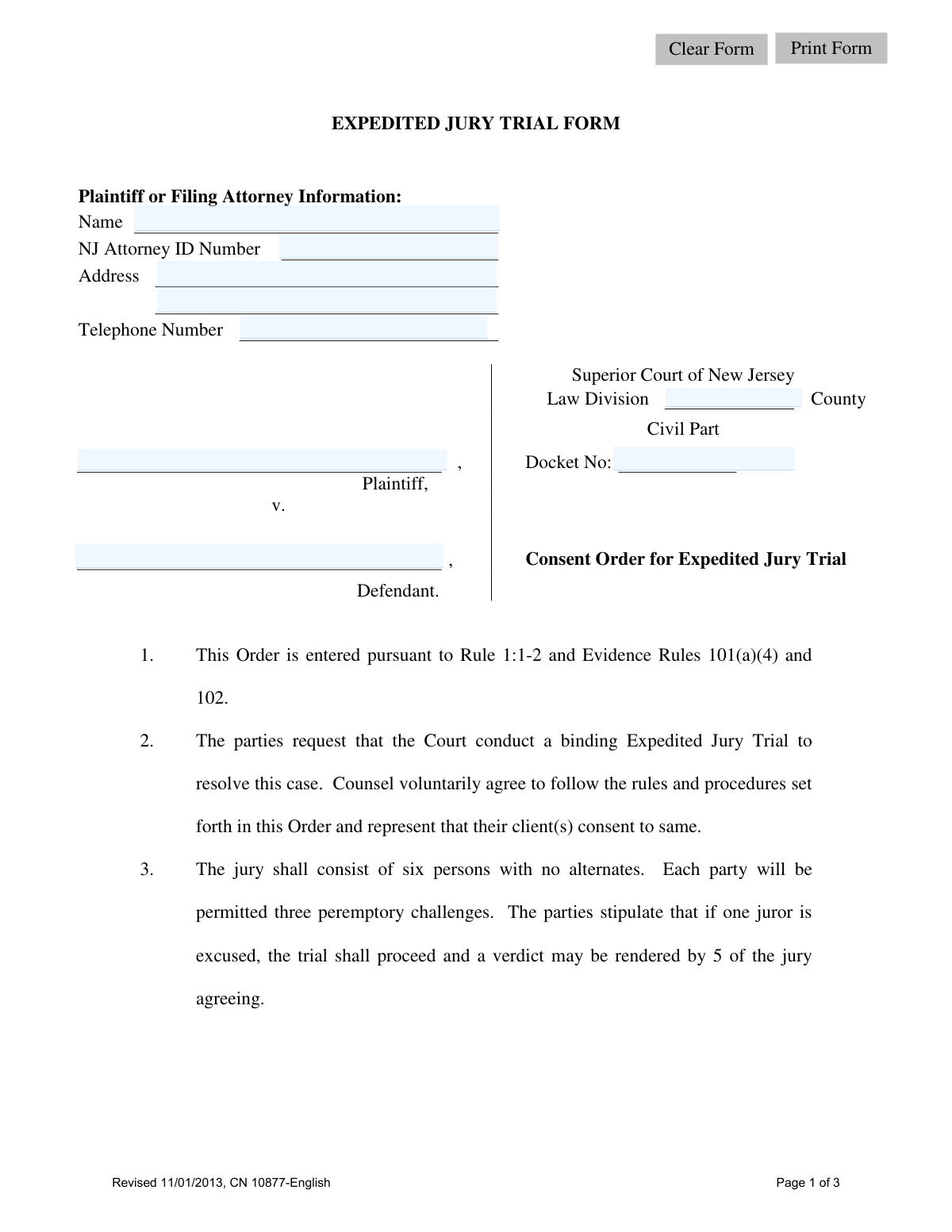
Yes! You can use AI to fill out Superior Court of New Jersey, Consent Order for Expedited Jury Trial
This form is a binding agreement, known as a Consent Order, submitted to the Superior Court of New Jersey's Law Division. Parties voluntarily agree to specific rules for an expedited jury trial, including limitations on witnesses, evidence presentation, and waived objections, to resolve their case more quickly. Today, this form can be filled out quickly and accurately using AI-powered services like Instafill.ai, which can also convert non-fillable PDF versions into interactive fillable forms.
Our AI automatically handles information lookup, data retrieval, formatting, and form filling.
It takes less than a minute to fill out CN 10877 using our AI form filling.
Securely upload your data. Information is encrypted in transit and deleted immediately after the form is filled out.
Form specifications
| Form name: | Superior Court of New Jersey, Consent Order for Expedited Jury Trial |
| Number of fields: | 14 |
| Number of pages: | 1 |
| Language: | English |
Instafill Demo: How to fill out PDF forms in seconds with AI
How to Fill Out CN 10877 Online for Free in 2026
Are you looking to fill out a CN 10877 form online quickly and accurately? Instafill.ai offers the #1 AI-powered PDF filling software of 2026, allowing you to complete your CN 10877 form in just 37 seconds or less.
Follow these steps to fill out your CN 10877 form online using Instafill.ai:
- 1 Navigate to Instafill.ai and upload or select the Expedited Jury Trial Form.
- 2 Use the AI assistant to input the Plaintiff or Filing Attorney's information, including name, NJ Attorney ID number, address, and phone number.
- 3 Enter the specific case details such as the County, Civil Part, Docket Number, and the full names of the Plaintiff and Defendant.
- 4 Carefully review the pre-set stipulations regarding jury size, evidence rules, and waived objections to ensure all parties are in agreement.
- 5 If there are any additional stipulations or orders agreed upon by both parties, add them to the space provided in section 9.
- 6 Electronically sign the form in the designated fields for the attorneys representing the plaintiff and defendant.
- 7 Download, print, and submit the completed and signed consent order to the court for the judge's signature and official entry.
Our AI-powered system ensures each field is filled out correctly, reducing errors and saving you time.
Why Choose Instafill.ai for Your Fillable CN 10877 Form?
Speed
Complete your CN 10877 in as little as 37 seconds.
Up-to-Date
Always use the latest 2026 CN 10877 form version.
Cost-effective
No need to hire expensive lawyers.
Accuracy
Our AI performs 10 compliance checks to ensure your form is error-free.
Security
Your personal information is protected with bank-level encryption.
Frequently Asked Questions About Form CN 10877
This form is a consent order for parties in a New Jersey civil case to agree to a faster, simplified, and binding jury trial with modified rules for evidence and procedure.
The attorneys for both the plaintiff and the defendant must complete and sign the form, certifying that their clients consent to the expedited trial process. A judge must also sign it to make it an official court order.
Yes, the form specifies that the trial is binding. A final judgment will be entered based on the jury's verdict.
An expedited trial uses a smaller six-person jury, strictly limits each side to one live witness, and has shorter time limits for arguments. It also streamlines the evidence process by having parties waive many common objections beforehand.
Each party is limited to calling only one lay witness for live testimony, which can include a videotaped deposition. Other evidence, like expert reports and documents, is submitted as exhibits without live testimony.
You will need the filing attorney's name, NJ Attorney ID number, address, and phone number, as well as the county, court docket number, and the names of the plaintiff and defendant.
The parties agree to waive many common trial objections, such as 'leading' or 'argumentative.' Key objections related to relevance or prejudice are ruled on by the judge before the trial begins.
The jury consists of six people with no alternates. A binding verdict can be reached if at least five of the six jurors agree on the outcome.
It means that both the plaintiff and the defendant must voluntarily agree to all the terms and procedures outlined in the form. The trial cannot proceed under these expedited rules without the consent of all parties.
Subject to the court's discretion, each attorney is allowed a maximum of 15 minutes for their opening statement and 30 minutes for their summation.
Yes, services like Instafill.ai use AI to accurately auto-fill form fields from your saved information, which can save you time and reduce errors.
You can use a service like Instafill.ai to upload the form, fill it out interactively online, and then download the completed document for printing and signing.
Tools like Instafill.ai can convert flat, non-fillable PDFs into interactive forms that you can easily type into directly from your computer.
After the attorneys for both parties sign the consent form, it is submitted to a judge. Once the judge signs it, it becomes an official and binding court order.
Compliance CN 10877
Validation Checks by Instafill.ai
1
Ensures Filing Attorney Name is Provided
This validation checks that the 'filerName' field is not empty. The name of the plaintiff or filing attorney is essential for identifying the responsible party submitting the form and for all official court correspondence. A failure to provide this name would render the form invalid and prevent it from being docketed or processed.
2
Validates NJ Attorney ID Number Format
This check verifies that the 'filerIDNumber' field contains a value that conforms to the standard format for a New Jersey Attorney ID. This ID is a unique identifier crucial for verifying the attorney's credentials and good standing with the state bar. An invalid or missing ID could lead to rejection of the filing, as it questions the authority of the filer.
3
Verifies Telephone Number Format
This validation ensures that the 'filerPh' field contains a valid 10-digit telephone number, accommodating common formats like (XXX) XXX-XXXX or XXX-XXX-XXXX. A correct phone number is critical for the court or opposing counsel to contact the filing attorney regarding the case. An invalid format could prevent communication, causing delays or missed deadlines.
4
Checks for Complete Filer Address
This check confirms that the 'filerAddr' field is not left blank and contains basic address components. A complete and accurate mailing address is mandatory for serving official notices, orders, and other legal documents from the court. An incomplete or missing address will result in the form's rejection, as it prevents official communication.
5
Validates County Selection
This validation ensures that the 'TypeCounty' field contains a valid New Jersey county name, preferably from a pre-approved list. Specifying the correct county is fundamental as it determines the proper venue and jurisdiction for the case. An incorrect or misspelled county name would cause the case to be misrouted, leading to significant administrative delays.
6
Ensures Docket Number Presence and Format
This check verifies that the 'caseDocket' field is filled and adheres to the specific format used by the New Jersey Superior Court (e.g., CNTY-L-NNNNNN-YY). The docket number is the primary unique identifier for a case within the court system. A missing or incorrectly formatted docket number would make it impossible to associate the form with the correct case file, leading to immediate rejection.
7
Requires Plaintiff Name
This validation confirms that the 'plaName' field, identifying the plaintiff, is not empty. The identity of the plaintiff is a core component of any legal action and is necessary to properly caption the case. Without the plaintiff's name, the form is fundamentally incomplete and cannot be processed by the court clerk.
8
Requires Defendant Name
This validation confirms that the 'defName' field, identifying the defendant, is not empty. The identity of the defendant is essential for defining the parties to the dispute and ensuring proper notice. A submission lacking the defendant's name is incomplete and would be rejected as it fails to properly identify the opposing party.
9
Logical Check for Distinct Plaintiff and Defendant
This check ensures that the value entered in the 'plaName' field is not identical to the value in the 'defName' field. In a standard civil lawsuit, a party cannot sue itself, so having the same name for both plaintiff and defendant indicates a likely data entry error. This check prevents the submission of a logically flawed form that would require correction.
10
Validates Order Date Format and Plausibility
This validation checks that the 'sigDt' field contains a date in a valid format (e.g., MM/DD/YYYY) and that the date is not in the future. The date of the order is a critical piece of information establishing when the order becomes effective. An invalid or future date would create legal ambiguity and cause the form to be returned for correction.
11
Ensures Plaintiff's Attorney Consent
This check verifies that the 'sigPlaAtty' field is not empty, indicating that the attorney for the plaintiff has provided their signature or name. As this is a 'Consent Order,' the explicit consent of all parties is mandatory for the expedited trial rules to apply. A missing signature from the plaintiff's side invalidates the agreement and would prevent the judge from signing the order.
12
Ensures Defendant's Attorney Consent
This check verifies that the 'sigDefAtty' field is not empty, indicating that the attorney for the defendant has provided their signature or name. The consent of the defendant's counsel is equally as crucial as the plaintiff's for this 'Consent Order' to be binding. The absence of this signature signifies a lack of agreement, making the entire order unenforceable and subject to rejection.
13
Cross-Validates Attorney Name and ID
This validation ensures that if the 'filerName' field is filled, the 'filerIDNumber' field must also be filled. The form is intended to be filed by a licensed attorney, who is identified by both name and their official ID number. This check prevents submissions from individuals who may not be authorized attorneys and ensures the filer can be properly verified.
Common Mistakes in Completing CN 10877
Users often make typos, transpose digits, or omit the required prefix (e.g., 'L-') when entering the docket number. This happens due to manual data entry errors or referencing outdated documents. An incorrect docket number is a critical error that can lead to the form being rejected by the clerk, misfiled with the wrong case, or significant processing delays, jeopardizing the trial schedule. To avoid this, always cross-reference the docket number with the most recent official court filing or notice.
The names of the plaintiff and defendant entered on the form must exactly match the official case caption. Common mistakes include using abbreviations, misspellings, or omitting parties in multi-party litigation. These discrepancies can create legal ambiguity and may require an amended filing, causing delays. It is essential to copy the names precisely from the original complaint or the court's case summary to ensure consistency.
Attorneys sometimes forget to enter their New Jersey Attorney ID Number or input an incorrect one. This unique identifier is crucial for the court to verify the attorney's standing and associate the filing with the correct counsel of record. Leaving this field blank or providing an invalid number can result in the court clerk rejecting the document. AI-powered tools like Instafill.ai can store and auto-populate this information, eliminating the risk of omission or typos.
Filers frequently provide an incomplete address, such as omitting a suite number, floor, or correct ZIP code. This often occurs when rushing to complete the form. An incomplete address can cause crucial court notices and correspondence to be delayed or returned as undeliverable. Always provide the full, official mailing address for your firm to ensure timely communication from the court.
This is a 'Consent Order,' meaning it is void without the signatures of attorneys for both the plaintiff(s) and defendant(s). A common mistake is submitting the form with only one party's signature, rendering the agreement unenforceable and the filing invalid. Before submitting, ensure all required signature lines are completed to certify that all parties consent to the expedited trial provisions. If the form is a flat PDF, a tool like Instafill.ai can make it fillable to easily add digital signatures.
Section 9, 'The following is also stipulated or ordered,' is intended for any additional agreements between the parties. A mistake is to either leave it blank when custom stipulations exist or to fill it with poorly worded, ambiguous language. This can lead to disputes over the terms of the agreement during the trial. Any additional stipulations should be drafted with clear, precise legal language agreed upon by both parties.
Entering the wrong county name in the 'Superior Court of New Jersey' section is a frequent error, often due to a typo or confusion in cases with multi-county jurisdiction. This mistake will cause the document to be filed in the wrong venue, leading to immediate rejection and the need to refile in the correct county. Double-check the case's official venue before filling out this field to prevent unnecessary delays.
An undated signature can raise questions about when the consent was actually given, potentially affecting the order's validity. Attorneys sometimes sign the document but forget to fill in the date field next to their signature or the 'IT IS SO ORDERED' date. Always ensure that every signature is accompanied by the correct date to maintain a clear and enforceable record of the agreement.
The top section is for 'Plaintiff or Filing Attorney Information,' but users sometimes mistakenly enter the plaintiff's name instead of the attorney's. The court needs the contact information of the filing attorney for communication and record-keeping. This error can cause confusion and misdirected correspondence. The attorney's name, ID, address, and phone number should be entered in this section.
Phone numbers are often entered in non-standard formats, with missing area codes, or containing typos. This can prevent the court clerk or opposing counsel from being able to make contact if urgent questions arise regarding the filing. To avoid this, use a standard format like (XXX) XXX-XXXX and double-check the number for accuracy. Form-filling tools like Instafill.ai can help by automatically formatting phone numbers correctly.
Saved over 80 hours a year
“I was never sure if my IRS forms like W-9 were filled correctly. Now, I can complete the forms accurately without any external help.”
Kevin Martin Green
Your data stays secure with advanced protection from Instafill and our subprocessors

Robust compliance program
Transparent business model
You’re not the product. You always know where your data is and what it is processed for.
ISO 27001, HIPAA, and GDPR
Our subprocesses adhere to multiple compliance standards, including but not limited to ISO 27001, HIPAA, and GDPR.
Security & privacy by design
We consider security and privacy from the initial design phase of any new service or functionality. It’s not an afterthought, it’s built-in, including support for two-factor authentication (2FA) to further protect your account.
Fill out CN 10877 with Instafill.ai
Worried about filling PDFs wrong? Instafill securely fills superior-court-of-new-jersey-consent-order-for-expedited-jury-trial forms, ensuring each field is accurate.