Yes! You can use AI to fill out Superior Court of New Jersey, Report and Award of Arbitrator(s) - Auto / Personal Injury

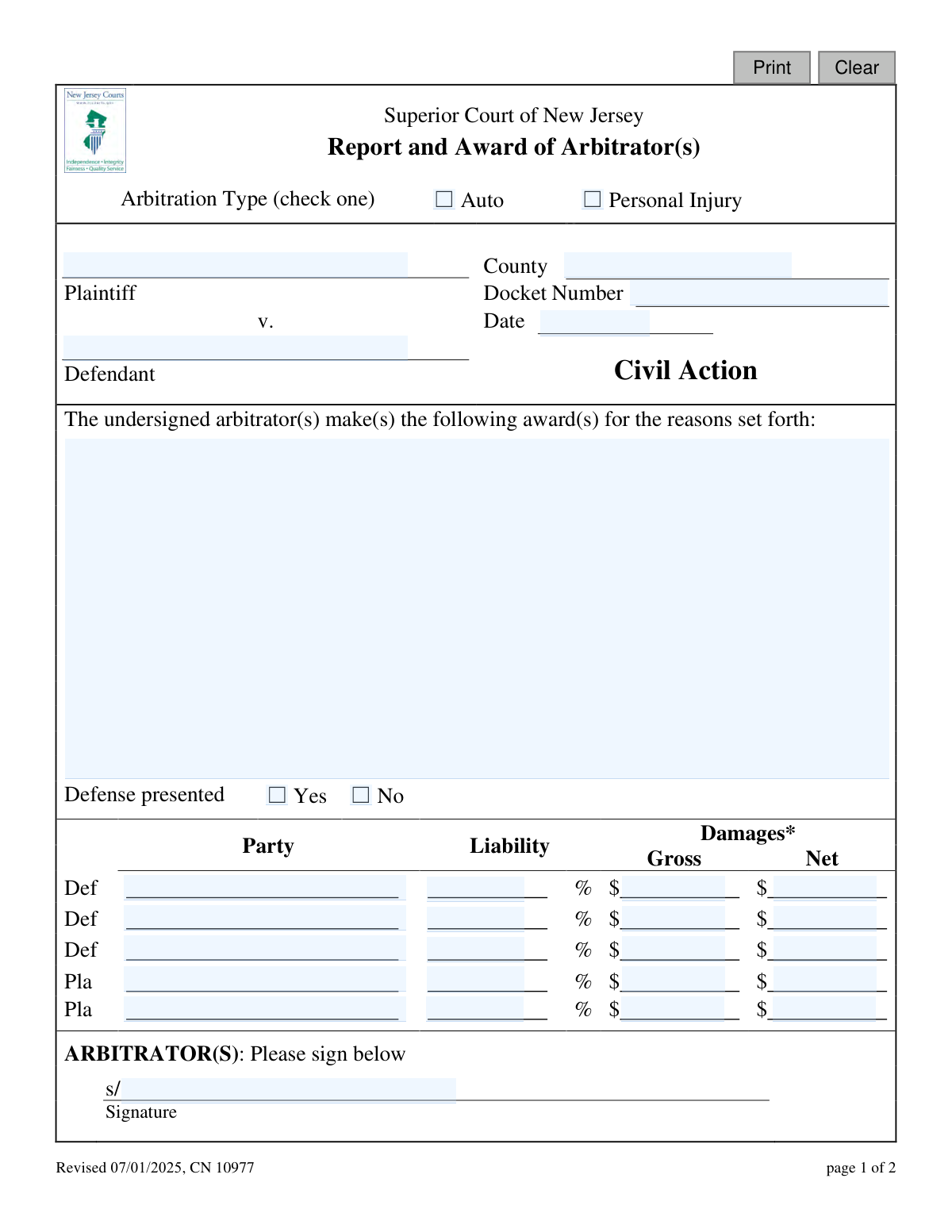
This is an official form from the Superior Court of New Jersey used by one or more arbitrators to report their decision and any monetary awards in auto or personal injury cases. It formalizes the outcome of the arbitration by detailing party liability percentages, damage calculations, and the reasons for the award. Today, this form can be filled out quickly and accurately using AI-powered services like Instafill.ai, which can also convert non-fillable PDF versions into interactive fillable forms.
CN 10977 is part of the New Jersey forms and superior court forms categories on Instafill.
Our AI automatically handles information lookup, data retrieval, formatting, and form filling.
It takes less than a minute to fill out CN 10977 using our AI form filling.
Securely upload your data. Information is encrypted in transit and deleted immediately after the form is filled out.

Form specifications

Form name: Superior Court of New Jersey, Report and Award of Arbitrator(s) - Auto / Personal Injury
Number of fields: 36
Number of pages: 1
Language: English
main-image

Instafill Demo: How to fill out PDF forms in seconds with AI

How to Fill Out CN 10977 Online for Free in 2026

Are you looking to fill out a CN 10977 form online quickly and accurately? Instafill.ai offers the #1 AI-powered PDF filling software of 2026, allowing you to complete your CN 10977 form in just 37 seconds or less.
Follow these steps to fill out your CN 10977 form online using Instafill.ai:
  1. 1 Navigate to Instafill.ai and upload or select the 'Report and Award of Arbitrator(s)' form.
  2. 2 Provide the case information, including the county, docket number, plaintiff and defendant names, and the date.
  3. 3 Select the arbitration type (Auto or Personal Injury) and indicate whether a defense was presented.
  4. 4 Use the AI assistant to accurately input the liability percentages and gross/net damage amounts for each party involved.
  5. 5 Clearly state the reasons for the award in the provided description field.
  6. 6 Review all entered information for correctness, then as the arbitrator(s), digitally sign the document in the designated signature fields.
  7. 7 Download the completed CN 10977 form to file with the court's division manager and share with the involved parties.

Our AI-powered system ensures each field is filled out correctly, reducing errors and saving you time.

Why Choose Instafill.ai for Your Fillable CN 10977 Form?

Speed

Complete your CN 10977 in as little as 37 seconds.

Up-to-Date

Always use the latest 2026 CN 10977 form version.

Cost-effective

No need to hire expensive lawyers.

Accuracy

Our AI performs 10 compliance checks to ensure your form is error-free.

Security

Your personal information is protected with bank-level encryption.

Frequently Asked Questions About Form CN 10977

This form is used by arbitrators in the Superior Court of New Jersey to officially document their decision and the monetary award, if any, in an auto or personal injury arbitration case.

The arbitrator(s) assigned to the case are responsible for filling out the details of the award, including liability and damages, and signing the form. The parties or their counsel then sign to acknowledge receipt of the award.

A 'trial de novo' is a request for a new trial in the Superior Court, which essentially rejects the arbitrator's award. This allows the case to be heard again by a judge or jury as if the arbitration never happened.

To reject the award, you must file a 'trial de novo' request with the division manager within 30 days of the award date. A fee of $265 must be paid at the time of filing.

Gross damages represent the total amount of compensation awarded before any reductions. Net damages are the final amount payable after applying a party's percentage of liability, which reduces the gross amount accordingly.

The 'Liability %' assigns a percentage of fault to each party involved in the case. For example, if a plaintiff is found to be 10% at fault, their gross damage award will be reduced by 10% to calculate the net award.

No, signing the bottom of the form only acknowledges that you have received a copy of the arbitrator's award. It does not indicate your agreement with the decision.

Not necessarily. The form explicitly states that the damage amounts are 'Exclusive of prejudgment interest,' so additional interest may be calculated and added to the final judgment if applicable.

The arbitrator will need the case details (County, Docket Number, Plaintiff/Defendant names), the date, and the specific findings on liability percentages and gross damage amounts for each party.

This checkbox indicates whether the defendant and their counsel participated in the arbitration hearing and presented a defense. The arbitrator checks 'Yes' or 'No' based on the proceedings.

Yes, services like Instafill.ai use AI to help you accurately auto-fill form fields, which can save time and reduce errors. This is especially useful for legal professionals who handle many similar cases.

You can use a service like Instafill.ai to upload the form and fill it out online. The platform allows you to easily enter information into the fields, save your progress, and download the completed document.

If you have a flat, non-fillable PDF, you can upload it to Instafill.ai. The service can automatically convert it into an interactive, fillable form for you to complete online.

Compliance CN 10977
Validation Checks by Instafill.ai

1
Ensures Arbitration Type is Selected
This check verifies that either 'Auto' or 'Personal Injury' has been selected for the 'Arbitration Type'. This is a mandatory field as it defines the legal context and applicable rules for the arbitration. Failure to select a type will prevent form submission, as the case cannot be correctly categorized.
2
Validates Docket Number Presence and Format
This validation ensures the 'Docket Number' field is not empty and conforms to the standard format for New Jersey Superior Court civil actions. The docket number is the primary unique identifier for the case within the court system, and an incorrect or missing number would make it impossible to file the award correctly. The submission will be rejected if the format is invalid or the field is blank.
3
Requires Core Party and Venue Information
This check confirms that the 'Plaintiff', 'Defendant', and 'County' fields are all populated. This information is essential for identifying the primary parties and the legal jurisdiction of the case. Without this data, the award document is legally insufficient and cannot be properly recorded or enforced.
4
Verifies a Valid and Logical Award Date
This validation ensures the 'Date' field (`orderDt`) contains a valid date in the expected format (e.g., MM/DD/YYYY) and is not a future date. The date of the award is legally significant, as it starts the 30-day clock for any appeals. An invalid or future date would create legal ambiguity and cause the submission to be rejected.
5
Confirms Selection for 'Defense Presented'
This check requires that either 'Yes' or 'No' is selected for the 'Defense presented' field. This is a specific finding the arbitrator must report and is a required element of the arbitration summary. A missing selection results in an incomplete report, and the form cannot be submitted until a choice is made.
6
Ensures Total Liability Sums to 100%
This validation calculates the sum of all liability percentages entered for both plaintiffs and defendants (`liability`, `liability2`, etc.). The total must equal exactly 100% to ensure that all fault has been allocated. An award that allocates more or less than 100% of the liability is logically and legally flawed, so the system will return an error and prevent submission.
7
Validates Numeric Format for Damage Amounts
This check verifies that all 'Gross' and 'Net' damage fields contain only valid, non-negative numeric or currency values. Entering text or negative numbers would make the financial calculations of the award impossible and legally void. The system will flag any non-numeric entries and require correction before submission.
8
Validates Range of Liability Percentage
This validation ensures that each individual liability percentage entered is a number between 0 and 100, inclusive. A percentage outside this range is mathematically impossible and indicates a data entry error. This check prevents illogical allocations of fault and is critical for the integrity of the award calculation.
9
Checks for Logical Consistency Between Gross and Net Damages
This check ensures that for any given party, the entered 'Net' damages amount is not greater than the 'Gross' damages amount. Gross damages represent the total award before any reductions, so the net amount cannot logically exceed it. This serves as a crucial sanity check on the financial figures to catch significant data entry or calculation errors.
10
Requires at Least One Arbitrator Signature
This validation confirms that the arbitrator's signature field (`arbSig`) is not empty. The arbitrator's signature is what makes the report an official and binding award. Without it, the document has no legal authority, so the form cannot be considered complete or valid for submission.
11
Ensures Party Name is Present for Award Rows
This check verifies that if any liability or damage amount is entered in a row, the corresponding party name field (`defParty`, `plaParty`, etc.) is also filled out. It is impossible to assign liability or damages without identifying the party to whom they are assigned. This prevents the creation of 'orphan' awards that are legally unenforceable.
12
Verifies Award Reasoning is Provided
This validation checks that the 'awardDesc' field, which contains the reasons for the award, is not empty. While the core of the award is the financial figures, the narrative reasoning is crucial for understanding the arbitrator's decision and for any subsequent legal review or appeal. The system should issue a strong warning or block submission if this field is left blank.
13
Cross-Validates Liability and Damage Entries
This check ensures that if a party is assigned a liability percentage greater than zero, a corresponding gross damage amount is also entered. An allocation of fault is typically meaningless without an associated damage figure to which it applies. This validation prevents incomplete or ambiguous award entries that could lead to disputes over the final amount owed.

Common Mistakes in Completing CN 10977

Incorrect or Incomplete Docket Number

Users often mistype the docket number or use an incorrect format, which is crucial for identifying the case. This happens due to simple data entry errors or not having the correct case file on hand. An incorrect docket number can lead to the award being filed in the wrong case, causing significant administrative delays and potential legal complications that require motions to correct.

Mathematical Errors in Net Award Calculation

The form requires calculating the 'Net' award by applying the 'Liability %' to the 'Gross' damages, a frequent source of manual calculation errors. For example, a 20% liability for a plaintiff should result in a net award of 80% of the gross amount, but this is often miscalculated. Such errors make the award legally incorrect and unenforceable, requiring amendment and refiling, which delays payment and case closure.

Incorrect Apportionment of Liability

When multiple parties are involved, the sum of all assigned liability percentages for both plaintiffs and defendants must equal exactly 100%. Arbitrators sometimes miscalculate this total, especially in complex cases with several parties. An award with liability not totaling 100% is facially defective and will be rejected by the court, invalidating the entire liability assessment.

Improperly Including Prejudgment Interest

A footnote explicitly states that damage amounts are 'Exclusive of prejudgment interest,' but filers sometimes include it in the 'Gross' damages field. This mistake occurs when filers overlook the fine print or are accustomed to other forms where interest is included. Including it results in an incorrect award amount that can be challenged and may require the award to be amended and reissued.

Insufficient Rationale for the Award

The free-text section for the award's reasoning is often filled with vague or conclusory statements instead of a clear explanation of the findings. This happens when arbitrators rush or fail to detail the basis for their decisions on liability and damages. A poorly reasoned award is more susceptible to being challenged or appealed, as it fails to provide a clear record of the decision-making process.

Missing Arbitrator's Signature

The arbitrator's signature is what validates the award, but it can be easily overlooked in the rush to complete the paperwork. An unsigned award is not a valid legal document and has no legal effect. This oversight will cause the court to reject the filing, halting all post-arbitration deadlines and processes until a properly signed form is submitted.

Omitting the Arbitration Type

Filers frequently forget to check the 'Auto' or 'Personal Injury' box at the top of the form. This information is essential for the court's case management and statistical tracking. Forgetting to specify the arbitration type can lead to administrative processing delays or the form being returned for completion, slowing down the finalization of the case.

Using an Obsolete Form Version

Courts regularly update their forms, and this one has a revision date of '07/01/2025'. Using an older version is a common mistake that leads to automatic rejection by the court clerk. This forces the arbitrator to re-prepare the entire award on the current form, wasting time and delaying the start of the 30-day period for any trial de novo request.

Reversing Plaintiff and Defendant Roles

In the caption and award sections, filers sometimes inadvertently switch the plaintiff and defendant names. This simple but critical error can occur due to haste or confusion, especially in cases with counterclaims. Reversing the parties renders the award nonsensical and legally unenforceable, requiring a corrected filing to ensure the award is applied to the correct parties.

Failure to Obtain Signatures for Receipt

The second page requires signatures from counsel or pro se litigants to acknowledge receipt of the award, but these are often missed. This is critical as the signature starts the 30-day clock for a trial de novo request. Without these signatures, a party could later dispute the date of receipt, creating legal arguments over deadlines and potentially invalidating a rejection as untimely.
Saved over 80 hours a year

“I was never sure if my IRS forms like W-9 were filled correctly. Now, I can complete the forms accurately without any external help.”

Kevin Martin Green

Your data stays secure with advanced protection from Instafill and our subprocessors

Robust compliance program

Transparent business model

You’re not the product. You always know where your data is and what it is processed for.

ISO 27001, HIPAA, and GDPR

Our subprocesses adhere to multiple compliance standards, including but not limited to ISO 27001, HIPAA, and GDPR.

Security & privacy by design

We consider security and privacy from the initial design phase of any new service or functionality. It’s not an afterthought, it’s built-in, including support for two-factor authentication (2FA) to further protect your account.

Fill out CN 10977 with Instafill.ai

Worried about filling PDFs wrong? Instafill securely fills superior-court-of-new-jersey-report-and-award-of-arbitrators-auto-personal-injury forms, ensuring each field is accurate.

Related forms by category

New Jersey forms State of New Jersey Alternate Benefit Program Withdrawal Request Acknowledgement Receipt, Horizon Blue Cross Blue Shield of New Jersey Applied Behavior Analysis Supplemental Information Form, State of New Jersey Application for Employment (Form DPF-663), New Jersey Judiciary Plea Form (Plea 01), Supplemental Plea Form for Certain Sexual Offenses: Megan’s Law/Parole Supervision for Life/Community Supervision for Life (Plea 05), Financial Questionnaire to Establish Indigency, New Jersey Judiciary Resource Family Information Form, Foreclosure Case Information Statement (FCIS) - Appendix XII-B2, New Jersey Judiciary Records Request Form, Superior Court of New Jersey, Application for Appeal and Order, FL Certification of Requested Background Checks for Kinship Legal Guardianship, Certification of Caregiver as to Knowledge of Identity and/or Location of Parents, FL Order Judgment for Kinship Legal Guardianship, New Jersey Judiciary Certification of Repair and Plea of Guilty, Uniform Summary Support Order (USSO), New Jersey Judiciary Volunteer Application (CN 10293), Application to Take the New Jersey Court Interpreter Oral Examination, New Jersey Judiciary Attorney Fee Arbitration Request, Order to Show Cause with Temporary Restraints Pursuant to Rule 4:52, Tax Court of New Jersey, State Tax Complaint · + 158 more →
superior court forms FW-003, Order on Court Fee Waiver (Superior Court), FW-003, Order on Court Fee Waiver (Superior Court), Form FW-003, Order on Court Fee Waiver (Superior Court), Declaration of Facts of Death (California Superior Court), Form FW-003-GC, Order on Court Fee Waiver (Superior Court) (Ward or Conservatee), Superior Court of Chatham County, Georgia, Hearing Request Form, Form FW-006, Request for Hearing About Court Fee Waiver Order (Superior Court), Form FW-002, Request to Waive Additional Court Fees (Superior Court), Form FW-008, Order on Court Fee Waiver After Hearing (Superior Court), Form FW-002-GC, Request to Waive Additional Court Fees (Superior Court) (Ward or Conservatee), Form REC-001(N), Notice of Intent to Destroy Superior Court Records; Offer to Transfer Possession, Form REC-001(R), Request for Transfer or Extension of Time for Retention of Superior Court Records, Notice of Hearing on Request for Transfer or Extension of Time for Retention of Superior Court Records; Court Order; Release and Receipt of Superior Court Records, Form REC-002(R), Release and Receipt of Superior Court Records, Superior Court of New Jersey, Application for Appeal and Order, Superior Court of New Jersey Dissolution (FM) Case Management Order, New Jersey Judiciary – Superior Court, Appellate Division Application for Permission to File Emergent Motion, New Jersey Judiciary Superior Court - Appellate Division Civil Case Information Statement, New Jersey Judiciary Superior Court - Appellate Division Criminal Case Information Statement, New Jersey Judiciary Superior Court - Appellate Division Notice of Appeal (CN: 10502) · + 23 more →