
Yes! You can use AI to fill out Uniform Residential Loan Application (Freddie Mac Form 65 / Fannie Mae Form 1003)
Don't type 473 fields by hand. Tell our AI about yourself, or upload a document you already have, and it fills every field in seconds. You check it, then download, print or sign.
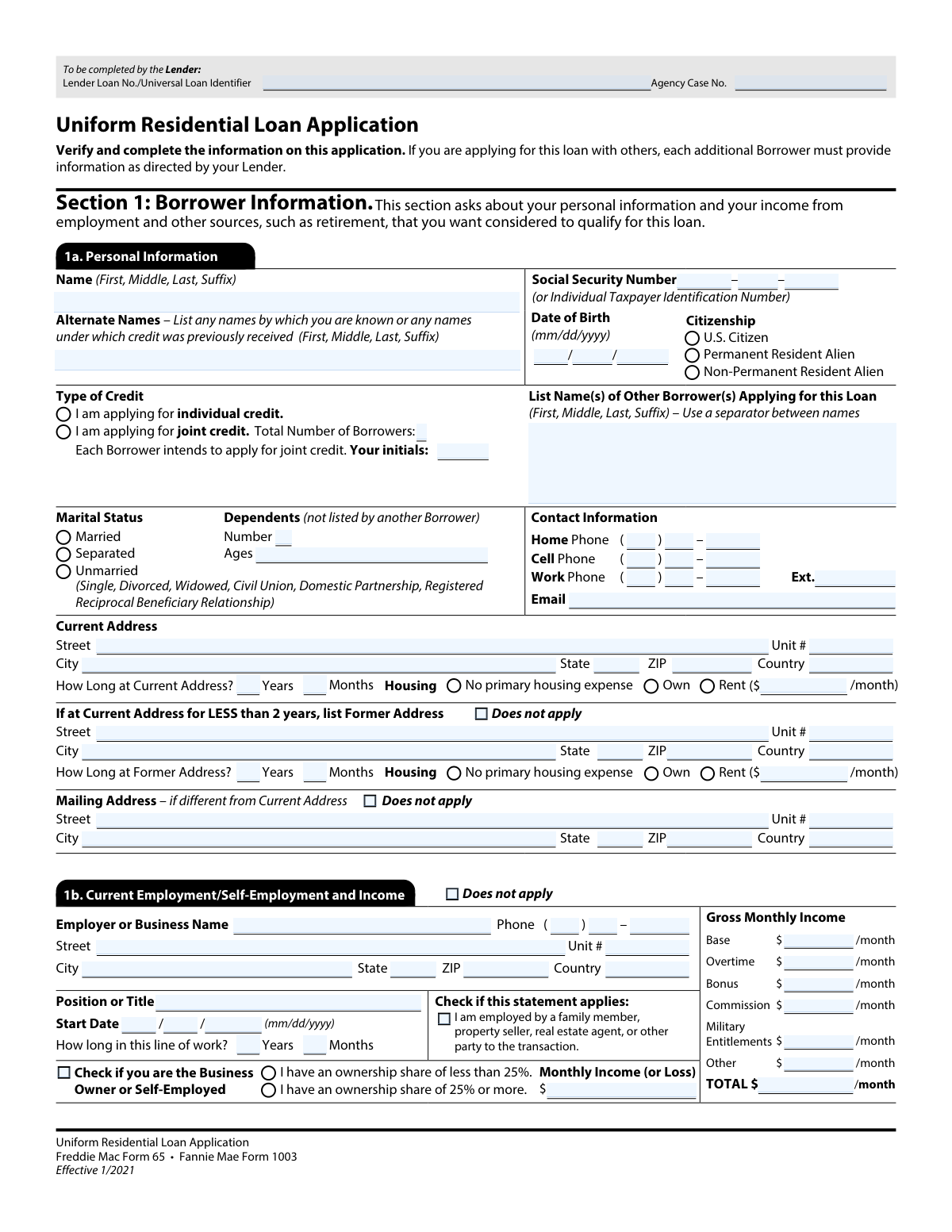
The AI does the filling. You just check it.
No typing into boxes, nothing to install.
What this form asks for
The AI fills all of it, from your answers or your documents.
The AI checks your answers before you download
15 checks built for this form, so a wrong date or a missing answer is caught before anyone else sees it.
Validate that the Borrower Name (first, last; middle/suffix if provided) is present and contains only allowed characters (letters, spaces, hyphens, apostrophes) and does not include numeric-only or placeholder text (e.g., 'N/A'). This is important for identity verification, credit pulls, and document matching across disclosures and closing documents. If validation fails, the submission should be rejected or routed for manual review with a request to correct the name fields.
If the applicant provides any indication of prior names (or the lender workflow flags a mismatch with credit/ID), require at least one Alternate Name entry and validate it uses the same name rules as the primary name. Alternate names are critical for accurate credit history retrieval and fraud prevention. If missing or malformed, the system should block credit ordering and prompt the applicant to add/correct alternate names.
Validate that the Social Security Number is exactly 9 digits (optionally formatted as XXX-XX-XXXX) or that an ITIN is 9 digits with valid ITIN patterns, and ensure only one identifier type is captured per borrower record. This prevents failed credit bureau requests and reduces identity errors. If validation fails, the application should not proceed to underwriting/credit pull and must request a corrected identifier.
Validate all dates are in mm/dd/yyyy format and represent real calendar dates (no 02/30, etc.). Apply reasonableness rules: DOB cannot be in the future and should indicate an adult borrower per program rules; employment start/end dates cannot be in the future (except projected military expiration) and end date must be after start date; signature dates cannot be in the future. If any date fails, the system should flag the specific field and prevent submission until corrected.
Require exactly one citizenship status selection (U.S. Citizen, Permanent Resident Alien, or Non-Permanent Resident Alien). Citizenship impacts eligibility, documentation requirements, and compliance reporting. If none or multiple are selected, the application should be considered incomplete and blocked from submission.
If 'joint credit' is selected, require Total Number of Borrowers to be a positive integer (>=2), require initials for the joint credit intent statement, and require at least one other borrower name listed using the specified separator rules. If 'individual credit' is selected, ensure Total Number of Borrowers is blank or equals 1 and that no other borrower names are provided. If inconsistent, the system should stop processing because it affects disclosures, liability, and underwriting.
And 9 more checks
- Marital Status Required and Valid Value Set Enforcement
- Dependents Count/Ages Logical Validation
- Phone Number and Email Format Validation (Including Extension Rules)
- Current Address Completeness and Residency Duration Validation
- Housing Expense and Tenure Consistency (Own/Rent/No Expense)
- Employment Section Completeness When Not Marked 'Does Not Apply'
- Self-Employment and Ownership Share Selection Rules
- Income Totals Arithmetic Validation (Employment and Other Income)
- Assets/Liabilities Numeric and Account Identifier Validation
Let AI fill out your URLA (Form 1003/65)
No typing. Every field filled in seconds, checked, ready to sign.
How to Fill Out URLA (Form 1003/65) Online for Free in 2026
What the AI walks you through.
- Enter borrower personal details in Section 1 (name, SSN/ITIN, DOB, citizenship, marital status, dependents, contact info, and address history).
- Add employment and income information in Sections 1b–1e (current/previous jobs, self-employment indicators, and other income sources you want considered).
- List financial accounts and funds in Section 2 (bank/retirement accounts, other assets/credits) and disclose monthly liabilities and other expenses.
- Provide real estate information in Section 3 (properties owned, values, mortgage details, occupancy, and rental income where applicable).
- Complete loan and subject property details in Section 4 (loan purpose, loan amount, property address/units/value, other financing, rental income, and gifts/grants).
- Answer all required declarations and acknowledgments in Sections 5–6 (occupancy, undisclosed borrowing/credit, legal/credit events, and sign/date authorizations).
- Finish remaining sections as applicable (Sections 7–9: military service, optional demographic information, and loan originator details) and review for accuracy before submitting.
Common Mistakes in Completing URLA (Form 1003/65)
The ones the AI is built to catch.
Name and alternate-name mismatches (missing middle name/suffix/previous names)
Incorrect SSN/ITIN or leaving it blank for a co-borrower
Date format errors (mm/dd/yyyy) and inconsistent employment dates
Selecting the wrong credit type (individual vs. joint) or missing required initials
Address history gaps (less than 2 years) and incomplete address details
Housing expense mistakes (rent/own/no expense) and missing monthly amount
Employment section marked “Does not apply” or missing 2-year history
Misreporting self-employment/business ownership and ownership percentage
Income entry errors (gross vs. net, inconsistent totals, and missing variable income details)
Omitting “other income” that should be counted or disclosing restricted income incorrectly
Assets and liabilities incomplete (missing account numbers, balances, or undisclosed debts/leases)
Declarations answered inaccurately (undisclosed borrowing, new credit, occupancy, or prior property ownership)
Frequently Asked Questions About URLA (Form 1003/65)
Is it really free for 7 days?
Can I fill other forms too?
How do I cancel?
How does the AI fill out URLA (Form 1003/65)?
What happens to my information?
How complex is URLA (Form 1003/65) to fill out?
What is the Uniform Residential Loan Application (Form 1003/Form 65) used for?
Who needs to complete this application if there are multiple borrowers?
What does “Type of Credit: individual vs. joint” mean, and what is the “Total Number of Borrowers” field?
What personal information is required in Section 1a (Borrower Information)?
Do I have to list a former address if I haven’t lived at my current address for two years?
How do I complete employment and income in Sections 1b–1d?
What should I do if I’m self-employed or a business owner?
Do I have to disclose alimony, child support, or separate maintenance income in Section 1e?
What assets should I list in Section 2 (Assets and Liabilities)?
What liabilities do I need to include in Sections 2c and 2d?
If I own real estate, what information is required in Section 3?
What if I do not own any real estate?
How do I fill out Section 4 for a purchase vs. a refinance?
What are the “Declarations” in Section 5, and why do they matter?
Is demographic information in Section 8 required, and what happens if I don’t provide it?
Get your URLA (Form 1003/65) filled out by AI
$0 today. Cancel before Oct 31 and you pay nothing.
Other forms like this one
loan application forms: Form 5, SBA Disaster Loan Application, HomePlus Loan Application (Individuals) – China Banking Corporation (CBC), Account Reduction Loan Application 401(a) Plan, Electrical Workers Local Union No. 369 Retirement Plan, General Purpose Loan Application Packet, IW DC of SOV Annuity Trust, Account Reduction Loan Application 403(b) Plan, Account Reduction Loan Application 401(a) Plan, Uniform Residential Loan Application (Freddie Mac Form 65 / Fannie Mae Form 1003), Uniform Residential Loan Application (Fannie Mae Form 1003 / Freddie Mac Form 65), uniform-residential-loan-application, Uniform Residential Loan Application, Fannie Mae Form 1003 / Freddie Mac Form 65, DSCR Business Purpose Loan Application, Uniform Residential Loan Application (Fannie Mae Form 1003), Public Service Loan Forgiveness (PSLF) & TEPSLF Certification & Application, Form 1003, Uniform Residential Loan Application
Fannie Mae forms: Fannie Mae Residential Broker Price Opinion (BPO) (Revised 03/99), Uniform Underwriting and Transmittal Summary (Fannie Mae Form 1008 / Freddie Mac Form 1077), Uniform Residential Loan Application (Freddie Mac Form 65 / Fannie Mae Form 1003), Fannie Mae Form 1009, Master-Subordinate Subscriber Data Sharing Relationship Form, Fannie Mae Form 10, Authorized Individuals Form, Uniform Residential Appraisal Report (Fannie Mae Form 1004 / Freddie Mac Form 70), Uniform Residential Loan Application (Fannie Mae Form 1003 / Freddie Mac Form 65), Uniform Residential Loan Application, Fannie Mae Form 1003 / Freddie Mac Form 65, Fannie Mae Form 1073 / Freddie Mac Form 465, Individual Condominium Unit Appraisal Report, Uniform Residential Loan Application (Fannie Mae Form 1003)
Freddie Mac forms: Uniform Underwriting and Transmittal Summary (Fannie Mae Form 1008 / Freddie Mac Form 1077), Uniform Residential Loan Application (Freddie Mac Form 65 / Fannie Mae Form 1003), Uniform Residential Appraisal Report (Fannie Mae Form 1004 / Freddie Mac Form 70), Uniform Residential Loan Application (Fannie Mae Form 1003 / Freddie Mac Form 65), Uniform Residential Loan Application, Fannie Mae Form 1003 / Freddie Mac Form 65, Fannie Mae Form 1073 / Freddie Mac Form 465, Individual Condominium Unit Appraisal Report
loan forms: Empower Loan Administration Form, Form 5, SBA Disaster Loan Application, Form 1098-E, Student Loan Interest Statement, HomePlus Loan Application (Individuals) – China Banking Corporation (CBC), Income-Driven Repayment (IDR) Plan Request (PAYE, IBR, and ICR) — William D. Ford Federal Direct Loan (Direct Loan) Program and Federal Family Education Loan (FFEL) Programs (OMB No. 1845-0102), Direct Consolidation Loan Request to Add Loans (William D. Ford Federal Direct Loan Program) (OMB No. 1845-0007), Vanguard Taking a Loan from Your Retirement Plan, Empower Loan Payment Change Request Form, Account Reduction Loan Application 401(a) Plan, Electrical Workers Local Union No. 369 Retirement Plan, General Purpose Loan Application Packet, IW DC of SOV Annuity Trust, Account Reduction Loan Application 403(b) Plan, Empower 401(k) Loan Prepayment Request Form, Account Reduction Loan Application 401(a) Plan, Loan Rehabilitation: Income and Expense Information, William D. Ford Federal Direct Loan (Direct Loan) Program/Federal Family Education Loan (FFEL) Program, Transamerica Online Loan and Distribution Request, Uniform Residential Loan Application (Freddie Mac Form 65 / Fannie Mae Form 1003), Uniform Residential Loan Application (Fannie Mae Form 1003 / Freddie Mac Form 65), uniform-residential-loan-application, Uniform Residential Loan Application, Fannie Mae Form 1003 / Freddie Mac Form 65, DSCR Business Purpose Loan Application
EDD forms: Uniform Underwriting and Transmittal Summary (Fannie Mae Form 1008 / Freddie Mac Form 1077), Uniform Residential Loan Application (Freddie Mac Form 65 / Fannie Mae Form 1003), Uniform Residential Appraisal Report (Fannie Mae Form 1004 / Freddie Mac Form 70), Uniform Residential Loan Application (Fannie Mae Form 1003 / Freddie Mac Form 65), Uniform Residential Loan Application, Fannie Mae Form 1003 / Freddie Mac Form 65, Fannie Mae Form 1073 / Freddie Mac Form 465, Individual Condominium Unit Appraisal Report, Form DE 4, Employee’s Withholding Allowance Certificate (Rev. 56)
Let AI fill out your URLA (Form 1003/65)
Your trial starts once a card is added. You pay nothing before Oct 31.
Our AI already knows this form, all 473 fields of it. Skip the typing: tell it about yourself, or upload what you have, and it fills the whole form in seconds.
- AI fills every field on all 9 pages, tables and checkboxes included
- No typing into boxes: answer a few questions, or upload a document you already have, an old copy of this form, a photo of a document
- The AI checks the answers; you review and change anything before you download
- Download the finished PDF, print it, or sign it online
- Encrypted, and never used to train AI
Cancel before Oct 31 and you pay nothing.
A card is needed to start the trial. Cancel in two clicks from your account.
Terms · Privacy