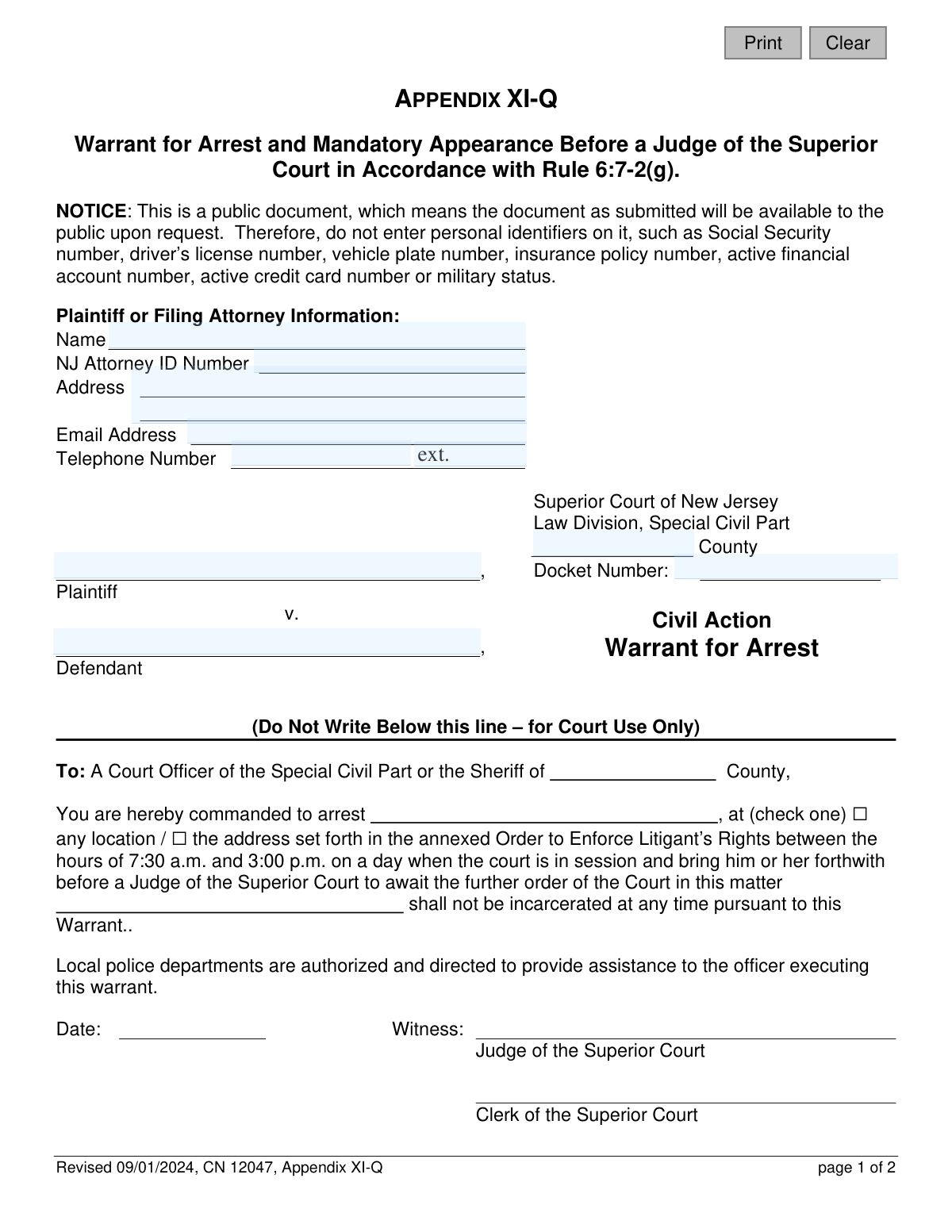
Yes! You can use AI to fill out Warrant for Arrest and Mandatory Appearance Before a Judge of the Superior Court in Accordance with Rule 6:7-2(g) - Appendix XI-Q
Appendix XI-Q is a legal document issued by the Superior Court of New Jersey, Law Division, Special Civil Part. It serves as a warrant commanding a court officer or sheriff to arrest a specific individual and bring them before a judge in relation to a civil action, as per Rule 6:7-2(g). Today, this form can be filled out quickly and accurately using AI-powered services like Instafill.ai, which can also convert non-fillable PDF versions into interactive fillable forms.
Our AI automatically handles information lookup, data retrieval, formatting, and form filling.
It takes less than a minute to fill out Appendix XI-Q using our AI form filling.
Securely upload your data. Information is encrypted in transit and deleted immediately after the form is filled out.
Form specifications
| Form name: | Warrant for Arrest and Mandatory Appearance Before a Judge of the Superior Court in Accordance with Rule 6:7-2(g) - Appendix XI-Q |
| Number of fields: | 12 |
| Number of pages: | 1 |
| Language: | English |
Instafill Demo: How to fill out PDF forms in seconds with AI
How to Fill Out Appendix XI-Q Online for Free in 2026
Are you looking to fill out a APPENDIX XI-Q form online quickly and accurately? Instafill.ai offers the #1 AI-powered PDF filling software of 2026, allowing you to complete your APPENDIX XI-Q form in just 37 seconds or less.
Follow these steps to fill out your APPENDIX XI-Q form online using Instafill.ai:
- 1 Navigate to Instafill.ai and upload or select the Appendix XI-Q form.
- 2 Use the AI assistant to input the Plaintiff or Filing Attorney's information, including name, NJ Attorney ID number, address, and contact details.
- 3 Enter the specific court information, such as the County and the case Docket Number.
- 4 Clearly identify the Plaintiff and Defendant by providing their full names in the designated fields.
- 5 Review all the information you have entered for accuracy, as the remainder of the form is for court use only.
- 6 Download, print, or electronically submit the completed warrant as required for filing with the Superior Court.
Our AI-powered system ensures each field is filled out correctly, reducing errors and saving you time.
Why Choose Instafill.ai for Your Fillable Appendix XI-Q Form?
Speed
Complete your Appendix XI-Q in as little as 37 seconds.
Up-to-Date
Always use the latest 2026 Appendix XI-Q form version.
Cost-effective
No need to hire expensive lawyers.
Accuracy
Our AI performs 10 compliance checks to ensure your form is error-free.
Security
Your personal information is protected with bank-level encryption.
Frequently Asked Questions About Form Appendix XI-Q
This form is a civil warrant used by the New Jersey Superior Court to compel a defendant to appear before a judge. It is typically issued when a person has failed to comply with a previous court order in a civil case, such as an Order to Enforce Litigant’s Rights.
No, this is a civil warrant for arrest, not a criminal one. The purpose is to bring the person to court to address a civil matter, and the form explicitly states the person shall not be incarcerated pursuant to this warrant.
The plaintiff or their attorney fills out the top portion with their information and the case details. The main body of the warrant, including the command to arrest, is completed and signed by a Judge of the Superior Court before it is issued.
You must provide your name, NJ Attorney ID (if applicable), address, email, and phone number. You also need to enter the case details, including the plaintiff and defendant names, the county, and the docket number.
This form is a public document, meaning anyone can request to see it. To protect privacy and prevent identity theft, you must not include sensitive personal identifiers like SSNs, driver's license numbers, or financial account numbers.
This means the defendant will not be held in jail based on this specific warrant. They will be arrested and immediately brought before a judge during court hours to address the civil case matter.
A Court Officer or Sheriff is commanded to arrest the named defendant and bring them directly to a Superior Court Judge. The arrest can only occur between 7:30 a.m. and 3:00 p.m. on a day the court is in session.
You should cooperate with the officer, as you will be taken directly to court, not to jail. It is highly advisable to contact an attorney immediately to understand your rights and the specifics of the case against you.
The warrant is directed to a Court Officer of the Special Civil Part or the Sheriff of the specified county. The form also authorizes local police departments to provide assistance to the officer executing the warrant.
Yes, services like Instafill.ai can use AI to accurately auto-fill form fields with your case and personal information. This helps save time and reduce the risk of errors when completing the plaintiff or attorney information section.
You can use a service like Instafill.ai to complete the form online. Simply upload the form, and the platform will help you fill in the required fields for the plaintiff/attorney section before you print it for submission to the court.
If you have a non-fillable or 'flat' PDF, you can upload it to Instafill.ai. The service can convert the document into an interactive, fillable form that you can complete on your computer.
This rule pertains to proceedings in the Special Civil Part to enforce judgments. Subsection (g) specifically outlines the court's authority to issue a warrant for arrest when a person fails to obey a court order.
Compliance Appendix XI-Q
Validation Checks by Instafill.ai
1
Prohibits Personal Identifiers in All Fields
Scans all submitted text fields to ensure they do not contain personal identifiers as explicitly forbidden by the form's notice. This includes Social Security numbers, driver's license numbers, financial account numbers, and vehicle plate numbers. This check is critical for privacy and compliance with court rules, and failure will result in rejection of the form to protect sensitive data from public record.
2
Validates NJ Attorney ID Number Format
Ensures the 'NJ Attorney ID Number' field, if provided, follows the specific format for New Jersey attorneys. This typically involves a numeric-only value of a certain length. Correctly formatted IDs are essential for verifying the attorney's credentials and standing with the state bar, and a format mismatch will trigger an error.
3
Validates Docket Number Format
Checks that the 'Docket Number' field conforms to the standard structure for NJ Special Civil Part cases, such as 'DC-######-YY'. This validation ensures the warrant is associated with the correct existing case file. An incorrectly formatted docket number could lead to filing rejection or misfiling the document, causing significant legal and administrative delays.
4
Ensures County is a Valid NJ County
Verifies that the 'County' field contains one of the 21 official counties in New Jersey. This is crucial as it determines the jurisdiction of both the Superior Court and the Sheriff executing the warrant. An invalid county name would make the warrant legally unenforceable and will be rejected.
5
Mandatory Case Information Completeness
Confirms that the core fields identifying the case—'Plaintiff Name', 'Defendant Name', 'County', and 'Docket Number'—are all filled out. A warrant is invalid and cannot be processed without this fundamental information. If any of these fields are empty, the submission will be rejected for being incomplete.
6
Validates Attorney/Plaintiff Email Address Format
Checks that the 'Email Address' field contains a structurally valid email address (e.g., '[email protected]'). This is important for ensuring reliable electronic communication and service of documents from the court. An invalid email format will prevent submission until corrected.
7
Validates Attorney/Plaintiff Telephone Number Format
Ensures the 'Telephone Number' field is in a recognizable phone number format (e.g., 10 digits, with or without common separators like parentheses or hyphens). A valid phone number is required for direct contact by court staff. The system should flag entries that do not match a standard phone number pattern.
8
Conditional Requirement for Attorney ID
This check implements logic for pro se litigants. If the 'Plaintiff Name' is identical to the 'Filing Attorney Name', the 'NJ Attorney ID Number' field is not required. However, if the names are different, the Attorney ID is considered mandatory, ensuring that a representing attorney is properly identified.
9
Completeness of Filer's Contact Information
Verifies that if the 'Filing Attorney Name' or 'Plaintiff Name' is provided in the top section, the corresponding 'Address', 'Email Address', and 'Telephone Number' fields are also completed. This ensures the court has full contact information for the filing party. Missing contact details will result in a validation failure, as the court must be able to communicate with the filer.
10
Ensures Defendant Name is Provided
Confirms that the 'Defendant' field is not empty, as this name identifies the individual to be arrested. The entire purpose of the warrant is to command the arrest of a specific person. A submission without a defendant's name is fundamentally invalid and will be immediately rejected.
11
Ensures Plaintiff Name is Provided
Checks that the 'Plaintiff' field is filled out to identify the party who initiated the civil action. This is a basic requirement for any legal filing to establish the parties to the case. The form cannot be processed without knowing who the plaintiff is.
12
Checks for Obsolete Form Version
Validates that the submission is based on the current version of the form, identified by its revision date ('Revised 09/01/2024'). Courts periodically update forms to comply with new rules and laws. Submitting an outdated form can lead to rejection, so this check ensures the filer is using the most recent and legally compliant document.
Common Mistakes in Completing Appendix XI-Q
The form explicitly warns filers not to include personal identifiers like Social Security or driver's license numbers, as it's a public document. People often miss this notice in their haste, leading to the public exposure of sensitive data and potential rejection by the court clerk. To avoid this, carefully read all notices on the form before entering any information.
A critical and surprisingly common error is swapping the names of the plaintiff (the party filing the action) and the defendant (the party the action is against). This mistake can invalidate the warrant, cause significant legal confusion, and require a complete refiling of the document. Always double-check the original case file to confirm the correct parties before filling out the form.
The docket number is the unique identifier for the case and must be entered exactly as it appears on court records. Common errors include transposing digits, omitting the prefix, or using an incorrect format, which prevents the clerk from linking the warrant to the correct case file. This halts all processing until the filer submits a corrected form.
The form clearly marks a section with 'Do Not Write Below this line – for Court Use Only.' Filers sometimes mistakenly write in the date, witness, or judge's signature lines in this area. This will cause the form to be rejected as improperly completed, as it interferes with the court's official processing and stamping procedures.
The 'NJ Attorney ID Number' is a mandatory field for attorneys filing the form, used to verify their standing to practice. Forgetting to include it, or entering an incorrect or inactive ID, will lead to immediate rejection by the court. This simple oversight can cause unnecessary delays in a time-sensitive legal process.
The form requires the filer to check one of two boxes to specify the arrest parameters: 'any location' or 'the address set forth in the annexed Order.' Overlooking this simple checkbox renders the warrant ambiguous and unenforceable. Law enforcement cannot execute a warrant that lacks clear instructions on the authorized location for the arrest.
The form requires the filer to specify the County for the Superior Court's Special Civil Part. Leaving this field blank or entering the wrong county will cause the warrant to be misfiled or rejected by the clerk's office. This simple oversight delays the legal process, as the document must be routed to the correct jurisdiction to be acted upon.
If the form is printed and filled out by hand, poor handwriting can make names, addresses, and docket numbers impossible for the court clerk and law enforcement to read. This often leads to data entry errors, miscommunications, or outright rejection of the document. To prevent this, it's best to use a fillable version; if the form is a non-fillable PDF, AI tools like Instafill.ai can convert it into a fillable format for clean, typed entries.
The form's footer indicates a revision date and a history of amendments, showing that it is periodically updated. Using an older version can lead to rejection, as court procedures, rules, and required information change over time. Always ensure you are using the most current version of any legal form, typically found on the official court system's website.
Saved over 80 hours a year
“I was never sure if my IRS forms like W-9 were filled correctly. Now, I can complete the forms accurately without any external help.”
Kevin Martin Green
Your data stays secure with advanced protection from Instafill and our subprocessors

Robust compliance program
Transparent business model
You’re not the product. You always know where your data is and what it is processed for.
ISO 27001, HIPAA, and GDPR
Our subprocesses adhere to multiple compliance standards, including but not limited to ISO 27001, HIPAA, and GDPR.
Security & privacy by design
We consider security and privacy from the initial design phase of any new service or functionality. It’s not an afterthought, it’s built-in, including support for two-factor authentication (2FA) to further protect your account.
Fill out Appendix XI-Q with Instafill.ai
Worried about filling PDFs wrong? Instafill securely fills warrant-for-arrest-and-mandatory-appearance-before-a-judge-of-the-superior-court-in-accordance-with-rule-67-2g-appendix forms, ensuring each field is accurate.