Fill out property insurance forms
with AI.
Property insurance forms are essential documents used to assess and mitigate risks associated with physical assets and business operations. These forms, ranging from standard ACORD forms to specialized insurance application forms and dwelling fire forms, allow insurers to gather the detailed information necessary to calculate premiums and provide adequate coverage. By documenting building specifications, safety protocols, and potential liability exposures, these records ensure that both the insurer and the policyholder have a clear understanding of the protections in place against unforeseen damages or legal claims.
By continuing, you acknowledge Instafill's Privacy Policy and agree to get occasional product update and promotional emails.
About property insurance forms
Business owners, property managers, and insurance brokers typically encounter these forms during the underwriting or renewal process. For instance, specialized facilities like martial arts studios or fitness centers must provide granular details regarding their operations—such as contact levels and equipment safety—to secure comprehensive property and liability coverage. Accuracy is critical in these situations, as incomplete or incorrect data can lead to delayed quotes, higher premiums, or even the denial of coverage. Providing a thorough history of prior claims and current exposures is a standard requirement for anyone looking to safeguard their investments.
Navigating the complexities of these detailed applications can be a significant administrative burden, often requiring hours of manual data entry. Tools like Instafill.ai use AI to fill these forms in under 30 seconds, handling sensitive data accurately and securely to streamline the entire application process. This practical approach allows professionals to focus on risk management and business growth rather than getting bogged down by repetitive paperwork.
Every form on this page can be completed without typing. Instafill is form filling software that reads a PDF and fills it for you — including flat and scanned documents that carry no fillable fields at all.
Forms in This Category
The forms in this category have a median Form Complexity Index of 67/100 (Complex), measured across 14 forms by field count, input difficulty, length, conditional logic and structure. See how it is calculated.
| Form Name | Pages | FCI | |
|---|---|---|---|
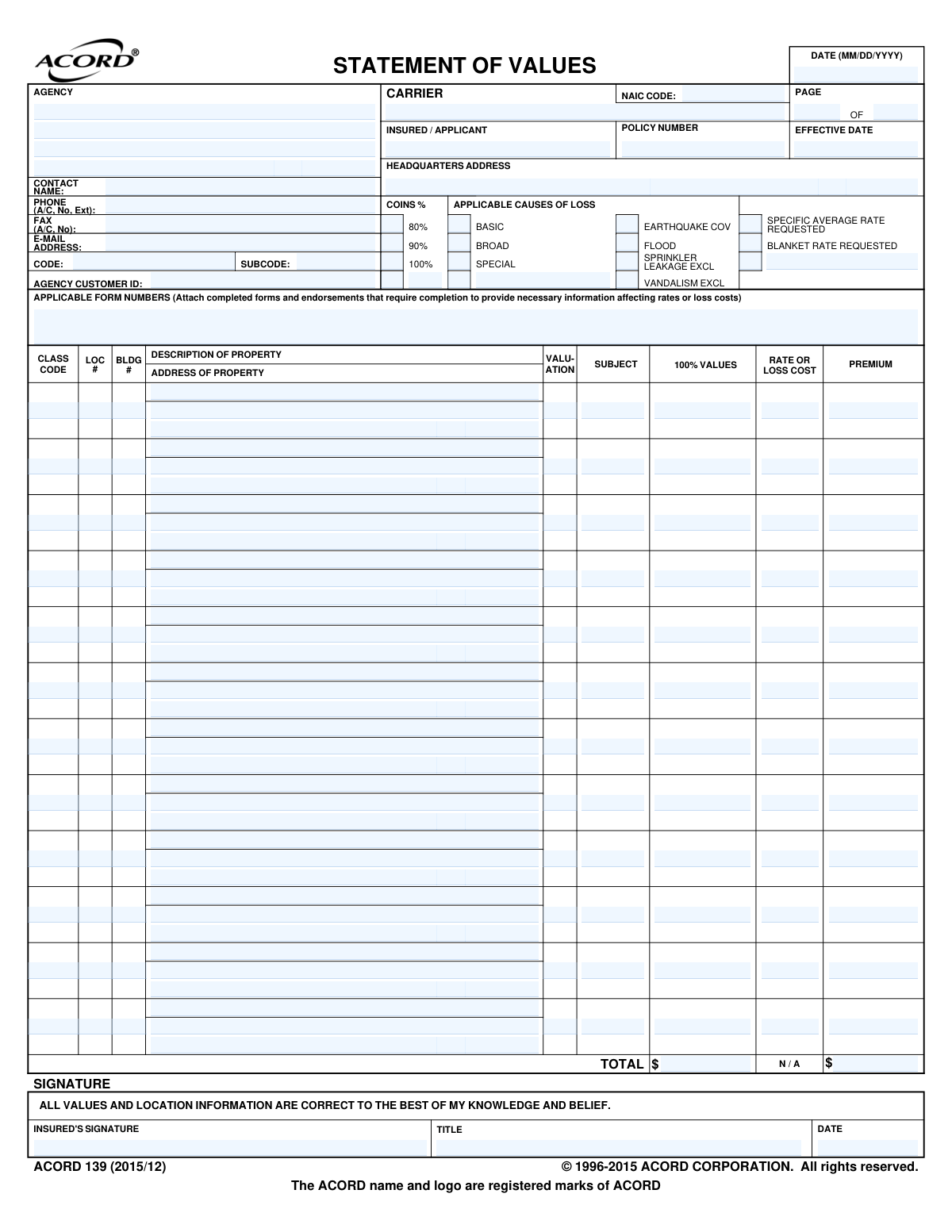
| 1. | ACORD 139, Statement of Values | 1 | Complex 63 |
| 2. | ACORD 140, Property Section | 3 | Very Complex 80 |
| 3. | ACORD 155, Equipment Breakdown Section | 2 | Moderate 61 |
| 4. | ACORD 159, Business Income Worksheet | 1 | Moderate 62 |
| 5. | ACORD 160, Property Loss Notice | 6 | Complex 68 |
| 6. | ACORD 24, Certificate of Property Insurance | 1 | Moderate 58 |
| 7. | ACORD 27, Evidence of Property Insurance | 1 | Moderate 55 |
| 8. | ACORD 28, Evidence of Commercial Property Insurance | 1 | Complex 67 |
| 9. | ACORD 810, Business Income / Extra Expense / Rental Value | 2 | Moderate 53 |
| 10. | Evidence of Commercial Property Insurance | 2 | Complex 63 |
| 11. | FARM LIABILITY / LIMITED PROPERTY - APPLICATION | 8 | Very Complex 80 |
| 12. | Habitational Risks Supplement Application Form | 7 | Complex 74 |
| 13. | Martial Arts Studio General Liability and Property Application (Fitness and Wellness Insurance / Philadelphia Insurance Companies) (03/2011) | 8 | Complex 74 |
| 14. | Uniform Mitigation Verification Inspection Form | 6 | Complex 73 |
- Enterprise-grade security & data encryption
- 99%+ accuracy powered by AI
- 1,000+ forms from all industries
- Complete forms in under 60 seconds
How to Choose the Right Form
Choosing the right property insurance form depends heavily on your specific business niche and the type of risk you are looking to cover. While many general property insurance forms—such as standard ACORD forms or dwelling fire applications—provide a broad framework, specialized industries often require dedicated applications to capture unique exposures.
For Fitness and Combat Sports Businesses
If you operate a dojo, karate school, or MMA gym, standard property forms often fall short because they don’t account for professional liability or specific sparring risks. In this category, the Martial Arts Studio General Liability and Property Application (Philadelphia Insurance Companies) is the primary choice.
Select this form if your business needs a comprehensive package that includes:
- Commercial General Liability: Coverage for slip-and-fall incidents or general business operations.
- Professional Liability: Protection against claims specifically related to instruction and training errors.
- Property & Business Income: To protect your physical studio, mats, equipment, and potential financial loss due to property damage.
- Crime and Flood Coverage: Specific add-ons available within this single underwriting application.
Specialized vs. Standard Insurance Forms
While you might be searching for general "insurance application forms" or "dwelling fire forms," those are typically used for residential rental properties or generic commercial buildings. The Martial Arts Studio General Liability and Property Application is an underwriting document tailored specifically for the fitness and wellness sector. Using this targeted form instead of a generic property form ensures that you provide the insurer with the necessary details regarding tournaments, contact levels, and safety equipment, which are critical for an accurate quote.
Streamlining Your Application
Filing specialized property insurance forms can be complex due to the detailed exposure questions. To avoid delays in the quoting process, ensure you have your prior carrier history and specific equipment values ready. Using a tool like Instafill.ai can help you complete this application accurately by guiding you through the required fields and converting static PDFs into interactive, fillable documents.
Form Comparison
| Form | Primary Coverage | Target Business | Key Information Needed | Optional Coverages |
|---|---|---|---|---|
| Martial Arts Studio General Liability and Property Application (Fitness and Wellness Insurance / Philadelphia Insurance Companies) (03/2011) | Provides General Liability, Professional Liability, and Property insurance for martial arts facilities. | Martial arts studios, dojos, and fitness centers requiring specialized liability and property protection. | Details on sparring levels, tournament participation, safety protocols, and previous insurance claim history. | Includes options for business income, flood, crime, and specific equipment breakdown coverage. |
Tips for property insurance forms
Underwriters for property and liability insurance need exact details on your daily operations, such as the intensity of contact during sparring or the frequency of tournaments. Providing specific numbers regarding participants and equipment usage prevents delays during the risk assessment process and ensures your policy matches your actual risk profile.
When filling out property sections, include accurate valuations for specialized equipment, flooring, and fixtures. Keeping a current list of replacement costs helps you avoid being underinsured and ensures that your business income coverage is calculated correctly in the event of a loss.
Property insurance forms often ask for details regarding fire alarms, sprinkler systems, and security measures. Highlighting these features accurately can positively impact your eligibility and may lead to more competitive premium quotes from the insurer.
Most insurance applications require a detailed history of claims or losses from the last three to five years. Having your 'loss runs' or previous carrier information ready before you start will prevent you from having to pause the application to search for old records.
Using AI-powered tools like Instafill.ai allows you to complete complex property insurance forms in under 30 seconds with high accuracy. These tools intelligently map your data to the correct fields while ensuring your sensitive business information remains secure throughout the process.
Avoid the common mistake of using outdated purchase prices for property and equipment. Using current replacement cost values on your forms ensures that your coverage limits are sufficient to rebuild or replace items at today’s market prices.
Frequently Asked Questions
Property insurance forms are essential documents used by businesses and individuals to apply for coverage against physical damage or loss to buildings, equipment, and inventory. They provide underwriters with the necessary data to assess risk levels and determine appropriate premium rates for the requested coverage.
These forms are used by business owners, property managers, and specialty facility operators, such as martial arts studios or fitness centers, who need to protect their physical assets. Insurance brokers also use these forms to collect client data before submitting it to various carriers for competitive quotes.
Most applications require basic business details, building construction information, security measures like fire alarms or sprinklers, and a history of previous claims. For specialized property insurance, you may also need to provide details about specific operations, equipment values, and safety protocols relevant to your industry.
ACORD forms are industry-standard documents recognized by almost all insurance agencies and carriers for general data collection. Company-specific forms are often more detailed and tailored to specific niche markets or unique coverage packages, such as those designed for fitness and wellness businesses.
It is generally advisable to submit your property insurance forms at least 30 to 60 days before your current policy expires or before a new business location opens. This allows underwriters sufficient time to review the application, ask follow-up questions, and provide an accurate quote without a lapse in coverage.
Dwelling fire forms are specialized property insurance documents typically used for non-owner-occupied homes or rental properties. They focus primarily on the physical structure and specific named perils like fire, lightning, or smoke, rather than the broader liability coverage found in standard homeowners' policies.
Yes, you can fill out property insurance forms using AI tools like Instafill.ai. These tools can accurately extract data from your existing business documents and place it directly into the correct fields on the insurance application, reducing the risk of manual entry errors and ensuring all required fields are addressed.
Using AI-powered services, you can often complete complex property insurance forms in under 30 seconds. The technology streamlines the process by mapping data from your source files to the PDF fields, which is significantly faster than manually typing in business details and exposure information.
Completed forms are usually submitted directly to your insurance broker or the underwriting department of the insurance carrier. In many cases, these forms must be sent along with supporting documents, such as loss runs or safety manuals, to complete the underwriting file for review.
Providing accurate operations info, such as contact levels in a martial arts studio or specific fire hazards in a warehouse, ensures your policy is tailored to your actual risks. Incomplete or vague information can lead to delayed quotes, higher premiums, or even the denial of a claim if the risk was not properly disclosed.
While the application itself is a request for coverage, the signatures represent a statement that all information provided is true to the best of your knowledge. Once the insurer accepts the application and issues a policy, the details in the form often become part of the legal contract between the insured and the insurance company.
Glossary
- Form Complexity Index
- Instafill’s 0–100 measure of how much effort a form takes to complete, calculated deterministically from the form’s own structure rather than estimated. It combines the number of fillable fields (the largest factor), how difficult those fields are to complete based on their type, the number of pages that contain fields, the amount of conditional “fill-only-if” logic, and how many sections the form is divided into, then adds modifiers for tables and repeating lists, bundled instruction pages, and dense page layouts. A higher score means the form is harder to fill out by hand. The forms in this category have a median Form Complexity Index of 67/100 (Complex). See exactly how it is calculated.
- Commercial General Liability (CGL)
- A standard insurance policy that protects businesses against claims for bodily injury or property damage arising from their operations, products, or premises.
- Underwriting
- The process an insurance company uses to evaluate the risk of a potential client to determine if they are eligible for coverage and what the premium should be.
- ACORD Forms
- Standardized industry documents used by insurance agents and carriers to collect and share data consistently across different insurance companies.
- Business Income Coverage
- Protection that replaces lost revenue and covers operating expenses if a business is forced to close temporarily due to a covered property loss like a fire.
- Exposure
- A measure of the potential for loss based on business operations, such as the number of students, frequency of tournaments, or level of physical contact allowed.
- Professional Liability
- Coverage that protects against claims of negligence or mistakes in the professional services provided, such as improper instruction or coaching errors.
- Prior Carrier History
- A record of previous insurance providers and claims, used by underwriters to assess a business's stability and risk profile over time.
- Endorsement
- An amendment or addition to an insurance policy that changes the original terms, such as adding extra coverage for specific equipment or events.