
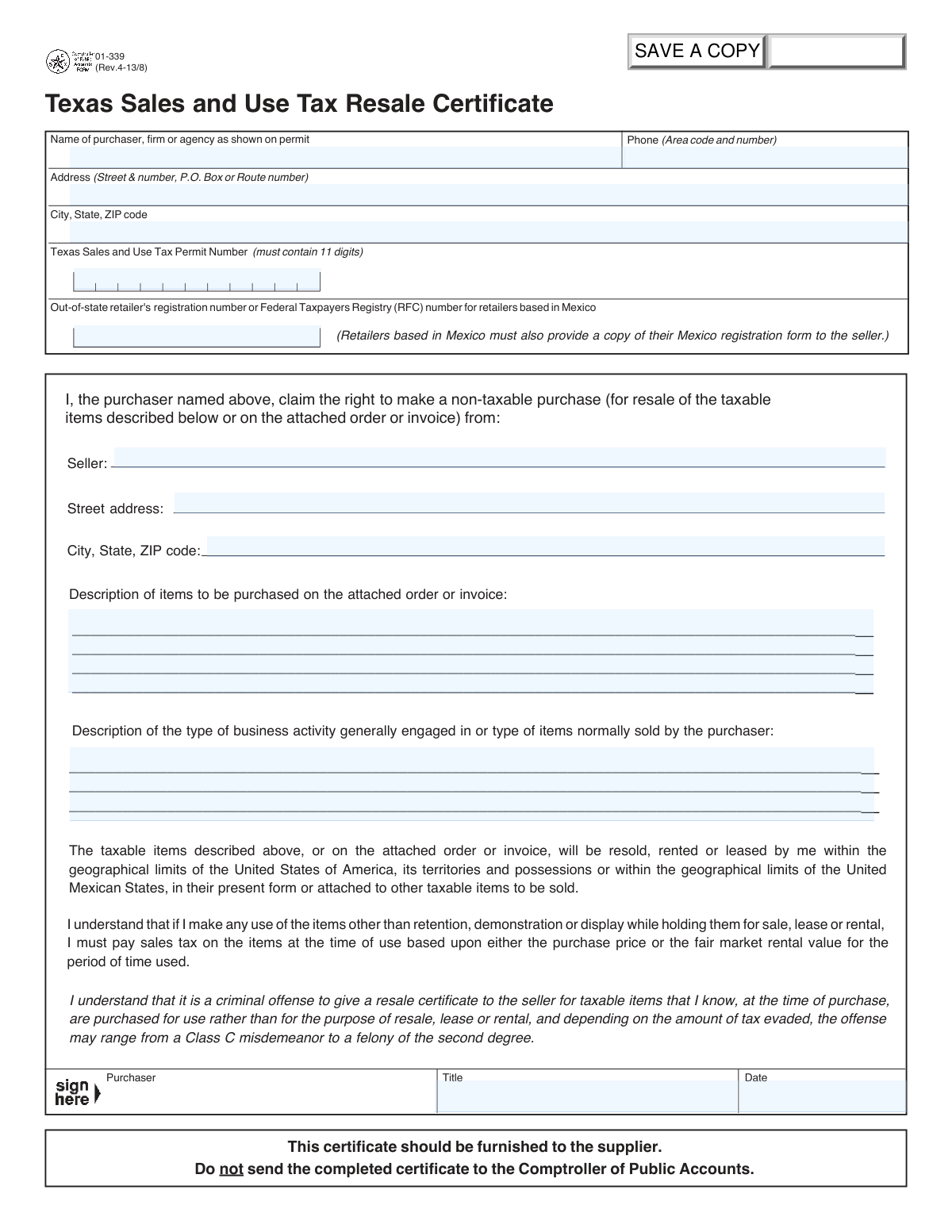
Yes! You can use AI to fill out Form 01-339, Texas Sales and Use Tax Resale Certificate / Texas Sales and Use Tax Exemption Certification
Don't type 27 fields by hand. Tell our AI about yourself, or upload a document you already have, and it fills every field in seconds. You check it, then download, print or sign.
The AI does the filling. You just check it.
No typing into boxes, nothing to install.
What this form asks for
The AI fills all of it, from your answers or your documents.
The AI checks your answers before you download
16 checks built for this form, so a wrong date or a missing answer is caught before anyone else sees it.
Validates that the 'Name of purchaser, firm or agency' field is completed with a real legal name (not blank, not 'N/A', not 'same as above', and not only initials). This matters because the certificate is only meaningful if it clearly identifies the party claiming resale/exemption. If validation fails, the submission should be rejected or routed for manual review because the certificate may be unenforceable.
Checks that the purchaser phone number includes a valid 10-digit US phone number (optionally with punctuation like (###) ###-####) and does not contain letters or too few digits. The form explicitly requests area code and number, and suppliers often need a reliable contact for audit support. If invalid, prompt the user to correct the phone number before acceptance.
Ensures the purchaser address includes a street number and street name or a valid P.O. Box/Route, and is not left blank. This is important for identifying the purchaser’s place of business for tax documentation and audit trails. If the address is incomplete (e.g., only a city or only a street name), the form should fail validation and require correction.
Validates that city and state are present and that the state is a valid US state/territory abbreviation when a US ZIP is provided. Also checks ZIP code format as 5 digits or ZIP+4 (##### or #####-####). If the city/state/ZIP combination is malformed or missing, the submission should be blocked because the purchaser location cannot be reliably determined.
For the resale certificate side, verifies that the Texas Sales and Use Tax Permit Number is present and contains exactly 11 digits (numeric only, no letters, no spaces). The form explicitly states the permit number must contain 11 digits, and incorrect length undermines validity. If it fails, the system should reject the resale certificate or require the user to correct the permit number.
Checks that the user does not provide conflicting registration identifiers (e.g., both a Texas 11-digit permit number and a Mexico RFC number) unless the workflow explicitly allows dual registration. This prevents ambiguity about which jurisdictional registration supports the claim. If both are provided without an allowed reason, flag for manual review or require the user to select the correct registration type.
And 10 more checks
- Mexico Retailer Requirement: RFC Provided and Mexico Registration Copy Acknowledged
- Seller Identification Completeness (Name and Address)
- Items Description Present or Attachment Referenced
- Business Activity / Normally Sold Items Provided (Resale Certificate)
- Purchaser Title Present and Reasonable
- Signature/Attestation Presence (Purchaser Signed)
- Date Format and Not in the Future
- Certificate Type Consistency: Resale vs Exemption
- Exemption Reason Required (Exemption Certification)
- Motor Vehicle Purchase Prohibited (Exemption Certification)
Let AI fill out your Texas Form 01-339
No typing. Every field filled in seconds, checked, ready to sign.
How to Fill Out Texas Form 01-339 Online for Free in 2026
What the AI walks you through.
- Choose the correct section to complete: Resale Certificate (for resale/lease/rental) or Exemption Certification (for a specific exemption reason).
- Enter purchaser information: legal name, phone number, and full address (city, state, ZIP).
- If completing the Resale Certificate, provide the 11-digit Texas Sales and Use Tax Permit Number (or the applicable out-of-state registration number / Mexico RFC, and attach Mexico registration if required).
- Enter seller information: seller name, street address, and city/state/ZIP.
- Describe the items being purchased (or reference/attach the related order or invoice) and, for resale, describe the purchaser’s general business activity or items normally sold; for exemption, state the exemption reason.
- Review the statements regarding proper use, tax liability, and criminal penalties to ensure the purchase qualifies for resale or the claimed exemption.
- Sign and date the certificate (include purchaser title), then provide it to the supplier; do not send the completed form to the Texas Comptroller of Public Accounts.
Common Mistakes in Completing Texas Form 01-339
The ones the AI is built to catch.
Using the wrong certificate (resale vs. exemption)
Entering an invalid Texas Sales and Use Tax Permit Number (not 11 digits)
Trying to use a non-existent “tax exempt number” on the exemption form
Leaving the item description too vague or writing “various items”
Not describing the purchaser’s business activity or normal items sold (resale certificate)
Incomplete seller information (name/address/city-state-zip missing)
Using the certificate for items that will be used, not resold (misuse of resale certificate)
Failing to state a clear exemption reason (exemption certification)
Attempting to use the exemption certificate for a motor vehicle purchase
Missing purchaser signature, title, or date
Sending the completed certificate to the Comptroller instead of the supplier
Frequently Asked Questions About Texas Form 01-339
Is it really free for 7 days?
Can I fill other forms too?
How do I cancel?
How does the AI fill out Texas Form 01-339?
What happens to my information?
How complex is Texas Form 01-339 to fill out?
What is Form 01-339 used for?
Who should use the Texas Sales and Use Tax Resale Certificate side of the form?
Who should use the Texas Sales and Use Tax Exemption Certification side of the form?
Do I send the completed certificate to the Texas Comptroller?
What information is required on the Resale Certificate?
What information is required on the Exemption Certification?
Do I need an exemption number or “tax exempt number” for the Exemption Certification?
What if I don’t have a Texas Sales and Use Tax Permit Number?
I’m a retailer based in Mexico—what do I need to provide?
Can I attach an order or invoice instead of listing all items on the form?
What does it mean that items will be resold, rented, or leased within the U.S. or Mexico?
What if I use the items instead of reselling them?
Are there penalties for misusing a resale or exemption certificate?
Can this exemption certificate be used to buy a motor vehicle tax-free?
How long does it take to process this form?
Get your Texas Form 01-339 filled out by AI
$0 today. Cancel before Nov 1 and you pay nothing.
Other forms like this one
sales tax forms: WestRock Credit Application and Uniform Sales & Use Tax Exemption/Resale Certificate — Multijurisdiction, Form DR 0024, Standard Sales Tax Receipt for Vehicle Sales, Form ST-120, New York State and Local Sales and Use Tax Resale Certificate, Form ST-105, General Sales Tax Exemption Certificate
resale certificate forms: WestRock Credit Application and Uniform Sales & Use Tax Exemption/Resale Certificate — Multijurisdiction, California Department of Tax and Fee Administration Form CDTFA-230, General Resale Certificate, Form ST-120, New York State and Local Sales and Use Tax Resale Certificate
tax exemption forms: WestRock Credit Application and Uniform Sales & Use Tax Exemption/Resale Certificate — Multijurisdiction, 2023 Schedule IL-E/EIC, Illinois Exemption and Earned Income Tax Credit (Illinois Department of Revenue), Form ST-105, General Sales Tax Exemption Certificate, Stipulation of Settlement With Exemption (Local Property Tax)
certification forms: Form HS 200, Licensure & Certification Application, W-9, Request for Taxpayer Identification Number and Certification, Form WH-380-E, Certification of Health Care Provider, Form WH-385, Certification for Serious Injury or Illness, Form WH-380-F, Certification of Health Care Provider, Form WH-385-V, Certification for Serious Injury or Illness, Form 8802, Application for U.S. Residency Certification, Form I-905, Application for Authorization to Issue Certification for Health Care Workers, Form N-648, Medical Certification for Disability Exceptions, Dakota County CDA New Admissions Informal Review Request Form (Housing Choice Voucher Program) and HUD Form 5382, Certification of Domestic Violence, Dating Violence, Sexual Assault, or Stalking, and Alternate Documentation, NJ Department of Labor & Workforce Development Form MW-562, Payroll Certification for Public Works Projects (Contractor and Subcontractor’s Weekly and Final Certification), ROTC Cadet Academic Plan / Degree and Credit Hour Worksheet (Student Identification, Term-by-Term Courses, GPA Summary, and Completion Certification), Certification for Special Assessment (Office of Building, Planning, & Code Compliance, City of Knox, Indiana), Outpatient Behavioral Health (BH) – ABA Treatment Request: Required Information for Precertification (GR-69017-4), Form W-9, Request for Taxpayer Identification Number and Certification, 401(k) Program Rollover Certification, WTIA 401(k) Plan Rollover Contribution Employee Certification, Trust Certification and Trustee Powers, Form GR-68831, Precertification Information Request Form, Precertification request form: Advanced Radiology and Cardiology Services
ESA forms: WestRock Credit Application and Uniform Sales & Use Tax Exemption/Resale Certificate — Multijurisdiction, Texas Real Estate Commission (TREC) One to Four Family Residential Contract (Resale) (TREC No. 20-18), SOL·LICITUD DE PARTICIPACIÓ AL MERCAT ARTESANAL DE LA FIRA ANDRATX (Application to Participate in the Andratx Fair Artisan Market), Vanguard Wholesale Funds - Application Form – Associations, Vanguard Wholesale Funds - Application Form – Companies, Vanguard Wholesale Funds – Application Form – Trusts, Vanguard Wholesale Funds – Know Your Customer (KYC) Refresh Form – Company, Vanguard Wholesale Funds – Know Your Customer (KYC) Refresh Form – Trusts, California Department of Tax and Fee Administration Form CDTFA-230, General Resale Certificate, Form ST-120, New York State and Local Sales and Use Tax Resale Certificate, IRA/ESA Distribution Request Instructions, IRA/ESA Distribution Request
Let AI fill out your Texas Form 01-339
Your trial starts once a card is added. You pay nothing before Nov 1.
Our AI already knows this form, all 27 fields of it. Skip the typing: tell it about yourself, or upload what you have, and it fills the whole form in seconds.
- AI fills every field on both pages, checkboxes included
- No typing into boxes: answer a few questions, or upload a document you already have, an old copy of this form, a photo of a document
- The AI checks the answers; you review and change anything before you download
- Download the finished PDF, print it, or sign it online
- Encrypted, and never used to train AI
Cancel before Nov 1 and you pay nothing.
A card is needed to start the trial. Cancel in two clicks from your account.
Terms · Privacy