Fill out Department of Labor forms
with AI.
Department of Labor (DOL) forms are essential documents used to regulate the relationship between employers and employees at both the state and federal levels. These forms cover a wide range of critical workplace issues, including wage and hour compliance, workers' compensation, and labor standards enforcement. By standardizing how information is reported, these documents ensure that workers are treated fairly under the law and that businesses remain compliant with complex regulations like the Prevailing Wage Act or the Federal Employees' Compensation Act.
By continuing, you acknowledge Instafill's Privacy Policy and agree to get occasional product update and promotional emails.
About Department of Labor forms
This category is frequently used by small business owners, HR professionals, and government contractors who must submit certified payroll forms or duty status reports. For example, contractors working on public works projects often need to file payroll certifications, like Form MW-562, to prove they are paying prevailing wages. Similarly, federal employees and their supervisors use documents like Form CA-17 to manage return-to-work transitions following an injury. Employees also rely on these forms, such as the NYSDOL LS 223, to report wage theft or labor violations. Because these forms often serve as legal records, accuracy is paramount to avoid penalties or delays in benefit processing.
Managing these documents can be time-consuming, but tools like Instafill.ai use AI to fill these forms in under 30 seconds while ensuring data is handled accurately and securely. This allows users to focus on their work rather than manual data entry, turning complex compliance tasks into a streamlined process.
Every form on this page can be completed without typing. Instafill is form filling software that reads a PDF and fills it for you — including flat and scanned documents that carry no fillable fields at all.
Forms in This Category
The forms in this category have a median Form Complexity Index of 76/100 (Complex), measured across 4 forms by field count, input difficulty, length, conditional logic and structure. See how it is calculated.
- Enterprise-grade security & data encryption
- 99%+ accuracy powered by AI
- 1,000+ forms from all industries
- Complete forms in under 60 seconds
How to Choose the Right Form
Navigating Department of Labor (DOL) requirements can be complex because the necessary paperwork varies significantly depending on whether you are dealing with federal workers' compensation, state-level payroll compliance, or labor standard violations. To choose the right form, first identify your specific jurisdiction and the nature of your labor issue.
Federal Workers’ Compensation & Return-to-Work
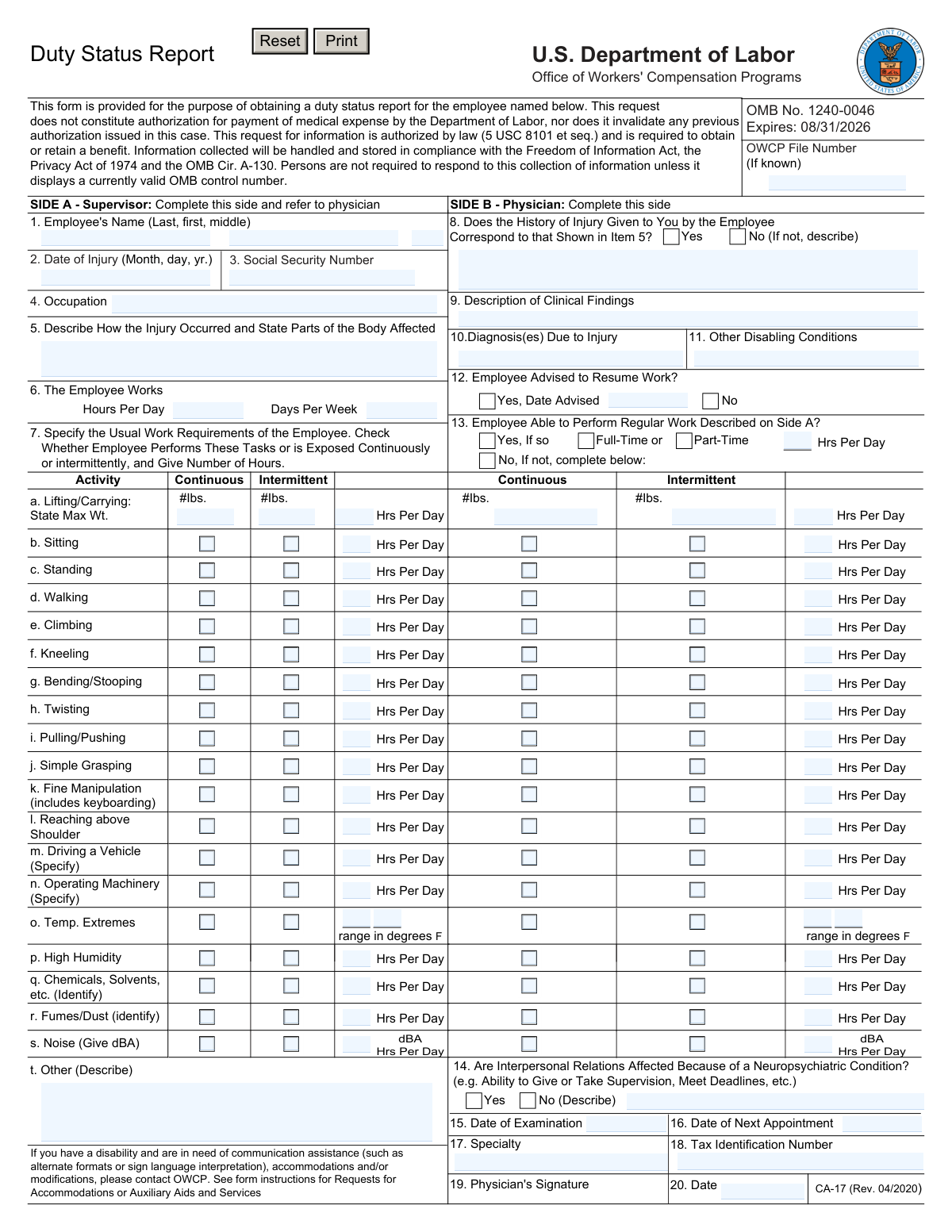
If you are a federal employee or a supervisor managing a workers’ compensation claim under the Office of Workers' Compensation Programs (OWCP), you will likely need Form CA-17, Duty Status Report.
- Purpose: This form facilitates communication between the employing agency and the treating physician regarding an injured worker's physical capacity.
- Who uses it: The supervisor completes Side A to describe job demands, while the physician completes Side B to outline medical restrictions.
- Use Case: Essential for FECA claims to determine if an employee can return to regular duty or requires a modified assignment.
New Jersey Public Works & Certified Payroll
Contractors and subcontractors operating in New Jersey must adhere to strict reporting standards for public construction.
- Form MW-562, Payroll Certification for Public Works Projects: This is the primary document used to certify that workers are being paid according to the New Jersey Prevailing Wage Act. It tracks daily hours, work classifications, and fringe benefit contributions. Use this for weekly and final project certifications to ensure legal compliance.
New York State Labor Complaints
For employees in New York State who believe their rights have been violated, the NYSDOL Division of Labor Standards Complaint Form (LS 223) is the standard tool for seeking recourse.
- Purpose: This form is used to report unpaid wages, minimum wage violations, illegal deductions, or unpaid overtime.
- Use Case: If your employer has failed to provide required pay stubs, meal periods, or wage supplements (like vacation pay), filing an LS 223 initiates an official investigation by the New York State Department of Labor.
When filling out these forms, ensure you have specific details ready, such as project numbers, employer contact information, and exact dates of work, to avoid processing delays.
Form Comparison
| Form | Purpose | Who Files It | Jurisdiction | Key Requirements |
|---|---|---|---|---|
| Form CA-17, Duty Status Report (U.S. Department of Labor, Office of Workers' Compensation Programs) | Reports medical findings and work capacity for federal workers' compensation claims. | Supervisor completes job demands; treating physician completes medical restrictions. | Federal (U.S. Department of Labor, OWCP). | Medical diagnosis, physical limitations, and return-to-work status. |
| NJ Department of Labor & Workforce Development Form MW-562, Payroll Certification for Public Works Projects | Certifies compliance with prevailing wage laws on public construction projects. | Contractors and subcontractors performing work on New Jersey public projects. | New Jersey (State). | Work classifications, hourly rates, fringe benefits, and weekly gross/net wages. |
| New York State Department of Labor (NYSDOL) Division of Labor Standards Complaint Form (LS 223) | Files a formal complaint for unpaid wages or labor law violations. | Employees who have not received proper minimum wage, overtime, or supplements. | New York (State). | Employer details, hours worked, claim period, and specific wage amounts owed. |
Tips for Department of Labor forms
When completing certified payroll forms like the MW-562, ensure that employee work classifications exactly match the job descriptions listed in the prevailing wage determination. Incorrect classifications are a common cause of compliance audits and can lead to significant penalties for contractors.
For Form CA-17, the supervisor must clearly define the physical requirements of the job on Side A before the physician completes Side B. Providing precise descriptions of lifting, standing, or reaching requirements helps the doctor make an accurate determination about work capacity and return-to-work status.
Before filing a Labor Standards Complaint like form LS 223, gather all relevant pay stubs, time cards, and employment contracts. Having specific dates and dollar amounts ready will ensure your claim is processed quickly and reduce the likelihood of the Department of Labor requesting follow-up information.
AI-powered tools like Instafill.ai can complete these Department of Labor forms in under 30 seconds with high accuracy, serving as a major time-saver for those managing multiple filings. Your data stays secure during the process, ensuring that sensitive payroll and medical information is handled with the necessary privacy.
Always double-check identifiers such as the OWCP file number, Social Security Numbers, or Taxpayer Identification Numbers before submission. Errors in these fields are a leading cause of administrative delays and can result in the temporary suspension of benefits or claim reviews.
For contractors working on public works projects, filling out payroll certifications weekly rather than waiting until the end of the project prevents data loss. Regular filing ensures that hours and fringe benefit contributions are recorded while the information is fresh and easily accessible for reporting.
Many Department of Labor forms require specific certifications from both the employer and the employee or a medical professional. Missing a signature or date on a certified payroll record or a duty status report can render the entire document invalid for compliance purposes and halt your progress.
Frequently Asked Questions
Department of Labor forms are used to regulate and document various aspects of the workplace, including wage compliance, workers' compensation, and labor standards. They serve as legal records to ensure employers follow federal and state laws regarding pay, safety, and employee rights.
Generally, contractors and subcontractors working on public works projects are required to file certified payroll forms, such as the NJ MW-562. These forms verify that workers are being paid the prevailing wage rate as required by law for government-funded construction or service projects.
An employee should use a complaint form, like the NYSDOL LS 223, if they believe their employer has violated labor laws. This includes issues like unpaid wages, withheld overtime pay, illegal deductions from paychecks, or failure to provide mandated sick leave.
Form CA-17 requires input from both the supervisor and the treating physician. The supervisor describes the physical requirements of the employee's job, while the physician provides a diagnosis and specifies any work restrictions or capacity for returning to duty.
Yes, modern AI tools like Instafill.ai allow you to fill out Department of Labor forms in under 30 seconds. The AI accurately extracts data from your source documents and places it into the correct fields, reducing the risk of manual entry errors.
Processing times vary significantly depending on whether the form is filed at the federal or state level and the complexity of the case. After submitting a form like the LS 223, the Department of Labor evaluates the information to determine if an investigation is warranted.
Submission instructions depend on the specific form; federal workers' compensation forms are typically sent to the Office of Workers' Compensation Programs (OWCP), while state-specific payroll or complaint forms are submitted to the respective state's Department of Labor office.
Providing inaccurate information on certified payroll forms can lead to significant legal consequences, including civil or criminal penalties for the contractor. It may also result in the suspension of payments for the project until the records are corrected and compliance is verified.
Yes, the Department of Labor operates at both the federal and state levels. Federal forms like the CA-17 apply to federal employees or federal programs, while state forms like the NY LS 223 or NJ MW-562 are specific to the regulations and workers within those individual states.
When using AI-powered platforms like Instafill.ai, filling out complex Department of Labor forms can be completed in less than 30 seconds. The system automates the data entry process by mapping information from your existing records directly into the required PDF fields.
No, you do not need a lawyer to fill out or submit a labor standards complaint form. These forms are designed to be completed by the affected employee, though providing clear documentation and detailed evidence will help the Department of Labor evaluate your claim more effectively.
The prevailing wage is the minimum hourly rate, including benefits, that must be paid to workers on public works projects. Forms like the NJ MW-562 ensure that contractors are providing fair compensation as determined by the regulatory agency for that specific region and trade.
Glossary
- Form Complexity Index
- Instafill’s 0–100 measure of how much effort a form takes to complete, calculated deterministically from the form’s own structure rather than estimated. It combines the number of fillable fields (the largest factor), how difficult those fields are to complete based on their type, the number of pages that contain fields, the amount of conditional “fill-only-if” logic, and how many sections the form is divided into, then adds modifiers for tables and repeating lists, bundled instruction pages, and dense page layouts. A higher score means the form is harder to fill out by hand. The forms in this category have a median Form Complexity Index of 76/100 (Complex). See exactly how it is calculated.
- Prevailing Wage
- The minimum hourly wage rate and fringe benefits that contractors must pay workers on government-funded construction or public works projects, as determined by the applicable federal or state labor agency for each job classification in a specific geographic area.
- Certified Payroll
- A weekly payroll report submitted by contractors and subcontractors on prevailing wage projects, accompanied by a signed Statement of Compliance certifying that all workers were paid the correct wages, overtime, and fringe benefits required by law.
- Davis-Bacon and Related Acts (DBRA)
- A set of federal laws requiring contractors and subcontractors on federally funded or federally assisted construction projects to pay workers no less than the locally prevailing wages and fringe benefits for corresponding work on similar projects in the area.
- OWCP (Office of Workers' Compensation Programs)
- The division of the U.S. Department of Labor that administers workers' compensation benefits for federal employees injured on the job, including managing claims, medical treatment authorization, and wage-loss payments under FECA.
- FECA (Federal Employees' Compensation Act)
- The federal law that provides workers' compensation benefits—including medical care, wage replacement, and vocational rehabilitation—to civilian federal employees who suffer work-related injuries or illnesses.
- Statement of Compliance
- A signed certification included with certified payroll submissions in which the contractor or subcontractor attests that the payroll records are accurate and that workers were paid at least the required prevailing wages and fringe benefits; willful falsification can result in criminal penalties.
- Fringe Benefits
- Non-wage compensation required under prevailing wage laws, such as employer contributions to health insurance, pension plans, vacation pay, or apprenticeship programs, which can be paid directly to workers or contributed to approved benefit plans.
- Modified Duty
- A temporary or permanent work assignment adjusted to accommodate a worker's medical restrictions, allowing an injured employee to return to work in a limited capacity while recovering, rather than remaining fully off duty.
- Debarment
- A penalty that prohibits a contractor or subcontractor from bidding on or being awarded future government-funded contracts, typically imposed for serious or repeated violations of prevailing wage or labor laws.
- Wage Supplements
- Additional compensation beyond base wages that employers may be required to provide, such as vacation pay, holiday pay, sick leave, or health benefits; under New York State law, failure to pay these can be the basis for a labor standards complaint.