Fill out government benefit forms
with AI.
Government benefit forms serve as the essential bridge between citizens and the support systems designed to assist them during specific life events. These documents are used to apply for financial aid, healthcare services, and insurance benefits provided by various federal and state agencies. Whether you are navigating the complexities of veterans' services or seeking social security support, these forms are the primary mechanism for establishing eligibility and ensuring that you receive the resources you are entitled to under the law.
By continuing, you acknowledge Instafill's Privacy Policy and agree to get occasional product update and promotional emails.
About government benefit forms
Typically, these forms are required by individuals facing significant life transitions, such as retirement, the onset of a disability, or the loss of a loved one. For example, veterans holding government life insurance might use forms like VA Form 29-357 to claim disability benefits or request a waiver of premiums when they are no longer able to work. Because these applications often require detailed medical history, employment records, and personal identifying information, completing them accurately is critical to avoid processing delays or benefit denials.
Dealing with complex government paperwork can be overwhelming, especially when you are already managing health or financial challenges. Tools like Instafill.ai use AI to fill these forms in under 30 seconds, ensuring your data is handled accurately and securely while saving significant manual effort. By streamlining the documentation process, you can focus more on your well-being and less on the administrative burden of filing formal claims.
Every form on this page can be completed without typing. Instafill is form filling software that reads a PDF and fills it for you — including flat and scanned documents that carry no fillable fields at all.
Forms in This Category
The forms in this category have a median Form Complexity Index of 68/100 (Complex), measured across 4 forms by field count, input difficulty, length, conditional logic and structure. See how it is calculated.
| Form Name | Pages | FCI | |
|---|---|---|---|
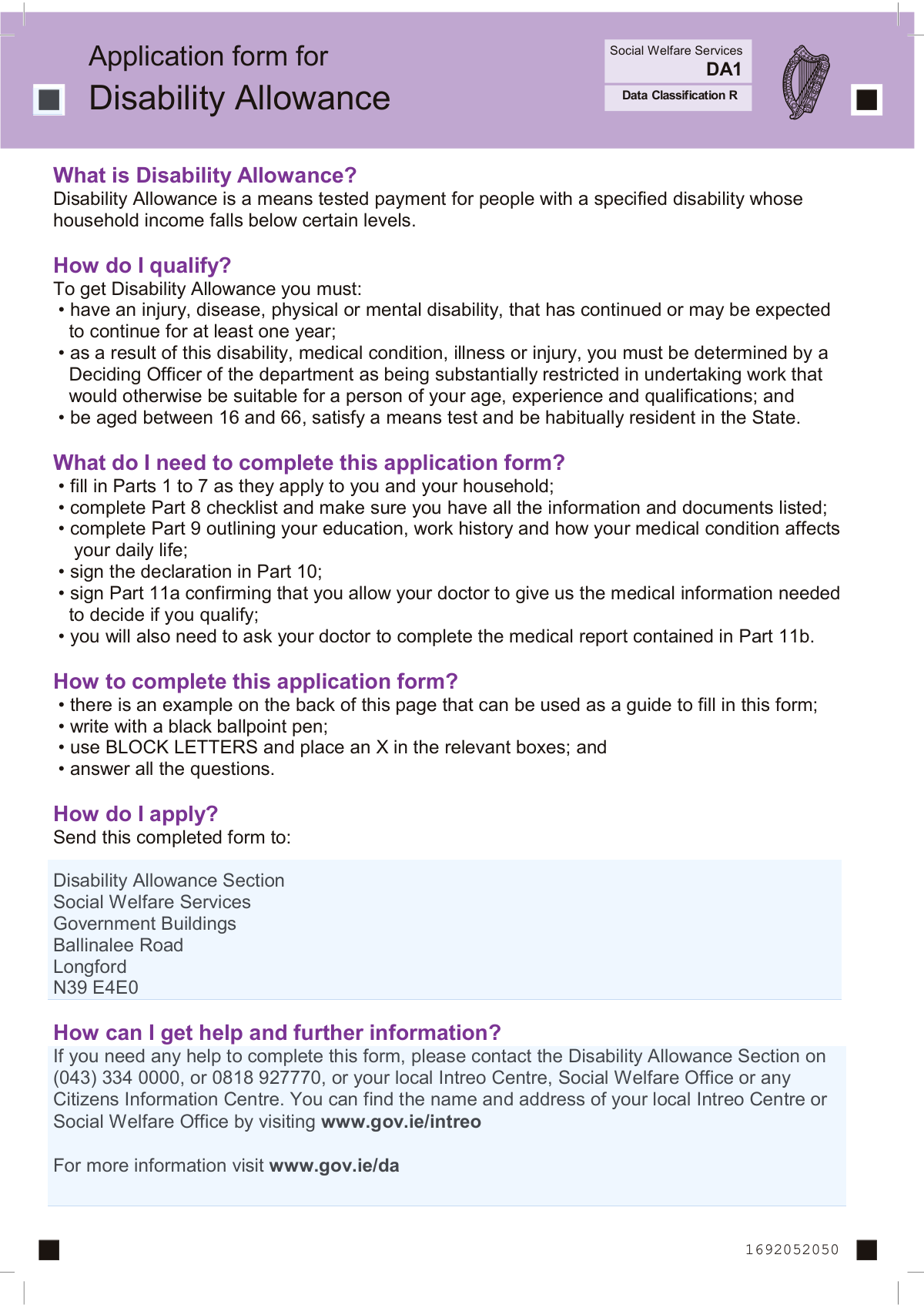
| 1. | Form DA1, Disability Allowance Application form | 24 | Complex 67 |
| 2. | Form SC ISP-1300, Application for CPP Survivor's Pension and Surviving Child's Benefit | 15 | Complex 73 |
| 3. | Form SSA-632-BK, Request for Waiver of Overpayment Recovery | 10 | Complex 68 |
| 4. | VA Form 29-357, Claim for Disability Insurance Benefits (Government Life Insurance) | 3 | Complex 66 |
- Enterprise-grade security & data encryption
- 99%+ accuracy powered by AI
- 1,000+ forms from all industries
- Complete forms in under 60 seconds
How to Choose the Right Form
Navigating government benefit forms can be complex, especially when dealing with Department of Veterans Affairs (VA) insurance claims. Selecting the right document ensures that your application is processed without delays and that you receive the financial relief you are entitled to.
Claims for Government Life Insurance
If you are a veteran who holds a Government Life Insurance policy and have become totally disabled, you likely need to file a claim to protect your coverage and receive benefits.
- VA Form 29-357 (Claim for Disability Insurance Benefits): This is the essential document used to apply for disability insurance benefits under your existing VA policy. It serves a dual purpose: it allows you to claim monthly disability payments and requests a "waiver of premiums," which means you may no longer have to pay for your insurance coverage while you are disabled.
When to Use VA Form 29-357
You should choose this form if the following criteria apply to your situation:
- Total Disability: You have a physical or mental impairment that prevents you from following any substantially gainful occupation.
- Age Requirement: In most cases, the disability must have started before your 65th birthday to qualify for the waiver and benefits.
- Policy Type: You must specifically hold a Government Life Insurance policy (such as National Service Life Insurance or Veterans' Special Life Insurance).
Preparing Your Submission
To ensure your claim is successful, VA Form 29-357 requires specific sections to be completed by different parties:
- Part I: This section is completed by you (the veteran) or your legal representative. It covers your personal identifying information, work history, and the date your disability began.
- Part II: This is the medical report. It must be completed by a licensed practitioner or a hospital official to document the medical basis of your disability.
If you have already received a Social Security disability award letter, including a copy of that letter with your form can help the VA evaluate your eligibility more efficiently. Using Instafill.ai can help you navigate these fields and ensure all required sections are legible and complete before submission.
Form Comparison
| Form | Primary Purpose | Eligibility Criteria | Key Sections |
|---|---|---|---|
| VA Form 29-357, Claim for Disability Insurance Benefits (Government Life Insurance) | Apply for disability benefits and premium waivers for government life insurance policies. | Veterans with total disability occurring before age 65 under specific policies. | Includes claimant identifying information, work history, and medical practitioner reports. |
| VA Form 29-357, Claim for Disability Insurance Benefits (Government Life Insurance) | Claim disability insurance benefits and request refunds for premiums paid during disability. | Insured veterans who become totally disabled and meet policy-specific requirements. | Divided into Part I for veteran details and Part II for medical substantiation. |
Tips for government benefit forms
Ensure Part II of your benefit forms is completed by a licensed practitioner or hospital official before submission. Having your medical records and disability onset dates ready will prevent delays in processing your claim.
Double-check your Government Life Insurance policy numbers and VA claim details to ensure they match official records. Incorrect identification numbers are a common cause of administrative rejection or processing lag.
If you have already received a disability award from the Social Security Administration, include a copy of the award letter with your application. This serves as strong supporting evidence and can help substantiate your claim for disability insurance benefits.
AI-powered tools like Instafill.ai can complete these forms in under 30 seconds with high accuracy, and your data stays secure during the process. This is a real time-saver for people dealing with multiple government forms that require repetitive personal information.
When describing your disability onset, provide specific dates and details regarding how your condition impacted your ability to work. Clear timelines help the VA evaluate your eligibility for premium waivers and disability benefits more effectively.
Government benefit forms often require signatures from both the applicant and a medical professional. Before submitting, verify that all required sections are signed and dated to avoid having the entire form returned for completion.
Always keep a digital or physical copy of every form and supporting document you submit to the VA. This ensures you have a reference point if you need to follow up on your claim status or provide additional information later.
Frequently Asked Questions
Government benefit forms are official documents used by individuals to apply for financial assistance, insurance coverage, or specialized services provided by federal or state agencies. These forms collect necessary personal, financial, and medical data to determine if an applicant meets the specific criteria for programs like VA life insurance disability or Social Security.
The correct form depends on the specific benefit you are seeking and the agency managing it. For example, if you hold Government Life Insurance and become disabled, you would look for forms specifically issued by the Department of Veterans Affairs (VA) for that purpose, such as those related to disability insurance claims.
Generally, these benefits are available to veterans who hold active Government Life Insurance policies and have become totally disabled before reaching a certain age, often 65. Eligibility typically requires proof that the disability prevents the individual from maintaining gainful employment.
Most benefit applications require secondary documentation such as medical records, employment history, and proof of identity. In many cases, including a Social Security disability award letter can help substantiate your claim and speed up the review process by the issuing agency.
Yes, many disability-related government forms include a specific section that must be completed by a licensed medical professional or hospital official. This part of the form provides the clinical evidence and professional assessment necessary for the agency to evaluate the severity and onset of the condition.
Submission instructions vary by agency, but most forms can be mailed to a specific regional office or uploaded through an official government portal. It is important to check the instructions page of the specific form to ensure you are sending it to the correct processing center for your geographic location.
Yes, you can use AI-powered tools like Instafill.ai to simplify the process of completing complex government forms. These tools can accurately extract information from your source documents and place it directly into the required fields, ensuring that the final document is legible and complete.
While manual entry can take a significant amount of time, AI tools like Instafill.ai can fill these forms in under 30 seconds. This technology accurately extracts and places data from your source documents, allowing you to generate a completed form almost instantly.
A waiver of premiums is a benefit that allows a policyholder to stop paying insurance premiums while remaining covered, usually because they have become totally disabled. Many government benefit forms allow you to apply for this waiver and a claim for disability benefits simultaneously to protect your coverage.
Submitting an incomplete form can lead to significant delays or a denial of benefits while the agency requests missing information. Ensuring that every required field is addressed and all medical reports are signed before submission is critical for timely processing.
Glossary
- Form Complexity Index
- Instafill’s 0–100 measure of how much effort a form takes to complete, calculated deterministically from the form’s own structure rather than estimated. It combines the number of fillable fields (the largest factor), how difficult those fields are to complete based on their type, the number of pages that contain fields, the amount of conditional “fill-only-if” logic, and how many sections the form is divided into, then adds modifiers for tables and repeating lists, bundled instruction pages, and dense page layouts. A higher score means the form is harder to fill out by hand. The forms in this category have a median Form Complexity Index of 68/100 (Complex). See exactly how it is calculated.
- Waiver of Premiums
- A provision in an insurance policy that allows the insured person to stop making payments while they are totally disabled, while keeping the coverage in full force.
- Total Disability
- A medical condition that prevents an individual from following any substantially gainful occupation, which is a primary requirement for certain VA insurance claims.
- Disability Onset Date
- The specific date when a medical condition first prevented a person from working, used by the VA to determine when benefit eligibility begins.
- Attending Licensed Practitioner
- A medical professional, such as a doctor or hospital official, who is responsible for completing the medical certification portion of the benefit application.
- Government Life Insurance (GLI)
- A variety of life insurance programs specifically managed or supervised by the Department of Veterans Affairs for service members and veterans.
- Premium Refund
- A repayment of insurance premiums that were paid during a period when the veteran was later determined to be eligible for a waiver due to disability.
- Social Security Disability Award Letter
- An official document from the Social Security Administration used as supporting evidence to prove a person's disability status and the date it was established.
- Substantially Gainful Occupation
- A term used to describe employment that provides a steady income; being unable to perform such work is often a requirement for receiving disability benefits.