Form CH-006: PA-BH-Res-PCS, Oregon Behavioral Health Support Program Plan of Care Authorization (Plan of Care Request for Behavioral Health Residential or Personal Care Services) Completed Form Examples and Samples
View filled-out examples and samples of Oregon's Form CH-006: PA-BH-Res-PCS. Our guide provides detailed examples for completing the Plan of Care Authorization for Behavioral Health Residential or Personal Care Services, helping providers correctly document clinical justifications and treatment goals.
Form CH-006: PA-BH-Res-PCS, Oregon Behavioral Health Support Program Plan of Care Authorization (Plan of Care Request for Behavioral Health Residential or Personal Care Services) has a moderate Form Complexity Index of 46/100 — Instafill’s AI completes it in under a minute.
Form Complexity Index
Moderate
46 / 100
| Fillable fields | 75 |
| Pages | 3 |
| Fields per page | 25 |
| Sections | 16 |
| Conditional rules | 6 |
| Tables & lists | — |
| Instruction pages | — |
| Instafill Form ID | IF-FORM-CH-006-PA-BH-RES-PCS-OREGON-BEHAVIORAL-HEALTH |
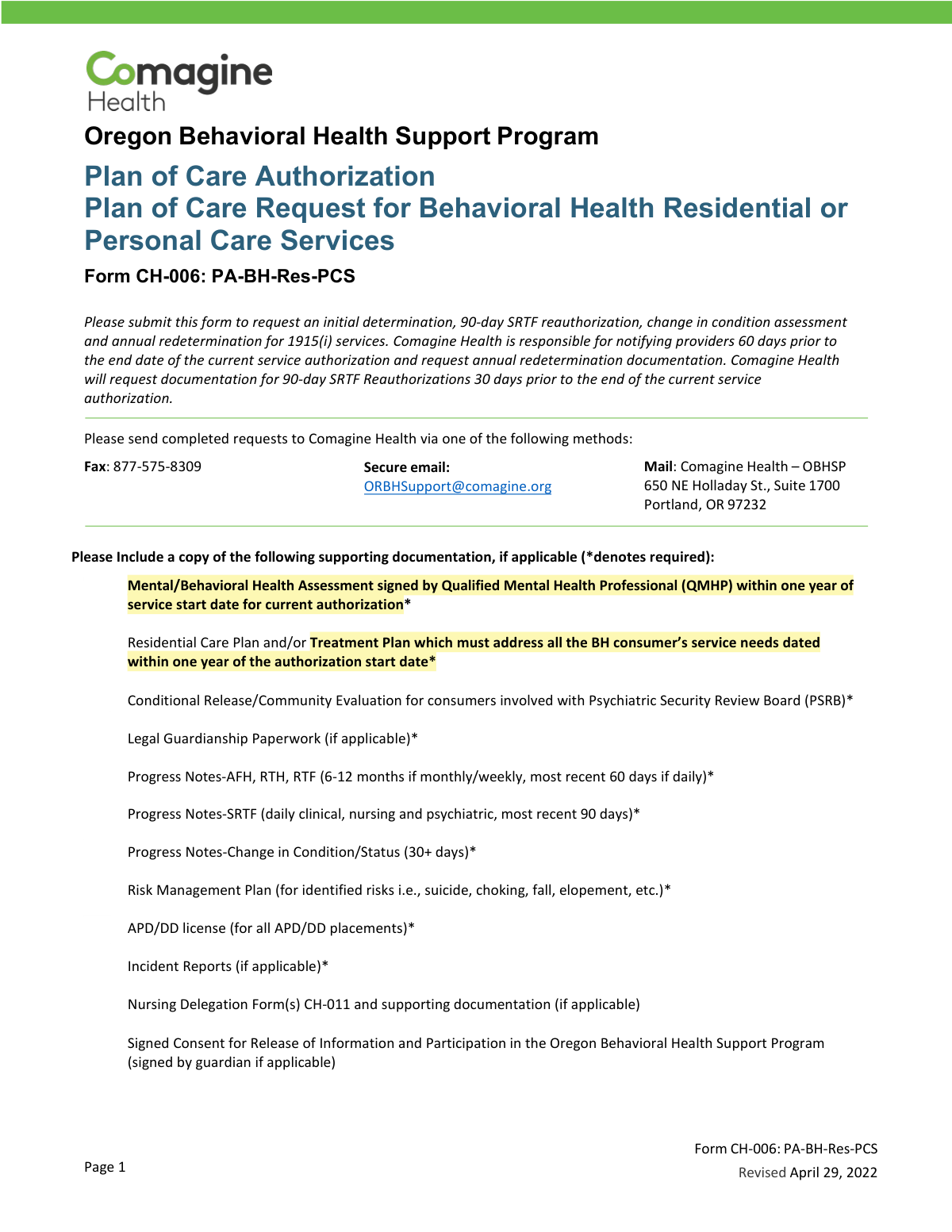
Form CH-006: PA-BH-Res-PCS Example – Adult Residential Treatment Request
How this form was filled:
This example shows a completed Form CH-006 requesting initial authorization for an adult client with co-occurring schizoaffective disorder and severe alcohol use disorder. It details the clinical justification, treatment history, and specific goals that demonstrate the medical necessity for a Residential Treatment Facility (RTF) level of care.
Information used to fill out the document:
- Client Name: Jane Smith
- Medicaid Prime #: 987654321A
- Date of Birth: 1990-05-20
- Requesting Provider: Dr. Alan Grant, LCSW
- Provider Agency: Willamette Valley Community Mental Health
- Provider NPI: 1234567890
- Request Type: Initial Request
- Requested Service: Behavioral Health Residential Treatment Facility (RTF)
- Request Date: 2026-03-15
- Requested Dates of Service (Start): 2026-03-20
- Requested Dates of Service (End): 2026-09-19
- Primary Diagnosis: F25.0 Schizoaffective Disorder, Bipolar Type
- Secondary Diagnosis: F10.20 Alcohol Use Disorder, Severe
- Presenting Problem Summary: Client presents with acute psychiatric decompensation, including auditory hallucinations and paranoid ideation, exacerbated by a recent relapse on alcohol. She is currently homeless after being evicted and is unable to manage daily living activities or maintain her safety in the community.
- Clinical Justification: Client's symptoms meet criteria for residential level of care due to significant risk of harm to self and an inability to function in a less restrictive setting. Outpatient and intensive outpatient services were attempted in the past year but were unsuccessful in preventing relapse and hospitalization. A 24-hour structured therapeutic environment is medically necessary to stabilize her psychosis, establish sobriety, and develop foundational coping skills.
- Treatment Goal 1: Symptom Stabilization: Client will report a 75% reduction in auditory hallucinations and paranoid thoughts within 90 days, as measured by weekly clinical assessment.
- Treatment Goal 2: Sobriety and Relapse Prevention: Client will maintain continuous sobriety throughout her stay and will be able to identify 3 triggers and 3 coping strategies for alcohol cravings.
- Treatment Goal 3: Develop Independent Living Skills: Client will independently manage her medication regimen and complete all assigned daily living skill modules (e.g., budgeting, meal preparation) prior to discharge.
What this filled form sample shows:
- Correctly populated client demographic and Medicaid information.
- Clear identification of co-occurring DSM-5 diagnoses (F25.0 and F10.20) to support the request.
- A strong clinical justification section that explains why a residential level of care is medically necessary over less restrictive options.
- Specific, measurable, achievable, relevant, and time-bound (SMART) treatment goals for the plan of care.
- Properly formatted dates of service request for an initial authorization.
Form specifications and details:
| Form Name: | Form CH-006: PA-BH-Res-PCS, Oregon Behavioral Health Support Program Plan of Care Authorization |
| Form Use Case: | Initial authorization request for an adult with severe and persistent mental illness (SPMI) and a co-occurring substance use disorder requiring residential treatment. |
| Jurisdiction: | Oregon, USA |
| Governing Body: | Oregon Health Authority (OHA) |
| Categories: | CAR forms, health care forms, behavioral health forms, authorization forms, service authorization forms, L.A. Care forms, health services forms, health forms, health care program forms |
| Created: | January 31, 2026 01:16 AM |