Yes! You can use AI to fill out Form FL-343, Spousal, Domestic Partner, or Family Support Order Attachment
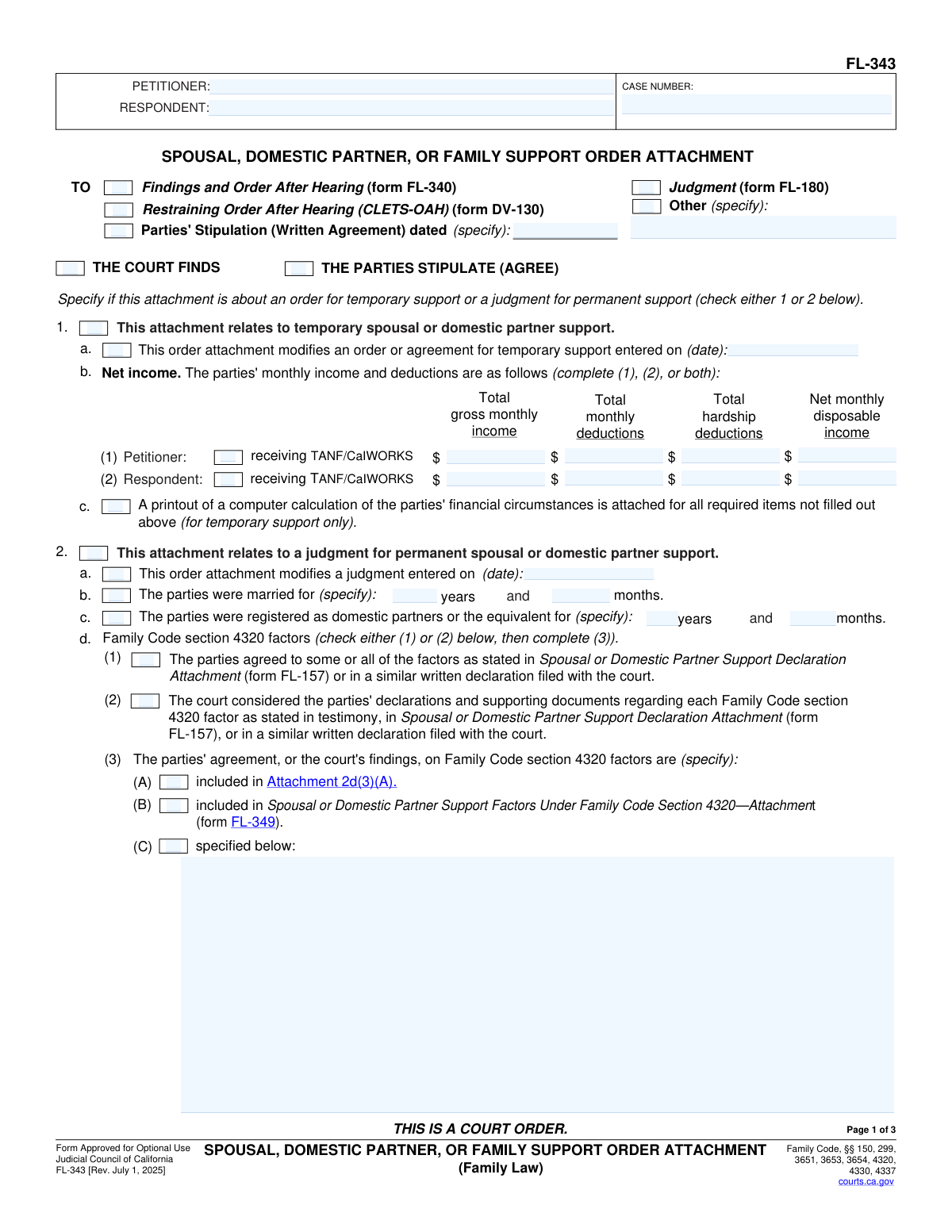
Form FL-343, Spousal, Domestic Partner, or Family Support Order Attachment, is a California Judicial Council form used in family law cases to provide the specific details of a court-ordered support arrangement. It attaches to a primary order, such as a Judgment (FL-180) or Findings and Order After Hearing (FL-340), to document the amount, duration, and other terms of spousal, domestic partner, or family support. This form is crucial for creating a clear, detailed, and legally enforceable support order. Today, this form can be filled out quickly and accurately using AI-powered services like Instafill.ai, which can also convert non-fillable PDF versions into interactive fillable forms.
FL-343 is part of the
California court forms, family court forms and family law forms categories on Instafill.
Our AI automatically handles information lookup, data retrieval, formatting, and form filling.
It takes less than a minute to fill out FL-343 using our AI form filling.
Securely upload your data. Information is encrypted in transit and deleted immediately after the form is filled out.
Form specifications
| Form name: | Form FL-343, Spousal, Domestic Partner, or Family Support Order Attachment |
| Number of fields: | 106 |
| Number of pages: | 1 |
| Language: | English |
Instafill Demo: How to fill out PDF forms in seconds with AI
How to Fill Out FL-343 Online for Free in 2026
Are you looking to fill out a FL-343 form online quickly and accurately? Instafill.ai offers the #1 AI-powered PDF filling software of 2026, allowing you to complete your FL-343 form in just 37 seconds or less.
Follow these steps to fill out your FL-343 form online using Instafill.ai:
- 1 Navigate to Instafill.ai and upload or select Form FL-343.
- 2 Use the AI assistant to automatically fill in the case caption, including Petitioner and Respondent names and the case number.
- 3 Indicate which primary court order this form is an attachment to, such as a Judgment (FL-180) or Order After Hearing (FL-340).
- 4 Specify whether the order is for temporary or permanent support, and provide the required financial details, such as income and deductions for each party.
- 5 Clearly state the support amount, the start date for payments, the payment schedule, and the method of payment.
- 6 Define the conditions for support termination, earnings assignment, and any other specific orders or agreements between the parties.
- 7 Review all entered information for accuracy, then download the completed form to be filed with the court as part of your legal proceedings.
Our AI-powered system ensures each field is filled out correctly, reducing errors and saving you time.
Why Choose Instafill.ai for Your Fillable FL-343 Form?
Speed
Complete your FL-343 in as little as 37 seconds.
Up-to-Date
Always use the latest 2026 FL-343 form version.
Cost-effective
No need to hire expensive lawyers.
Accuracy
Our AI performs 10 compliance checks to ensure your form is error-free.
Security
Your personal information is protected with bank-level encryption.
Frequently Asked Questions About Form FL-343
Form FL-343 is a California court form used to detail the specific terms of a spousal, domestic partner, or family support order. It is an attachment that provides the details for a primary order, such as a Judgment (FL-180) or an Order After Hearing (FL-340).
This form is completed to document a court's decision or a couple's agreement regarding support. It is typically filled out by the parties' attorneys or the judge as part of a divorce, legal separation, or domestic partnership dissolution case.
Temporary support is ordered while a case is ongoing and is based primarily on income and need. Permanent support is ordered as part of the final judgment and considers numerous factors listed in Family Code section 4320, such as the length of the marriage and standard of living.
For temporary support, you must provide each party's total gross monthly income, monthly deductions, and any hardship deductions to determine net disposable income. Alternatively, you can attach a computer calculation printout with this information.
These are the legal factors a court must consider when ordering permanent spousal support. They include the length of the marriage, each party's earning capacity, age and health, and the standard of living during the marriage, among others.
An earnings assignment is a court order directing the paying party's employer to deduct support payments directly from their wages. This is the standard method for ensuring consistent support payments in California.
When the court terminates jurisdiction, it permanently gives up its power to make any future orders for spousal support. This is a final decision that prevents either party from requesting support in the future.
According to Section 6, support payments automatically terminate when either party dies, or when the person receiving support remarries or registers a new domestic partnership, unless the parties have a written agreement stating otherwise.
Yes, Section 8 of the form requires both parties to inform each other in writing of any change in employment within 10 days. This notice must include the new employer’s name, address, and telephone number.
The notice at the end of the form states that any party required to pay support must also pay interest on overdue amounts at the legal rate, which is currently 10 percent.
Yes, services like Instafill.ai use AI to help you accurately auto-fill form fields with your case information, saving time and reducing the risk of errors. This is especially useful for entering names, case numbers, and other repeating data.
To fill out Form FL-343 online, you can upload the PDF to Instafill.ai. The platform will make it an interactive, fillable form that you can complete, save, and print from any device.
If you have a non-fillable or 'flat' PDF, you can use a service like Instafill.ai to make it interactive. Simply upload the file, and their technology will convert it into a fillable form you can complete online.
Compliance FL-343
Validation Checks by Instafill.ai
1
Header Information Consistency Across Pages
Ensures the 'PETITIONER', 'RESPONDENT', and 'CASE NUMBER' fields are filled and contain the exact same information on all three pages of the form. This is critical for document integrity and to ensure all pages are correctly associated with the same legal case. Mismatched information could lead to the form being rejected by the court clerk.
2
Requires Selection of Parent Document
Validates that at least one checkbox is selected in the 'TO' section on page 1, indicating which main order this form is an attachment to (e.g., FL-340, FL-180). If the 'Other' checkbox is selected, the corresponding text field must be filled out. This is mandatory for the form to have legal context and be filed correctly.
3
Ensures Exclusive Selection of Support Type
Verifies that either Item 1 (temporary support) or Item 2 (permanent support) is checked, but not both. These options are mutually exclusive and define the fundamental nature of the support order. An invalid selection makes the order ambiguous and unenforceable.
4
Validates Net Income Calculation for Temporary Support
Checks the financial figures in Item 1b. The value in 'Net monthly disposable income' must equal 'Total gross monthly income' minus 'Total monthly deductions' and 'Total hardship deductions'. This ensures mathematical accuracy in the financial data used to determine temporary support, preventing errors in the court's calculations.
5
Validates Format of Marriage or Partnership Duration
Ensures that the 'years' and 'months' fields in Items 2b and 2c contain only non-negative integers. Additionally, it validates that the 'months' value is less than 12. This maintains data integrity for a key factor in determining permanent support.
6
Validates Jurisdiction Termination Date
Checks that if a date is entered in Item 3c for when the court's jurisdiction over support ends, it is a valid date format and is set in the future. A past date would be logically incorrect and could create legal confusion. This ensures the order's prospective effect is clear.
7
Ensures Payor and Payee Are Different Parties
Validates in Item 4a that the party selected as the payor (e.g., 'petitioner') is different from the party selected as the payee (e.g., 'respondent'). A person cannot be ordered to pay support to themselves. This is a fundamental logical check to prevent a nonsensical and invalid order.
8
Verifies Logical Support Payment Dates
Checks that the 'Support payments will begin' date in Item 4b is a valid date. If a payment end date is specified in Item 4c(1), this validation ensures the end date is on or after the begin date. This prevents the creation of an impossible payment schedule.
9
Ensures Conditional Payment Schedule Details are Complete
Validates the payment schedule options in Item 4c. If option (1) 'payable through' is checked, an end date must be provided. If option (2) 'payable on the' is checked, a day of the month (1-31) must be entered. If option (3) 'Other' is checked, the specification text field must be filled.
10
Requires Positive Integer for Earnings Assignment Stay
Validates that if the checkbox in Item 5b is selected to stay the service of an earnings assignment, the 'days late' field must be filled with a positive integer. This number defines the grace period for payments, and leaving it blank or using an invalid number would make the condition unenforceable.
11
Cross-Validates Family Support Selections
Ensures consistency between different sections of the form. If 'family support' is selected as the payment type in Item 4a, the 'Family support orders' checkbox in Item 7 must also be checked, and vice-versa. This maintains logical integrity across the document and ensures all required family support provisions are triggered.
12
Cross-Validates Attachment to Restraining Order
Verifies that if Item 10a ('This form is attached to Restraining Order After Hearing') is checked, then the corresponding 'Restraining Order After Hearing (CLETS-OAH) (form DV-130)' checkbox is also selected in the 'TO' section on page 1. This ensures the form's relationship to a protective order is clearly and consistently documented.
13
Requires Date for Party Stipulation
Validates that if 'THE PARTIES STIPULATE (AGREE)' is selected at the top of page 1, the associated date field must be filled with a valid date. The date of the agreement is a critical piece of information for establishing when the stipulation was made. Failure to provide it makes the agreement's timeline unclear.
14
Ensures a Valid Support Amount is Entered
Checks that the monetary amount for support specified in Item 4a is a valid, positive number. An order cannot be created with a zero, negative, or non-numeric support amount. This is a fundamental requirement for a legally binding financial order.
Common Mistakes in Completing FL-343
Users often meticulously fill out the Petitioner, Respondent, and Case Number on the first page but forget to repeat this information in the headers of pages 2 and 3. If the pages of the document become separated during court processing, the unidentifiable pages can be lost or disregarded, potentially leading to the rejection of the entire filing. To prevent this, double-check that the header on every single page is completed accurately before submission.
A frequent error is filling out information in both Section 1 (Temporary Support) and Section 2 (Permanent Support), or filling out the incorrect one. These sections are mutually exclusive and are governed by different legal standards, so selecting the wrong one can lead to an order that does not reflect the court's actual ruling or the parties' agreement. Carefully determine if the order is for temporary support (pre-judgment) or permanent support (in a final judgment) and complete only the corresponding section.
In Section 4a, users must clearly designate which party is the payor and which is the payee by checking the appropriate 'petitioner' or 'respondent' box for each role. A common mistake is to leave one or both of these blank, or to check both boxes for a single role, which makes the order ambiguous and unenforceable. To avoid this, carefully select one party to pay and one party to receive support, ensuring the order is legally clear.
In Section 3, accidentally checking box 3b ('The court terminates jurisdiction') when the intent was to reserve it (3a) is a catastrophic error. Terminating jurisdiction permanently prevents the supported party from ever requesting that support again, even if circumstances change drastically. This mistake is often irreversible and has profound financial consequences, so these boxes must be reviewed with extreme care.
Users sometimes miscalculate or estimate the length of the marriage/partnership in Section 2b/2c. In California, the duration of the marriage, particularly whether it crosses the 10-year threshold, is a critical factor that affects the court's ability to set an end date for support. An inaccurate calculation can lead to significant disputes and unintended long-term financial obligations or limitations.
When filling out the income details in Section 1b, people often confuse gross and net income, use estimates instead of actual figures from pay stubs, or miscalculate deductions. These errors lead directly to an incorrect calculation of guideline support, resulting in a support order that is either too high or too low. It is crucial to use precise figures from recent financial documents to ensure the calculation is accurate.
The form allows users to reference other documents by checking boxes like 1c (computer calculation printout) or 2d(3)(A) (attachment for 4320 factors). A common oversight is checking the box but failing to physically attach the corresponding document to the filing. This makes the order incomplete and can lead to rejection by the court clerk or a legal challenge from the other party for being unsubstantiated.
At the very top of the form, users must check a box to indicate which primary court order this form is an attachment to (e.g., FL-340, FL-180). Neglecting to check any box leaves the context of the support order unclear, which can cause confusion and processing delays. Always ensure you specify whether this attachment is part of a temporary order, a final judgment, or another specified order.
In sections that allow for custom text, such as 6b (custom termination agreement) or 11 (Other orders), parties often write terms that are vague or open to interpretation. For example, writing 'support ends when payee is financially stable' is ambiguous and invites future conflict and litigation. Any custom terms must be drafted with absolute clarity, using specific dates, events, and amounts to be enforceable and avoid future disputes.
Section 4 requires specific details about the support payment, including the start date (4b) and payment frequency/due date (4c). People sometimes leave these fields blank, assuming a default will apply. This creates uncertainty and can lead to disputes about when the first payment was due or whether a payment is late, making enforcement difficult.
Saved over 80 hours a year
“I was never sure if my IRS forms like W-9 were filled correctly. Now, I can complete the forms accurately without any external help.”
Kevin Martin Green
Your data stays secure with advanced protection from Instafill and our subprocessors

Robust compliance program
Transparent business model
You’re not the product. You always know where your data is and what it is processed for.
ISO 27001, HIPAA, and GDPR
Our subprocesses adhere to multiple compliance standards, including but not limited to ISO 27001, HIPAA, and GDPR.
Security & privacy by design
We consider security and privacy from the initial design phase of any new service or functionality. It’s not an afterthought, it’s built-in, including support for two-factor authentication (2FA) to further protect your account.
Fill out FL-343 with Instafill.ai
Worried about filling PDFs wrong? Instafill securely fills form-fl-343-spousal-domestic-partner-or-family-support-order-attachment forms, ensuring each field is accurate.