Fill out business investment account forms
with AI.
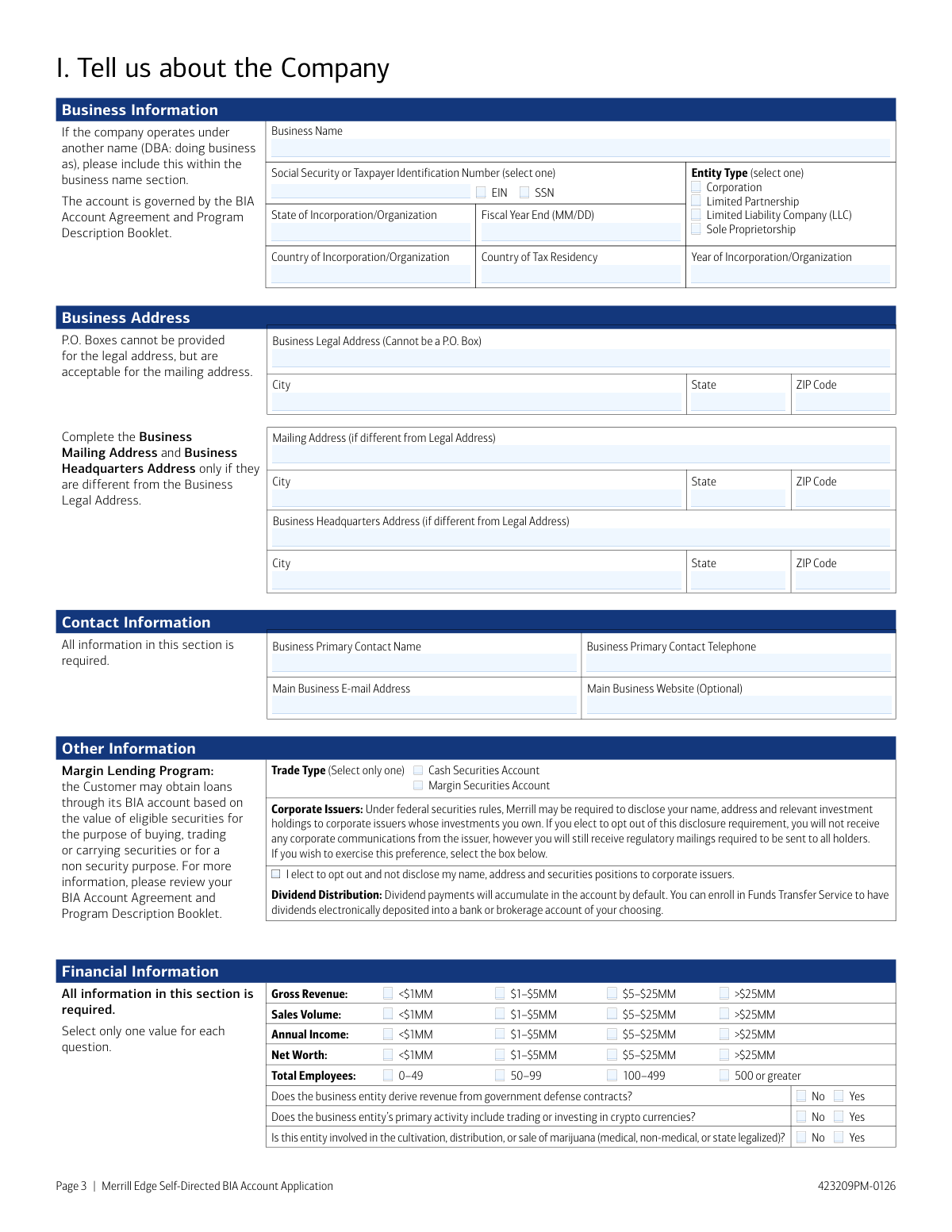
Business investment account forms are essential documents used by legal entities to establish a financial footprint in the securities market. Whether a company is a small LLC or a large corporation, these forms serve as the legal foundation for opening brokerage accounts, such as the Merrill Edge® Self-Directed Business Investor Account. They are designed to capture critical data regarding the business's structure, tax identification, and financial objectives, ensuring that the financial institution complies with "Know Your Customer" (KYC) and anti-money laundering regulations.
By continuing, you acknowledge Instafill's Privacy Policy and agree to get occasional product update and promotional emails.
About business investment account forms
These forms are typically handled by business owners, corporate officers, or financial advisors who need to manage a company’s capital and surplus cash efficiently. Completing these applications often involves providing intricate details about principals, beneficial owners, and authorized traders. Because these booklets and agreements can be lengthy and require precise financial information, the process is often seen as a significant administrative hurdle. Accuracy is paramount, as errors in tax status or entity classification can lead to processing delays or regulatory complications that stall a company's investment strategy.
To streamline this administrative burden, tools like Instafill.ai use AI to accurately complete these complex PDF forms in under 30 seconds while maintaining high standards of data security. This modern approach allows businesses to move from paperwork to active investing much faster, ensuring that all fields are handled correctly without the need for tedious manual data entry.
Every form on this page can be completed without typing. Instafill is form filling software that reads a PDF and fills it for you — including flat and scanned documents that carry no fillable fields at all.
Forms in This Category
The forms in this category have a median Form Complexity Index of 69/100 (Complex), measured across 1 forms by field count, input difficulty, length, conditional logic and structure. See how it is calculated.
| Form Name | Pages | FCI | |
|---|---|---|---|
| 1. | Merrill Edge® Self‑Directed Business Investor Account (BIA Account) Account Application Booklet and Agreements | 1 | Complex 69 |
- Enterprise-grade security & data encryption
- 99%+ accuracy powered by AI
- 1,000+ forms from all industries
- Complete forms in under 60 seconds
How to Choose the Right Form
Determining if the BIA Account is Right for You
The primary document in this category is the Merrill Edge® Self‑Directed Business Investor Account (BIA Account) Account Application Booklet and Agreements. This is the essential gateway for businesses that want to take control of their own investment strategies. Choose this form if your goal is to establish a self-directed account for trading stocks, mutual funds, and other securities through Merrill Edge.
Supported Business Entities
This comprehensive application is designed to accommodate a wide variety of legal structures. You should use this form if you are applying on behalf of any of the following:
- Corporations: Both S-Corps and C-Corps.
- Limited Liability Companies (LLCs): Including single-member and multi-member LLCs.
- Partnerships: General partnerships, limited partnerships (LP), or limited liability partnerships (LLP).
- Sole Proprietorships: Small business owners operating as individuals or under a DBA.
What You’ll Need to Complete the Application
Because the Merrill Edge® BIA Account Application is a multi-part booklet rather than a simple one-page form, it requires detailed information to meet legal and regulatory compliance. Before you begin, ensure you have these details ready:
- Company Identification: Your Federal Tax ID (EIN) and official date of formation.
- Principal Information: Legal names, addresses, and Social Security numbers for all company principals, officers, or authorized signers.
- Financial Standing: Estimates of the company's annual income, net worth, and liquid assets.
- Investment Objectives: A clear idea of your business’s risk tolerance and trading goals.
Efficiency Tip
Given the length of the BIA Account Application Booklet and Agreements, manual entry can be time-consuming and prone to errors. Using Instafill.ai allows you to navigate the complex fields of this PDF efficiently, ensuring that your tax status and financial data are mapped correctly across the entire agreement, which helps speed up the account approval process by minimizing data entry mistakes.
Form Comparison
| Form | Purpose | Eligible Entities | Key Requirements |
|---|---|---|---|
| Merrill Edge® Self‑Directed Business Investor Account (BIA Account) Account Application Booklet and Agreements | Establishing a self-directed brokerage account for business-related investment and trading. | Corporations, LLCs, Partnerships, and Sole Proprietorships looking to manage business capital. | Requires company data, principal identification, financial standing, and tax status documentation. |
Tips for business investment account forms
AI-powered tools like Instafill.ai can complete these complex investment forms in under 30 seconds with high accuracy. This technology ensures your business data stays secure during the process, making it a reliable time-saver for managing lengthy application booklets.
Before starting the application, ensure you have your Employer Identification Number (EIN), Articles of Incorporation, or Operating Agreement ready. Having these documents on hand prevents interruptions and ensures the information you provide matches your official legal records exactly.
Business accounts often require signatures from multiple principals, such as CEOs, partners, or managing members. Review the application early to determine who needs to sign so you can coordinate their availability and avoid significant submission delays.
Discrepancies between the business name on the form and the name registered with the IRS can lead to immediate rejection. Double-check that your legal entity name and tax ID are entered exactly as they appear on your official SS-4 confirmation or recent tax returns.
These forms typically ask for your business’s financial goals and risk appetite to meet regulatory 'know your customer' requirements. Discussing these details with your stakeholders beforehand ensures consistency and accuracy across all your financial and investment documentation.
Incomplete sections, especially regarding beneficial ownership and financial standing, are the most common cause of processing holds. A final scan to ensure every required field is filled will save you days of administrative back-and-forth with the brokerage firm.
Frequently Asked Questions
These forms are designed for a variety of legal entities including C-Corporations, S-Corporations, Limited Liability Companies (LLCs), Partnerships, and Sole Proprietorships. They allow these organizations to manage surplus cash or invest capital in securities under the company's name rather than an individual's name.
The application establishes a formal brokerage relationship between a business and a financial institution. It serves to gather necessary regulatory information, verify the identity of the business and its owners, and document the terms of the investment agreement to ensure legal compliance.
Generally, you will need your business’s Employer Identification Number (EIN), formation documents such as Articles of Incorporation, and personal identification for all authorized signers. You may also need to provide financial statements or proof of the business's physical operating address.
Yes, AI-powered tools like Instafill.ai can process these complex documents in under 30 seconds by extracting data from your existing business records. The technology accurately places information into the correct fields, reducing the manual effort required for lengthy multi-page application booklets.
While manual completion of a multi-page booklet can take an hour or more, using AI automation can reduce this time significantly. With Instafill.ai, the data extraction and placement process is completed almost instantly, allowing for a much faster submission cycle.
Authorization depends on the business structure; typically, an officer of a corporation, a managing member of an LLC, or a general partner must sign. The application usually requires a corporate resolution or a similar document to prove that the individual has the legal authority to act on behalf of the company.
A self-directed account gives the business full control over its investment decisions without requiring a dedicated financial advisor for every trade. This is often used by businesses looking to invest in stocks, bonds, or mutual funds to grow their reserves or manage corporate wealth more flexibly.
Yes, disclosing the tax status of the business is a mandatory part of the application process for regulatory and withholding purposes. You will likely need to provide information regarding your FATCA status and certify the business's tax classification to ensure compliance with IRS regulations.
Once the forms are submitted, the financial institution will review the application for compliance and perform 'Know Your Customer' (KYC) checks. If approved, the account is opened, and the business can then fund the account and begin trading securities.
Most financial institutions require detailed information for all 'Control Persons' and individuals with significant ownership, often defined as 25% or more. This is a standard anti-money laundering requirement designed to identify the actual individuals who benefit from or control the business's assets.
If you encounter a static or non-fillable PDF version of a business investment form, AI tools can convert these into interactive, fillable documents. Services like Instafill.ai allow you to transform these traditional PDFs into digital forms that can be completed and signed electronically.
Glossary
- Form Complexity Index
- Instafill’s 0–100 measure of how much effort a form takes to complete, calculated deterministically from the form’s own structure rather than estimated. It combines the number of fillable fields (the largest factor), how difficult those fields are to complete based on their type, the number of pages that contain fields, the amount of conditional “fill-only-if” logic, and how many sections the form is divided into, then adds modifiers for tables and repeating lists, bundled instruction pages, and dense page layouts. A higher score means the form is harder to fill out by hand. The forms in this category have a median Form Complexity Index of 69/100 (Complex). See exactly how it is calculated.
- Beneficial Owner
- An individual who directly or indirectly owns 25% or more of the equity interests of a business entity or has significant responsibility to control the company.
- Authorized Signer
- A person legally designated by a business to conduct transactions, sign documents, and manage the investment account on behalf of the entity.
- Self-Directed Account
- An investment account where the account holder makes all trading decisions and selections without receiving professional advice or management from the brokerage firm.
- Margin Account
- A brokerage account that allows the business to borrow funds from the broker to purchase securities, using the existing assets in the account as collateral.
- Control Person
- An individual with high-level management authority, such as a CEO, Managing Member, or General Partner, who has the power to direct the business's operations.
- TIN (Taxpayer Identification Number)
- A unique identification number used for tax purposes; for businesses, this is typically an Employer Identification Number (EIN) issued by the IRS.
- FINRA (Financial Industry Regulatory Authority)
- A regulatory body that oversees brokerage firms and their employees to ensure they follow federal laws and industry standards.
- Cash Account
- The most basic type of brokerage account, where the business must pay the full amount for any securities or stocks purchased using available cash on hand.