Fill out charitable contribution forms
with AI.
Charitable contribution forms serve as the essential link between philanthropic intent and financial compliance. These documents are used to formalize the transfer of assets—ranging from cash and mutual funds to restricted securities—to qualified non-profit organizations and donor-advised funds. Proper documentation is not only necessary for the recipient to process the gift but is also critical for the donor to secure the appropriate tax deductions and maintain clear records for the IRS.
By continuing, you acknowledge Instafill's Privacy Policy and agree to get occasional product update and promotional emails.
About charitable contribution forms
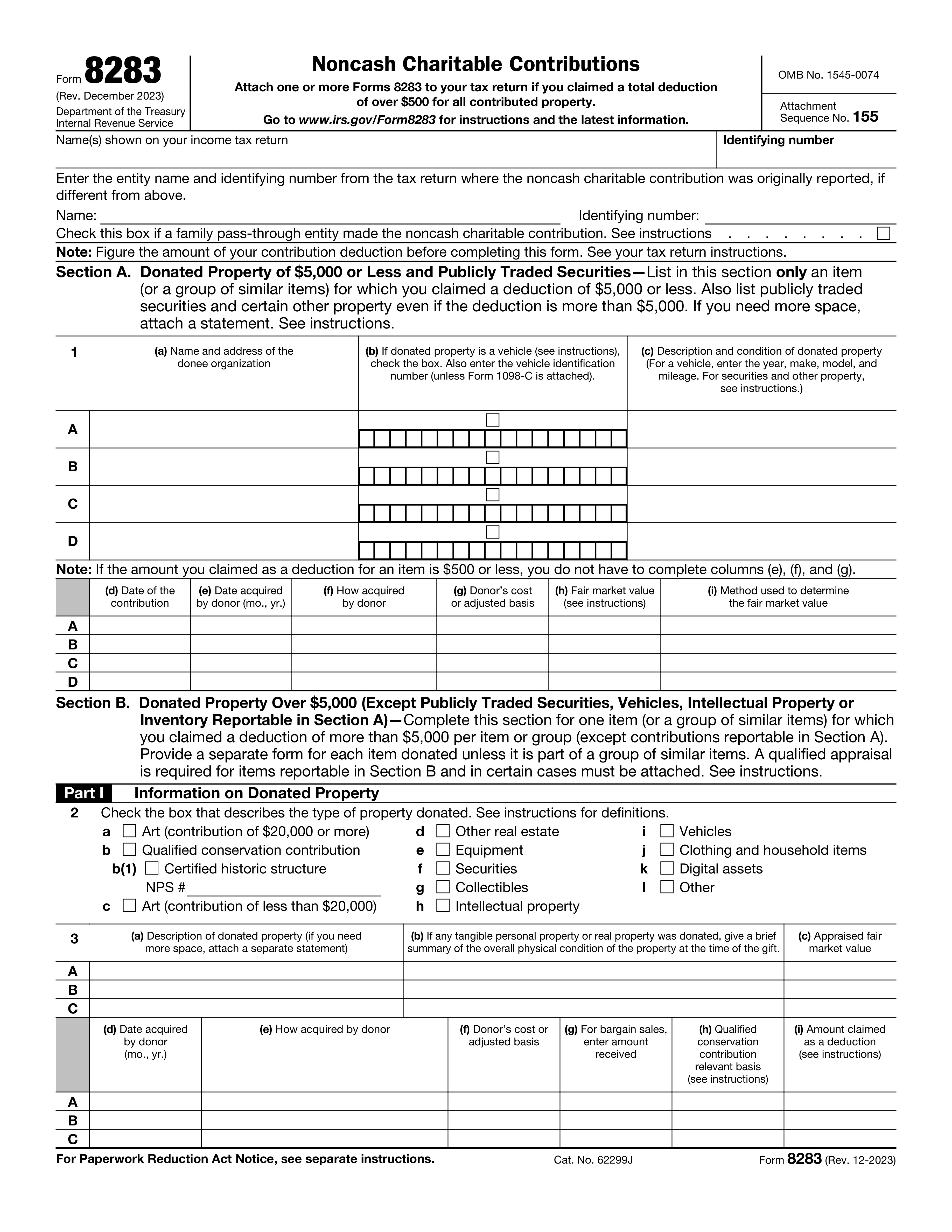
Individual donors, financial planners, and legal professionals typically encounter these forms when facilitating significant gifts or managing year-end tax planning. For instance, those contributing to a Fidelity Charitable Giving Account or a Vanguard Charitable philanthropic account must provide detailed letters of instruction and asset history to ensure the contribution is irrevocable and correctly invested. Additionally, taxpayers donating non-cash property valued over $500 must file specific IRS forms, such as Form 8283, to substantiate their claims. Whether you are moving stocks or donating physical property, precision in these documents ensures that your charitable goals are met without administrative delays.
Completing these complex investment and tax forms manually can be a tedious process, but tools like Instafill.ai use AI to fill these forms in under 30 seconds with high accuracy and security. This streamlined approach helps donors and advisors handle the necessary paperwork efficiently, allowing more time to focus on the impact of their giving.
Every form on this page can be completed without typing. Instafill is form filling software that reads a PDF and fills it for you — including flat and scanned documents that carry no fillable fields at all.
Forms in This Category
The forms in this category have a median Form Complexity Index of 58/100 (Moderate), measured across 6 forms by field count, input difficulty, length, conditional logic and structure. See how it is calculated.
| Form Name | Pages | FCI | |
|---|---|---|---|
| 1. | Form 8283, Noncash Charitable Contributions | 2 | Moderate 62 |
| 2. | Fidelity Charitable 144/145 Contribution Form | 1 | Moderate 58 |
| 3. | Fidelity Charitable Contribution Form | 5 | – |
| 4. | Fidelity Charitable Irrevocable Contribution Form and Letter of Instruction | 5 | Moderate 58 |
| 5. | Irrevocable Contribution Form and Letter of Instruction | 5 | Moderate 58 |
| 6. | Make a contribution - Vanguard Charitable | 1 | Moderate 58 |
- Enterprise-grade security & data encryption
- 99%+ accuracy powered by AI
- 1,000+ forms from all industries
- Complete forms in under 60 seconds
How to Choose the Right Form
IRS Tax Compliance and Reporting
If you have already donated non-cash property and need to report it to the IRS to claim a tax deduction, you must use Form 8283, Noncash Charitable Contributions. This form is mandatory for taxpayers whose total non-cash contributions exceed $500. It provides the necessary documentation for items like clothing, household goods, or equipment donated to qualified organizations.
Fidelity Charitable Giving Accounts
When funding a donor-advised fund through Fidelity, the form you choose depends on the specific nature of the asset you are transferring:
- For Standard Assets: Use the Fidelity Charitable Irrevocable Contribution Form and Letter of Instruction or the Fidelity Charitable Contribution Form. These are the primary documents for transferring cash, publicly traded stocks, or mutual funds into your Giving Account. They allow you to specify how the proceeds should be allocated among various investment pools.
- For Restricted Securities: If you are donating control or restricted shares subject to SEC regulations, you must use the Fidelity Charitable 144/145 Contribution Form. This form captures specific acquisition history and donor information required to comply with Rule 144/145 while facilitating the transfer to your Charitable Investment Advisor Program (CIAP).
Vanguard Charitable Contributions
If you manage your philanthropic giving through Vanguard, use the Make a contribution - Vanguard Charitable form. This document is designed for donors making irrevocable contributions of mutual funds, bonds, or cash to their Vanguard philanthropic accounts. Similar to the Fidelity forms, it serves as both a legal transfer of ownership and a set of instructions for future investment direction.
Key Considerations
Remember that contributions to donor-advised funds are irrevocable. Once you submit forms like the Fidelity Charitable Irrevocable Contribution Form, the assets belong to the charitable sponsor. Ensure all transfer instructions and asset details are accurate before finalizing your submission to avoid delays in receiving your tax substantiation.
Form Comparison
| Form | Accepted Asset Types | Recipient Entity | Primary Purpose |
|---|---|---|---|
| Form 8283, Noncash Charitable Contributions | Noncash property valued at over $500 | The Internal Revenue Service during tax filing | Report noncash gifts to claim federal tax deductions |
| Fidelity Charitable 144/145 Contribution Form | Restricted or control securities under Rule 144/145 | Fidelity Charitable Giving Account program administrators | Manage SEC compliance for restricted stock contributions |
| Fidelity Charitable Irrevocable Contribution Form and Letter of Instruction | Cash, mutual funds, or physical stock certificates | Fidelity Charitable Giving Account program administrators | Authorize irrevocable transfers and select specific investment pools |
| Make a contribution - Vanguard Charitable | Cash, stocks, bonds, or mutual fund holdings | Vanguard Charitable Philanthropic Account program administrators | Document asset transfers for tax substantiation and investment |
| Fidelity Charitable Contribution Form | Stocks, securities, or various cash assets | Fidelity Charitable Giving Account program administrators | Formalize irrevocable asset transfers for tax and record-keeping |
| Fidelity Charitable Irrevocable Contribution Form and Letter of Instruction | Cash, stocks, or mutual fund assets | Fidelity Charitable Giving Account program administrators | Issue transfer instructions and allocate assets to investment pools |
Tips for charitable contribution forms
When contributing securities or mutual funds, ensure that CUSIP numbers and ticker symbols are exactly correct. Mismatched account numbers or incorrect ticker symbols can significantly delay the transfer process and may affect the official valuation date of your gift.
Most charitable contribution forms for Donor-Advised Funds (DAFs) are irrevocable, meaning once the transfer is processed, it cannot be reversed. Carefully review the dollar amount or the number of shares listed to ensure you are not over-contributing or selecting the wrong asset from your portfolio.
For noncash contributions exceeding $500, such as property or specialized securities, keep detailed records of how you acquired the asset and its cost basis. If the value exceeds $5,000, remember that you may need a qualified appraisal and a signature from the donee organization on IRS Form 8283.
Filling out the Letter of Instruction is only one part of the process; you should also notify your current brokerage that a transfer is initiated. Providing a copy of the completed form to both the charitable fund and your financial advisor ensures both parties are aligned to execute the trade quickly.
Many DAF forms require you to decide how your contribution will be invested immediately upon receipt. Research the available investment pools offered by providers like Fidelity or Vanguard beforehand so you can accurately fill out the percentage allocations without having to pause mid-form.
AI-powered tools like Instafill.ai can complete these complex charitable forms in under 30 seconds with high accuracy. Your data stays secure during the process, providing a massive time-saving advantage for donors who need to manage multiple forms across different charitable accounts.
Keep a digital copy of every signed contribution form alongside the final acknowledgment letter from the charity. This documentation is vital for substantiating your tax deductions and ensuring you have a clear paper trail for your annual tax filings.
Frequently Asked Questions
Charitable contribution forms are used to document the transfer of assets to qualified non-profit organizations or donor-advised funds. These documents ensure that both the donor and the recipient have a legal record of the transaction for tax deduction purposes. They are essential for substantiating claims made on annual tax returns.
You should use IRS Form 8283 when the total value of all noncash items donated to charities exceeds $500 in a single tax year. While standard receipts work for smaller items or cash, this specific form is required by the IRS to provide detailed information about the property's value and how it was acquired.
A Donor-Advised Fund contribution form is used to move assets into a private fund managed by a third party, such as Fidelity or Vanguard. Once the assets are in the fund, the donor can recommend grants to various charities over time. These forms are necessary to initiate the initial transfer of stocks, bonds, or cash into the DAF.
The Fidelity 144/145 form is specifically for donors who wish to contribute restricted or control securities, which are subject to specific SEC regulations. If you are an affiliate of the issuing company or hold shares that have not been registered, this form ensures the transfer complies with federal securities laws.
Generally, contributions made through these forms are irrevocable, meaning they cannot be refunded or returned once accepted by the charitable organization or fund. This irrevocable status is a key requirement for the donor to be eligible for an immediate tax deduction. Always review the terms of the specific fund before finalizing the document.
Most of these forms allow for the contribution of a wide range of assets, including cash, publicly traded stocks, mutual fund shares, and sometimes complex assets like private equity. The specific form you choose will depend on whether you are donating to a direct charity or a donor-advised fund.
Forms for donor-advised funds are typically submitted directly to the financial institution managing the fund, such as Fidelity Charitable or Vanguard Charitable. IRS forms like the 8283 are usually attached to your annual federal tax return. Always check the specific instructions on the form for the correct mailing address or digital upload portal.
Many charitable contribution forms require a signature from the donor and, in some cases, an acknowledgment from the recipient organization or a qualified appraiser. For noncash gifts of high value, the IRS requires the donee organization to sign Part IV of Form 8283 to verify receipt of the property.
Yes, you can fill out charitable contribution forms using AI tools like Instafill.ai. These tools can accurately extract data from your financial statements or source documents and place it directly into the correct fields on the PDF. This reduces manual entry errors and ensures that complex asset details are recorded accurately.
Using AI-powered services, you can complete these forms in under 30 seconds by uploading your relevant data. This is significantly faster than manual entry, especially for forms requiring detailed acquisition history or investment pool allocations. The AI ensures that even non-fillable PDF versions are converted into interactive, easy-to-complete documents.
While cash donations are often documented with a simple receipt, larger cash contributions to donor-advised funds still require a formal contribution form. These forms serve as a letter of instruction for how the cash should be invested within the fund. For direct donations to charities, a formal form is usually only required for non-cash items over a certain value.
Before starting, you should have your account numbers, the specific details of the assets (such as CUSIP numbers or ticker symbols), and the date the assets were originally acquired. If you are donating non-cash property, you may also need the original cost basis and a recent appraisal. Having these documents ready allows AI tools to populate the forms more efficiently.
Glossary
- Form Complexity Index
- Instafill’s 0–100 measure of how much effort a form takes to complete, calculated deterministically from the form’s own structure rather than estimated. It combines the number of fillable fields (the largest factor), how difficult those fields are to complete based on their type, the number of pages that contain fields, the amount of conditional “fill-only-if” logic, and how many sections the form is divided into, then adds modifiers for tables and repeating lists, bundled instruction pages, and dense page layouts. A higher score means the form is harder to fill out by hand. The forms in this category have a median Form Complexity Index of 58/100 (Moderate). See exactly how it is calculated.
- Donor Advised Fund (DAF)
- A private fund managed by a charitable organization that allows donors to make a charitable contribution, receive an immediate tax deduction, and then recommend grants from the fund over time.
- Irrevocable Contribution
- A donation that cannot be cancelled, returned, or refunded once it has been accepted by the charitable organization.
- Noncash Charitable Contribution
- A donation of property or assets other than money, such as stocks, mutual funds, or physical goods, which often requires specific IRS reporting like Form 8283.
- Cost Basis
- The original value of an asset for tax purposes, usually the purchase price, used to determine capital gains or losses when the asset is donated.
- Rule 144/145 Securities
- Restricted or control stocks that are subject to specific SEC regulations regarding their sale and transfer, often requiring extra documentation when donated.
- CIAP (Charitable Investment Advisor Program)
- A program that allows a donor to have their personal investment advisor manage the assets held within their charitable giving account.
- Qualified Appraisal
- An official estimate of an item's value performed by a certified professional, required by the IRS for noncash donations exceeding certain dollar thresholds.
- Investment Pool
- A collection of funds from many donors that are grouped together and invested in a specific strategy, such as growth or conservative income, to increase the value of the charitable account.