Fill out deferred compensation forms
with AI.
Deferred compensation forms are essential tools for managing 457(b) retirement plans, primarily used by government employees and those working for qualifying non-profit organizations. These documents facilitate the movement and management of retirement assets, allowing participants to defer a portion of their income for future use. Whether you are initiating an outgoing rollover to an IRA, requesting a benefit distribution after leaving service, or converting pre-tax funds into a Roth account, these forms ensure that your financial transitions are documented correctly and comply with IRS regulations.
By continuing, you acknowledge Instafill's Privacy Policy and agree to get occasional product update and promotional emails.
About deferred compensation forms
Typically, these forms are required during significant career or life transitions. Employees who have recently retired or changed jobs often need to complete distribution requests or separation from employment withdrawal forms to access their funds or move them to a new employer's plan. Additionally, keeping beneficiary designations up to date is a critical part of estate planning to ensure assets are distributed according to your wishes. Notable examples include the New York State Deferred Compensation Plan forms and the Housing Agency Retirement Trust documentation, which cover everything from account transfers to beneficiary changes.
Navigating the complexities of retirement paperwork can be time-consuming, but modern tools simplify the process. Tools like Instafill.ai use AI to fill these forms in under 30 seconds, handling your data accurately and securely to save you time on administrative tasks.
Every form on this page can be completed without typing. Instafill is form filling software that reads a PDF and fills it for you — including flat and scanned documents that carry no fillable fields at all.
Forms in This Category
The forms in this category have a median Form Complexity Index of 56/100 (Moderate), measured across 7 forms by field count, input difficulty, length, conditional logic and structure. See how it is calculated.
- Enterprise-grade security & data encryption
- 99%+ accuracy powered by AI
- 1,000+ forms from all industries
- Complete forms in under 60 seconds
How to Choose the Right Form
Selecting the correct deferred compensation form depends primarily on which government agency you work for and whether you are moving money into, out of, or within your retirement account.
Moving Funds After Leaving Employment
If you have recently separated from service or reached retirement age, you likely need a distribution or "outgoing" form to access your funds:
- New York State Employees: Use the New York State Deferred Compensation Plan Outgoing Rollover to move assets to an IRA or a new employer's plan. If you prefer to receive cash payments (lump sum or periodic) rather than a rollover, use the New York State Deferred Compensation Plan Benefit Distribution Request.
- East Bay Regional Park District: Use the Separation from Employment Withdrawal Form to request payments or rollovers specifically for the East Bay 457(b) plan.
- Housing Agency Retirement Trust (HART): Use the Request For Distribution Form (also known as the 457(b) Termination Form) to specify how you want your funds disbursed upon leaving your role.
Consolidating and Managing Your Assets
If you are currently employed and want to simplify your retirement management or update your account details, look for transfer or administrative forms:
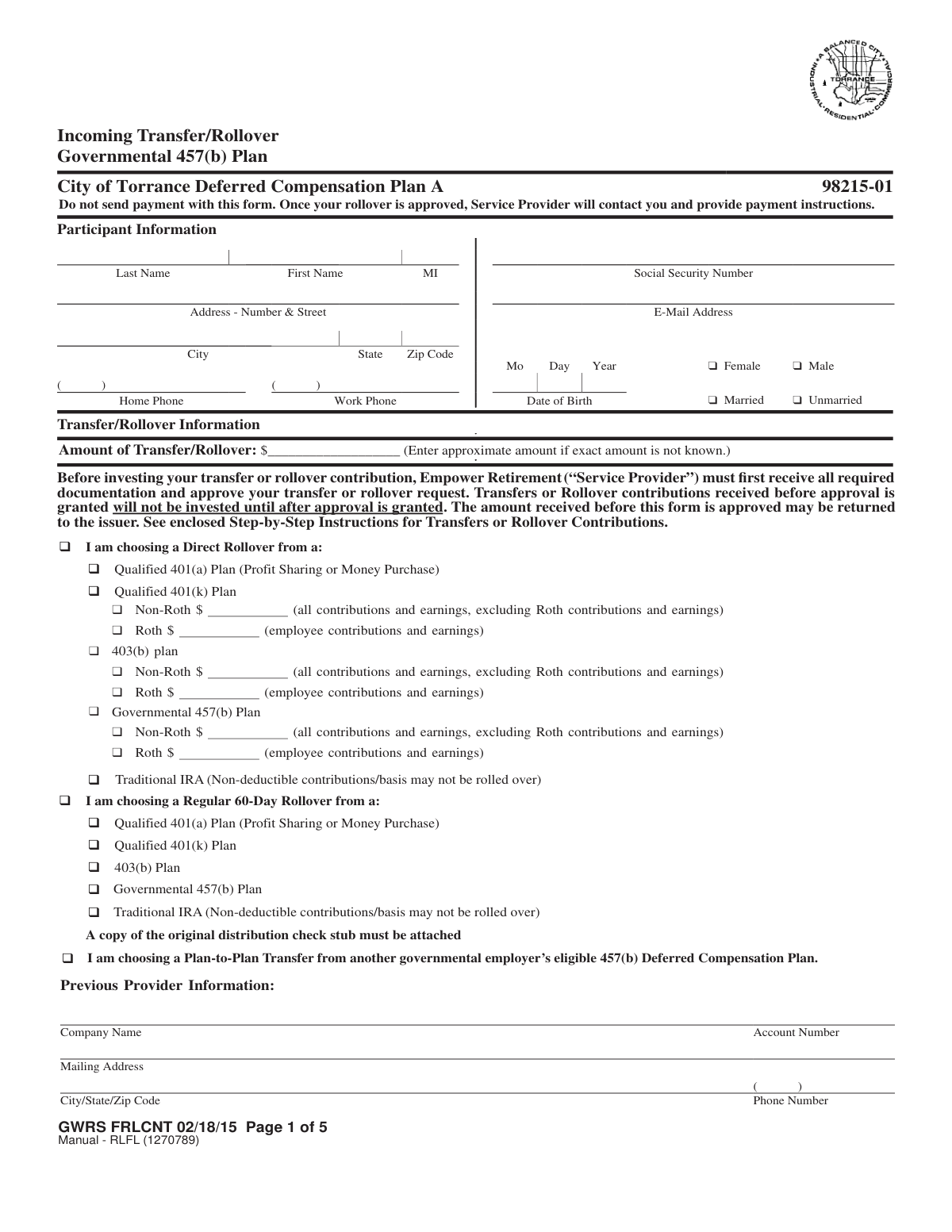
- City of Torrance Employees: The Incoming Transfer/Direct Rollover Governmental 457(b) Plan form allows you to move money from an old 401(k), 403(b), or another 457(b) into your current City of Torrance account.
- Updating Beneficiaries: For those in the HART plan, the Change of Beneficiary Designation Form is essential for ensuring your assets are distributed according to your current wishes, avoiding potential legal complications for your heirs.
Special Tax Conversions
If you are a New York State employee looking to convert pre-tax savings into post-tax funds for future tax-free growth, the New York State Deferred Compensation Plan Direct Rollover to a Roth IRA is the specific document required. Note that this involves paying income tax on the amount rolled over in the current year.
Form Comparison
| Form | Primary Action | Eligibility | Timing / Trigger |
|---|---|---|---|
| New York State Deferred Compensation Plan Outgoing Rollover | Transfer assets from NYSDCP to another retirement account or IRA. | NYSDCP participants separated from service or over age 59.5. | After leaving employment or reaching the required distribution age. |
| New York State Deferred Compensation Plan Benefit Distribution Request | Request lump-sum, periodic, or partial payments from a 457 account. | NYSDCP participants eligible for plan distributions. | When seeking direct access to retirement funds for personal use. |
| New York State Deferred Compensation Plan Direct Rollover to a Roth IRA | Convert pre-tax plan assets into a post-tax Roth IRA. | NYSDCP participants desiring tax-free future growth and withdrawals. | When performing a Roth conversion for specific tax planning goals. |
| Incoming Transfer/Direct Rollover Governmental 457(b) Plan, City of Torrance Deferred Compensation Plan | Consolidate external retirement funds into the City of Torrance plan. | City of Torrance employees with assets in other eligible plans. | When moving funds from a 401(k), 403(b), or another 457(b). |
| Separation from Employment Withdrawal Form for East Bay Regional Park District 457(b) Deferred Compensation Plan | Withdraw or roll over funds after leaving district employment. | Former employees of the East Bay Regional Park District. | Upon separation from employment to manage or access account balances. |
| The Housing Agency Retirement Trust 457(b) Deferred Compensation Plan Request For Distribution Form | Request distribution or transfer of funds upon termination of employment. | Participants of The Housing Agency Retirement Trust (HART). | After leaving a job covered by the HART retirement plan. |
| The Housing Agency Retirement Trust 457b Deferred Compensation Plan Change of Beneficiary Designation Form | Designate or update primary and contingent beneficiaries for account assets. | All current participants in the HART 457(b) retirement plan. | Anytime personal circumstances change to ensure proper asset distribution. |
Tips for deferred compensation forms
Ensure your social security number, account ID, and employer details match your latest statement exactly. Even a small typo can lead to a rejected distribution request or a delayed rollover, potentially causing significant financial delays.
Be careful when selecting your payment method, as direct rollovers generally avoid immediate taxation while cash distributions trigger mandatory withholding. If you are moving funds into a Roth IRA, remember that these conversions are typically taxable events that require careful planning.
Before initiating an outgoing rollover, contact the receiving plan to obtain their specific mailing address and "Payable To" instructions. Providing the correct delivery details on your deferred compensation form ensures your funds arrive at the right destination without getting lost in transit.
AI-powered tools like Instafill.ai can complete these complex deferred compensation forms in under 30 seconds with high accuracy. Your sensitive financial data stays secure during the process, making it a major time-saver for government employees managing multiple retirement accounts.
Retirement assets often bypass probate, so keeping your beneficiary forms current is essential for ensuring your funds go to the right people. Review these forms annually or after events like marriage, divorce, or the birth of a child to prevent legal disputes.
Many distribution forms require your employer to certify that you have officially separated from service. Check with your HR department to ensure your status has been updated in their system before you submit your withdrawal request to avoid automatic rejections.
Save copies of every submitted form and the corresponding confirmation receipts for your personal records. Having these documents organized simplifies your tax preparation and provides a clear audit trail if there are ever discrepancies with your account balance.
Frequently Asked Questions
These forms are used by employees to manage their 457(b) retirement accounts, specifically for moving funds, requesting payouts, or updating beneficiary information. They ensure that retirement assets are handled according to federal tax laws and the specific rules set by the employer's plan.
These forms are primarily designed for government employees, public sector workers, and certain non-profit staff participating in deferred compensation plans like the NYSDCP. You will likely need them when you change jobs, retire, reach a certain age, or wish to consolidate multiple retirement accounts.
Use a distribution form if you want to receive a direct payment, such as a lump sum or periodic payments, to your personal bank account. Choose a rollover form if you intend to move your balance to another retirement vehicle, like an IRA or a new employer's 401(k), to maintain the tax-deferred status of your savings.
You should submit this form once you have officially ended your employment with the participating agency or district. Many plans require a short waiting period after your final paycheck to ensure all contributions have been posted before they can process a full withdrawal or rollover.
Yes, many governmental 457(b) plans allow for incoming transfers from other eligible retirement plans like 401(k)s or 403(b)s. You will need to complete an incoming transfer or direct rollover form to provide details about the sending institution and your investment choices.
An updated beneficiary form ensures your retirement assets are distributed according to your current wishes in the event of your death, bypassing the lengthy probate process. Major life events like marriage, divorce, or the birth of a child are critical times to review and submit a new designation form.
Generally, distributions are treated as taxable income in the year you receive them unless they are rolled over into another qualified retirement account. Some forms, such as a Roth IRA rollover, specifically involve converting pre-tax money into post-tax funds, which triggers a tax liability for the current year.
Yes, you can use AI-powered tools like Instafill.ai to complete these forms quickly. The AI can accurately extract data from your source documents and place it into the correct fields, even if you are working with a non-fillable PDF version of the form.
Using AI technology, you can fill out these deferred compensation forms in under 30 seconds. This method is much faster than manual entry and helps prevent errors in critical sections like account numbers, tax identification, and distribution amounts.
Completed forms are typically submitted to the plan administrator or your employer's human resources department. While some organizations allow for digital uploads, others may require you to mail a signed original or a notarized document to a specific processing center.
A direct rollover moves funds into a traditional IRA or another employer plan where taxes remain deferred until you withdraw the money. A Roth rollover moves funds into a Roth account, meaning you pay taxes on the amount now so that future growth and qualified withdrawals can be tax-free.
Most forms require specific details that must be verified by your plan administrator, such as your date of separation or final contribution date. While you can prepare the form yourself, the plan may require a signature from an authorized employer representative before the request is finalized.
Glossary
- Form Complexity Index
- Instafill’s 0–100 measure of how much effort a form takes to complete, calculated deterministically from the form’s own structure rather than estimated. It combines the number of fillable fields (the largest factor), how difficult those fields are to complete based on their type, the number of pages that contain fields, the amount of conditional “fill-only-if” logic, and how many sections the form is divided into, then adds modifiers for tables and repeating lists, bundled instruction pages, and dense page layouts. A higher score means the form is harder to fill out by hand. The forms in this category have a median Form Complexity Index of 56/100 (Moderate). See exactly how it is calculated.
- 457(b) Plan
- A tax-advantaged retirement savings plan available to state and local government employees and some non-profit workers. It allows participants to defer a portion of their salary into the account before taxes are withheld.
- Deferred Compensation
- A portion of an employee's income that is set aside to be paid at a later date, usually after retirement. This strategy helps reduce current taxable income and allows the funds to grow tax-deferred.
- Direct Rollover
- The process of moving retirement funds directly from one plan provider to another, such as from a 457(b) to an IRA. This method avoids immediate tax withholding and potential early withdrawal penalties.
- Separation from Service
- The official termination of employment due to resignation, retirement, or discharge. This event is typically a requirement for a participant to become eligible for distributions from their deferred compensation plan.
- Distribution Request
- A formal application to withdraw money from a retirement account. Distributions can be taken as a single lump sum, periodic payments, or transferred to another eligible retirement plan.
- Roth IRA Conversion
- The process of moving pre-tax retirement funds into a post-tax Roth account. While the amount converted is taxed as income in the year of the transfer, the funds then grow tax-free for future withdrawals.
- Contingent Beneficiary
- A secondary person or entity designated to receive retirement assets if the primary beneficiary is no longer living at the time of the account holder's death.
- Lump-Sum Payment
- A one-time distribution of the entire account balance or a specific dollar amount, rather than receiving the funds through a series of smaller, scheduled payments.