Fill out DST investment forms
with AI.
Delaware Statutory Trust (DST) investment forms represent the essential documentation required for investors seeking fractional ownership in professionally managed real estate assets. These forms are critical for maintaining regulatory compliance and ensuring that all parties adhere to the complex legal framework governing private placements. Primarily used in the context of 1031 exchanges, these documents allow investors to defer capital gains taxes while diversifying their portfolios across high-quality commercial properties without the burdens of direct property management.
By continuing, you acknowledge Instafill's Privacy Policy and agree to get occasional product update and promotional emails.
About DST investment forms
The individuals who typically encounter these forms are accredited investors, financial advisors, and institutional entities looking for passive income opportunities or tax-efficient reinvestment strategies. Completing these documents is a necessary step during the due diligence and subscription phases of an investment. Forms such as Investor Questionnaires and Qualification Certifications are used to verify that a participant meets specific financial thresholds required by the SEC, protecting both the investor and the trust sponsor during the offering process.
Navigating the paperwork for a DST investment can be time-consuming, especially when dealing with long legal disclosures and detailed financial certifications. Tools like Instafill.ai use AI to fill these forms in under 30 seconds, ensuring that data is handled accurately and securely so you can focus on your investment strategy rather than manual data entry.
Every form on this page can be completed without typing. Instafill is form filling software that reads a PDF and fills it for you — including flat and scanned documents that carry no fillable fields at all.
Forms in This Category
The forms in this category have a median Form Complexity Index of 65/100 (Complex), measured across 1 forms by field count, input difficulty, length, conditional logic and structure. See how it is calculated.
| Form Name | Pages | FCI | |
|---|---|---|---|
| 1. | FSC Industrial 6, DST Investor Questionnaire, Including Qualification Certifications and Privacy Notice | 1 | Complex 65 |
- Enterprise-grade security & data encryption
- 99%+ accuracy powered by AI
- 1,000+ forms from all industries
- Complete forms in under 60 seconds
How to Choose the Right Form
Choosing the correct documentation for a Delaware Statutory Trust (DST) investment is critical for ensuring compliance with SEC regulations and securing your position in a private placement. While DST offerings vary by sponsor, the primary focus of these forms is to verify your eligibility as an investor.
Determining Your Eligibility
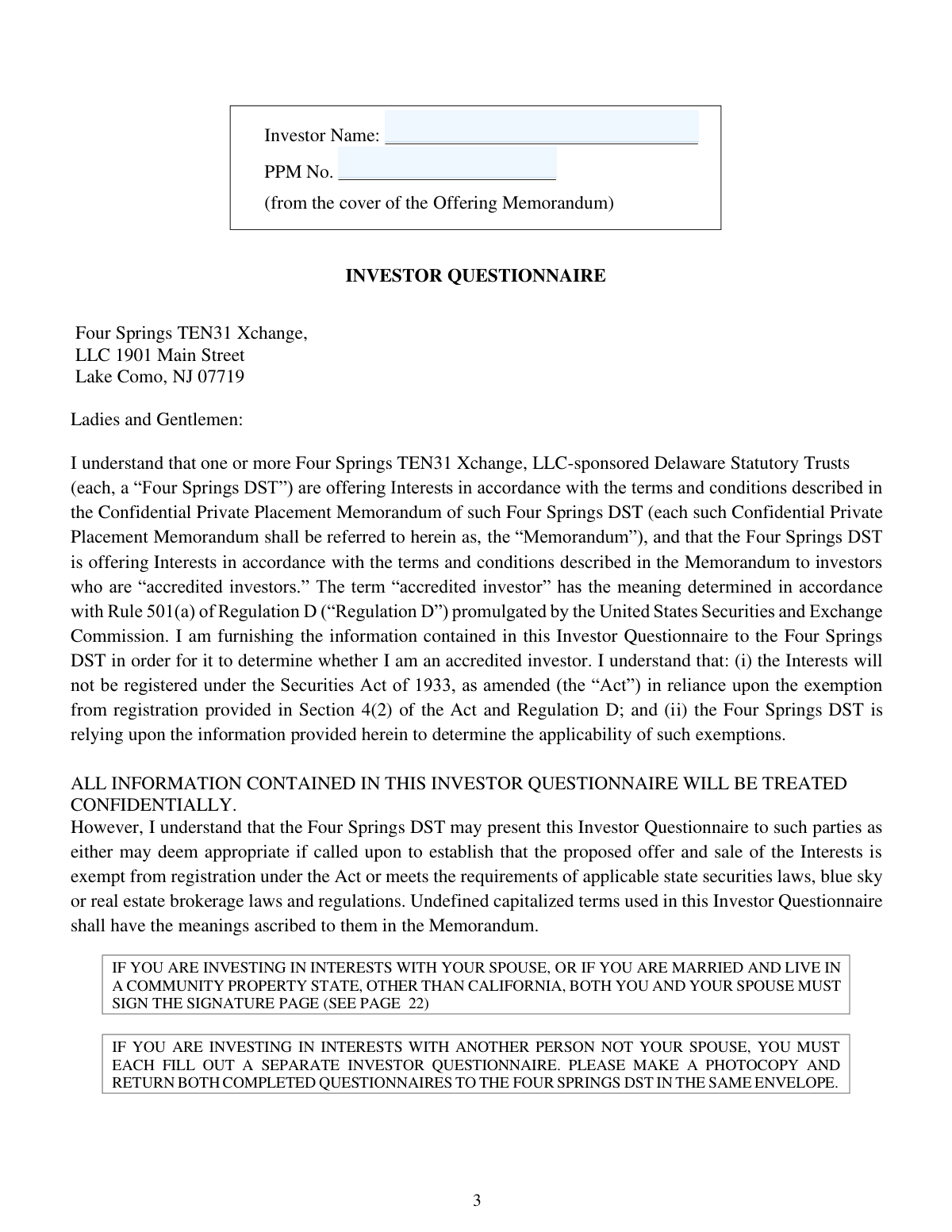
The primary document in this category is the FSC Industrial 6, DST Investor Questionnaire, Including Qualification Certifications and Privacy Notice. This form is specifically designed for individuals or entities looking to invest in Four Springs-sponsored DSTs.
You should choose this form if:
- You are targeting a Four Springs offering: This specific questionnaire is tailored to their internal compliance and the legal requirements of the FSC Industrial 6 trust.
- You need to verify Accredited Investor status: Under SEC Regulation D, sponsors must confirm that participants meet specific income or net worth thresholds. This form includes the necessary "Qualification Certifications" to satisfy these legal standards.
- You are concerned about data security: The document includes a "Privacy Notice," which outlines how your sensitive financial information will be handled during the subscription process.
What to Expect in the Form
The FSC Industrial 6, DST Investor Questionnaire is comprehensive. It requires detailed information regarding your financial background and investment experience. Using Instafill.ai allows you to navigate these complex fields more efficiently, ensuring that every certification—from your net worth to your tax identification number—is filled out accurately to avoid delays in the investment process.
If you are participating in a different DST program not sponsored by Four Springs, you may need a different sponsor-specific questionnaire. However, for those moving forward with the FSC Industrial 6 offering, this is the definitive document required to initiate your investment and confirm your status as an accredited investor.
Form Comparison
| Form | Primary Purpose | Target Investor | Key Requirements | Timing |
|---|---|---|---|---|
| FSC Industrial 6, DST Investor Questionnaire, Including Qualification Certifications and Privacy Notice | Verifies accredited investor status for Four Springs-sponsored Delaware Statutory Trust investments. | Potential investors seeking to participate in private placement real estate offerings. | Includes qualification certifications, investor information, and acknowledgement of privacy notices. | Completed once per investment offering to ensure SEC Regulation D compliance. |
Tips for DST investment forms
Most DST investments require you to meet specific income or net worth thresholds to qualify as an accredited investor under SEC guidelines. Ensure you have your financial data ready to confirm your eligibility before you begin the questionnaire to avoid delays.
If you are investing through a Trust, LLC, or IRA, ensure you select the correct entity type on the form. Providing the matching EIN or Tax ID for that specific entity is essential for proper tax reporting and ownership records.
AI-powered tools like Instafill.ai can complete these complex investment forms in under 30 seconds with high accuracy. Your sensitive financial data remains secure during the process, making it a practical time-saver for investors handling multiple subscription documents.
If your DST investment is part of a 1031 exchange, the name on the investment form must exactly match the name on the title of the relinquished property. Small discrepancies in spelling or entity names can cause significant legal hurdles during the closing process.
DST forms often include specific privacy notices explaining how your sensitive financial information is shared with sponsors and broker-dealers. Reviewing these sections helps you understand how your data is protected while you comply with regulatory requirements.
You will likely need to provide contact details for your CPA, attorney, or financial advisor for verification purposes. Having these details on hand allows you to complete the professional reference sections quickly without searching through your records.
Frequently Asked Questions
DST investment forms are used to facilitate participation in a Delaware Statutory Trust, often for the purpose of a 1031 exchange or private placement. These documents allow the trust sponsor to gather necessary financial data and ensure that the investor meets all legal and regulatory requirements for the specific offering.
An accredited investor is generally defined by the SEC as someone with a net worth exceeding $1 million (excluding their primary residence) or an annual income exceeding $200,000 for at least two years. Many DST investment forms require you to certify this status to comply with Regulation D private placement rules.
Yes, you can use AI tools like Instafill.ai to complete these forms in under 30 seconds. The AI accurately extracts relevant data from your source documents and places it into the correct fields, ensuring the questionnaire is filled out precisely and efficiently.
While manual completion can be time-consuming due to the level of detail required, using an automated service can reduce the process to less than a minute. This technology handles the data mapping and entry, allowing you to quickly move to the review and signing stage.
These forms usually ask for your contact details, tax identification numbers, and specific certifications regarding your financial sophisticated and net worth. They also include privacy notices that explain how your sensitive financial data will be handled by the trust sponsor.
Because DST investment forms require the disclosure of sensitive personal and financial information, federal law requires sponsors to provide a privacy notice. This document outlines the protocols used to protect your data and explains who may have access to it during the investment process.
Completed and signed forms should typically be submitted to the trust sponsor, your broker-dealer, or your financial advisor. Most sponsors provide specific instructions on whether they prefer digital uploads, email submissions, or physical mail.
Yes, if you are investing jointly with a spouse or through an entity like an LLC or Trust, the form will require specific certifications for all parties involved. You must ensure that the 'accredited investor' status is verified for the specific ownership structure you are using for the investment.
Providing inaccurate information can jeopardize the legal standing of the investment offering and may result in the rejection of your subscription. It is vital to ensure all certifications regarding your financial status and identity are truthful and verifiable.
Often, yes. In addition to the questionnaire, you may be asked to provide third-party verification of your accredited status, such as a letter from a CPA, attorney, or financial advisor, or copies of tax returns and bank statements.
Glossary
- Form Complexity Index
- Instafill’s 0–100 measure of how much effort a form takes to complete, calculated deterministically from the form’s own structure rather than estimated. It combines the number of fillable fields (the largest factor), how difficult those fields are to complete based on their type, the number of pages that contain fields, the amount of conditional “fill-only-if” logic, and how many sections the form is divided into, then adds modifiers for tables and repeating lists, bundled instruction pages, and dense page layouts. A higher score means the form is harder to fill out by hand. The forms in this category have a median Form Complexity Index of 65/100 (Complex). See exactly how it is calculated.
- Delaware Statutory Trust (DST)
- A legal entity that allows multiple investors to hold fractional ownership in professionally managed real estate, often used to qualify for tax-deferred exchanges.
- Accredited Investor
- An individual or entity meeting specific SEC financial criteria, such as a net worth exceeding $1 million (excluding primary residence) or a high annual income.
- 1031 Exchange
- A tax-deferred transaction that allows an investor to sell an investment property and reinvest the proceeds into a 'like-kind' asset to defer capital gains taxes.
- Regulation D (Reg D)
- A set of SEC rules that allows companies to sell securities in a private placement without full public registration, provided they follow specific disclosure requirements.
- Private Placement Memorandum (PPM)
- A legal document provided to prospective investors that discloses the terms, risks, and financial details of a private investment opportunity.
- Beneficial Interest
- The right to receive the economic benefits, such as income and appreciation, from the assets held within the trust based on the investor's ownership percentage.
- Subscription Agreement
- The formal contract between an investor and the trust that outlines the terms of the investment and confirms the investor's commitment to purchase an interest.
- Qualified Purchaser
- An individual or entity with a higher financial threshold than an accredited investor, typically owning at least $5 million in investments.