Fill out federal court forms
with AI.
Federal court forms, often referred to as AO (Administrative Office) forms, are the standard documents required for proceedings in United States District Courts. These forms ensure that the legal process remains uniform across different jurisdictions, covering everything from initiating a lawsuit to filing motions or requesting subpoenas. Using the correct, standardized documentation is essential for maintaining the integrity of a case and ensuring that all parties are properly notified and legal requirements are met.
By continuing, you acknowledge Instafill's Privacy Policy and agree to get occasional product update and promotional emails.
About federal court forms
These forms are typically used by legal professionals, pro se litigants, and administrative staff involved in civil litigation. Whether you are serving a summons, such as Form AO 440, or filing an affidavit, these documents are necessary whenever a case enters the federal judicial system. Because federal procedures are strict regarding formatting and deadlines, having access to clear, accurate forms is vital for avoiding procedural delays or dismissed filings.
Filling out complex legal paperwork can be time-consuming and prone to manual errors. Tools like Instafill.ai use AI to complete these federal court forms in under 30 seconds, ensuring data is handled accurately and securely. This provides a practical way to streamline document preparation while maintaining the high standards required for court submissions.
Every form on this page can be completed without typing. Instafill is form filling software that reads a PDF and fills it for you — including flat and scanned documents that carry no fillable fields at all.
Forms in This Category
The forms in this category have a median Form Complexity Index of 45/100 (Basic), measured across 3 forms by field count, input difficulty, length, conditional logic and structure. See how it is calculated.
| Form Name | Pages | FCI | |
|---|---|---|---|
| 1. | AO 440, Summons in a Civil Action | 2 | Basic 45 |
| 2. | AO 88B, Subpoena to Produce Documents, Information, or Objects or to Permit Inspection of Premises in a Civil Action | 2 | Moderate 48 |
| 3. | Federal Coronavirus Aid, Relief, and Economic Security Act (CARES Act) Compliance Certification | 1 | Simple 26 |
- Enterprise-grade security & data encryption
- 99%+ accuracy powered by AI
- 1,000+ forms from all industries
- Complete forms in under 60 seconds
How to Choose the Right Form
Navigating Federal Civil Litigation
Choosing the correct federal court form is essential for ensuring your legal proceedings move forward without procedural delays. Most forms in this category are issued by the Administrative Office of the U.S. Courts (AO) and follow strict formatting requirements for the United States District Courts.
Initiating a Civil Lawsuit
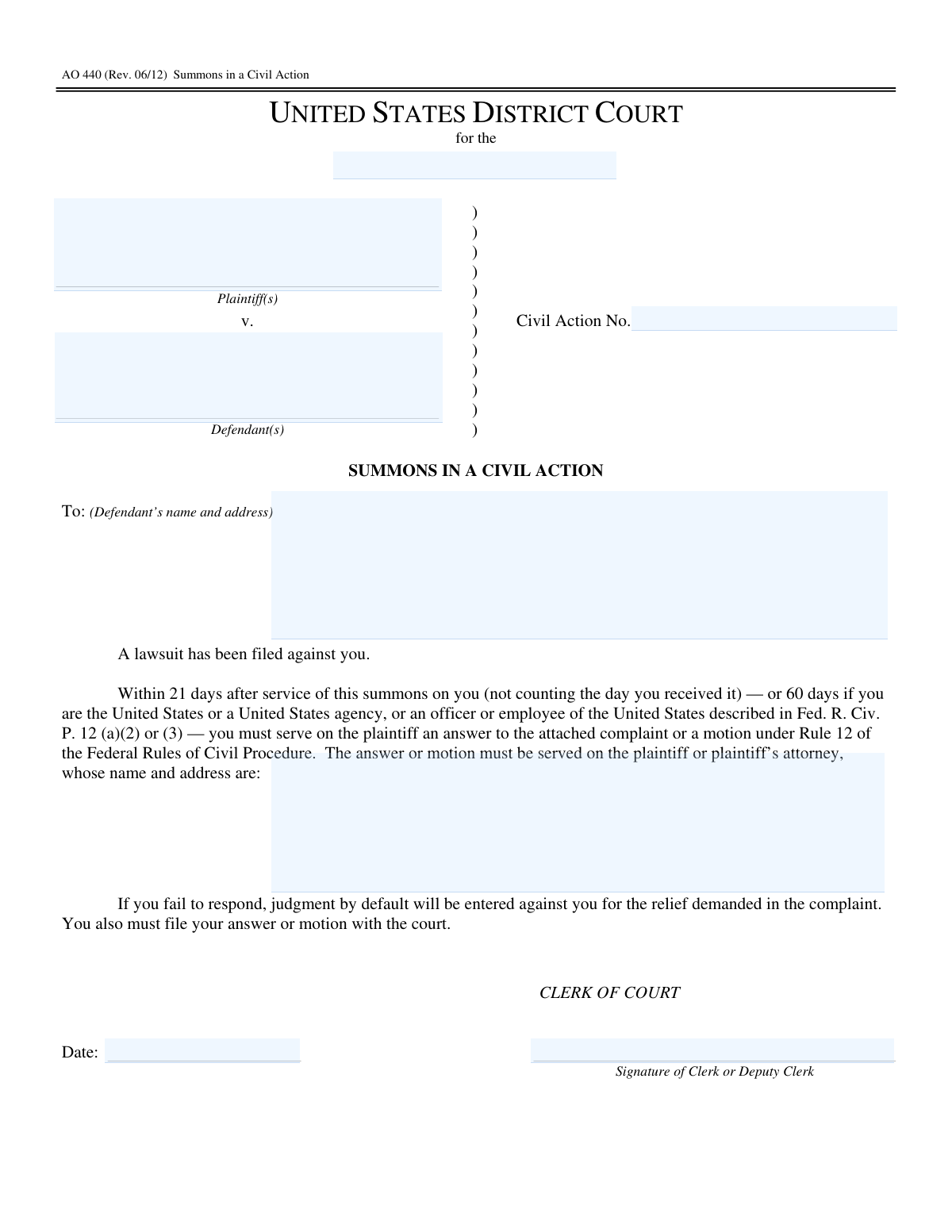
If you are the plaintiff starting a new legal action, the most critical document you will need is the AO 440, Summons in a Civil Action. This form serves as the official notice to the defendant that a lawsuit has been filed against them.
Use AO 440 when you need to:
- Formally notify defendants: It provides the defendant with the necessary legal notice required by the Federal Rules of Civil Procedure.
- Establish deadlines: The form clearly states the timeframe (usually 21 days) within which the defendant must file an answer or a motion under Rule 12.
- Prevent default: It warns the defendant that failure to respond may result in a default judgment for the relief demanded in the complaint.
Key Considerations for AO Forms
When preparing your federal court forms, keep the following in mind to ensure your filing is accepted by the clerk:
- Consistency is Critical: The names of the parties and the court listed on the AO 440, Summons in a Civil Action must exactly match the information provided in your formal Complaint.
- Multiple Defendants: If your lawsuit involves more than one defendant, a separate summons (AO 440) must be prepared for each individual or entity being sued.
- Service of Process: Remember that the summons must be served alongside a copy of the complaint by someone who is at least 18 years old and not a party to the case.
By using Instafill.ai, you can quickly populate these technical AO forms with AI assistance, ensuring that all fields are legible and correctly formatted for federal court standards.
Form Comparison
| Form | Primary Purpose | Issued By | Key Requirement |
|---|---|---|---|
| AO 440, Summons in a Civil Action | Notifies a defendant of a lawsuit and their deadline to respond. | Prepared by the plaintiff and officially issued by the court clerk. | Must be served to the defendant along with a copy of the complaint. |
Tips for federal court forms
Ensure the correct district court and case number are clearly listed on all federal forms. Even minor errors in these identifiers can lead to filing delays or administrative rejection by the court clerk.
Managing complex legal paperwork is faster with AI-powered tools like Instafill.ai, which can complete these forms in under 30 seconds with high accuracy. Your data stays secure throughout the process, making it a reliable and practical way to handle multiple court documents efficiently.
While federal forms like the AO 440 are standardized, individual district courts often have specific local rules regarding how summons must be served. Always check the local court's website to ensure your delivery method complies with their specific requirements.
Always save a finalized copy of every federal form before submitting it to the court or serving it to a defendant. Having a timestamped record of your filings helps resolve disputes regarding deadlines or missing documentation later in the litigation process.
Many federal courts require specific formats for signatures, such as a physical signature or a specific electronic format like /s/ followed by your name. Check whether your specific district allows digital signatures before finalizing your AO forms to avoid technical rejections.
For forms like the Summons in a Civil Action, the defendant's name must exactly match the name listed in the formal complaint. Inaccurate spelling or outdated addresses can result in failed service and may require you to re-file and pay additional fees.
Federal court forms are updated periodically by the Administrative Office of the U.S. Courts. Using an outdated version of a form can lead to it being returned by the clerk, so always ensure you are using the current standard version for your filing.
Frequently Asked Questions
Federal court forms, often referred to as AO forms, are standardized documents used in United States District Courts to manage civil and criminal litigation. They ensure that all parties provide the necessary information required by the federal court system in a consistent format that meets judicial standards.
These forms are used by plaintiffs, defendants, and their legal representatives when involved in litigation within the federal court system. For example, a plaintiff must complete a Summons in a Civil Action to officially notify a defendant that a lawsuit has been initiated against them.
Once completed and signed, these forms are generally filed with the Clerk of Court in the specific United States District Court where the case is being heard. Many federal courts now require electronic filing through the Case Management/Electronic Case Files (CM/ECF) system, though some jurisdictions still accept paper filings.
Yes, AI tools like Instafill.ai can fill these federal forms in under 30 seconds by accurately extracting and placing data from your source documents. This technology ensures that complex fields are populated correctly, reducing the risk of manual entry errors that could delay your case.
Using traditional manual entry, filling out complex legal documents can take a significant amount of time, but AI-powered services can complete the process in less than 30 seconds. This allows users to focus on the legal strategy of their case rather than the repetitive task of data entry.
The AO 440, or Summons in a Civil Action, is a foundational document that informs a defendant of their legal obligation to respond to a complaint. It outlines the timeframe for a response and warns that failure to act may result in a default judgment being entered against them.
While most AO forms are standardized for use across all United States District Courts, some local courts may have specific supplemental requirements or local rules. It is always advisable to check the specific website of the district court where you are filing to ensure you have all necessary local paperwork.
Filing an incorrect or incomplete form can lead to administrative delays, the rejection of your filing by the court clerk, or potential legal consequences. Using automated tools can help ensure that all required fields are accurately populated with the correct data from your legal records.
The 'AO' stands for the Administrative Office of the United States Courts. This agency provides administrative, legal, and management services to the federal courts, including the creation of standardized forms for civil, criminal, and bankruptcy proceedings.
The form you need depends on the stage of your legal proceeding and your role in the case. If you are starting a lawsuit, you will likely need a summons and a civil cover sheet; if you are responding to one, you may need different appearance or motion forms.
Glossary
- Form Complexity Index
- Instafill’s 0–100 measure of how much effort a form takes to complete, calculated deterministically from the form’s own structure rather than estimated. It combines the number of fillable fields (the largest factor), how difficult those fields are to complete based on their type, the number of pages that contain fields, the amount of conditional “fill-only-if” logic, and how many sections the form is divided into, then adds modifiers for tables and repeating lists, bundled instruction pages, and dense page layouts. A higher score means the form is harder to fill out by hand. The forms in this category have a median Form Complexity Index of 45/100 (Basic). See exactly how it is calculated.
- Summons
- A formal notice issued by a court that informs a defendant they are being sued and must respond within a specific timeframe.
- Civil Action
- A non-criminal lawsuit filed to resolve disputes between individuals or organizations, typically involving legal duties and responsibilities.
- Service of Process
- The formal procedure of delivering legal documents, such as a summons and complaint, to a defendant to ensure they have legal notice of the case.
- AO Forms
- Standardized legal documents created by the Administrative Office of the United States Courts for use in federal district court proceedings.
- Default Judgment
- A ruling made by a judge in favor of the plaintiff when the defendant fails to respond to a summons or appear in court as required.
- Complaint
- The initial legal document filed by a plaintiff that outlines the facts of the case and the legal reasons for suing the defendant.
- Plaintiff
- The person, business, or entity that initiates a lawsuit by filing a legal claim against another party in court.
- Defendant
- The individual or organization being sued in a civil action who must respond to the allegations made by the plaintiff.
- Proof of Service
- A written statement or affidavit filed with the court that confirms legal documents were successfully delivered to the defendant.