Fill out financial investor forms
with AI.
Financial investor forms are essential documents used to facilitate investments in specialized vehicles like hedge funds, private equity, and other managed assets. These forms serve as the legal bridge between an investor and a fund manager, ensuring that all regulatory requirements are met before capital is committed. They are critical for establishing compliance with global standards, such as Anti-Money Laundering (AML) and Know Your Customer (KYC) protocols, which protect both the individual and the financial institution from legal and financial risks.
By continuing, you acknowledge Instafill's Privacy Policy and agree to get occasional product update and promotional emails.
About financial investor forms
Typically, these forms are required by high-net-worth individuals, qualified investors, and institutional entities looking to diversify their portfolios through sophisticated investment strategies. You will encounter these documents when applying for entry into a Qualified Investor Hedge Fund or when updating your tax residency status under FATCA or CRS regulations. Because these forms often require detailed disclosures regarding the source of funds and personal financial history, accuracy is paramount to avoid delays in the subscription process. Completing these multi-page documents manually can be a tedious and error-prone task. Tools like Instafill.ai use AI to fill these forms in under 30 seconds, handling sensitive data accurately and securely to ensure your application is ready for submission without the usual administrative burden.
Every form on this page can be completed without typing. Instafill is form filling software that reads a PDF and fills it for you — including flat and scanned documents that carry no fillable fields at all.
Forms in This Category
The forms in this category have a median Form Complexity Index of 64/100 (Complex), measured across 1 forms by field count, input difficulty, length, conditional logic and structure. See how it is calculated.
| Form Name | Pages | FCI | |
|---|---|---|---|
| 1. | Application Form: Individual Investor | Qualified Investor Hedge Fund | 1 | Complex 64 |
- Enterprise-grade security & data encryption
- 99%+ accuracy powered by AI
- 1,000+ forms from all industries
- Complete forms in under 60 seconds
How to Choose the Right Form
Identifying the Right Investor Profile
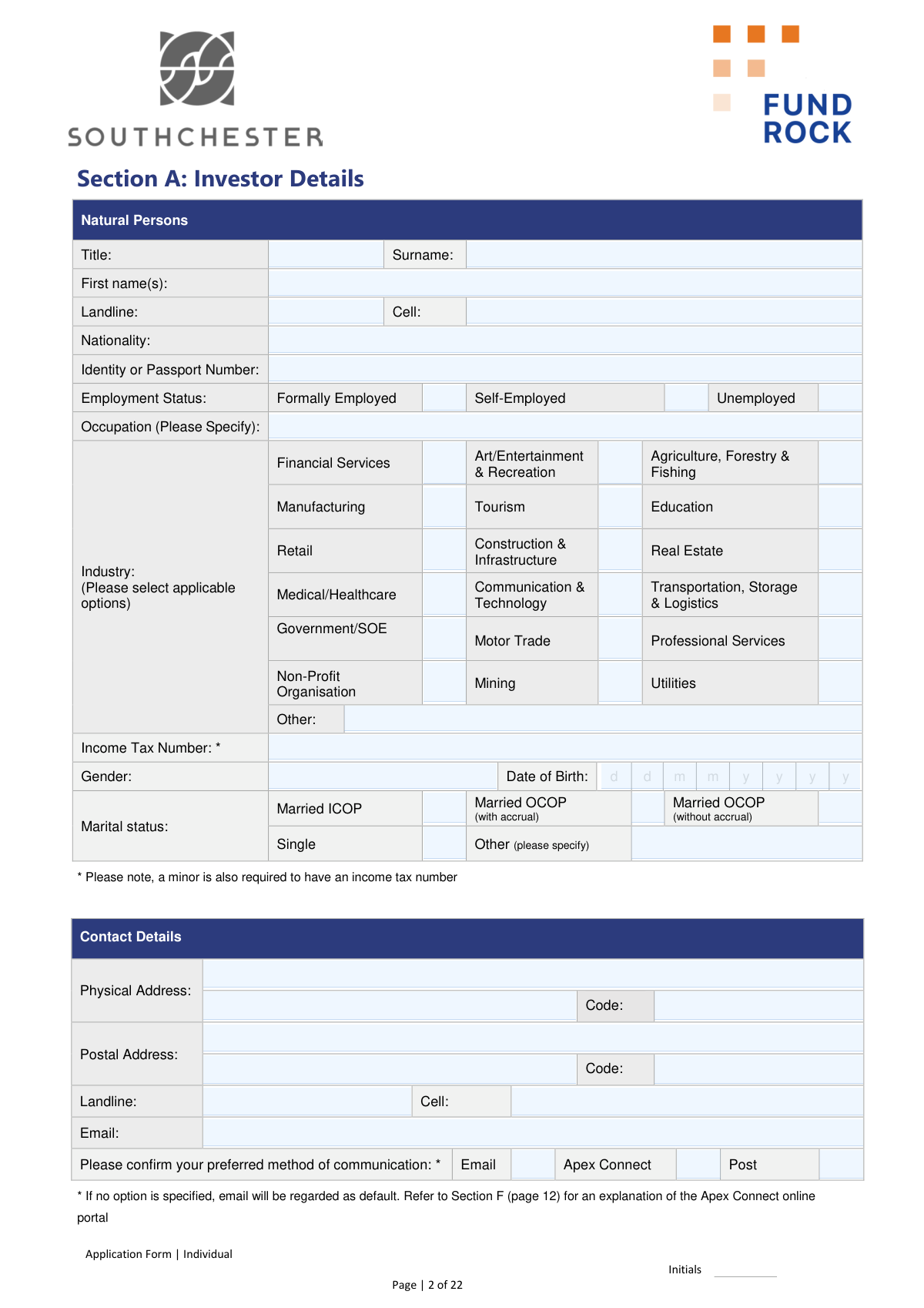
Navigating financial investment documentation requires precision, as the requirements often vary based on your legal status and the type of fund you are entering. In this category, the primary document is the Application Form: Individual Investor | Qualified Investor Hedge Fund. This form is specifically tailored for "Natural Persons"—individual human beings—rather than corporate entities, trusts, or partnerships.
When to Use This Application
You should select this form if you are applying to invest in a hedge fund managed by entities such as FundRock and you meet the legal criteria for a Qualified Investor. This generally means you have a sophisticated understanding of financial markets, have previous experience in alternative investments, or meet the specific minimum investment thresholds required by regional regulatory bodies.
Key Requirements for Completion
Because hedge funds are highly regulated, the Application Form: Individual Investor | Qualified Investor Hedge Fund is comprehensive and multi-faceted. To complete it efficiently using Instafill.ai, ensure you have the following information ready:
- Personal Identification: Standard KYC (Know Your Customer) and FICA documentation to verify your identity.
- Tax Residency: Detailed information for FATCA (Foreign Account Tax Compliance Act) and CRS (Common Reporting Standard) purposes to ensure international tax compliance.
- Source of Wealth: Clear documentation regarding where the investment capital originated to satisfy Anti-Money Laundering (AML) protocols.
Avoiding Common Mistakes
Before starting your digital application, verify that you are not investing on behalf of a legal entity. If you are representing a company, a retirement fund, or a family trust, this "Individual Investor" form will be rejected by fund administrators. Always ensure the fund name listed on the form matches the specific Qualified Investor Hedge Fund you intend to join to avoid administrative delays.
Form Comparison
| Form | Purpose | Who Files It | Key Sections | Frequency |
|---|---|---|---|---|
| Application Form: Individual Investor | Qualified Investor Hedge Fund | Apply for investment in a Qualified Investor Hedge Fund managed by FundRock. | Individual investors who meet specific qualified investor criteria and eligibility requirements. | Personal data, source of funds, tax residency, and FICA/FATCA compliance details. | Submitted once during the initial application process for fund participation. |
Tips for financial investor forms
Before starting the application, ensure you meet the specific net worth or income thresholds required for hedge fund participation. These forms often require you to certify your status as a 'Qualified Investor' to comply with financial regulations, and providing incorrect status can lead to immediate rejection.
Financial institutions are legally obligated to verify where your investment capital originates to prevent money laundering. Have supporting documents like bank statements, sale agreements, or inheritance records ready to justify the source of your funds as requested in the compliance sections.
AI-powered tools like Instafill.ai can complete these complex financial forms in under 30 seconds with high accuracy. This technology ensures that even non-fillable PDFs become interactive, while your sensitive data stays secure throughout the entire automated filling process.
Errors in your tax identification numbers or residency status can trigger significant delays or even tax withholding issues. Carefully review the FATCA and CRS sections to ensure your international tax obligations are reported correctly according to your current residency.
Keep digital copies of your government-issued ID, proof of address, and tax certificates in a secure, accessible folder. Having these documents on hand allows you to quickly cross-reference data while filling out the multi-page application, ensuring consistency across all fields.
Investment forms often require signatures in multiple sections, including specific declarations for risk and fees. Scan the document for 'Witness' or 'Commissioner of Oaths' requirements before you begin, as missing a single signature point is a common reason for processing delays.
Pay close attention to the sections detailing management fees, performance hurdles, and advisor commissions. Understanding these costs upfront is essential for accurately calculating your potential net returns and ensuring you agree to the fund's specific fee structure.
Frequently Asked Questions
These forms are generally required for individuals seeking to invest in specialized vehicles like Qualified Investor Hedge Funds. These investors must usually meet specific financial criteria, such as a high net worth or a high level of professional investment experience, to ensure they understand the risks involved.
Financial institutions are required by law to collect tax residency data to comply with international regulations such as the Foreign Account Tax Compliance Act (FATCA) and the Common Reporting Standard (CRS). This information helps authorities prevent tax evasion by ensuring financial data is reported to the correct jurisdictions.
Most applications require proof of identity, such as a certified copy of a passport, and proof of address, like a recent utility bill. Additionally, you may need to provide documents that verify your source of wealth or source of funds to satisfy Anti-Money Laundering (AML) requirements.
Yes, you can use AI tools to streamline the completion of complex investor documents. Services like Instafill.ai can fill these forms in under 30 seconds by accurately extracting data from your source documents and placing it directly into the required fields.
While manually completing multi-page investor applications can take an hour or more, AI-powered tools significantly reduce this time. Using an automated system allows you to complete the entire form in less than 30 seconds while maintaining a high level of data accuracy.
Once the form is filled and signed, it is typically submitted to the fund manager or the designated fund administrator. Submission is often handled through a secure client portal or via encrypted email, though some funds may still require a physical copy for their records.
The 'Source of Funds' section is a regulatory requirement designed to prevent money laundering. It requires the investor to explain the origin of the specific capital being invested, ensuring that the money comes from legitimate and legal activities.
Many modern fund managers and administrators accept digital signatures for investor applications to speed up the onboarding process. However, some jurisdictions or specific fund rules may still require a 'wet' physical signature, so it is important to verify the requirements with the fund manager.
If you encounter a flat or non-fillable PDF, you can use AI services to convert it into an interactive, fillable document. This allows you to type directly into the fields or use automated data extraction to populate the form without needing to print and scan it.
Forms for financial investors include specific sections for personal identification and verification of address to comply with regulations like the Financial Intelligence Centre Act (FICA). These sections are mandatory to ensure the fund manager is not facilitating financial crimes or anonymous investing.
Glossary
- Form Complexity Index
- Instafill’s 0–100 measure of how much effort a form takes to complete, calculated deterministically from the form’s own structure rather than estimated. It combines the number of fillable fields (the largest factor), how difficult those fields are to complete based on their type, the number of pages that contain fields, the amount of conditional “fill-only-if” logic, and how many sections the form is divided into, then adds modifiers for tables and repeating lists, bundled instruction pages, and dense page layouts. A higher score means the form is harder to fill out by hand. The forms in this category have a median Form Complexity Index of 64/100 (Complex). See exactly how it is calculated.
- Qualified Investor
- An individual or entity that meets specific financial criteria, such as a high net worth or professional investment experience, permitting them to invest in complex or high-risk funds.
- FATCA (Foreign Account Tax Compliance Act)
- A United States federal law requiring foreign financial institutions to report the assets and identities of US persons to the Internal Revenue Service (IRS).
- CRS (Common Reporting Standard)
- A global standard for the automatic exchange of financial account information between government authorities to help fight tax evasion.
- FICA (Financial Intelligence Centre Act)
- A regulatory framework, common in jurisdictions like South Africa, designed to combat financial crimes such as money laundering and terrorist financing.
- Source of Funds (SoF)
- A requirement for investors to provide evidence or an explanation of how they acquired the specific money used for a transaction or investment.
- Tax Residency
- The jurisdiction or country where an investor is legally obligated to pay taxes, determined by factors like physical presence or citizenship.
- KYC (Know Your Customer)
- The mandatory process of verifying a client's identity and assessing the risks associated with their financial profile before allowing an investment.
- Ultimate Beneficial Owner (UBO)
- The person who ultimately owns or controls an investment, even if the account is held in the name of a legal entity or third party.