Fill out financial suitability forms
with AI.
Financial suitability forms are essential tools used by financial institutions, investment firms, and regulatory bodies to ensure that specific investment products align with an individual's financial goals, risk tolerance, and net worth. They serve as a protective measure for both the investor and the sponsor, ensuring compliance with SEC regulations and other legal standards. By documenting an investor's background and financial position, these forms help verify 'accredited investor' status, which is often a legal prerequisite for participating in private placements or specialized investment vehicles like Delaware Statutory Trusts (DSTs).
By continuing, you acknowledge Instafill's Privacy Policy and agree to get occasional product update and promotional emails.
About financial suitability forms
These forms are typically required for high-net-worth individuals, institutional investors, or those looking to diversify their portfolios through private equity or real estate offerings. They are most commonly encountered during the subscription or onboarding process for new investment opportunities where detailed qualification certifications and privacy notices are mandatory. Completing these documents accurately is vital to avoid delays in the funding process and to ensure that all parties remain in compliance with complex securities laws.
Navigating these detailed questionnaires can be a repetitive and time-consuming task, particularly when managing multiple investment applications. Tools like Instafill.ai use AI to fill these forms in under 30 seconds, ensuring that data is handled accurately and securely while significantly reducing the administrative burden on investors and financial advisors.
Every form on this page can be completed without typing. Instafill is form filling software that reads a PDF and fills it for you — including flat and scanned documents that carry no fillable fields at all.
Forms in This Category
The forms in this category have a median Form Complexity Index of 65/100 (Complex), measured across 1 forms by field count, input difficulty, length, conditional logic and structure. See how it is calculated.
| Form Name | Pages | FCI | |
|---|---|---|---|
| 1. | FSC Industrial 6, DST Investor Questionnaire, Including Qualification Certifications and Privacy Notice | 1 | Complex 65 |
- Enterprise-grade security & data encryption
- 99%+ accuracy powered by AI
- 1,000+ forms from all industries
- Complete forms in under 60 seconds
How to Choose the Right Form
When to Use the FSC Industrial 6 Questionnaire
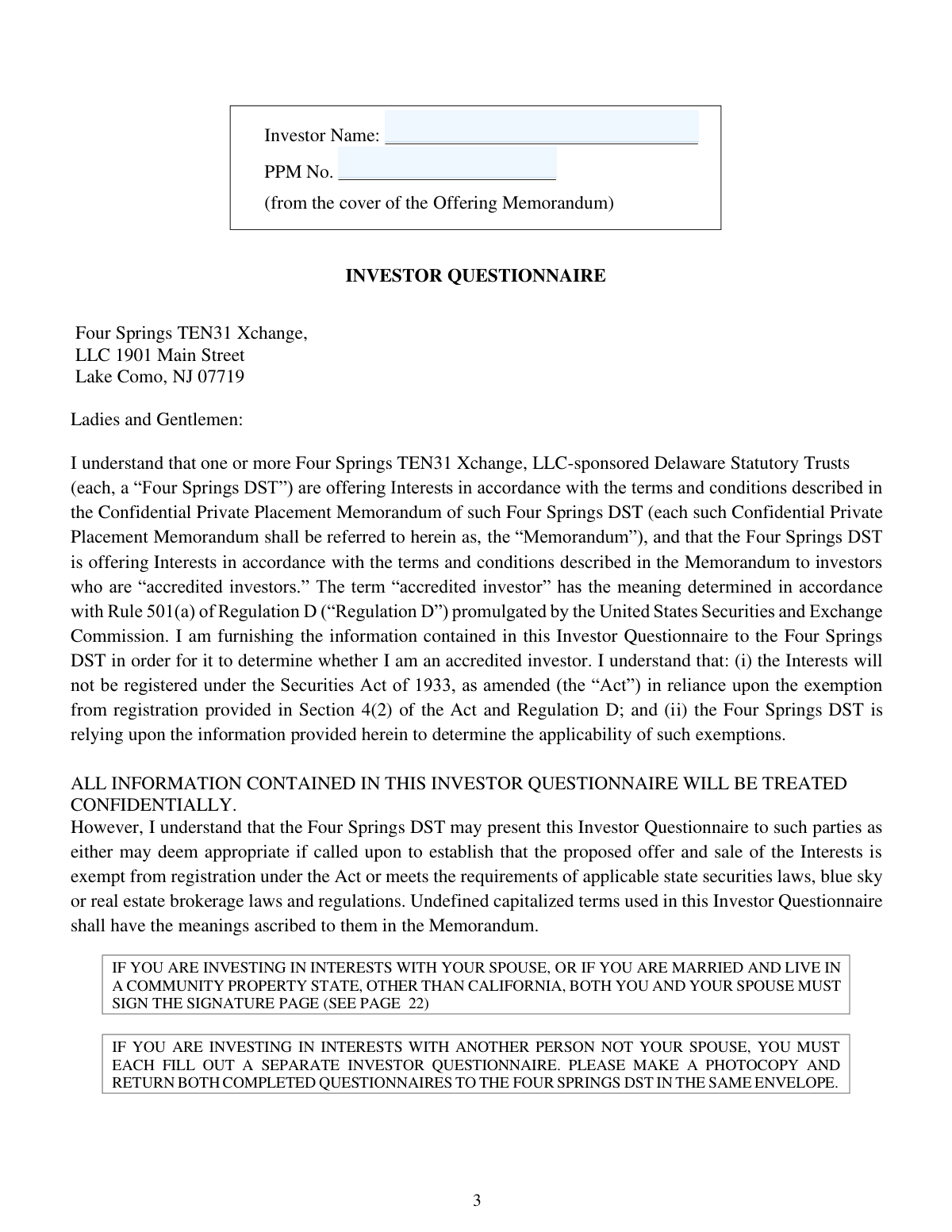
The FSC Industrial 6, DST Investor Questionnaire, Including Qualification Certifications and Privacy Notice is a specialized document designed for a specific investment vehicle. You should choose this form if you are a potential investor looking to participate in a Delaware Statutory Trust (DST) sponsored by Four Springs Capital. Because suitability forms are often specific to the investment sponsor, ensure your offering memorandum matches this specific provider before beginning.
Key Criteria for Selection
To determine if this is the correct document for your current financial transaction, consider the following requirements:
- Specific Sponsorship: This questionnaire is unique to Four Springs-sponsored offerings. If you are investing with a different sponsor or in a different type of real estate investment trust (REIT), you will likely require a different suitability form tailored to that specific entity.
- Accredited Investor Verification: Under SEC Regulation D, many private placements are restricted to individuals or entities that meet "accredited investor" status. This form is the primary tool used to gather the necessary financial certifications to prove your eligibility based on income or net worth.
- Comprehensive Documentation: Beyond just the questionnaire, this document includes a Privacy Notice and specific Qualification Certifications. If your legal or financial advisor has requested a comprehensive packet that covers both suitability and data privacy for a DST, this is the correct file to select.
Completing the Form Efficiently
Because financial suitability forms require sensitive data regarding net worth, annual income, and previous investment experience, accuracy is paramount. The FSC Industrial 6 must be filled out in its entirety to prevent administrative delays in the investment process. Using AI-driven tools like Instafill.ai can help you navigate the complex fields of this PDF, ensuring that all certifications are properly addressed and that the document is formatted correctly for submission to the fund manager or sponsor.
Form Comparison
| Form | Primary Purpose | Target User | Key Requirement | Investment Type |
|---|---|---|---|---|
| FSC Industrial 6, DST Investor Questionnaire, Including Qualification Certifications and Privacy Notice | Confirms accredited investor status for Four Springs private placements. | Individual or entity investors seeking Delaware Statutory Trust opportunities. | Proof of meeting SEC Regulation D accreditation standards. | Private placements within Delaware Statutory Trusts (DSTs). |
Tips for financial suitability forms
Accuracy is critical when calculating your net worth or annual income to meet suitability requirements. Overestimating or underestimating these figures can lead to delays in the approval process or potential disqualification from the investment opportunity.
Before filling out the questionnaire, review the specific SEC Regulation D criteria for accredited investors. Ensure you meet the necessary income or net worth thresholds to avoid having your application rejected by the sponsor during the vetting process.
When submitting several forms for a single investment, ensure that your financial data remains consistent throughout. Discrepancies between your investor questionnaire and other subscription agreements can trigger additional scrutiny and slow down your transaction.
Completing complex financial questionnaires manually can be tedious and prone to errors. AI-powered tools like Instafill.ai can complete these forms in under 30 seconds with high accuracy, while ensuring your sensitive financial data stays secure during the process.
Many financial suitability forms require you to provide proof of assets or income to verify your status. Gathering tax returns, bank statements, or brokerage reports beforehand will allow you to complete the form more efficiently without searching for documents mid-process.
Because these forms require highly sensitive personal and financial information, always read the included privacy notice. Understanding how the sponsor handles and protects your data is essential for maintaining your financial security during the investment process.
Missing a signature or failing to check a certification box is one of the most common reasons for form rejection. Carefully review the final page to ensure all required attestations are acknowledged and dated correctly before final submission.
Frequently Asked Questions
These forms help investment sponsors and broker-dealers ensure that a potential investment aligns with an individual's financial situation and risk tolerance. They are primarily used to comply with SEC regulations that restrict certain private offerings to qualified participants who can bear the associated risks.
Individuals looking to participate in private placements, hedge funds, or complex real estate structures like Delaware Statutory Trusts (DSTs) usually need to complete these forms. They ensure the investor has the necessary net worth or income to handle the risks associated with non-publicly traded securities.
Under SEC Regulation D, an accredited investor is generally defined as someone with a net worth exceeding $1 million (excluding their primary residence) or an annual income over $200,000 for the past two years. Entities like trusts and corporations can also qualify based on specific asset thresholds.
DST forms are included because these trusts are structured as private placements that require participants to prove their financial status before investing. The forms confirm that the investor understands the illiquid nature of the asset and meets the legal qualifications to participate.
You should have your recent tax returns, bank statements, and a clear summary of your investment experience and total net worth available. Having these documents ready allows for a smoother verification process when the sponsor reviews your questionnaire for compliance.
Sponsors use the data to perform 'know your customer' (KYC) checks and to fulfill their legal obligation to screen for accredited status. This protects the investment firm from regulatory penalties and ensures the offering is only sold to parties who meet the suitability requirements.
No, they are usually required for private offerings and alternative investments that fall under specific SEC exemptions. Publicly traded stocks and mutual funds generally do not require the same level of detailed financial suitability screening for individual retail investors.
Yes, AI tools like Instafill.ai can fill these forms in under 30 seconds by accurately extracting and placing data from your source financial documents. This technology ensures that complex certifications and personal details are mapped correctly to the PDF without manual entry errors.
When using AI-powered platforms, you can complete these forms in less than a minute by uploading your relevant documents. Manual entry can take significantly longer, especially when navigating multi-page questionnaires with detailed privacy notices and qualification sections.
If your financial profile does not meet the specific thresholds outlined in the form, the sponsor will likely decline your participation in the investment. This is a protective measure designed to prevent investors from entering high-risk positions that exceed their financial capacity.
Suitability information is generally required for each new investment offering, though some sponsors may accept a certification for a set period. You should provide updated forms if your financial status changes significantly or if a new subscription agreement requires a fresh qualification certification.
Glossary
- Form Complexity Index
- Instafill’s 0–100 measure of how much effort a form takes to complete, calculated deterministically from the form’s own structure rather than estimated. It combines the number of fillable fields (the largest factor), how difficult those fields are to complete based on their type, the number of pages that contain fields, the amount of conditional “fill-only-if” logic, and how many sections the form is divided into, then adds modifiers for tables and repeating lists, bundled instruction pages, and dense page layouts. A higher score means the form is harder to fill out by hand. The forms in this category have a median Form Complexity Index of 65/100 (Complex). See exactly how it is calculated.
- Accredited Investor
- An individual or entity allowed to invest in unregistered securities based on meeting specific income or net worth thresholds set by the SEC.
- Delaware Statutory Trust (DST)
- A legal entity that allows multiple investors to hold fractional ownership in a single piece of real estate or a portfolio of properties.
- SEC Regulation D
- A set of federal rules that allows companies to raise capital through private sales of securities without the need for full public registration.
- Private Placement
- The sale of securities directly to a pre-selected group of investors rather than publicly on the open market.
- Financial Suitability
- A standard used to ensure that a specific investment aligns with an individual's financial situation, risk tolerance, and long-term goals.
- 1031 Exchange
- A tax-deferred transaction allowing an investor to sell a property and reinvest the proceeds into a 'like-kind' investment, such as a DST, to defer capital gains taxes.
- Qualified Purchaser
- A high-level investor category for individuals or entities with at least $5 million in investments, often required for more exclusive private funds.
- Net Worth
- The total value of all assets owned by a person or company, minus the total value of all their liabilities and debts.