Fill out industrial permit forms
with AI.
Industrial permit forms are essential regulatory documents that ensure businesses operate in compliance with local environmental and safety standards. These forms cover a wide range of operational requirements, from managing hazardous waste to regulating the discharge of industrial byproducts into public systems. By requiring these permits, local authorities can protect public infrastructure, such as municipal wastewater systems, and ensure that industrial activities do not negatively impact the surrounding environment or public health.
By continuing, you acknowledge Instafill's Privacy Policy and agree to get occasional product update and promotional emails.
About industrial permit forms
Typically, these forms are completed by facility managers, compliance officers, and business owners in sectors like manufacturing, chemical processing, or large-scale food production. They are necessary when establishing a new facility, renewing existing licenses, or making significant changes to industrial processes. For instance, a facility may need to submit a wastewater discharge permit application to detail the volume and nature of its runoff, ensuring it meets specific pre-treatment standards before entering the city's sewer lines.
Navigating the technical details of these applications can be a tedious process for busy professionals. Tools like Instafill.ai use AI to fill these industrial permit forms in under 30 seconds, handling complex data accurately and securely to streamline the compliance process. This approach minimizes the risk of manual errors and allows teams to focus on their core operations instead of paperwork.
Every form on this page can be completed without typing. Instafill is form filling software that reads a PDF and fills it for you — including flat and scanned documents that carry no fillable fields at all.
Forms in This Category
The forms in this category have a median Form Complexity Index of 70/100 (Complex), measured across 1 forms by field count, input difficulty, length, conditional logic and structure. See how it is calculated.
| Form Name | Pages | FCI | |
|---|---|---|---|
| 1. | KC Water Industrial User Wastewater Discharge Permit Application | 11 | Complex 70 |
- Enterprise-grade security & data encryption
- 99%+ accuracy powered by AI
- 1,000+ forms from all industries
- Complete forms in under 60 seconds
How to Choose the Right Form
Navigating industrial compliance in Kansas City requires precision and a clear understanding of local environmental regulations. If your facility produces anything other than standard domestic sewage, you likely need to document your waste streams to remain in compliance with city ordinances.
Wastewater Discharge Compliance
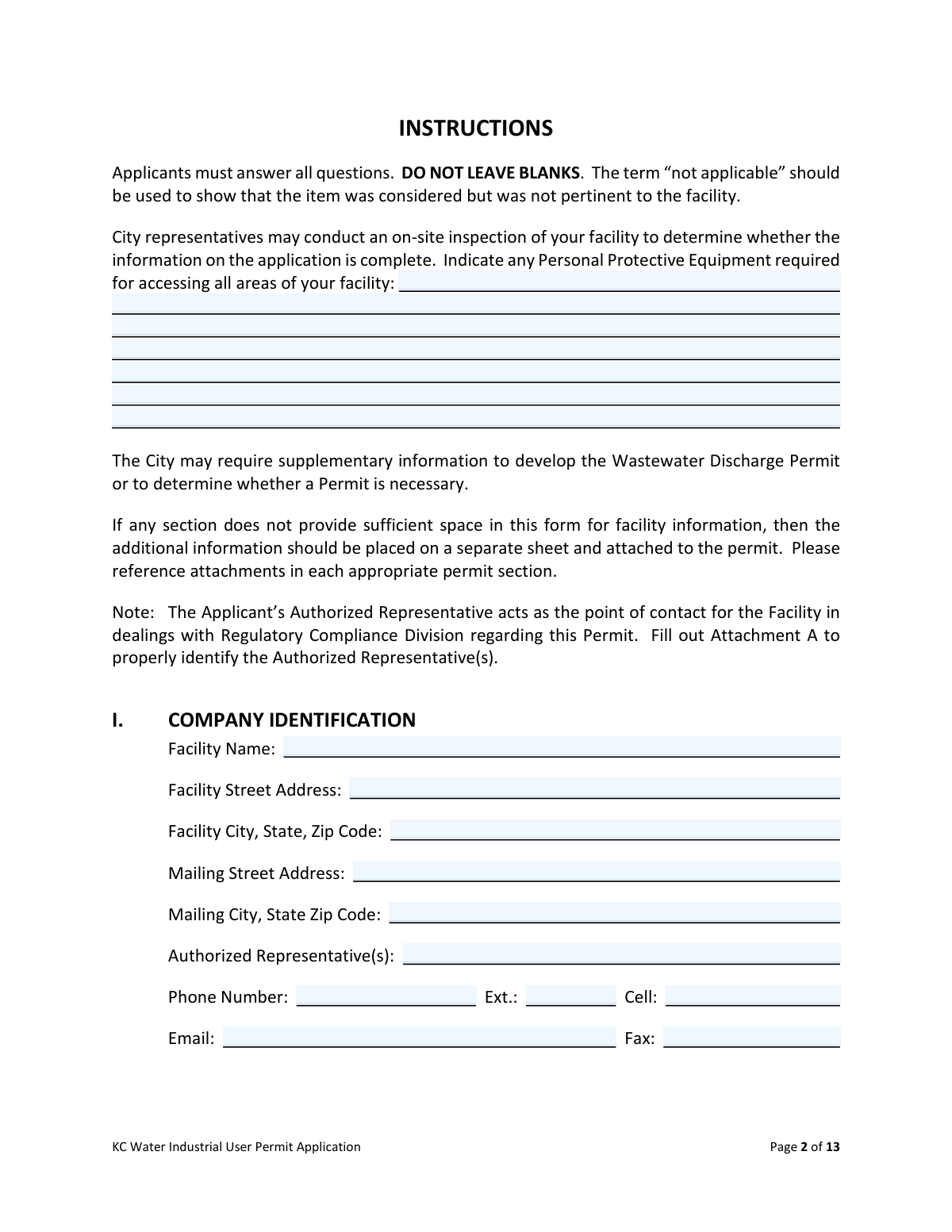
The primary document in this category is the KC Water Industrial User Wastewater Discharge Permit Application. This form is specifically designed for industrial facilities operating within Kansas City, Missouri, that intend to discharge process wastewater into the public sewer system.
You should prioritize this application if your business falls into any of the following categories:
- Significant Industrial Users (SIUs): Facilities subject to federal categorical pretreatment standards.
- High-Volume Dischargers: Businesses discharging an average of 25,000 gallons per day or more of process wastewater.
- Regulated Processes: Any facility that has a reasonable potential to adversely affect the publicly owned treatment works (POTW).
Key Information Needed for Your Application
Before beginning the KC Water Industrial User Wastewater Discharge Permit Application, ensure you have the following data points ready to ensure a smooth filing process:
- Facility Schematics: Detailed layouts of your plumbing and discharge points.
- Production Metrics: Information regarding your manufacturing rates and operational hours.
- Chemical Inventory: A list of all raw materials and chemicals used on-site that could potentially impact the wastewater stream.
- Pretreatment Details: Documentation of any existing systems used to treat water before it leaves your facility.
Streamlining Your Permit Process
Completing the KC Water Industrial User Wastewater Discharge Permit Application can be complex due to the technical nature of the data required. By using Instafill.ai, you can transform this static PDF into an interactive, AI-assisted document. This helps ensure that every technical field is addressed accurately, reducing the likelihood of delays or requests for additional information from KC Water authorities.
Form Comparison
| Form | Purpose | Who Files It | Key Requirements | Jurisdiction |
|---|---|---|---|---|
| KC Water Industrial User Wastewater Discharge Permit Application | Request authorization to discharge industrial wastewater into the public sewer system. | Industrial facilities in Kansas City, Missouri, that produce non-domestic wastewater. | Requires data on discharge volume, chemical characteristics, and onsite treatment methods. | Kansas City (KC Water), Missouri department of water services. |
Tips for industrial permit forms
Dealing with complex industrial paperwork can be time-consuming, but AI-powered tools like Instafill.ai can complete these forms in under 30 seconds with high accuracy. Your data stays secure during the process, making it a reliable and practical way to handle permit requirements efficiently.
Ensure you have up-to-date diagrams of your facility's plumbing and discharge points before filling out industrial permit forms. Accurate site maps prevent delays in the approval process and ensure inspectors have the correct information from day one.
Be specific about the types and quantities of chemicals used in your industrial processes. Providing a clear inventory helps regulatory bodies assess potential risks to the wastewater system and ensures your permit accurately reflects your actual operations.
If your facility uses grease traps, oil-water separators, or pH neutralization systems, include detailed descriptions of these units. Clearly outlining your pre-treatment steps demonstrates compliance with local standards and can speed up the permit review.
Avoid guessing your daily discharge volumes, as inaccurate data can lead to permit violations or incorrect billing. Use meter readings or engineering calculations to provide the most precise flow data possible for your industrial application.
Industrial permits often require periodic renewals or updates when your processes change. Save digital copies of every submitted form and supporting document to make future renewals faster and ensure you have a paper trail for environmental audits.
Frequently Asked Questions
An industrial wastewater discharge permit authorizes a facility to release non-domestic wastewater into the municipal sewer system under specific conditions. These permits ensure that industrial pollutants are managed and treated properly to prevent damage to the city's infrastructure and the local environment.
Any business or facility that discharges process wastewater—other than standard domestic sewage—into the public sewer system typically needs to apply. This includes manufacturing plants, food processing facilities, and other industrial operations that use water in their production or cleaning processes.
Applicants generally need to provide details regarding their facility's operations, the volume of water used, and the specific characteristics of the wastewater being discharged. This often includes descriptions of chemical storage, production rates, and any pretreatment systems currently in place.
Yes, industrial permit forms can be completed efficiently using AI tools like Instafill.ai. These services can accurately extract data from your internal business documents and place it into the required form fields, ensuring that complex data sets are handled correctly.
While manual entry for detailed industrial forms can take hours, AI-powered tools can fill these forms in under 30 seconds. The technology identifies the necessary data points from your source files and populates the PDF instantly, significantly reducing administrative overhead.
For Kansas City facilities, the completed application should be submitted to the KC Water Pretreatment Program. It is important to verify the current submission method, whether via mail or a digital portal, as specified in the form's instructions or on the city's official website.
Facilities are typically categorized as either Significant Industrial Users (SIU) or Non-Significant Industrial Users based on the volume of discharge and the nature of the pollutants. This classification determines the frequency of monitoring and the specific regulatory standards the facility must meet.
Operating without a required industrial discharge permit can result in significant financial penalties and legal enforcement actions from local or federal authorities. In some cases, the city may suspend water or sewer services to the facility until compliance is reached.
No, these permits are usually issued for a fixed term, often ranging from three to five years. Facilities must track their expiration dates and submit renewal applications well in advance to ensure they remain in continuous compliance with local regulations.
If there is a significant change in your production process or the volume and chemistry of your wastewater, you must notify the regulatory agency. This often requires filing an updated application or an amendment to your existing permit to reflect the new discharge profile.
Glossary
- Form Complexity Index
- Instafill’s 0–100 measure of how much effort a form takes to complete, calculated deterministically from the form’s own structure rather than estimated. It combines the number of fillable fields (the largest factor), how difficult those fields are to complete based on their type, the number of pages that contain fields, the amount of conditional “fill-only-if” logic, and how many sections the form is divided into, then adds modifiers for tables and repeating lists, bundled instruction pages, and dense page layouts. A higher score means the form is harder to fill out by hand. The forms in this category have a median Form Complexity Index of 70/100 (Complex). See exactly how it is calculated.
- POTW (Publicly Owned Treatment Works)
- A treatment plant owned by a municipality or state that is designed to treat domestic and industrial wastewater before it is released into the environment.
- Pretreatment
- The process of treating industrial wastewater at the facility to remove or reduce pollutants before discharging it into the public sewer system.
- Significant Industrial User (SIU)
- A classification for industrial facilities that discharge large volumes of wastewater or contribute specific pollutants that could impact the local treatment plant.
- BOD (Biochemical Oxygen Demand)
- A measurement of the amount of dissolved oxygen needed by organisms to break down organic material in wastewater, used to gauge the strength of the waste.
- TSS (Total Suspended Solids)
- The measure of particles trapped by a filter in a water sample, used to determine the concentration of solid pollutants in the discharge.
- Slug Discharge
- Any non-routine or accidental release of wastewater that has a high volume or concentration of pollutants that could interfere with the treatment system.
- Categorical Pretreatment Standards
- Uniform national regulations developed by the EPA that limit the discharge of pollutants from specific industrial categories, such as metal finishing or chemical manufacturing.
- NAICS Code
- The North American Industry Classification System code used to identify the specific type of business activity conducted at the industrial facility.