Fill out investment direction forms
with AI.
Investment direction forms are essential documents used by investors to provide specific instructions to financial institutions or plan administrators regarding the allocation of their assets. These forms serve as the legal bridge between an individual's financial strategy and the actual execution of trades or fund movements. Whether you are directing a rollover into a corporate retirement plan or authorizing a private equity purchase through a self-directed IRA, these documents ensure that your capital is deployed exactly according to your risk tolerance and long-term objectives. Without these formal directives, custodians cannot legally move funds or finalize investment positions on your behalf.
By continuing, you acknowledge Instafill's Privacy Policy and agree to get occasional product update and promotional emails.
About investment direction forms
Typically, these forms are required during significant financial transitions or when seeking to diversify a portfolio. For instance, employees joining a new company often use rollover direction forms to consolidate their savings, while sophisticated investors use buy direction letters to facilitate alternative investments like private equity. Because these documents involve specific financial data and legal authorizations, accuracy is paramount to avoid processing delays or tax implications. Tools like Instafill.ai use AI to fill these forms in under 30 seconds, ensuring that your data is handled accurately and securely while saving you the hassle of manual entry. This allows investors to focus on their portfolio strategy rather than the administrative burden of paperwork.
Every form on this page can be completed without typing. Instafill is form filling software that reads a PDF and fills it for you — including flat and scanned documents that carry no fillable fields at all.
Forms in This Category
The forms in this category have a median Form Complexity Index of 43/100 (Basic), measured across 2 forms by field count, input difficulty, length, conditional logic and structure. See how it is calculated.
| Form Name | Pages | FCI | |
|---|---|---|---|
| 1. | Inotiv, Inc. Retirement Plan Rollover Investment Direction Form | 1 | – |
| 2. | The Entrust Group - Private Equity Buy Direction Letter | 1 | Basic 43 |
- Enterprise-grade security & data encryption
- 99%+ accuracy powered by AI
- 1,000+ forms from all industries
- Complete forms in under 60 seconds
How to Choose the Right Form
Identify Your Custodian or Plan Sponsor
The first step in choosing the right investment direction form is identifying which financial institution or employer plan is managing your assets. These forms are specific to the entity holding your funds and cannot be used interchangeably between different custodians.
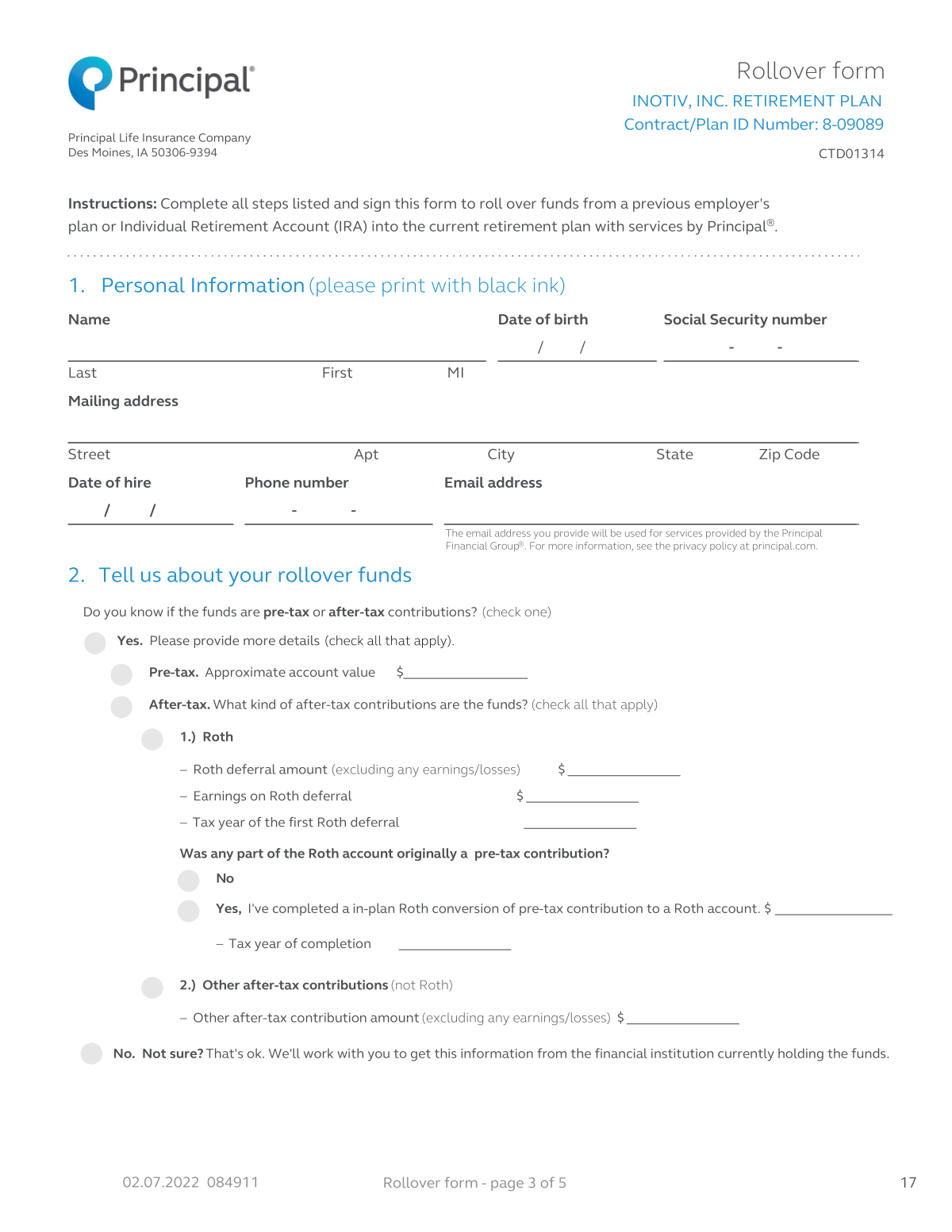
- Inotiv, Inc. Employees: If you are a participant in the Inotiv, Inc. Retirement Plan and are transferring funds from a previous employer's 401(k) or a traditional IRA, you need the Inotiv, Inc. Retirement Plan Rollover Investment Direction Form. This form tells the plan administrator exactly how to allocate your incoming rollover balance across available investment options to match your risk tolerance.
- The Entrust Group Clients: If you maintain a self-directed IRA (SDIRA) with The Entrust Group and intend to invest in non-publicly traded assets, you will likely need The Entrust Group Private Equity Buy Direction Letter. This is specific to Entrust account holders who are moving beyond stocks and bonds into private markets.
Determine the Type of Transaction
Are you setting up your general account balance or executing a specific asset purchase? The purpose of the transaction dictates which document is required:
- For Account Allocation and Rollovers: Use the Inotiv, Inc. Retirement Plan Rollover Investment Direction Form when your goal is to manage the overarching strategy for your retirement account balance following a rollover. It focuses on percentage-based allocations into various mutual funds or target-date funds.
- For Specific Asset Purchases: Use The Entrust Group Private Equity Buy Direction Letter when you have already identified a specific private equity opportunity. This form acts as a formal authorization for the custodian to release funds to a specific entity for a designated number of shares or investment interest.
Key Information You Will Need
Before filling out these forms on Instafill.ai, ensure you have the following ready:
- For Rollovers: Your total rollover amount and the specific fund names or ticker symbols offered by the Inotiv plan.
- For Private Equity: The legal name of the entity you are investing in, the exact purchase price, and the specific funding instructions (such as wire or check details).
Form Comparison
| Form | Purpose | Account Type | Investment Focus |
|---|---|---|---|
| Inotiv, Inc. Retirement Plan Rollover Investment Direction Form | Directs the allocation of rollover funds into specific retirement plan options. | Employer-sponsored retirement plan account for Inotiv employees. | Standard retirement plan investment options and mutual funds. |
| The Entrust Group Private Equity Buy Direction Letter | Authorizes the custodian to execute a specific private equity purchase. | Self-directed Individual Retirement Account (SDIRA) with Entrust Group. | Private equity shares, alternative assets, and non-public offerings. |
Tips for investment direction forms
Ensure that your specific retirement account or IRA number is accurately recorded on the form. Misidentifying the account or plan can lead to significant processing delays or funds being incorrectly allocated to the wrong investment vehicle.
When directing investments across multiple funds or assets, verify that your percentage breakdowns sum up to exactly 100%. Even a minor 1% discrepancy can cause the custodian to reject the form and require a full resubmission.
Private equity or rollover forms often require supplemental paperwork, such as subscription agreements or transfer statements. Keeping these documents organized and ready to upload alongside your direction letter ensures a smoother and faster approval process.
AI-powered tools like Instafill.ai can complete these complex investment forms in under 30 seconds with high accuracy. Your sensitive financial data stays secure during the process, making it an efficient and safe choice for managing multiple direction letters.
Explicitly state whether the investment is being funded via wire transfer, ACH, or a rollover from another plan. Providing clear instructions on the source of funds helps the custodian execute the trade within your desired financial timeframe.
Some investment direction forms require a wet signature or even a medallion signature guarantee for high-value transactions. Review the form’s instructions early to determine if you need a physical signature or a witness before you attempt to submit digitally.
Before submitting, review your selected investment choices against your long-term goals and risk tolerance. These forms are legally binding instructions for your custodian, so ensure the asset mix accurately reflects your intended portfolio balance.
Frequently Asked Questions
These forms serve as formal instructions to a plan administrator or custodian regarding how to allocate or invest funds within a specific account. They ensure that your capital is moved according to your financial goals and risk tolerance rather than being placed in a default holding account.
Individuals participating in employer-sponsored retirement plans or those managing self-directed IRAs usually need these forms. Whether you are rolling over funds from a previous employer or directing a custodian to purchase private equity, these forms provide the necessary legal authorization for the transaction.
You should file these forms whenever you are initiating a rollover, making a new investment purchase, or changing the allocation of your existing portfolio. Timely submission is critical to ensure your funds are not left uninvested or sitting in low-interest cash accounts for an extended period.
The correct form depends on your specific custodian and the type of asset you are acquiring. For example, a rollover into a corporate retirement plan requires a plan-specific rollover form, while a private equity purchase through a self-directed IRA requires a specific buy direction letter.
Generally, you will need your personal account numbers, the specific name of the investment or asset, the exact dollar amount or percentage to be invested, and details about the funding source. Some forms may also require the tax identification numbers of the entities involved in the transaction.
Yes, AI tools like Instafill.ai can fill these investment forms in under 30 seconds by accurately extracting data from your source documents and placing it into the required fields. This technology helps eliminate manual entry errors and ensures all necessary sections are completed correctly.
While manual entry can take 15 to 20 minutes, using an AI-powered platform can complete the process in less than 30 seconds. Services like Instafill.ai can automatically parse your financial data and populate the PDF fields instantly.
Completed forms should be submitted directly to your plan administrator or the financial custodian managing your account, such as your employer's HR department or an IRA custodian. Most institutions accept submissions via secure online portals, though some may still require a physical signature and mail-in submission.
Yes, once signed and submitted, these forms act as a legal directive that authorizes the custodian to move funds or purchase assets on your behalf. Because the custodian is following your specific instructions, they are generally not liable for the investment's performance, making accuracy in the form essential.
If a plan administrator receives funds without a specific direction form, the money may be placed in a default investment vehicle, such as a money market fund or a Qualified Default Investment Alternative (QDIA). This may not align with your long-term financial strategy, so it is important to submit the direction form as soon as the rollover is initiated.
Glossary
- Form Complexity Index
- Instafill’s 0–100 measure of how much effort a form takes to complete, calculated deterministically from the form’s own structure rather than estimated. It combines the number of fillable fields (the largest factor), how difficult those fields are to complete based on their type, the number of pages that contain fields, the amount of conditional “fill-only-if” logic, and how many sections the form is divided into, then adds modifiers for tables and repeating lists, bundled instruction pages, and dense page layouts. A higher score means the form is harder to fill out by hand. The forms in this category have a median Form Complexity Index of 43/100 (Basic). See exactly how it is calculated.
- Rollover
- The process of moving retirement savings from one eligible plan or IRA to another without incurring immediate taxes or penalties.
- Self-Directed IRA (SDIRA)
- An individual retirement account that gives the owner more control over their investments, allowing for alternative assets like real estate or private equity.
- Custodian
- A financial institution, such as a bank or trust company, that holds and protects the assets in an investment account and executes transactions on the owner's behalf.
- Plan Administrator
- The person or entity designated to oversee the management and compliance of a retirement plan, such as a company's 401(k).
- Private Equity
- Capital invested in private companies that are not listed on public stock exchanges, often used as an alternative investment in self-directed accounts.
- Asset Allocation
- The method of dividing investment funds across different categories, like stocks or bonds, to meet specific financial goals and manage risk.
- Qualified Plan
- A retirement savings plan established by an employer that meets IRS requirements and offers tax-deferred growth on contributions.
- Direct Rollover
- A transfer of retirement funds directly from the current plan provider to a new one, ensuring the money remains tax-deferred throughout the move.