Fill out non-qualified annuity forms
with AI.
Non-qualified annuities are financial products funded with after-tax dollars, offering tax-deferred growth outside of employer-sponsored plans or traditional IRAs. Because these accounts do not fall under the same IRS regulations as qualified plans, they require specific documentation to manage ownership, beneficiary designations, and distribution methods. Properly completing these forms is essential for maintaining the tax-advantaged status of your investment and ensuring that your financial legacy is preserved according to your specific instructions.
By continuing, you acknowledge Instafill's Privacy Policy and agree to get occasional product update and promotional emails.
About non-qualified annuity forms
Investors, retirees, and estate planners often use these forms during significant life events or when adjusting a long-term financial strategy. For example, a Beneficiary Designation Form is frequently used to ensure that death benefits are distributed directly to heirs, potentially avoiding the lengthy and costly probate process. Whether you are updating contact information or authorizing a withdrawal, having the correct paperwork on hand ensures that your insurance provider or financial institution can process your requests without administrative delays.
Managing this paperwork no longer requires hours of manual data entry. Tools like Instafill.ai use AI to fill these forms in under 30 seconds, handling your sensitive data accurately and securely to streamline your financial management tasks.
Every form on this page can be completed without typing. Instafill is form filling software that reads a PDF and fills it for you — including flat and scanned documents that carry no fillable fields at all.
Forms in This Category
| Form Name | Pages | FCI | |
|---|---|---|---|
| 1. | TIAA Non-Qualified Annuity Beneficiary Designation Form | 1 | – |
- Enterprise-grade security & data encryption
- 99%+ accuracy powered by AI
- 1,000+ forms from all industries
- Complete forms in under 60 seconds
How to Choose the Right Form
Designating Your Beneficiaries
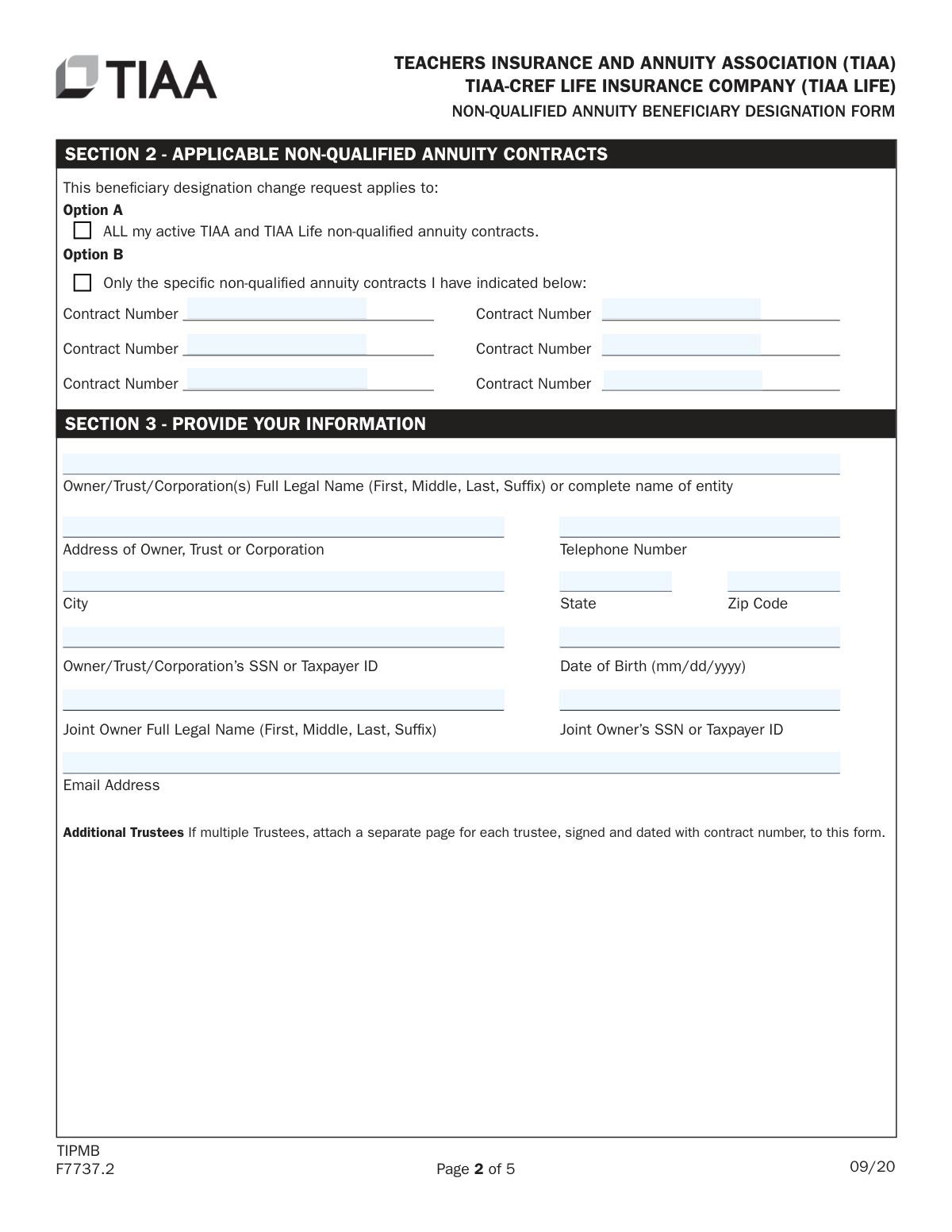
The primary document in this category is the TIAA Non-Qualified Annuity Beneficiary Designation Form (F7737.2). This form is essential for any individual holding a non-qualified annuity with TIAA who wants to ensure their assets are distributed according to their specific wishes upon their death.
Unlike qualified annuities, which are often tied to employer-sponsored retirement plans, non-qualified annuities are funded with after-tax dollars. Because these assets sit outside standard retirement accounts, having a clear and updated beneficiary form is the most effective way to avoid the time-consuming and costly probate process for your heirs.
Key Considerations for Your Form
When completing the TIAA Non-Qualified Annuity Beneficiary Designation Form, you should consider the following details to ensure your intent is clear:
- Primary vs. Contingent Beneficiaries: You will need to name primary beneficiaries (those first in line to receive benefits) and contingent beneficiaries (those who receive benefits only if the primary beneficiaries are no longer living).
- Allocation Percentages: The form allows you to specify exactly what percentage of the death benefit each individual or entity should receive. Ensure these totals add up to exactly 100% for each category.
- Detailed Instructions: If you are naming a trust or a specific legal entity, ensure you have the correct tax ID and legal name ready to include on the form.
When to Update Your Selection
You should revisit and potentially resubmit the TIAA Non-Qualified Annuity Beneficiary Designation Form during major life transitions to ensure your financial legacy remains accurate. Common triggers for an update include:
- Marriage, remarriage, or divorce
- The birth or adoption of a child or grandchild
- The death of a previously named beneficiary
- Significant changes in your overall estate planning strategy
By using Instafill.ai, you can quickly convert this PDF into an interactive, fillable document, making it easier to type in your details accurately and avoid the common errors associated with handwritten forms.
Form Comparison
| Form | Primary Purpose | Who Should File | When to Use |
|---|---|---|---|
| TIAA Non-Qualified Annuity Beneficiary Designation Form | Designates primary and contingent beneficiaries for death benefit distribution from non-qualified annuities. | TIAA annuity contract owners who want to specify who receives assets after death. | File when opening a new account or updating beneficiaries following major life events. |
Tips for non-qualified annuity forms
When filling out non-qualified annuity forms, ensure you distinguish between primary and contingent beneficiaries. Primary beneficiaries are first in line, while contingent beneficiaries receive assets only if the primary beneficiaries are deceased, providing a necessary backup for your estate plan.
A common mistake is assigning percentages that do not add up to exactly 100% for each beneficiary class. Double-check your math across all primary and contingent sections to ensure the form is not rejected by the provider for being mathematically inconsistent.
To prevent delays in benefit distribution, provide the full legal names and Social Security numbers of your beneficiaries. Using nicknames or incomplete information can lead to identity confusion and legal hurdles during the claims process.
Non-qualified annuity designations are not 'set it and forget it' documents. Review and update your forms after significant life changes such as marriage, divorce, or the birth of a child to keep your plan current.
Filling out complex annuity paperwork can be tedious, but AI-powered tools like Instafill.ai can complete these forms in under 30 seconds with high accuracy. Your data stays secure during the process, making it an ideal solution for those managing multiple financial documents efficiently.
Unlike life insurance, the earnings in a non-qualified annuity are typically taxable to the beneficiary as ordinary income. Providing your beneficiaries with a copy of the completed form helps them prepare for future tax obligations and financial planning.
Always keep a copy of the signed and dated beneficiary designation form alongside your other financial records. This serves as proof of your intent should the original document be lost or if there are discrepancies during the settlement of the annuity contract.
Frequently Asked Questions
These forms are used to manage annuities that were purchased with after-tax dollars, meaning the money contributed has already been taxed. Common forms in this category allow contract owners to update beneficiary designations, request withdrawals, or change ownership details to ensure the asset is managed according to their current financial plan.
A valid beneficiary designation ensures that the death benefits from your annuity are paid directly to the individuals or entities you choose, often bypassing the lengthy and expensive probate process. Without a clear form on file, the funds may default to your estate, which can lead to legal complications and unintended tax consequences for your heirs.
It is a best practice to review these forms annually or whenever you experience a major life event such as marriage, divorce, the birth of a child, or the death of a named beneficiary. Keeping these documents current ensures your assets are distributed exactly as you intend.
A primary beneficiary is the person or entity first in line to receive the annuity's death benefit. A contingent beneficiary serves as a backup and only receives the benefits if all named primary beneficiaries have passed away or are otherwise unable to accept the funds.
Yes, most financial institutions allow you to designate a legal entity like a trust or a non-profit organization as a beneficiary. You will typically need to provide the official legal name of the entity and its Tax Identification Number (TIN) to ensure the designation is processed correctly.
Completed forms should be submitted directly to the insurance company or financial institution that holds the annuity contract, such as TIAA. Most providers offer several submission methods, including secure online portals, fax, or standard mail to their administrative headquarters.
Yes, AI tools like Instafill.ai can significantly simplify the process by accurately extracting data from your source documents and placing it into the correct fields on the PDF. This technology can also convert static, non-fillable PDF forms into interactive documents that are much easier to complete digitally.
Using AI-powered services, you can fill out complex non-qualified annuity forms in under 30 seconds. The automation handles the repetitive data entry, ensuring that your information is placed accurately and reducing the time spent on manual paperwork.
You should have your annuity contract number, your Social Security number, and the full legal names and dates of birth for all beneficiaries. If you are naming a contingent beneficiary or a trust, ensure you have their contact information and Tax ID numbers available as well.
Requirements vary depending on the specific financial institution and state regulations. While many beneficiary forms only require the owner's signature, some may require a notary or a witness, particularly if you are in a community property state and naming someone other than your spouse as a primary beneficiary.
Glossary
- Non-Qualified Annuity
- An annuity funded with after-tax dollars, meaning contributions are not tax-deductible, but the earnings grow tax-deferred until they are withdrawn.
- Primary Beneficiary
- The person or entity first in line to receive the death benefit or account assets when the annuity owner passes away.
- Contingent Beneficiary
- A secondary beneficiary who receives the death benefit only if all the primary beneficiaries have died before the annuity owner.
- Annuitant
- The person whose life expectancy is used to calculate the annuity's payout; while often the same as the owner, it can be a different person.
- Cost Basis
- The total amount of after-tax money you have invested in the annuity, which is generally not subject to income tax when distributed.
- Tax-Deferred Growth
- A feature of annuities that allows investment earnings to accumulate without being taxed until the money is withdrawn from the account.
- Per Stirpes
- A legal term meaning that if a named beneficiary dies before the owner, their share of the assets will pass to their own legal heirs rather than to the other surviving beneficiaries.
- Death Benefit
- The payment made to designated beneficiaries upon the death of the annuity owner or annuitant, which can be a lump sum or a series of payments.