Fill out Northern Trust forms
with AI.
Northern Trust forms are essential documents for individuals and organizations managing significant assets, fiduciary responsibilities, and institutional investments. As a global leader in wealth management and asset servicing, Northern Trust requires detailed documentation to ensure compliance with strict federal regulations, including anti-money laundering (AML) and "Know Your Customer" (KYC) mandates. These forms serve as the foundation for establishing legal relationships, defining investment strategies, and maintaining the security of high-value financial accounts.
By continuing, you acknowledge Instafill's Privacy Policy and agree to get occasional product update and promotional emails.
About Northern Trust forms
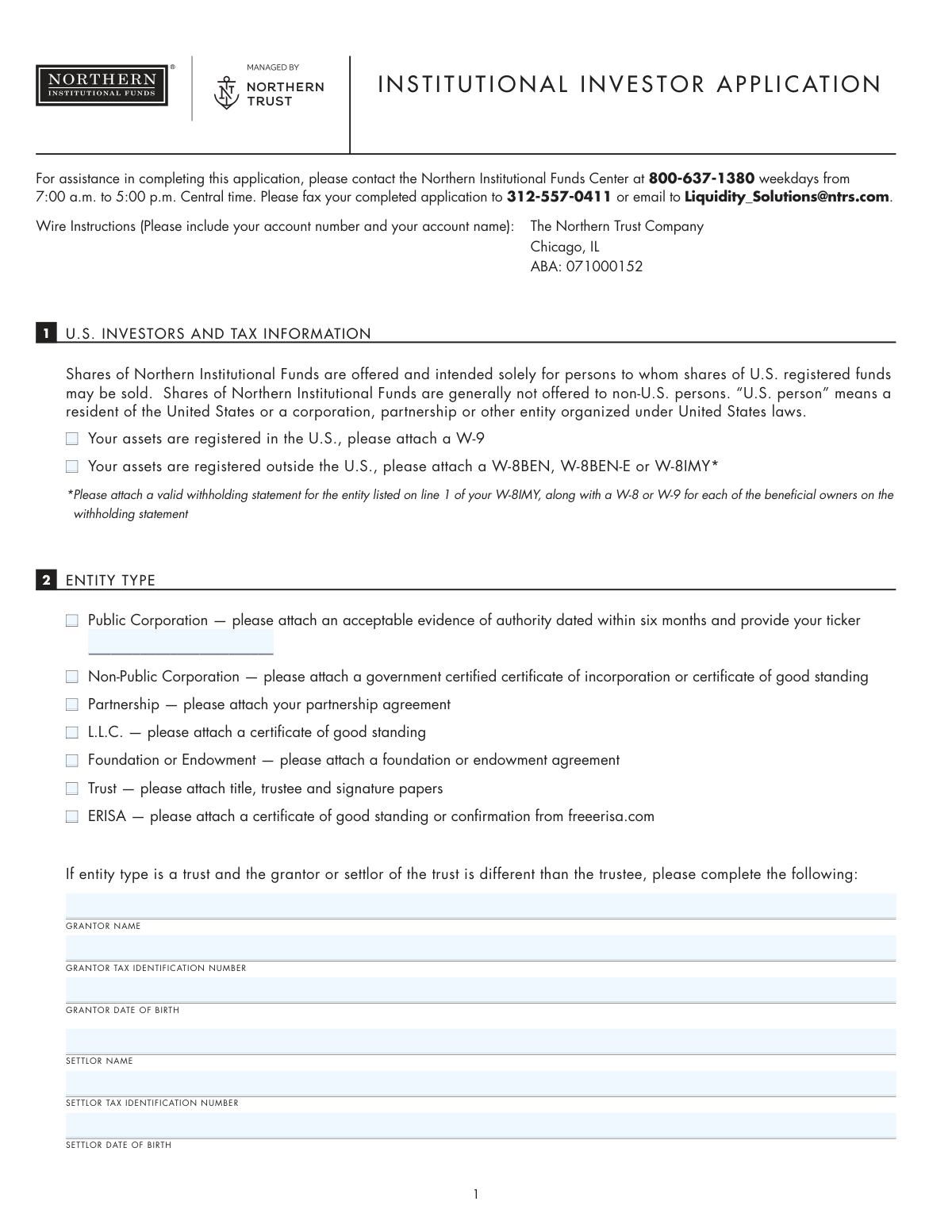
These documents are most frequently used by institutional investors, such as corporations, partnerships, and foundations, as well as high-net-worth individuals managing private trusts. For example, an Institutional Investor Application is a critical step for entities looking to open investment accounts, requiring precise information about tax status, beneficial ownership, and legal structure. Because these forms often involve complex legal and financial data, ensuring every field is completed correctly is vital to avoid administrative delays or compliance risks.
Navigating these multi-page documents manually can be a time-consuming task for busy professionals. Tools like Instafill.ai use AI to fill these forms in under 30 seconds, handling sensitive data accurately and securely while saving users from repetitive data entry. This approach allows investors to focus on their portfolio strategy rather than the friction of paperwork.
Every form on this page can be completed without typing. Instafill is form filling software that reads a PDF and fills it for you — including flat and scanned documents that carry no fillable fields at all.
Forms in This Category
The forms in this category have a median Form Complexity Index of 51/100 (Moderate), measured across 1 forms by field count, input difficulty, length, conditional logic and structure. See how it is calculated.
| Form Name | Pages | FCI | |
|---|---|---|---|
| 1. | Northern Trust Institutional Investor Application | 1 | Moderate 51 |
- Enterprise-grade security & data encryption
- 99%+ accuracy powered by AI
- 1,000+ forms from all industries
- Complete forms in under 60 seconds
How to Choose the Right Form
Northern Trust provides specialized documents for institutional wealth management and professional investment. While the bank offers a wide range of services, this category focuses on the essential paperwork required to establish a formal relationship with Northern Institutional Funds.
For Organizations and Entities
The primary document in this category is the Northern Trust Institutional Investor Application. This form is specifically designed for legal entities rather than individual personal accounts. You should choose this form if you are acting on behalf of:
- Corporations: For-profit businesses looking to manage corporate treasury or long-term investment assets.
- Partnerships: Both general and limited partnerships requiring a robust institutional platform.
- Trusts and Foundations: Charitable organizations, private foundations, or complex trust structures seeking to fulfill fiduciary duties through Northern Trust’s services.
Key Requirements for the Application
To successfully complete the Northern Trust Institutional Investor Application, you will need to provide detailed information to satisfy federal "Know Your Customer" (KYC) and anti-money laundering regulations. Ensure you have the following ready:
- Tax Status: Your organization’s Federal Employer Identification Number (EIN) and specific tax classification.
- Beneficial Ownership: Details for any individuals who own 25% or more of the entity, or a single individual with significant control.
- Legal Standing: Information regarding your entity's formation and legal jurisdiction.
Streamlining the Process
Because institutional applications are lengthy and require precise legal information, using the Northern Trust Institutional Investor Application on Instafill.ai allows you to use AI to map out complex fields. This ensures that your tax status and beneficial ownership details are captured correctly the first time, preventing back-and-forth with compliance officers and accelerating your time-to-market for new investments.
Form Comparison
| Form | Purpose | Eligible Entities | Key Information Required |
|---|---|---|---|
| Northern Trust Institutional Investor Application | To open a new investment account with Northern Institutional Funds. | Corporations, partnerships, trusts, foundations, and other institutional legal entities. | Tax status, beneficial ownership details, and specific investment intentions. |
Tips for Northern Trust forms
Ensure the entity name used on the application matches your Articles of Incorporation, Trust Agreement, or Partnership document exactly. Even minor discrepancies in suffixes like 'LLC' or 'Inc.' can cause Northern Trust to flag the application for manual review or rejection.
Institutional applications require specific information for all individuals with significant control or at least 25% ownership. Collect their full legal names, residential addresses, and Social Security or Tax ID numbers beforehand to avoid pausing mid-form.
Only individuals with documented authority to bind the institution should sign these forms. It is a best practice to have your corporate resolution or incumbency certificate ready to prove that the signatories have the legal right to open and manage the account.
Mistakes in the tax status section are common and can lead to incorrect withholding or reporting. Review your entity's tax classification and ensure you have the appropriate W-9 or W-8 series form available to submit alongside the primary application.
AI-powered tools like Instafill.ai can complete these complex institutional forms in under 30 seconds with high accuracy. This technology ensures your data stays secure during the process while significantly reducing the time spent on repetitive data entry for multiple entities.
Be precise when detailing your initial investment amount and the specific Northern Institutional Funds you wish to purchase. Clearly defining your wire or ACH instructions at the start prevents delays in the actual transfer of assets once the account is approved.
Frequently Asked Questions
These forms are specifically designed for legal entities rather than individual retail investors. Common users include corporations, partnerships, non-profits, foundations, and various types of trusts looking to establish investment accounts with Northern Institutional Funds.
This application serves as the foundational document required to open an account. It allows Northern Trust to gather necessary data on the entity’s legal structure, tax status, and investment objectives to ensure regulatory compliance and proper account setup.
Yes, AI tools like Instafill.ai can be used to fill out Northern Trust forms efficiently. These services can accurately extract data from your existing source documents and place it into the appropriate fields, significantly reducing the risk of manual entry errors.
While manual entry for complex institutional applications can be time-consuming, using AI-powered tools can complete the process in under 30 seconds. This technology automates the data mapping and entry tasks, allowing for a much faster turnaround.
When submitting an institutional application, you may need to provide supporting documents such as Articles of Incorporation, trust agreements, or partnership papers. These documents verify the legal existence of the entity and the authority of the individuals signing the form.
Financial institutions are required by federal regulations, such as 'Know Your Customer' (KYC) and Anti-Money Laundering (AML) laws, to identify the individuals who own or control a legal entity. This information helps maintain transparency and prevents financial crimes.
Completed and signed forms are typically submitted directly to Northern Trust via their secure client portals, by mail, or through your designated relationship manager. Always check the specific submission instructions included with your form package.
Yes, providing a valid TIN or Employer Identification Number (EIN) is a standard requirement for all institutional accounts. This information is used for tax reporting purposes and to verify the entity's standing with the relevant tax authorities.
The application asks about your investment goals, such as capital preservation or growth, to help align your account with suitable fund options. You should consult with your organization's financial advisors to ensure the selections accurately reflect your institutional strategy.
Most institutional forms allow for multiple authorized signers to be designated, which is common for large organizations or trusts with several trustees. You will typically need to provide identifying information and signatures for each person authorized to act on behalf of the account.
Glossary
- Form Complexity Index
- Instafill’s 0–100 measure of how much effort a form takes to complete, calculated deterministically from the form’s own structure rather than estimated. It combines the number of fillable fields (the largest factor), how difficult those fields are to complete based on their type, the number of pages that contain fields, the amount of conditional “fill-only-if” logic, and how many sections the form is divided into, then adds modifiers for tables and repeating lists, bundled instruction pages, and dense page layouts. A higher score means the form is harder to fill out by hand. The forms in this category have a median Form Complexity Index of 51/100 (Moderate). See exactly how it is calculated.
- Institutional Investor
- A large organization, such as a corporation, pension fund, or endowment, that invests high volumes of capital and is subject to different regulatory requirements than individual retail investors.
- Beneficial Owner
- An individual who ultimately owns or controls a significant portion (usually 25% or more) of a legal entity or has significant responsibility to control and manage the entity.
- KYC (Know Your Customer)
- A standard financial services process that requires institutions to verify the identity and legitimacy of their clients to prevent fraud and money laundering.
- Legal Entity Identifier (LEI)
- A unique 20-digit code used to identify legally distinct entities that engage in financial transactions, helping to increase transparency in global financial markets.
- FATCA (Foreign Account Tax Compliance Act)
- A federal law requiring financial institutions to report information about accounts held by U.S. persons or foreign entities with substantial U.S. ownership for tax purposes.
- Authorized Signatory
- A person officially designated by a company or organization to sign legal documents and enter into agreements on behalf of the entire entity.
- TIN (Taxpayer Identification Number)
- A unique number used for tax identification purposes; for institutional applicants, this is usually an Employer Identification Number (EIN) issued by the IRS.
- Control Person
- An individual with significant responsibility to control, manage, or direct a legal entity, such as a Chief Executive Officer, Chief Financial Officer, or Managing Member.