Fill out pharmacy forms
with AI.
Pharmacy forms serve as the essential communication link between healthcare providers, insurance companies, and patients. These documents are critical for ensuring that medications are dispensed correctly and that insurance coverage is applied appropriately. This category covers a variety of administrative paperwork, including insurance-specific prescription forms and prior authorization requests. These forms are vital for maintaining the continuity of care, as they allow providers to justify the medical necessity of specific treatments to pharmacy benefit managers, ensuring patients receive the medication they need without financial or logistical hurdles.
By continuing, you acknowledge Instafill's Privacy Policy and agree to get occasional product update and promotional emails.
About pharmacy forms
Healthcare professionals, such as physicians, nurses, and pharmacists, are the primary users of these forms, often needing to complete them under tight deadlines to avoid treatment delays. Patients may also need to access these forms when navigating insurance disputes or requesting coverage for non-formulary drugs. Whether dealing with a Uniform Pharmacy Prior Authorization Request Form or a specific carrier document like an Express Scripts request, accuracy is paramount. Even small errors can lead to rejected claims or lengthy administrative delays that impact patient health. Tools like Instafill.ai use AI to fill these forms in under 30 seconds, handling data accurately and securely to streamline this often-tedious administrative process.
Every form on this page can be completed without typing. Instafill is form filling software that reads a PDF and fills it for you — including flat and scanned documents that carry no fillable fields at all.
Forms in This Category
The forms in this category have a median Form Complexity Index of 48/100 (Moderate), measured across 2 forms by field count, input difficulty, length, conditional logic and structure. See how it is calculated.
| Form Name | Pages | FCI | |
|---|---|---|---|
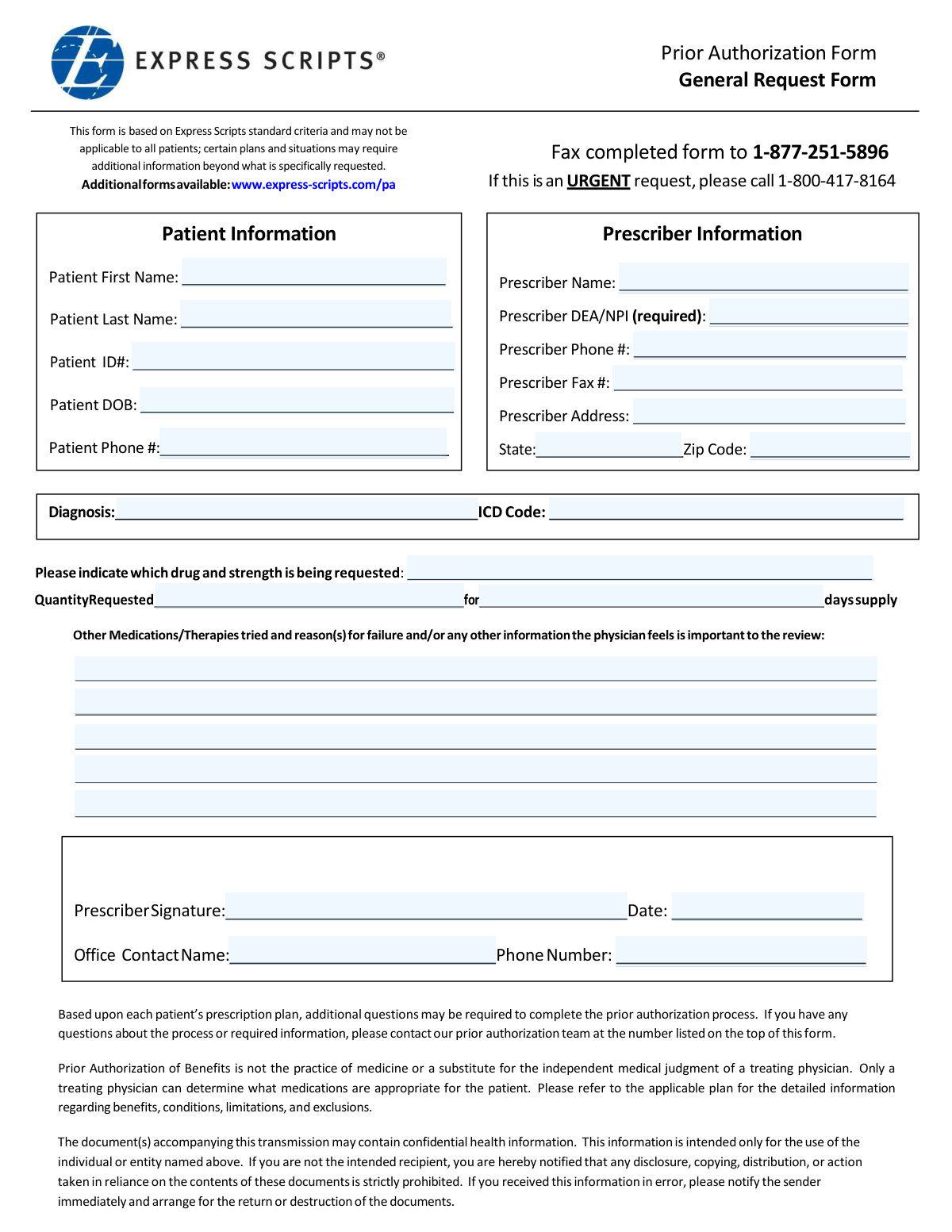
| 1. | Express Scripts Prior Authorization Form - General Request Form | 1 | Basic 39 |
| 2. | Uniform Pharmacy Prior Authorization Request Form | 2 | Moderate 48 |
- Enterprise-grade security & data encryption
- 99%+ accuracy powered by AI
- 1,000+ forms from all industries
- Complete forms in under 60 seconds
How to Choose the Right Form
Navigating pharmacy paperwork is often the final hurdle between a patient and their medication. When a prescription requires prior authorization (PA), choosing the correct form is essential to avoid delays in coverage and treatment.
For Express Scripts Members
If the patient’s prescription benefit manager is Express Scripts, you should use the Express Scripts Prior Authorization Form - General Request Form. This document is specifically designed for the Express Scripts system. Prescribers use it to provide the clinical justification and medical necessity required by this specific manager to approve coverage for non-formulary or restricted drugs.
For Standard or State-Mandated Requests
In cases where the insurer requires a standardized format or doesn't have a proprietary form, the Uniform Pharmacy Prior Authorization Request Form is the standard choice. This form is often utilized across various health plans and states to streamline the request process. It is the go-to option when you need a comprehensive, universally recognized document to demonstrate why a specific medication is necessary for a patient’s health.
Key Considerations for Selection
- Check the Insurance Card: Look at the patient's insurance card to identify the Pharmacy Benefit Manager (PBM). If "Express Scripts" is listed, prioritize their specific form.
- Standardization Requirements: Some states mandate the use of the Uniform Pharmacy Prior Authorization Request Form for all insurers operating within that state to simplify the administrative process.
- Clinical Documentation: Regardless of the form you choose, ensure you have diagnostic codes and clinical notes ready to justify why the preferred medication on the insurance formulary is not suitable.
Using Instafill.ai, you can quickly complete these PDFs by letting our AI handle the data entry, ensuring that all required fields are accurately populated for faster approval processing.
Form Comparison
| Form | Target Entity | Primary Use Case | Key Information Needed |
|---|---|---|---|
| Express Scripts Prior Authorization Form - General Request Form | Specifically for pharmacy benefits managed by the Express Scripts PBM. | Justifying medical necessity for medication coverage under specific Express Scripts plans. | Detailed prescriber clinical justification and patient-specific diagnosis for plan-specific approval. |
| Uniform Pharmacy Prior Authorization Request Form | Standardized for use across multiple health insurance carriers and plans. | Requesting pre-approval for non-formulary or restricted drugs from general insurers. | Documentation of medical necessity and history of alternative medication failures. |
Tips for pharmacy forms
Ensure that the patient's insurance ID and the prescriber’s NPI number are accurate and clearly legible. Incorrect or missing identifiers are the most common reasons for immediate rejection by pharmacy benefit managers.
When requesting prior authorization, include specific medical reasons why the standard formulary alternative is not suitable for the patient. Attaching relevant lab results or clinical notes can significantly increase the chances of a successful approval.
AI-powered tools like Instafill.ai can complete these pharmacy forms in under 30 seconds with high accuracy, which is a major time-saver for busy clinics. Your data stays secure during the process, ensuring sensitive patient information is handled safely.
Different insurance plans and pharmacy benefit managers may require submission via a specific fax number or a dedicated online portal. Always double-check the submission instructions on the form to ensure it reaches the correct department for processing.
Most prior authorizations are only valid for a limited period, such as six or twelve months. Setting a reminder to start the renewal process 30 days before the expiration date prevents lapses in patient medication coverage.
Pharmacy benefit managers frequently update their request forms to reflect new clinical guidelines. Using an outdated version can result in processing delays or unnecessary requests for additional information that is already integrated into the newer version.
Frequently Asked Questions
These forms are documents submitted by healthcare providers to insurance companies or pharmacy benefit managers (PBMs) to request coverage for specific medications. They are necessary when a drug is not on a standard formulary or requires special clinical oversight before the insurer will agree to pay for it.
In most cases, the prescribing physician or their clinical staff must complete these forms because they require medical documentation and professional diagnosis details. While patients may provide basic demographic or insurance information, the clinical justification must come from the healthcare provider.
This specific form is used when a patient's prescription plan is managed by Express Scripts and the prescribed medication requires a clinical review. It helps the prescriber justify the medical necessity of the drug based on the patient's history and the insurer's specific coverage criteria.
The uniform form is a standardized document accepted by many different insurance carriers to streamline the request process for restricted medications. It allows healthcare providers to use a consistent format across different plans when demonstrating why a specific treatment is essential for a patient's care.
Yes, AI tools like Instafill.ai can automatically fill out pharmacy forms by extracting data from clinical notes or source documents and placing it accurately into the required fields. This technology can also convert static or non-fillable PDF versions of these forms into interactive documents.
Using AI-powered services, these forms can be filled in under 30 seconds by accurately extracting and placing data from your existing records. This significantly reduces the administrative burden on clinical staff and allows for faster submission to insurance providers.
Completed forms are typically faxed or uploaded to the patient's insurance provider or the relevant pharmacy benefit manager (PBM). Submission details, such as a dedicated fax number or a link to a provider portal, are usually listed on the header or footer of the form itself.
Most forms require patient identification, insurance policy numbers, the prescriber’s NPI and contact information, and the specific diagnosis code (ICD-10). Additionally, the provider may need to list previous medications the patient has tried and failed as part of a step-therapy requirement.
Insurers use this process to manage costs and ensure that the prescribed treatment is medically necessary and appropriate for the patient's condition. It helps verify that the drug is being used according to clinical guidelines and that more cost-effective alternatives have been considered first.
If a request is denied, the healthcare provider can typically file an appeal or provide additional clinical documentation to support the necessity of the drug. Patients can also consult with their doctor to see if an alternative medication covered by their plan’s formulary is appropriate for their treatment.
The correct form depends on the patient's specific insurance provider or the pharmacy benefit manager listed on their prescription insurance card. You can usually find the required form on the insurer's website or use a standardized uniform form if the carrier accepts it for prior authorization requests.
Glossary
- Form Complexity Index
- Instafill’s 0–100 measure of how much effort a form takes to complete, calculated deterministically from the form’s own structure rather than estimated. It combines the number of fillable fields (the largest factor), how difficult those fields are to complete based on their type, the number of pages that contain fields, the amount of conditional “fill-only-if” logic, and how many sections the form is divided into, then adds modifiers for tables and repeating lists, bundled instruction pages, and dense page layouts. A higher score means the form is harder to fill out by hand. The forms in this category have a median Form Complexity Index of 48/100 (Moderate). See exactly how it is calculated.
- Prior Authorization (PA)
- A requirement by a health insurance plan that a doctor must obtain approval before a specific medication will be covered for a patient.
- Formulary
- A list of prescription drugs covered by a health insurance plan, which often dictates the cost and whether a prior authorization is required.
- Pharmacy Benefit Manager (PBM)
- A third-party company, such as Express Scripts, that manages prescription drug programs and processes insurance claims for health plans.
- Medical Necessity
- The clinical justification provided by a healthcare professional to prove that a specific medication is essential for treating a patient's medical condition.
- NPI Number
- A unique 10-digit National Provider Identifier issued to healthcare providers in the United States, used for identification on pharmacy and insurance forms.
- ICD-10 Code
- A standardized system of codes used by healthcare providers to classify and report medical diagnoses on insurance and prior authorization forms.
- Step Therapy
- An insurance protocol that requires a patient to try one or more lower-cost or preferred medications before the plan will cover a more expensive drug.
- NDC Number
- The National Drug Code is a unique identifier used to specify the exact manufacturer, strength, and package size of a prescription medication.