Fill out professional client forms
with AI.
Professional client forms are essential documents used by financial institutions, investment firms, and corporate entities to formalize complex business relationships. These forms are designed to establish the regulatory status of a client—often under frameworks like MiFID II—ensuring that the level of investor protection and communication is appropriate for their specific level of expertise. They serve as the foundation for account opening, providing critical data for anti-money laundering (AML) compliance, tax reporting under FATCA or CRS, and overall risk assessment.
By continuing, you acknowledge Instafill's Privacy Policy and agree to get occasional product update and promotional emails.
About professional client forms
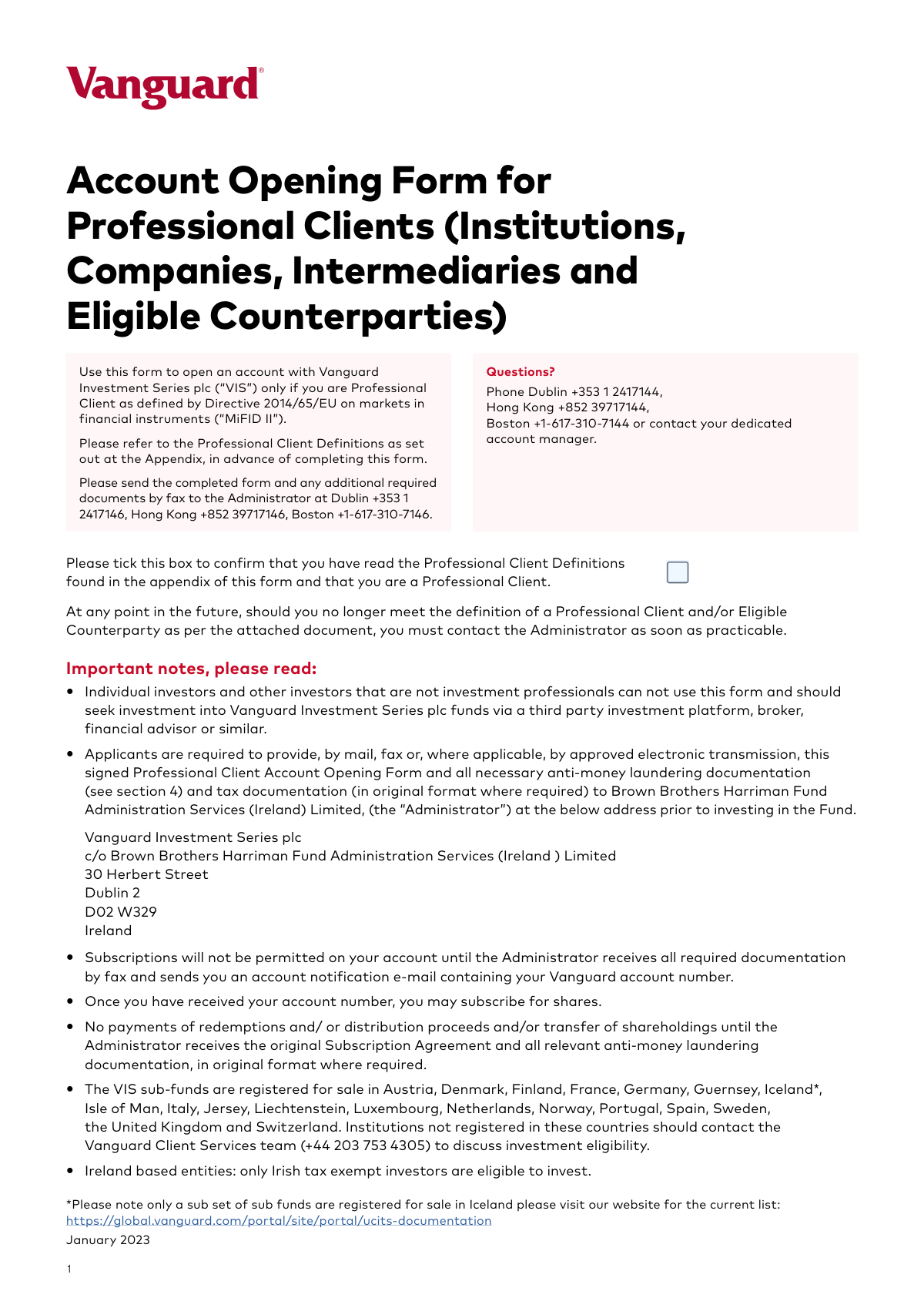
Typically, these forms are required by institutional investors, large companies, financial intermediaries, and eligible counterparties when entering into new investment agreements or opening corporate brokerage accounts. Whether you are representing a pension fund, a large enterprise, or a regulated financial entity, accurately completing these documents is a prerequisite for accessing professional-grade investment services. Forms such as the Account Opening Form for Professional Clients are standard requirements that ensure both the client and the institution remain compliant with international financial regulations.
Navigating these complex documents manually can be a time-consuming administrative burden for busy professionals. Tools like Instafill.ai simplify this process by using AI to populate these forms in under 30 seconds, ensuring that data is handled accurately and securely. This allows teams to focus on strategy and client relations rather than manual data entry and repetitive paperwork.
Every form on this page can be completed without typing. Instafill is form filling software that reads a PDF and fills it for you — including flat and scanned documents that carry no fillable fields at all.
Forms in This Category
The forms in this category have a median Form Complexity Index of 63/100 (Complex), measured across 1 forms by field count, input difficulty, length, conditional logic and structure. See how it is calculated.
| Form Name | Pages | FCI | |
|---|---|---|---|
| 1. | Account Opening Form for Professional Clients (Institutions, Companies, Intermediaries and Eligible Counterparties) | 1 | Complex 63 |
- Enterprise-grade security & data encryption
- 99%+ accuracy powered by AI
- 1,000+ forms from all industries
- Complete forms in under 60 seconds
How to Choose the Right Form
Navigating professional investment documentation requires precision, especially when dealing with institutional accounts. While this category currently features a primary application document, it is essential to ensure you meet the specific criteria for a "Professional Client" before beginning the process.
Determining Your Eligibility
The Account Opening Form for Professional Clients (Institutions, Companies, Intermediaries and Eligible Counterparties) is specifically designed for entities that qualify under the Markets in Financial Instruments Directive (MiFID II). You should use this form if you represent:
- Institutional Investors: Large-scale organizations managing significant capital and sophisticated portfolios.
- Corporate Entities: Companies seeking to establish investment positions with Vanguard Investment Series plc.
- Financial Intermediaries: Professionals or firms acting on behalf of other clients in a regulated capacity.
- Eligible Counterparties: Entities that are granted the specific regulatory status under MiFID II due to their high level of market expertise.
Key Requirements and Compliance
This comprehensive document serves several critical regulatory and administrative purposes. When preparing to fill out the Account Opening Form for Professional Clients, ensure you have the necessary data ready for:
- MiFID II Classification: Confirming your status to determine the appropriate level of investor protection.
- AML & KYC Compliance: Providing essential details for Anti-Money Laundering and Know Your Customer checks, which are mandatory for institutional onboarding.
- Tax Reporting: Including documentation for FATCA (Foreign Account Tax Compliance Act) and CRS (Common Reporting Standard) to ensure international tax compliance.
Streamlining the Application Process
Opening an account for a professional entity often involves complex data entry and multi-page documentation. Using the Account Opening Form for Professional Clients via Instafill.ai allows you to leverage AI to populate repetitive fields and convert static PDFs into interactive, fillable documents. This ensures that your application is accurate, compliant, and processed without the delays typically associated with manual paperwork.
Form Comparison
| Form | Purpose | Who Files It | Key Requirements |
|---|---|---|---|
| Account Opening Form for Professional Clients (Institutions, Companies, Intermediaries and Eligible Counterparties) | Establishes investment accounts and confirms Professional Client status under MiFID II regulations. | Institutional investors, corporate entities, intermediaries, and eligible counterparties opening Vanguard accounts. | Requires anti-money laundering (AML) documentation, FATCA/CRS tax reporting info, and entity registration. |
Tips for professional client forms
Ensure you correctly identify your entity as a professional client or eligible counterparty before starting the application. This classification dictates the level of investor protection you receive and determines which specific sections of the form are mandatory for your organization.
Professional account forms require supplementary documents such as Articles of Association, proof of registered address, and structure charts. Having these digital files organized beforehand prevents delays during the Anti-Money Laundering (AML) and Know Your Customer (KYC) verification phases.
AI-powered tools like Instafill.ai can complete these complex professional forms in under 30 seconds with high accuracy. This is a major time-saver for institutions dealing with multiple account openings, and the data stays secure during the entire automated process.
Provide your Global Intermediary Identification Number (GIIN) and tax residency status with precision. Incorrect tax information is a common reason for application rejection and can lead to complications with international tax compliance and reporting.
Check that the individuals signing the form have the documented legal authority to bind the institution. Including an updated certified signatory list or power of attorney helps the provider verify the application's validity without requesting further evidence.
Double-check that the bank account details provided for funding match the exact legal name of the entity opening the account. Any discrepancy between the applicant's name and the settlement bank account can trigger fraud alerts and stall the account activation process.
Frequently Asked Questions
These forms are primarily used by institutional investors, such as corporations, financial intermediaries, or eligible counterparties, to establish investment accounts. They collect essential data for regulatory compliance, including tax residency information and anti-money laundering (AML) details required by financial institutions.
A professional client is typically an entity that possesses the experience, knowledge, and expertise to make its own investment decisions and properly assess the risks involved. This category includes regulated entities like banks, insurance companies, and large corporate bodies that meet specific financial thresholds under regulations like MiFID II.
Yes, AI tools like Instafill.ai can process professional client forms by accurately extracting data from your corporate documents and placing it directly into the required fields. This ensures that complex institutional data is transferred without the risk of manual entry errors.
While manual completion of institutional forms can be time-consuming due to the high level of detail required, AI-powered services can complete these forms in under 30 seconds. This significantly speeds up the onboarding process for companies and intermediaries.
Most institutions will require proof of incorporation, an authorized signatory list, and identification documents for beneficial owners to satisfy Know Your Customer (KYC) requirements. Additionally, tax residency certificates or self-certification forms are often necessary for global tax compliance.
The classification determines the level of regulatory protection and the type of information the investment firm must provide to the client. Professional clients are generally assumed to have a higher level of financial sophistication, which may affect the disclosures and services they receive compared to retail clients.
Financial institutions are required by law to identify the tax residency of their account holders to prevent tax evasion. The Foreign Account Tax Compliance Act (FATCA) and the Common Reporting Standard (CRS) are international frameworks that facilitate the exchange of financial account information between different jurisdictions.
Yes, intermediaries such as brokers or wealth managers can use these forms to open accounts for their own clients or for underlying funds. In such cases, the intermediary must provide specific details regarding their regulatory status and their authority to act on behalf of the investors.
Submission methods vary by the investment provider but typically involve uploading the signed document through a secure digital portal or sending it via registered mail. Some providers may also accept digital signatures if they meet specific legal and security standards.
Institutions are generally required to notify the investment provider immediately of any material changes, such as a change in beneficial ownership, address, or tax status. Periodic reviews are often conducted by the provider to ensure that the client’s professional status remains accurate and compliant with current regulations.
Glossary
- Form Complexity Index
- Instafill’s 0–100 measure of how much effort a form takes to complete, calculated deterministically from the form’s own structure rather than estimated. It combines the number of fillable fields (the largest factor), how difficult those fields are to complete based on their type, the number of pages that contain fields, the amount of conditional “fill-only-if” logic, and how many sections the form is divided into, then adds modifiers for tables and repeating lists, bundled instruction pages, and dense page layouts. A higher score means the form is harder to fill out by hand. The forms in this category have a median Form Complexity Index of 63/100 (Complex). See exactly how it is calculated.
- Professional Client
- A client, such as a large company or institution, that is considered to have enough experience and knowledge to make their own investment decisions and understand the risks involved.
- MiFID II
- A European Union regulation designed to protect investors and increase transparency in financial markets by standardizing how firms report data and categorize their clients.
- AML (Anti-Money Laundering)
- A set of procedures and laws that financial institutions must follow to prevent the processing of illegally obtained funds and verify the identity of their clients.
- Eligible Counterparty
- A specific type of professional client, such as a bank or national government, that is granted the lowest level of regulatory protection because of its high level of financial expertise.
- FATCA (Foreign Account Tax Compliance Act)
- A United States law that requires non-U.S. financial institutions to report information about accounts held by U.S. taxpayers to help prevent tax evasion.
- CRS (Common Reporting Standard)
- An international system for the automatic exchange of financial information between different countries to ensure individuals and entities pay the correct amount of tax.
- LEI (Legal Entity Identifier)
- A unique 20-digit code used to identify legal entities that participate in financial transactions, which is required for reporting and transparency purposes.
- UBO (Ultimate Beneficial Owner)
- The individual person who ultimately owns or controls a legal entity, typically identified as anyone holding more than 25% of the company's shares or voting rights.