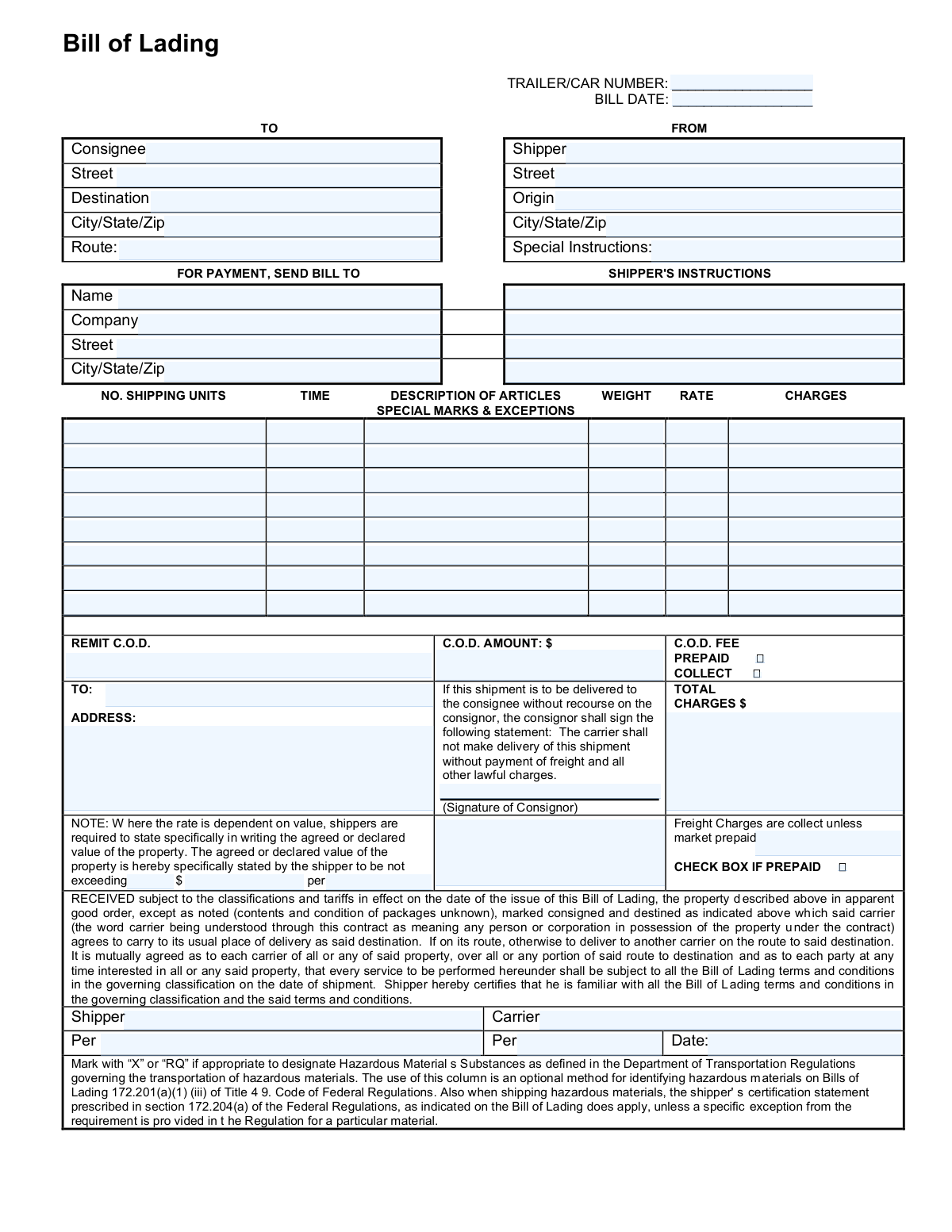
Yes! You can use AI to fill out Bill of Lading
A Bill of Lading (BOL) is a legally binding document issued by a carrier to a shipper, detailing the type, quantity, and destination of the goods being transported. It serves as a receipt for the shipment, a contract between the carrier and shipper, and a document of title to the goods, making its accuracy paramount for smooth trade. Today, this form can be filled out quickly and accurately using AI-powered services like Instafill.ai, which can also convert non-fillable PDF versions into interactive fillable forms.
Our AI automatically handles information lookup, data retrieval, formatting, and form filling.
It takes less than a minute to fill out BOL using our AI form filling.
Securely upload your data. Information is encrypted in transit and deleted immediately after the form is filled out.
Form specifications
| Form name: | Bill of Lading |
| Number of fields: | 132 |
| Number of pages: | 2 |
| Filled form examples: | Form BOL Examples |
| Language: | English |
Instafill Demo: How to fill out PDF forms in seconds with AI
How to Fill Out BOL Online for Free in 2026
Are you looking to fill out a BOL form online quickly and accurately? Instafill.ai offers the #1 AI-powered PDF filling software of 2026, allowing you to complete your BOL form in just 37 seconds or less.
Follow these steps to fill out your BOL form online using Instafill.ai:
- 1 Navigate to Instafill.ai and upload your Bill of Lading PDF or select the template.
- 2 Use the AI assistant to populate the Shipper/Exporter, Consignee, and Notify Party sections with complete names, addresses, and contact details.
- 3 Enter key shipment identifiers such as the Bill of Lading/PO number, Booking Number, and Export References.
- 4 Detail each item in the shipment, including the number of packages, description of goods, gross weight, measurements, and freight class.
- 5 Specify the complete shipping route, including the place of receipt, ports of loading and discharge, and final delivery location, along with carrier details.
- 6 Indicate how freight charges will be handled (Prepaid, Collect, or Third Party) and itemize all associated costs, rates, and declared values.
- 7 Carefully review all entered information for accuracy, then electronically sign and date the document to finalize the contract of carriage.
Our AI-powered system ensures each field is filled out correctly, reducing errors and saving you time.
Why Choose Instafill.ai for Your Fillable BOL Form?
Speed
Complete your BOL in as little as 37 seconds.
Up-to-Date
Always use the latest 2026 BOL form version.
Cost-effective
No need to hire expensive lawyers.
Accuracy
Our AI performs 10 compliance checks to ensure your form is error-free.
Security
Your personal information is protected with bank-level encryption.
Frequently Asked Questions About Form BOL
This is a Bill of Lading, a legal contract for the shipment of goods. It is typically completed by the shipper or their designated forwarding agent.
The Shipper is the sender of the goods, the Consignee is the intended recipient, and the Notify Party is the entity to be contacted upon the shipment's arrival, which may be different from the consignee.
Select 'Prepaid' if the shipper is paying for shipping in advance. Choose 'Collect' if the consignee will pay upon receipt. Select 'Third Party' if an entity other than the shipper or consignee is responsible for the bill.
You must provide a detailed description of the items, including the number of packages, any identifying marks or container numbers, gross weight, and measurements. This information is critical for handling, customs, and freight calculations.
Freight Class is a standardized shipping industry pricing classification based on an item's density, stowability, handling, and liability. You can find your item's freight class by consulting the National Motor Freight Traffic Association (NMFTA) or asking your logistics provider.
You must mark the 'Hazardous Material' field, usually with an 'X', for any item classified as such under federal regulations. Ensure you also provide all other required hazardous material documentation for the shipment.
Declared Value is the value stated by the shipper, which sets the carrier's liability limit for loss or damage. Insured Value is the amount covered by a separate cargo insurance policy, which can be higher for more comprehensive protection.
These numbers are crucial for tracking and administration. The 'Booking No.' confirms your reservation with the carrier, while the 'PO No.' (Purchase Order) links the shipment to a specific sales transaction for easy identification by all parties.
Yes, services like Instafill.ai use AI to auto-fill form fields accurately from your data sources, which saves time and helps prevent costly errors on complex shipping documents.
Simply upload the form to the Instafill.ai platform. The AI will make the document interactive, allowing you to connect your data to auto-fill fields or complete it manually in your browser.
You can use a service like Instafill.ai to solve this. It can convert non-fillable PDFs into interactive, fillable forms that you can easily complete, save, and share online.
This is the license number issued by the U.S. Federal Maritime Commission (FMC) to an Ocean Freight Forwarder or NVOCC. It confirms the agent is authorized to handle ocean freight.
'Place of Receipt by Pre-Carrier' is where the goods are first picked up by an initial carrier, like a truck. 'Port of Loading' is the seaport where the goods are loaded onto the main vessel for the sea voyage.
Compliance BOL
Validation Checks by Instafill.ai
1
Third Party Billing Conditional Requirement
This validation ensures that if the 'Third Party' checkbox is selected, the 'Third Party Billing Name and Address' and 'Third Party Phone Number' fields are mandatory and populated. This is critical for accurate invoicing and preventing financial disputes. A failure would block submission until the required third-party details are provided, ensuring the correct entity is billed.
2
Charge Payment Method Exclusivity
This check verifies that only one of the primary payment method checkboxes ('Prepaid', 'Collect', 'Third Party') is selected. A shipment's primary billing instruction must be unambiguous to avoid confusion in accounting and at the time of delivery. If multiple options are selected, the form should return an error prompting the user to choose only one.
3
Charge Totals Calculation Accuracy
This validation cross-references the sum of individual charge items with the overall totals. It confirms that the 'Total Prepaid' field equals the sum of all 'Prepaid Amount' fields, and 'Total Collect' equals the sum of all 'Collect Amount' fields. This automated check is vital for preventing financial discrepancies and ensuring the bill of lading is arithmetically correct.
4
Chronological Date Integrity
This check ensures that the 'Issued On Date' is not before the 'Date Shipped'. A bill of lading is a receipt for goods after they have been dispatched, so it cannot be logically issued before the shipment date. If the validation fails, it indicates a data entry error that must be corrected to maintain the document's legal and logical validity.
5
Mandatory Party Information Completeness
This validation confirms that the full name and address details for the 'Shipper/Exporter', 'Consignee', and 'Notify Party' are provided. These fields are essential for legal ownership, customs clearance, and successful delivery of the goods. An incomplete submission would be rejected, as missing information could lead to lost shipments or legal complications.
6
Item Description Dependency Check
This check ensures that for any item row where 'Number of Packages' is greater than zero, the corresponding 'Description of Package and Goods' and 'Gross Weight' fields are also filled. You cannot declare packages without describing what they are and how much they weigh. This prevents incomplete or vague shipment manifests, which is critical for customs and handling.
7
Valid Phone Number Formatting
This validation checks that all phone number fields (Shipper, Consignee, Notify Party, etc.) adhere to a standard, recognizable format. This is important for ensuring that all parties involved in the shipment can be contacted without issue. An invalid format would trigger a warning to re-enter the number correctly, preventing communication failures.
8
Hazardous Material Indicator Format
This check validates that any field indicating hazardous materials (e.g., 'Hazardous Material Indicator') only contains an 'X' or is left blank. This is a critical compliance and safety requirement for proper handling, placarding, and transportation. Any other input would be rejected to ensure there is no ambiguity about the hazardous nature of the cargo.
9
Mandatory Shipment Route Information
This validation ensures that core routing fields, specifically 'Port of Loading' and 'Port of Discharge', are not empty. A shipment cannot be processed without a clear origin and destination port. Failure to provide this information would make the document invalid and halt the booking process until corrected.
10
Port of Loading and Discharge Uniqueness
This logical check verifies that the 'Port of Loading' and 'Port of Discharge' are not the same. While there are rare exceptions, for the vast majority of shipments, these two locations must be different. This simple check helps catch significant data entry errors that could otherwise lead to mis-routing the entire shipment.
11
Numerical Field Type Validation
This check ensures that all fields intended for numerical data, such as 'Gross Weight', 'Declared Value', and all charge amounts, contain only valid numeric characters. This is fundamental for preventing calculation errors and data corruption within the system. Non-numeric entries would be rejected at the point of entry to maintain data integrity.
12
Bill of Lading or PO Number Presence
This validation confirms that the 'Bill of Lading / PO No.' field is populated. This number is the primary identifier for the entire shipment and is crucial for tracking, invoicing, and referencing by all parties. A form submitted without this key identifier would be considered incomplete and rejected.
Common Mistakes in Completing BOL
Users often provide partial addresses for the Shipper, Consignee, or Notify Party, such as omitting a ZIP code or suite number. This happens when rushing or not having complete details on hand, leading to customs holds, delivery delays, and costly re-routing fees. Always verify and enter the full, unabbreviated physical address, as this information is critical for both customs clearance and final delivery.
A frequent error is incorrectly identifying the parties involved, such as listing a freight forwarder as the consignee instead of the actual buyer. This stems from a misunderstanding of the distinct legal and logistical roles each party plays in a shipment. The consequences are severe, including cargo being released to the wrong entity, payment disputes, and legal challenges over ownership.
Describing cargo with generic terms like 'General Merchandise' or 'Parts' is a common mistake that guarantees customs scrutiny. Customs authorities require a precise, detailed description of all goods to assess duties, taxes, and security risks. Vague descriptions lead to mandatory inspections, significant delays, and potential fines for non-compliance.
Providing incorrect gross weight or dimensions is a critical error, often caused by using estimates or failing to include the weight of packaging. Carriers use this data to plan vessel stability and ensure safety, while customs uses it for verification. Discrepancies can result in costly freight re-rating, carrier rejection of the cargo, and safety hazards during transit.
Mistakes in the 'Charges To Be' section, such as selecting 'Prepaid' instead of 'Collect' or failing to provide details for 'Third Party' billing, are common. This often occurs when the person filling the form is not aligned with the sales terms (Incoterms). Such errors lead to billing disputes, delays in cargo release until payment is sorted out, and financial losses for either the shipper or consignee.
Failing to mark the 'Hazardous Material' box and provide the required documentation is a serious violation. Shippers may be unaware that common items like perfumes or electronics with lithium batteries are considered hazardous, or may omit it to avoid higher costs. The consequences include severe legal penalties, massive fines, and extreme safety risks to personnel, equipment, and the environment.
Many shippers mistakenly believe the 'Declared Value' is the insured amount, or they leave it blank, assuming the carrier's standard liability is sufficient. Carrier liability is legally limited and often extremely low, meaning you might only recover a fraction of your cargo's worth in case of loss or damage. To be fully protected, shippers must secure separate cargo insurance and not rely on the carrier's limited liability.
Omitting or transposing digits in the 'Booking No.', 'Bill of Lading / PO No.', or other reference fields is a frequent data entry error. These numbers are the primary keys that link the physical shipment to all related commercial documents, tracking systems, and payment instructions. Errors can make it impossible to track the shipment, match it to a purchase order, or process payments efficiently, causing administrative chaos.
A critical error is having discrepancies between the Bill of Lading and other documents like the Commercial Invoice or Packing List. For example, the consignee name or package count might differ. This happens when documents are prepared by different people without cross-verification, leading to customs holds and refusal by banks to honor letters of credit until all information is perfectly aligned.
Users often mix up specific logistical locations like 'Place of Receipt by Pre-Carrier' and 'Port of Loading'. The 'Place of Receipt' could be an inland factory, while the 'Port of Loading' is the seaport where it boards the main vessel. Confusing these terms can lead to incorrect routing by the carrier, transit delays, and disputes over where the carrier's responsibility begins and ends.
Guessing or using an incorrect 'Freight Class' is a costly mistake, particularly for LTL (Less-than-Truckload) shipments. Freight classification is a complex standard based on density, stowability, and liability, and incorrect entries are almost always caught by the carrier. This results in the shipment being re-classified, leading to unexpected and often significant additional charges and fees.
When a form is only available as a non-fillable PDF, users often print it and fill it out by hand, leading to illegible handwriting, smudges, and incomplete fields. This causes significant processing delays as staff must manually decipher the information, often requiring follow-up calls to clarify entries. AI-powered tools like Instafill.ai can convert these flat PDFs into fillable forms, ensuring all data is clear, legible, and complete, preventing these manual errors.
Saved over 80 hours a year
“I was never sure if my IRS forms like W-9 were filled correctly. Now, I can complete the forms accurately without any external help.”
Kevin Martin Green
Your data stays secure with advanced protection from Instafill and our subprocessors

Robust compliance program
Transparent business model
You’re not the product. You always know where your data is and what it is processed for.
ISO 27001, HIPAA, and GDPR
Our subprocesses adhere to multiple compliance standards, including but not limited to ISO 27001, HIPAA, and GDPR.
Security & privacy by design
We consider security and privacy from the initial design phase of any new service or functionality. It’s not an afterthought, it’s built-in, including support for two-factor authentication (2FA) to further protect your account.
Fill out BOL with Instafill.ai
Worried about filling PDFs wrong? Instafill securely fills bill-of-lading forms, ensuring each field is accurate.