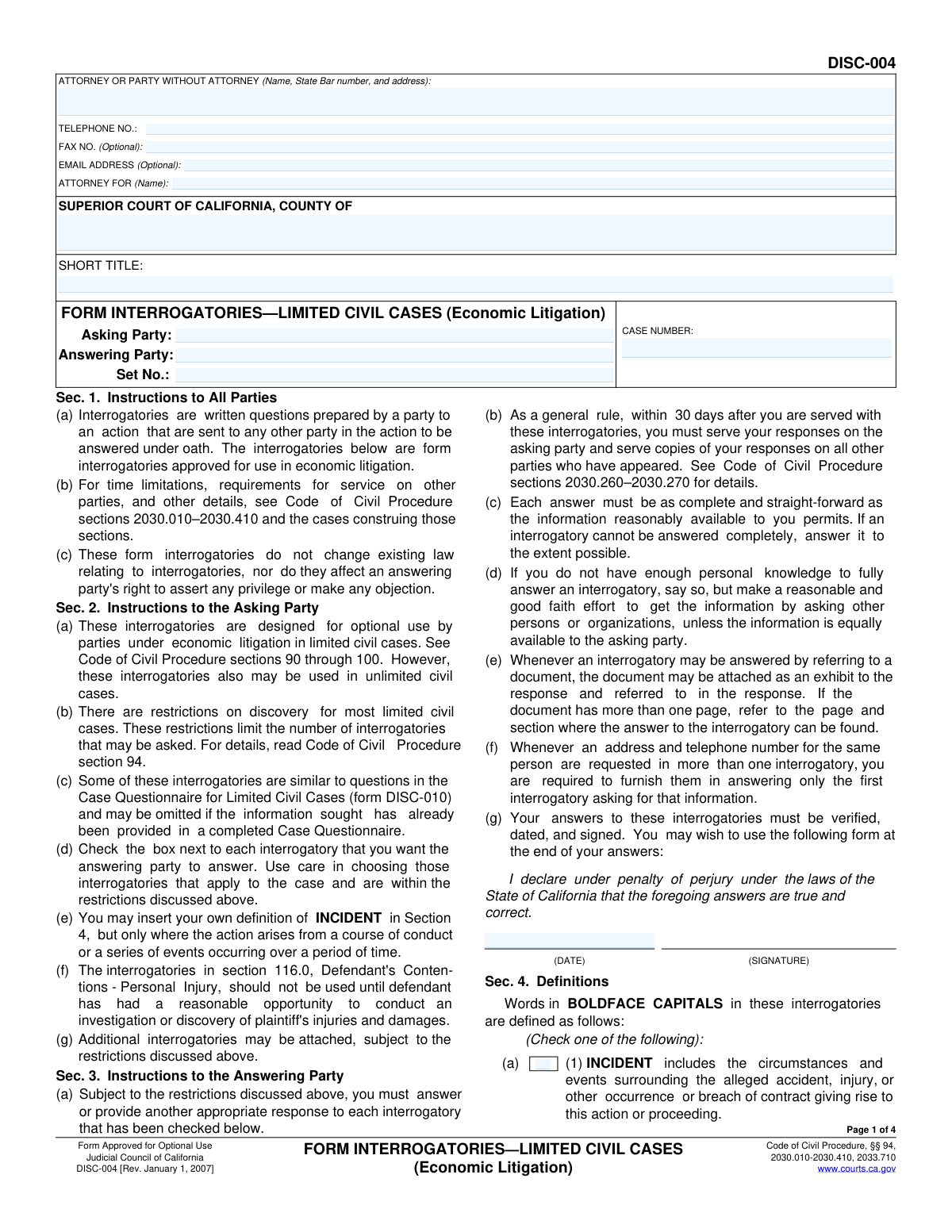
Yes! You can use AI to fill out Form DISC-004, Form Interrogatories—Limited Civil Cases (Economic Litigation)
Form DISC-004, Form Interrogatories—Limited Civil Cases (Economic Litigation), is a standard set of written questions approved by the Judicial Council of California for use in the discovery phase of limited civil lawsuits. These interrogatories are crucial for parties to exchange information under oath regarding the facts, claims, defenses, and damages involved in the case. Answering these questions thoroughly is a mandatory part of litigation, and today this form can be filled out quickly and accurately using AI-powered services like Instafill.ai, which can also convert non-fillable PDF versions into interactive fillable forms.
DISC-004 is part of the
California court forms, civil court forms and civil litigation forms categories on Instafill.
Our AI automatically handles information lookup, data retrieval, formatting, and form filling.
It takes less than a minute to fill out DISC-004 using our AI form filling.
Securely upload your data. Information is encrypted in transit and deleted immediately after the form is filled out.
Form specifications
| Form name: | Form DISC-004, Form Interrogatories—Limited Civil Cases (Economic Litigation) |
| Number of fields: | 96 |
| Number of pages: | 1 |
| Language: | English |
Instafill Demo: How to fill out PDF forms in seconds with AI
How to Fill Out DISC-004 Online for Free in 2026
Are you looking to fill out a DISC-004 form online quickly and accurately? Instafill.ai offers the #1 AI-powered PDF filling software of 2026, allowing you to complete your DISC-004 form in just 37 seconds or less.
Follow these steps to fill out your DISC-004 form online using Instafill.ai:
- 1 Navigate to Instafill.ai and upload the DISC-004 form or select it from the template library.
- 2 Use the AI assistant to populate initial case details like the court name, case number, and party information into the header.
- 3 As the asking party, check the boxes for the questions you want answered. As the answering party, provide responses only for the checked questions.
- 4 Fill in your detailed, sworn answers to each selected interrogatory using the interactive fields, referencing the form's definitions for capitalized terms.
- 5 Gather and reference any necessary documents, such as medical records or contracts, to provide complete and accurate answers.
- 6 Carefully review all your answers for accuracy and completeness before proceeding to the final step.
- 7 Electronically sign the verification declaration under penalty of perjury, then download the completed form to serve it on the opposing party as required by court rules.
Our AI-powered system ensures each field is filled out correctly, reducing errors and saving you time.
Why Choose Instafill.ai for Your Fillable DISC-004 Form?
Speed
Complete your DISC-004 in as little as 37 seconds.
Up-to-Date
Always use the latest 2026 DISC-004 form version.
Cost-effective
No need to hire expensive lawyers.
Accuracy
Our AI performs 10 compliance checks to ensure your form is error-free.
Security
Your personal information is protected with bank-level encryption.
Frequently Asked Questions About Form DISC-004
This form, known as Form Interrogatories, is a list of standard written questions that one party in a limited civil lawsuit sends to another party to gather information about the case under oath.
The 'Asking Party' is the person who sends the form and checks the boxes for the questions they want answered. The 'Answering Party' is the person who receives the form and must provide sworn answers to the checked questions.
No, you only need to provide answers for the interrogatories that have a checked box next to them. The Asking Party chooses which questions are relevant to the case.
As a general rule, you must serve your completed and signed responses on the asking party within 30 days after you were served with these interrogatories.
If you don't have enough personal knowledge to answer, you must say so. However, you are required to make a reasonable and good-faith effort to get the information from other people or organizations, unless it's equally available to the asking party.
Yes, if a question can be answered by referring to a document, you may attach it as an exhibit. You must refer to the specific page and section where the answer can be found in your response.
Yes, for most limited civil cases, there are restrictions on the amount of discovery, including the number of interrogatories that can be asked. You should refer to California Code of Civil Procedure section 94 for details.
Yes, your final answers must be verified. This means you must sign and date a declaration under penalty of perjury, stating that your answers are true and correct.
This section asks for personal details like your name and address, date of birth, driver's license information, residence and employment history for the last five years, and any felony convictions.
If you have a flat or non-fillable PDF, you can use a service like Instafill.ai. It can convert the document into an interactive, fillable form that you can easily complete online.
Yes, AI-powered services like Instafill.ai can help you fill out this form. They can auto-fill case information and other fields accurately, saving you time and helping to prevent errors.
To fill this form out online, you can upload it to a platform like Instafill.ai. Their system allows you to easily enter your information into the fields, check the necessary boxes, and then download the completed document.
They can cover similar information, and the instructions state that some interrogatories may be omitted if the information has already been provided in a completed Case Questionnaire.
Compliance DISC-004
Validation Checks by Instafill.ai
1
Case Number Format Validation
This check ensures that the 'CASE NUMBER' field adheres to the specific format required by the California court system. Court case numbers follow a standardized pattern that can include letters, numbers, and hyphens, which helps in uniquely identifying a case. If the entered number does not match the expected format, the system should flag it as an error to prevent filing rejections and ensure the document is correctly associated with the legal case.
2
State Bar Number Validation
This validation verifies that the 'State Bar number' provided in the 'ATTORNEY OR PARTY WITHOUT ATTORNEY' section is a valid number. California State Bar numbers are unique numerical identifiers assigned to licensed attorneys. This check is crucial for verifying the attorney's credentials and ensuring they are in good standing, which is essential for legal correspondence. An invalid number could indicate a typo or an unauthorized person attempting to file legal documents.
3
Exclusive INCIDENT Definition Selection
This check validates that in Section 4(a), only one of the two checkboxes for defining 'INCIDENT' is selected. The form provides a standard definition and an option for a custom definition, but they are mutually exclusive. Allowing both to be checked would create ambiguity in the legal record regarding the scope of the interrogatories. If both or neither are checked, the form submission should be blocked until the user selects exactly one option.
4
Conditional Custom INCIDENT Definition
This validation ensures that if the checkbox for a custom 'INCIDENT' definition (Sec. 4(a)(2)) is selected, the corresponding text field for the definition is not empty. It is a logical error to indicate a custom definition will be used without actually providing one. This check prevents incomplete or ambiguous submissions, forcing the user to provide the necessary text if they choose the custom option.
5
Party Identification Completeness
This check ensures that the 'Asking Party' and 'Answering Party' fields are both filled out. These fields are fundamental to the document's purpose, identifying the sender and the intended recipient of the interrogatories. Without this information, the document is legally meaningless and cannot be processed or enforced. The system should prevent submission if either of these critical fields is left blank.
6
Set Number Integrity
This validation confirms that the 'Set No.' field contains a positive integer. In legal discovery, parties may send multiple sets of interrogatories, and the set number is used to track them sequentially. This check ensures proper record-keeping and avoids confusion when referencing different sets of questions. An entry that is not a positive number (e.g., zero, a negative number, or text) should be rejected.
7
Date of Birth is in the Past
This check validates that the date of birth entered in response to question 102.2 is a valid date that occurs before the current date. A future or invalid date of birth is a logical impossibility and indicates a data entry error. This is important for establishing the identity and age of the individual, which can be relevant to the case. The system should reject any future dates or non-date entries.
8
Telephone Number Format
This validation ensures that the 'TELEPHONE NO.' and any other phone number fields on the form follow a standard U.S. phone number format (e.g., 10 digits, possibly with parentheses, spaces, or hyphens). Correctly formatted phone numbers are essential for ensuring that parties and attorneys can be reached regarding the case. An improperly formatted number could lead to communication breakdowns, so the system should prompt the user to correct it.
9
County Name Validation
This check verifies that the 'COUNTY OF' field contains the name of a valid California county. Filing a legal document in the wrong county can lead to significant delays, dismissal, or jurisdictional challenges. The validation should compare the entry against a predefined list of California's 58 counties to prevent misspellings or incorrect entries, ensuring the document is directed to the proper court.
10
Logical Date Sequence for Employment History
For question 102.5, which asks for employment history, this validation checks that for each job listed, the start date is before the end date. An end date that precedes a start date is a logical impossibility and indicates a data entry error. This ensures the timeline of the answering party's employment is accurate and coherent, which can be important for claims involving loss of income or earning capacity.
11
Previous Claim Date Range Check
This validation applies to the answer for question 111.1, which asks for personal injury claims made 'within the past ten years'. The check ensures that any dates provided in the response fall within this 10-year window from the date of submission. This prevents the inclusion of irrelevant, older claims and ensures the answer is responsive to the specific time frame requested in the interrogatory. Dates outside this range should be flagged for review.
12
Interrogatory Selection Requirement
This check ensures that the 'Asking Party' has selected at least one interrogatory checkbox (from 101.0 through 170.0) before the form can be considered complete. Sending a form with no questions checked is pointless and would be an invalid service of discovery. This validation prevents the submission of an empty request, ensuring the document has a purpose and is ready for the answering party.
Common Mistakes in Completing DISC-004
Parties often forget to fill out the entire caption at the top of the first page, omitting the Case Number, the correct court name, or the full names of the asking and answering parties. This happens due to oversight when rushing to complete the substance of the form. An incomplete or incorrect caption can lead to the document being rejected by the court clerk or causing confusion and delays in the legal process. To avoid this, double-check every field in the header before proceeding to the questions.
The answering party must sign a statement at the end of their answers declaring under penalty of perjury that the information is true and correct, as stated in Instruction 3(g). Forgetting this signature is a critical error that renders the entire set of responses invalid. The asking party can then file a motion to compel proper responses, causing delays and potential monetary sanctions. Always attach a separate, signed verification page to your final answers.
Instruction 3(d) requires the answering party to make a 'reasonable and good faith effort' to obtain information they don't personally know, unless it's equally available to the asking party. Many people mistakenly answer 'I don't know' without first checking with their employees, agents, or reviewing their own records. This is an improper response and can lead to legal challenges, as it fails to meet the discovery obligation. Before answering, you must actively seek out information within your control.
The form defines key terms like 'INCIDENT', 'YOU OR ANYONE ACTING ON YOUR BEHALF', and 'DOCUMENT' in Section 4. A common mistake is to answer questions without reading these definitions, leading to incomplete responses. For example, a question using 'YOU' requires information from your agents, attorneys, and insurance companies, not just yourself. This can result in evasive answers and motions to compel. Carefully review Section 4 before you begin answering any questions.
Interrogatories 102.4 and 102.5 specifically request residence and employment history for the 'last five years,' including dates. People frequently provide only their current information or an incomplete list, which constitutes an insufficient answer. This can damage credibility and lead to further, more detailed discovery requests from the opposing party. To avoid this, gather all relevant addresses, employer names, and date ranges for the full five-year period before you start filling out the form.
Interrogatory 104.1 asks for every insurance policy that may cover the damages. A frequent error is to list only the primary auto or home policy while omitting other potential coverage, such as an umbrella policy or a policy from an employer. This is a serious omission, as identifying insurance coverage is a primary goal of discovery. Failing to disclose all policies can lead to significant legal penalties if discovered later. Review all potential sources of coverage before answering.
Interrogatories 108.2 and 108.4 require you to 'show how you compute' your lost earnings. A common mistake is to simply state a total dollar amount without providing the underlying math (e.g., hours missed multiplied by the hourly wage). This is a non-responsive answer and will likely draw an objection and a demand for a more complete response. Always break down the calculation clearly to justify the total amount claimed.
When asked to state the facts supporting a claim or defense (e.g., Interrogatory 115.1), parties often provide a legal conclusion like 'The plaintiff was negligent.' This is incorrect; the form requires the specific facts that support that conclusion, such as 'The plaintiff was traveling 20 mph over the speed limit and did not stop at the stop sign.' Providing only conclusions is evasive and will require you to amend your answers later. Focus on describing what happened, not the legal label for it.
Instruction 3(e) allows you to answer an interrogatory by referring to a document, but it requires you to specify the page and section where the answer can be found. A common error is to write 'See attached medical records' and attach a hundred-page file, which is improper. This forces the other party to hunt for the information and can result in a motion to compel a more specific answer. If you reference a document, you must provide a pinpoint citation to the exact location of the answer.
Interrogatory 110.1 asks about any other injuries involving the 'same part of your body claimed to have been injured in the INCIDENT.' People sometimes omit prior or subsequent injuries, either by accident or intentionally, hoping to strengthen their case. This is a critical mistake that can destroy a party's credibility if uncovered. It is essential to be completely transparent and list all relevant medical history as requested to avoid accusations of hiding evidence.
Numerous interrogatories require the name, ADDRESS, and telephone number for individuals like witnesses (112.1), health care providers (106.3), and employers (102.5). A frequent error is providing only a name or an incomplete address without a zip code or phone number. This is an incomplete response that hinders the other party's ability to conduct their investigation. To avoid this, ensure you provide the full, correct contact details for every person identified in your answers. AI-powered tools like Instafill.ai can help by auto-completing and validating addresses to prevent such errors.
This mistake is made by the party sending the form. According to Instruction 2(d), the asking party must check the box next to each interrogatory they want answered. Sometimes, a party serves the form without checking any boxes, leaving the answering party unsure of what questions to respond to. This renders the discovery request defective and will require the asking party to re-serve it correctly, wasting time and resources. Since this form is a non-fillable PDF, a tool like Instafill.ai can convert it into an interactive version, making it easier to check the required boxes and avoid this simple but costly error.
Saved over 80 hours a year
“I was never sure if my IRS forms like W-9 were filled correctly. Now, I can complete the forms accurately without any external help.”
Kevin Martin Green
Your data stays secure with advanced protection from Instafill and our subprocessors

Robust compliance program
Transparent business model
You’re not the product. You always know where your data is and what it is processed for.
ISO 27001, HIPAA, and GDPR
Our subprocesses adhere to multiple compliance standards, including but not limited to ISO 27001, HIPAA, and GDPR.
Security & privacy by design
We consider security and privacy from the initial design phase of any new service or functionality. It’s not an afterthought, it’s built-in, including support for two-factor authentication (2FA) to further protect your account.
Fill out DISC-004 with Instafill.ai
Worried about filling PDFs wrong? Instafill securely fills form-disc-004-form-interrogatorieslimited-civil-cases-economic-litigation forms, ensuring each field is accurate.