Yes! You can use AI to fill out Selbstauskunft zur steuerlichen Ansässigkeit (Natürliche Person)

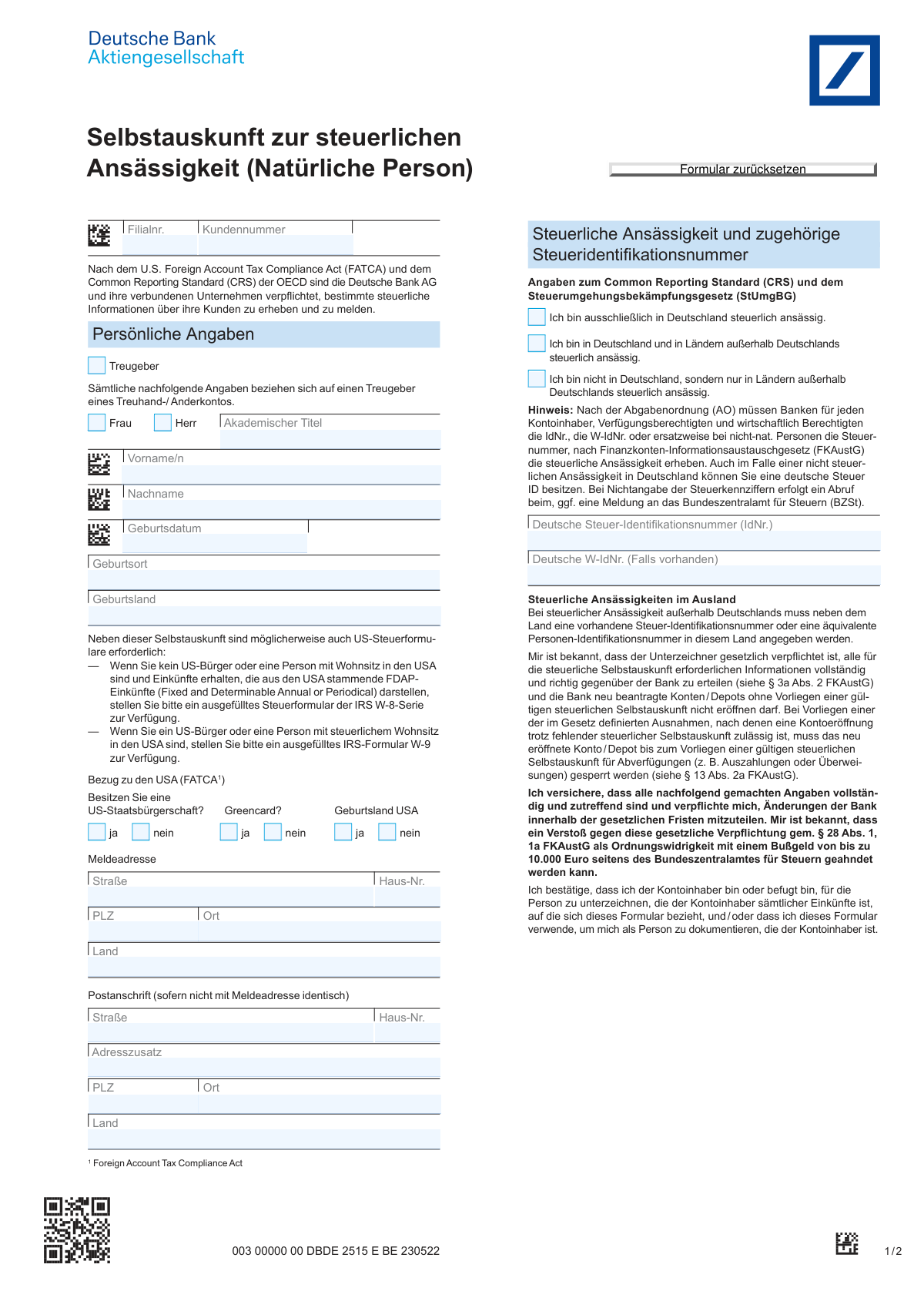
This form, the 'Selbstauskunft zur steuerlichen Ansässigkeit (Natürliche Person)', is a self-certification document used by German financial institutions to collect tax residency information from their clients. It is crucial for complying with international tax regulations like the Common Reporting Standard (CRS) and the Foreign Account Tax Compliance Act (FATCA) to prevent tax evasion. Today, this form can be filled out quickly and accurately using AI-powered services like Instafill.ai, which can also convert non-fillable PDF versions into interactive fillable forms.
Our AI automatically handles information lookup, data retrieval, formatting, and form filling.
It takes less than a minute to fill out Selbstauskunft steuerliche Ansässigkeit using our AI form filling.
Securely upload your data. Information is encrypted in transit and deleted immediately after the form is filled out.

Form specifications

Form name: Selbstauskunft zur steuerlichen Ansässigkeit (Natürliche Person)
Number of fields: 42
Number of pages: 2
Language: English
main-image

Instafill Demo: How to fill out PDF forms in seconds with AI

How to Fill Out Selbstauskunft steuerliche Ansässigkeit Online for Free in 2026

Are you looking to fill out a SELBSTAUSKUNFT STEUERLICHE ANSÄSSIGKEIT form online quickly and accurately? Instafill.ai offers the #1 AI-powered PDF filling software of 2026, allowing you to complete your SELBSTAUSKUNFT STEUERLICHE ANSÄSSIGKEIT form in just 37 seconds or less.
Follow these steps to fill out your SELBSTAUSKUNFT STEUERLICHE ANSÄSSIGKEIT form online using Instafill.ai:
  1. 1 Navigate to Instafill.ai and upload or select the 'Selbstauskunft zur steuerlichen Ansässigkeit' form.
  2. 2 Provide your personal information, including your full name, address, and date of birth, in the designated fields.
  3. 3 Declare your tax residency status by selecting whether you are a tax resident exclusively in Germany, in Germany and abroad, or only outside of Germany.
  4. 4 Enter your German Tax Identification Number (IdNr.) and the Tax Identification Numbers (TINs) for any other countries where you are a tax resident.
  5. 5 Complete the section regarding your U.S. status (FATCA) by indicating if you are a U.S. citizen, hold a Greencard, or were born in the USA.
  6. 6 Carefully review all the information you have entered to ensure it is complete and accurate before finalizing.
  7. 7 Electronically sign and date the form to certify the correctness of your self-declaration.

Our AI-powered system ensures each field is filled out correctly, reducing errors and saving you time.

Why Choose Instafill.ai for Your Fillable Selbstauskunft steuerliche Ansässigkeit Form?

Speed

Complete your Selbstauskunft steuerliche Ansässigkeit in as little as 37 seconds.

Up-to-Date

Always use the latest 2026 Selbstauskunft steuerliche Ansässigkeit form version.

Cost-effective

No need to hire expensive lawyers.

Accuracy

Our AI performs 10 compliance checks to ensure your form is error-free.

Security

Your personal information is protected with bank-level encryption.

Frequently Asked Questions About Form Selbstauskunft steuerliche Ansässigkeit

This form is a self-declaration used by banks to determine your tax residency status for legal compliance. It is required under international agreements like the Common Reporting Standard (CRS) and FATCA to prevent tax evasion.

This form must be completed by any individual ('Natürliche Person') who is opening or holding a bank account, including account holders, authorized signatories, and beneficial owners.

The IdNr. is a unique 11-digit tax identification number assigned to every resident in Germany. You can find it on official letters from the Federal Central Tax Office (Bundeszentralamt für Steuern) or on your income tax assessment.

Select the option 'Ich bin in Deutschland und in Ländern außerhalb Deutschlands steuerlich ansässig'. Then, provide your German Tax ID and list each additional country of tax residency along with its corresponding Tax Identification Number (TIN).

The form allows you to provide a reason if you cannot supply a TIN. For example, select 'Grund A' if the country doesn't issue TINs, or 'Grund B' if you are unable to obtain one for other reasons, which you must then explain.

This information is required by the U.S. Foreign Account Tax Compliance Act (FATCA). Banks are legally obligated to identify customers with US connections and report their account information to the tax authorities.

Failure to provide a valid self-declaration can prevent the bank from opening a new account. It could also lead to your account being blocked for withdrawals and transfers, and you may face a fine of up to €10,000.

You are legally required to inform the bank of any changes to your personal or tax residency details. You must submit a new, updated self-declaration form as soon as possible.

The 'Treugeber' (settlor/grantor) checkbox should only be ticked if the personal details you are providing are for the settlor of a trust account ('Treuhandkonto'). For a standard personal account, you can leave this box unchecked.

The 'W-IdNr.' (Wirtschafts-Identifikationsnummer) is a tax ID for economically active persons like freelancers or business owners. Most individuals only have the standard 'IdNr.' and can leave the 'W-IdNr.' field blank unless one has been specifically assigned to them.

Yes, services like Instafill.ai use AI to accurately auto-fill form fields from your saved profile, which can save you time and help avoid errors. This is especially useful for recurring information like your name, address, and tax numbers.

Simply upload the form to the Instafill.ai platform. The AI will identify the fields, allowing you to fill them out interactively, use your saved profile to auto-fill information, and then download the completed, ready-to-submit PDF.

You can use a service like Instafill.ai, which can convert flat, non-fillable PDFs into interactive, fillable forms. After uploading, the tool makes the fields clickable and typable, allowing you to complete the document digitally.

Compliance Selbstauskunft steuerliche Ansässigkeit
Validation Checks by Instafill.ai

1
Exclusive Tax Residency Status Selection
This check ensures that the user has selected exactly one of the three available tax residency options: 'ausschließlich in Deutschland', 'in Deutschland und in Ländern außerhalb Deutschlands', or 'nicht in Deutschland, sondern nur in Ländern außerhalb Deutschlands'. This selection is fundamental for determining the subsequent reporting obligations under CRS and FATCA. Failure to select one and only one option makes the form logically incomplete and prevents correct processing.
2
Conditional Requirement of German Tax ID
Validates that the 'Deutsche Steuer-Identifikationsnummer (IdNr.)' field is filled if the user declares tax residency in Germany (either exclusively or in addition to other countries). The German Tax ID is a mandatory piece of information for reporting to the German tax authorities (BZSt) under FKAustG. If this field is missing when required, the submission is incomplete and cannot be processed for account opening or maintenance.
3
German Tax ID (IdNr.) Format Validation
This check verifies that the provided German Tax ID ('IdNr.') conforms to the official 11-digit format. This includes checking for the correct length and potentially applying the checksum algorithm to ensure the number is structurally valid. An invalid ID number leads to rejection by the tax authorities and reporting failures, so it's crucial for data quality and compliance.
4
Conditional Requirement of Foreign Tax Residency Details
Ensures that if a user indicates tax residency outside of Germany (options 2 or 3), they must provide details for at least one foreign tax residency. The form cannot be submitted with a claim of foreign residency but no corresponding country or TIN information. This is a core requirement of the Common Reporting Standard (CRS) to identify and report on foreign accounts.
5
Completeness of Foreign Tax Residency Entry
For each foreign tax residency listed, this validation confirms that both the country ('Land') and a Tax Identification Number ('TIN') are provided. If a TIN is not available, one of the specified reasons (A, B, or C) must be selected instead. An entry with a country but no TIN or reason, or vice-versa, is considered incomplete and must be corrected before submission.
6
Date of Birth Format and Plausibility
This validation checks that the 'Geburtsdatum' (Date of Birth) is entered in a valid format (e.g., DD.MM.YYYY) and represents a plausible date. It ensures the date is in the past and that the individual is of a reasonable age to be opening a bank account (e.g., over 18). This prevents data entry errors and confirms the identity of the account holder.
7
Completeness of Personal Identification Data
Verifies that all mandatory personal information fields, including 'Vorname(n)', 'Nachname', 'Geburtsdatum', 'Geburtsort', and 'Geburtsland', are filled out. This information is essential for uniquely identifying the customer as required by anti-money laundering (AML) and tax laws. An incomplete personal data section will prevent the bank from legally opening or maintaining the account.
8
FATCA Indicator Question Completeness
This check ensures that for each of the three FATCA-related questions (US-Staatsbürgerschaft, Greencard, Geburtsland USA), a 'ja' or 'nein' option has been selected. Leaving any of these questions unanswered creates ambiguity regarding the person's US status, which is a critical compliance point for FATCA reporting. The form is considered incomplete if any of these binary questions are not answered.
9
Logical Consistency of Birth Country and FATCA
This validation cross-references the 'Geburtsland' field with the FATCA question 'Geburtsland USA'. If the user enters 'USA', 'United States', 'Vereinigte Staaten', or a similar variation in the 'Geburtsland' field, the check ensures that the 'Geburtsland USA' question is answered with 'ja'. This logical check helps prevent contradictory information and ensures accurate FATCA classification.
10
Completeness of Registered Address
Ensures that all components of the 'Meldeadresse' (registered address) are provided, including 'Straße', 'Haus-Nr.', 'PLZ', 'Ort', and 'Land'. A complete and valid address is a legal requirement for customer identification and is necessary for all official correspondence. Missing address components would render the customer record incomplete.
11
Signature Date Validity
This check validates that the 'Datum' field in the signature section contains a valid date that is not in the future or unreasonably far in the past. The signature date legally attests to when the self-declaration was made and its information was current. An invalid or implausible date can call the validity of the entire document into question.
12
CBI/RBI Special Condition Check
This validation identifies a specific high-risk scenario outlined in the form's notes. It checks if a user is tax resident in a 'Citizenship/Residence by Investment' (CBI/RBI) country (e.g., Malta, UAE, Cyprus) but was not born there (i.e., 'Geburtsland' is different). If this condition is met, the system flags that an additional due diligence form ('Erweiterte Sorgfaltspflichtprüfung CBI/RBI') is required, which is a critical step for OECD compliance.

Common Mistakes in Completing Selbstauskunft steuerliche Ansässigkeit

Incorrectly Determining Tax Residency Status

Many individuals misunderstand the legal definition of tax residency, which is often based on factors like physical presence (the 183-day rule) or one's center of vital interests, not just citizenship. This leads to selecting the wrong option (e.g., 'Germany only' when foreign ties create a dual residency). Incorrect declarations can result in improper tax reporting by the bank, leading to inquiries from tax authorities and potential penalties.

Confusing the German Tax ID (IdNr.) with the Tax Number (Steuernummer)

A frequent error is entering the local tax office's 'Steuernummer' instead of the permanent 11-digit 'Steuer-Identifikationsnummer (IdNr.)'. The 'IdNr.' is issued once by the Federal Central Tax Office (BZSt) and remains for life, whereas the 'Steuernummer' can change. Using the wrong number causes data mismatches and processing delays, as the bank must then request the correct IdNr. from the authorities. Always use the IdNr. found on official BZSt correspondence or your income tax assessment.

Omitting or Providing Incorrect Foreign Tax Identification Numbers (TINs)

When declaring tax residency outside of Germany, applicants often leave the TIN field blank or enter an incorrect number because they don't know what their TIN is called in that specific country (e.g., SSN, SIN, NIF). This renders the form incomplete and is a primary reason for rejection or delays in account opening, as CRS regulations require the TIN. You should consult the OECD's TIN portal or your foreign tax documents to find the correct number and format; AI-powered tools like Instafill.ai can also help validate known TIN formats for different countries.

Failing to Justify a Missing Foreign TIN

If a foreign TIN is not provided, the form requires a specific reason (A, B, or C) to be selected. A common mistake is to simply leave the TIN field blank without choosing a reason, which leads to an automatic rejection of the form. Another error is choosing an invalid reason, such as claiming the country doesn't issue TINs when it does. This causes significant delays as the bank must return the form for correction.

Providing Contradictory Information Regarding US Connections (FATCA)

Applicants often create contradictions, for example, by indicating they are not a US citizen but also stating their country of birth is the USA. Such inconsistencies immediately flag the account for enhanced scrutiny under FATCA rules. This happens because people, especially 'accidental Americans' who were born in the US but never lived there, may not realize they are considered US Persons for tax purposes, which can significantly delay account opening.

Incomplete or Inaccurate Personal Name Entry

Applicants sometimes enter only one of their first names, use a nickname, or omit a middle name that appears on their official ID. This creates a mismatch between the form and the identification documents (e.g., passport) used for verification. As a result, the bank's compliance process fails, and the application is delayed until the information is corrected to match the legal documents exactly. Always enter your full name(s) precisely as they appear on your government-issued ID.

Incorrectly Filling Out the Address Sections

A common error is to leave the 'Postanschrift' (mailing address) section blank when it differs from the 'Meldeadresse' (registered address), such as when using a P.O. Box. These mistakes can lead to important tax documents or bank correspondence being sent to the wrong place. The 'Meldeadresse' must be your official registered residence, and 'Postanschrift' should only be used for a different mailing address.

Forgetting to Sign and Date the Form

It is a simple but surprisingly common oversight to submit the form without a signature, date, and place of signature. A form without these elements is legally invalid and cannot be processed by the bank. This results in the immediate rejection of the submission, forcing the applicant to complete and resubmit the document, thereby delaying the entire process. Always perform a final check of the last page to ensure the signature block is fully completed.

Overlooking the Special Requirement for CBI/RBI Schemes

The form has a specific note about individuals who are tax residents in certain countries (e.g., Malta, UAE, Cyprus) through 'Citizenship/Residence by Investment' (CBI/RBI) programs. A critical mistake is failing to obtain and submit the required supplementary form, 'Erweiterte Sorgfaltspflichtprüfung CBI/RBI'. This oversight will halt the application, as banks are required to perform enhanced due diligence on such individuals. If you have residency in a listed country and were not born there, you must proactively request this additional form from the bank.

Entering an Incorrect Date of Birth Format

Individuals, particularly those from countries using the MM/DD/YYYY format, often enter their birth date incorrectly on German forms, which expect DD.MM.YYYY. This seemingly small data entry error can cause validation failures in the bank's system or lead to an incorrect age calculation, requiring manual correction. Using an AI-powered form-filling tool like Instafill.ai can help prevent this by automatically formatting the date correctly based on the form's regional standards, especially if the form is a non-fillable PDF which the tool can convert.
Saved over 80 hours a year

“I was never sure if my IRS forms like W-9 were filled correctly. Now, I can complete the forms accurately without any external help.”

Kevin Martin Green

Your data stays secure with advanced protection from Instafill and our subprocessors

Robust compliance program

Transparent business model

You’re not the product. You always know where your data is and what it is processed for.

ISO 27001, HIPAA, and GDPR

Our subprocesses adhere to multiple compliance standards, including but not limited to ISO 27001, HIPAA, and GDPR.

Security & privacy by design

We consider security and privacy from the initial design phase of any new service or functionality. It’s not an afterthought, it’s built-in, including support for two-factor authentication (2FA) to further protect your account.

Fill out Selbstauskunft steuerliche Ansässigkeit with Instafill.ai

Worried about filling PDFs wrong? Instafill securely fills selbstauskunft-zur-steuerlichen-ansssigkeit-natrliche-person forms, ensuring each field is accurate.