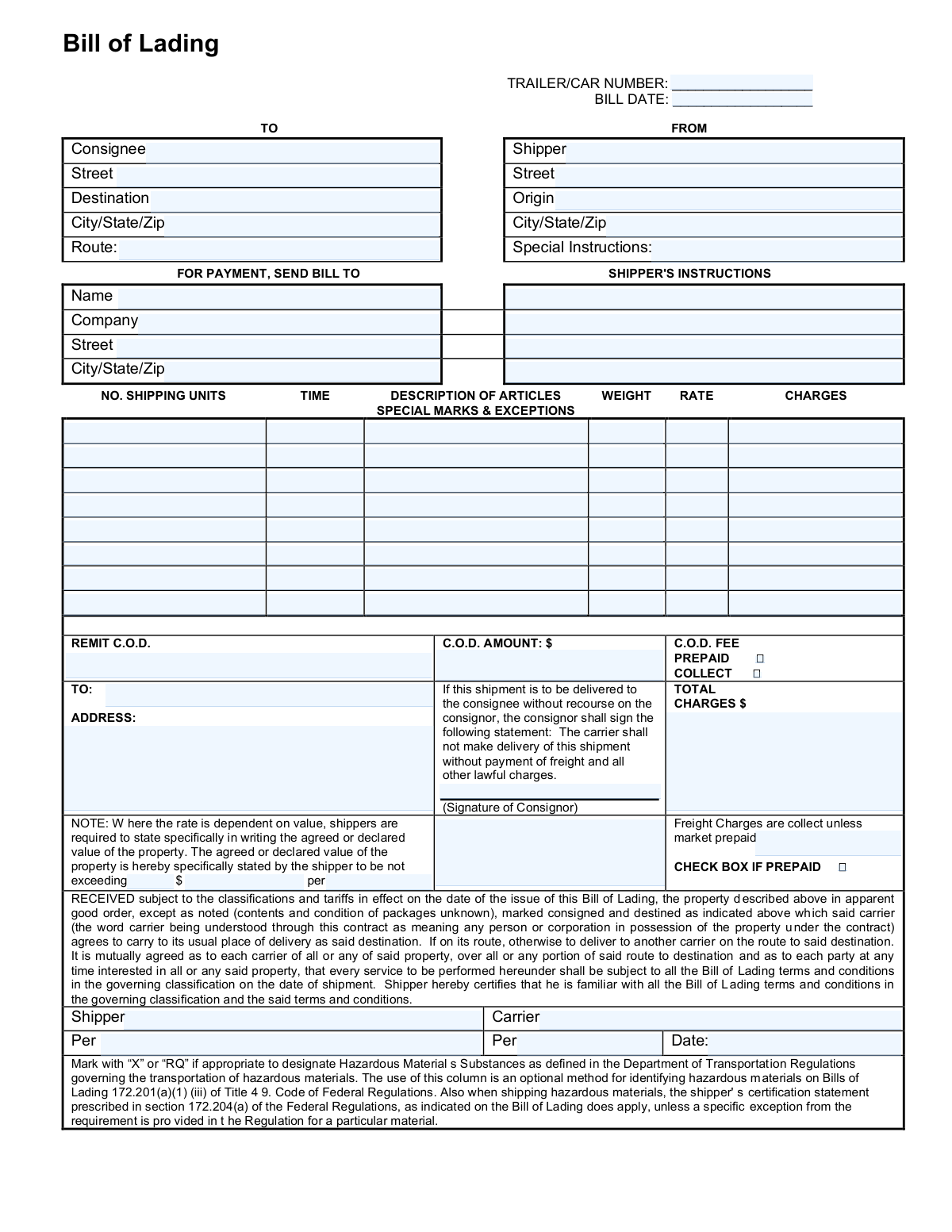
Yes! You can use AI to fill out Uniform Straight Bill of Lading

A Uniform Straight Bill of Lading is a non-negotiable legal document that serves as a contract between a shipper and a carrier for the transportation of goods. It is crucial for logistics as it provides a detailed receipt of the shipment, outlining the type, quantity, and destination of the items being moved, which is vital for ensuring clear communication and legal protection for all parties. Today, this form can be filled out quickly and accurately using AI-powered services like Instafill.ai, which can also convert non-fillable PDF versions into interactive fillable forms.
Our AI automatically handles information lookup, data retrieval, formatting, and form filling.
It takes less than a minute to fill out Bill of Lading using our AI form filling.
Securely upload your data. Information is encrypted in transit and deleted immediately after the form is filled out.

Form specifications

Form name: Uniform Straight Bill of Lading
Number of fields: 87
Number of pages: 1
Filled form examples: Form Bill of Lading Examples
Language: English
main-image

Instafill Demo: How to fill out PDF forms in seconds with AI

How to Fill Out Bill of Lading Online for Free in 2026

Are you looking to fill out a BILL OF LADING form online quickly and accurately? Instafill.ai offers the #1 AI-powered PDF filling software of 2026, allowing you to complete your BILL OF LADING form in just 37 seconds or less.
Follow these steps to fill out your BILL OF LADING form online using Instafill.ai:
  1. 1 Navigate to Instafill.ai and upload or select the Uniform Straight Bill of Lading form.
  2. 2 Enter the complete shipper (origin) and consignee (destination) information, including names, street addresses, city, state, and zip codes.
  3. 3 Provide shipment identification details such as the trailer/car number, bill date, and any specific routing instructions.
  4. 4 Carefully list each shipping item, detailing the number of units, a full description of the articles, weight, rate, and associated charges.
  5. 5 Specify the payment terms, including freight charge payment method (prepaid or collect) and any C.O.D. (Cash on Delivery) amount and remittance details.
  6. 6 If applicable, enter the declared value of the shipment and any special instructions for the carrier.
  7. 7 Review all entered information for accuracy, then have the authorized shipper and carrier representatives sign and date the document to execute the contract.

Our AI-powered system ensures each field is filled out correctly, reducing errors and saving you time.

Why Choose Instafill.ai for Your Fillable Bill of Lading Form?

Speed

Complete your Bill of Lading in as little as 37 seconds.

Up-to-Date

Always use the latest 2026 Bill of Lading form version.

Cost-effective

No need to hire expensive lawyers.

Accuracy

Our AI performs 10 compliance checks to ensure your form is error-free.

Security

Your personal information is protected with bank-level encryption.

Frequently Asked Questions About Form Bill of Lading

This form is a bill of lading, which serves as a contract between the shipper and carrier, a receipt for the goods, and a document of title for the shipment. It outlines the details of the goods being transported, their origin, and their destination.

The 'Shipper' is the person or company sending the goods. The 'Consignee' is the person or company scheduled to receive the goods at the final destination.

This form accommodates up to eight distinct items. If your shipment has more, you will need to use an additional form or attach a separate manifest, ensuring it is clearly referenced on the original bill of lading.

Only complete the C.O.D. section if you require payment for the goods to be collected upon delivery. If it is not a C.O.D. shipment, you can leave the 'COD Amount' and related fields blank.

The 'Declared Value' section is used to state the monetary value of the goods being shipped. This value is used to determine the carrier's liability limit for loss or damage and may affect insurance and freight charges.

Signing this indicates that the carrier cannot hold the shipper (consignor) responsible for freight charges if the consignee refuses to pay. If left unsigned, the shipper remains liable for unpaid charges.

Checking 'Prepaid' means the shipper has paid the C.O.D. service fee in advance. Checking 'Collect' means the fee will be collected from the consignee upon delivery, along with the C.O.D. amount for the goods.

In this field, you should provide a detailed description of the items, including what they are, how they are packaged (e.g., cartons, pallets), and any special identifying marks or numbers.

The shipper or their agent signs in the 'Shipper Signature' section. The carrier's representative signs in the 'Carrier Signature' section to acknowledge receipt of the goods.

Yes, services like Instafill.ai use AI to help you fill out forms like this one accurately and efficiently. These tools can auto-fill saved information, reducing manual data entry and saving you time.

You can easily complete this form online by uploading it to a platform like Instafill.ai. The service will make the form's fields interactive, allowing you to type in your information, save, and print or share the completed document.

If you have a non-fillable or 'flat' PDF, you can use a service like Instafill.ai to instantly convert it into an interactive, fillable form. This allows you to easily type your information into the correct fields directly on your computer.

Compliance Bill of Lading
Validation Checks by Instafill.ai

1
Validates Bill Date Format and Recency
This check ensures the 'Bill Date' is in a valid date format (e.g., MM/DD/YYYY) and is not a future date. A valid bill date is crucial for establishing the correct timeline for the shipment contract and for auditing purposes. If the date is invalid or in the future, the form submission will be rejected, prompting the user to enter a correct and logical date.
2
Ensures Signature Date is After Bill Date
This validation compares the 'Signature Date' with the 'Bill Date' to confirm the signature was applied on or after the bill was issued. This logical sequence is essential for the legal validity of the bill of lading, as it signifies agreement to terms that existed at the time of signing. A failure would indicate a data entry error and require correction before the document can be finalized.
3
Shipper Information Completeness
This check verifies that the 'Shipper Name', 'Shipper Street', and 'Origin City, State, Zip' fields are all filled out. Complete shipper information is mandatory for identifying the origin of the shipment and the responsible party. An incomplete shipper profile can lead to logistical delays, billing errors, and legal complications, so the submission will be blocked until all required fields are provided.
4
Consignee Information Completeness
This validation ensures that the 'Consignee Name', 'Consignee Street', and 'Consignee City, State, Zip' fields are not empty. The consignee is the intended recipient, and their full address is critical for successful delivery and communication. Missing consignee details will prevent the form from being processed to avoid misdirected or lost shipments.
5
Validates Zip Code Format for Shipper and Consignee
This check confirms that the zip codes provided in 'Origin City, State, Zip' and 'Consignee City, State, Zip' adhere to a standard format (e.g., 5-digit or ZIP+4). Correctly formatted zip codes are essential for automated sorting, routing, and accurate postage calculation by carriers. An invalid format will trigger an error, requiring the user to correct the entry to ensure deliverability.
6
Shipping Item Row Integrity
For each of the eight possible shipping items, this rule checks that if any field in a row is filled (e.g., 'Description'), then 'Number of Shipping Units' and 'Weight' must also be filled. This ensures that every listed item has the minimum required data for processing, pricing, and inventory. Incomplete item lines will be flagged, preventing submission until the necessary details are supplied.
7
Total Charges Calculation Consistency
This validation verifies that the 'Total Charges Amount' accurately reflects the sum of the 'Charges' fields from all individual shipping items. This cross-check is vital for preventing billing errors and ensuring financial accuracy on the document. If the total does not match the sum of its parts, an alert is raised, indicating a potential miscalculation or data entry mistake that needs review.
8
Conditional Requirement for C.O.D. Information
This check enforces that if the 'COD Amount' field contains a value greater than zero, then the 'Remit COD To' and 'Remittance Address' fields must be completed. This is critical to ensure the collected funds can be correctly and promptly sent to the appropriate party. Failure to provide remittance details for a C.O.D. shipment will block the submission to prevent financial loss or disputes.
9
Mutually Exclusive C.O.D. Fee Payment Method
This validation ensures that if a 'COD Amount' is specified, only one of the two C.O.D. fee payment options, 'Prepaid' or 'Collect', can be selected. The fee can either be paid by the shipper or the consignee, but not both, so selecting both is a logical contradiction. The form will return an error if both or neither are selected for a C.O.D. shipment, forcing a clear choice.
10
Declared Value Context Requirement
This rule ensures that if a 'Declared Value Amount' is entered, the corresponding 'Unit of Measure' field (e.g., 'pound', 'item') must also be filled. The unit of measure provides essential context to the declared value, which is used for liability and insurance purposes. A submission will fail if a value is declared without a unit, as this ambiguity could lead to significant disputes in case of a claim.
11
Mandatory Shipper and Carrier Signatures
This check verifies that the 'Shipper Signature' and 'Carrier Representative Name' fields are not empty. These signatures transform the document into a legally binding contract for the carriage of goods. Without them, the bill of lading is incomplete and unenforceable, so the system will prevent submission until these critical fields are populated.
12
Numeric Fields Must Be Positive Values
This validation ensures that all numeric entry fields for shipping items, such as 'Number of Shipping Units', 'Weight', 'Rate', and 'Charges', contain positive numerical values. Negative or zero values in these fields are illogical for a shipment and would cause errors in logistics planning and financial calculations. The system will reject entries that do not meet this criterion to maintain data integrity.
13
Distinct Origin and Destination Locations
This check verifies that the 'Origin Location' and 'Destination' fields do not contain the same information. A shipment, by definition, must move from one place to another, so identical origin and destination points indicate a data entry error. This sanity check prevents the creation of illogical shipping orders and prompts the user for correction.
14
Shipping Units Must Be an Integer
This validation ensures that the 'Number of Shipping Units' for every item is a whole number. Shipments are typically handled in discrete units (e.g., pallets, boxes, crates), and fractional units are not physically possible or logistically sound. The form will flag any decimal or non-integer values in this field to ensure accurate and practical shipping instructions.

Common Mistakes in Completing Bill of Lading

Incomplete or Vague Item Descriptions

Users often write generic descriptions like 'goods' or 'pallets' in the 'Description of Articles' fields instead of providing specific details. This happens due to haste or not understanding the need for specificity for freight classification and customs. Vague descriptions can lead to shipping delays, incorrect billing based on freight class, and disputes over lost or damaged items. To avoid this, always list the exact contents, quantity, and type of packaging for each item being shipped.

Incorrect Address Formatting or Information

Entering incomplete or non-standard addresses for the Shipper or Consignee is a frequent error, including omitting suite numbers, using P.O. Boxes for physical delivery locations, or typos in zip codes. Such errors are a primary cause of delivery delays, returned shipments, and costly re-delivery fees. Always double-check all address components for accuracy and completeness, ensuring it is a valid physical location. AI-powered tools like Instafill.ai can help by validating addresses against a database.

Miscalculating Weights and Charges

The form requires separate entries for weight, rate, and charges for multiple items, plus a 'Total Charges Amount'. Manual calculation often leads to mathematical errors in multiplication or addition. These miscalculations result in billing disputes, payment delays, and require corrected invoices to be issued. To avoid this, use a calculator for all totals and cross-verify the final amount. AI-powered form filling tools can perform these calculations automatically to ensure accuracy.

Mishandling the C.O.D. Section

The 'Cash on Delivery' (C.O.D.) section is frequently filled out incorrectly, often due to misunderstanding its conditional nature. Common mistakes include entering a 'COD Amount' but failing to specify the 'Remittance Address' or payment method (Prepaid/Collect). This can lead to drivers not collecting payment, or funds being sent to the wrong address or delayed. This section should only be completed if the shipment is explicitly C.O.D., and all related fields must be filled accurately.

Confusing Shipper and Consignee Information

It is surprisingly common for users to accidentally switch the 'Shipper' (origin) and 'Consignee' (destination) information. This often happens when filling out the form quickly, causing the shipment to be routed back to the sender or to an incorrect location entirely. This mistake results in significant delays and extra shipping costs. To prevent this, carefully read each field label and verify that origin details are in 'Shipper' sections and destination details are in 'Consignee' sections.

Incorrectly Declaring Value

The 'Declared Value' section is critical for liability but is often misunderstood, leading users to enter the total shipment value instead of the value per unit, or use the wrong 'Unit of Measure'. This mistake can severely limit the carrier's liability in case of loss or damage, potentially leading to significant financial loss for the shipper. It's crucial to understand the carrier's terms and accurately state the value per the specified unit (e.g., per pound) to ensure proper coverage.

Missing Signatures, Dates, or Titles

A Bill of Lading is a legal contract, and missing a signature, date, or title can create legal disputes or render it invalid. Users often forget to fill the 'Shipper Signature', 'Signature Date', or 'Shipper Title' fields, especially on printed copies. An unsigned Bill of Lading can be challenged, potentially voiding its terms and liability limits. If the form is a non-fillable PDF, tools like Instafill.ai can convert it into a fillable version, making it easier to add digital signatures and dates before printing.

Ambiguous Freight Payment Selection

Users frequently mark the wrong option for freight payment (e.g., 'Freight Charges Prepaid') or leave it blank, creating ambiguity about who is responsible for payment. This leads to billing delays and disputes between the shipper, consignee, and carrier, and can hold up the release of the cargo. The payment terms should be clearly agreed upon beforehand and marked correctly on the form to prevent confusion and ensure smooth processing.

Inconsistent Trailer/Car Number

The 'Trailer/Car Number' is the primary identifier for the physical unit carrying the goods, but typos or transpositions are common data entry errors. An incorrect number can cause significant confusion at terminals and warehouses, leading to delays in loading or unloading as staff try to locate the correct trailer. To avoid this, physically verify the number on the trailer against the number entered on the form before the driver departs.

Neglecting Special Instructions

Shippers often have crucial information like 'Liftgate required' or 'Delivery by appointment only' but fail to enter it in the 'Shipper Special Instructions' fields. Omitting these details can result in failed delivery attempts, extra fees for services that were not pre-arranged, and even damaged goods if special handling was required but not noted. All handling and delivery requirements must be explicitly written on the Bill of Lading to be enforceable.
Saved over 80 hours a year

“I was never sure if my IRS forms like W-9 were filled correctly. Now, I can complete the forms accurately without any external help.”

Kevin Martin Green

Your data stays secure with advanced protection from Instafill and our subprocessors

Robust compliance program

Transparent business model

You’re not the product. You always know where your data is and what it is processed for.

ISO 27001, HIPAA, and GDPR

Our subprocesses adhere to multiple compliance standards, including but not limited to ISO 27001, HIPAA, and GDPR.

Security & privacy by design

We consider security and privacy from the initial design phase of any new service or functionality. It’s not an afterthought, it’s built-in, including support for two-factor authentication (2FA) to further protect your account.

Fill out Bill of Lading with Instafill.ai

Worried about filling PDFs wrong? Instafill securely fills uniform-straight-bill-of-lading-1 forms, ensuring each field is accurate.