Fill out Alberta Precision Laboratories forms
with AI.
Alberta Precision Laboratories (APL) forms are essential documents used throughout the Alberta healthcare system to facilitate diagnostic testing and laboratory services. These forms serve as the primary communication tool between healthcare providers and diagnostic facilities, ensuring that specific tests—ranging from routine blood work to complex pathology—are performed correctly and results are routed to the appropriate clinical team. Because these documents are part of a provincial standard, they play a critical role in maintaining patient safety and diagnostic accuracy across both community and hospital settings.
By continuing, you acknowledge Instafill's Privacy Policy and agree to get occasional product update and promotional emails.
About Alberta Precision Laboratories forms
Physicians, nurse practitioners, and administrative staff typically use these forms during patient consultations or when coordinating specialized care. Whether you are managing a General Laboratory Requisition for a routine physical or coordinating more complex diagnostic screenings, having the correct, up-to-date paperwork is vital for avoiding delays at collection sites. For clinical staff, ensuring that patient demographics and provider billing information are entered correctly is paramount to the efficiency of the laboratory workflow.
Completing these detailed requisitions manually can be a significant administrative burden in a fast-paced medical environment. Tools like Instafill.ai use AI to fill these forms in under 30 seconds, handling sensitive data accurately and securely to streamline the documentation process. This modern approach helps reduce the time spent on repetitive data entry, allowing healthcare professionals to focus on patient outcomes rather than manual paperwork.
Every form on this page can be completed without typing. Instafill is form filling software that reads a PDF and fills it for you — including flat and scanned documents that carry no fillable fields at all.
Forms in This Category
The forms in this category have a median Form Complexity Index of 69/100 (Complex), measured across 1 forms by field count, input difficulty, length, conditional logic and structure. See how it is calculated.
| Form Name | Pages | FCI | |
|---|---|---|---|
| 1. | Alberta Precision Laboratories General Laboratory Requisition (Form 21302) | 1 | Complex 69 |
- Enterprise-grade security & data encryption
- 99%+ accuracy powered by AI
- 1,000+ forms from all industries
- Complete forms in under 60 seconds
How to Choose the Right Form
When navigating diagnostic services in Alberta, selecting the correct requisition is the first step toward getting accurate and timely results. While Alberta Precision Laboratories (APL) utilizes various specialized forms for niche testing—such as specific genetics or microbiology documents—most patients and providers will rely on the standard general requisition for day-to-day diagnostic needs.
The Primary Requisition
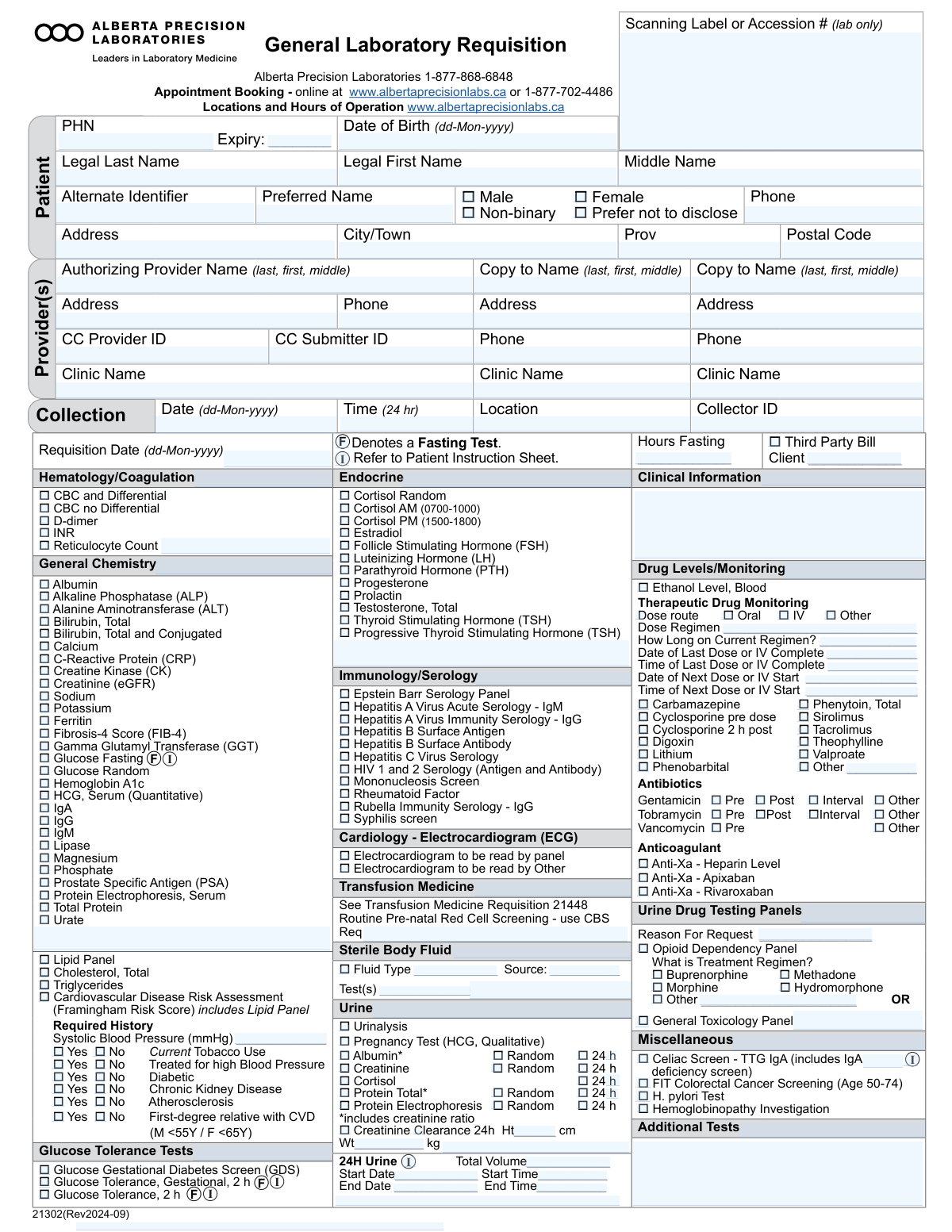
The Alberta Precision Laboratories General Laboratory Requisition (Form 21302) is the most common document used within the APL network. It is designed as a comprehensive tool for a wide range of standard diagnostic tests. You should choose this form if your requirements include:
- Routine Blood Work: This includes Complete Blood Counts (CBC), differential, and other standard hematology screenings.
- Metabolic and Chemistry Panels: Use this for checking electrolytes, glucose levels, renal function (creatinine/urea), and liver enzymes.
- Hormonal and Endocrine Testing: This form covers thyroid stimulating hormone (TSH), gestational diabetes screening, and other common metabolic markers.
- Urinalysis: Standard urine chemistry and microscopic examinations are facilitated through this specific requisition.
When to Use This Form
This form is intended for use by authorized healthcare providers—such as physicians, nurse practitioners, or midwives—to communicate testing orders to laboratory staff. If you are a patient, you generally do not "choose" this form yourself; your doctor will provide it to you. However, if you are a provider looking to streamline your clinic's workflow, ensuring you have the most up-to-date version of Form 21302 is vital for avoiding processing delays.
Ensuring Accuracy with AI
Because Form 21302 covers such a broad spectrum of tests, it is crucial to ensure that the "Tests Requested" section is clearly marked. Using Instafill.ai can help you convert a static PDF of this requisition into a fillable format, allowing for legible, typed entries that reduce the risk of manual transcription errors at the lab. This ensures that patient demographics, billing details (including provincial health numbers), and provider information are perfectly clear before the patient arrives at the collection site.
Form Comparison
| Form | Primary Purpose | Who Uses It | Key Sections Included |
|---|---|---|---|
| Alberta Precision Laboratories General Laboratory Requisition (Form 21302) | Requesting specific laboratory tests including hematology, chemistry, and endocrine panels. | Authorized healthcare providers and physicians practicing within the province of Alberta. | Patient demographics, provider information, billing details, and comprehensive test checklists. |
Tips for Alberta Precision Laboratories forms
Discrepancies between the requisition and your Alberta Health Care Insurance Plan (AHCIP) card can lead to processing delays or billing errors. Double-check that the name, birthdate, and personal health number (PHN) are entered exactly as they appear on your official identification.
Each requisition must include the ordering physician's name and their unique Practitioner ID (PRACID). Omitting this information or providing an incorrect clinic phone number can prevent the lab from sending results back to your doctor promptly.
The General Laboratory Requisition covers a wide range of panels from hematology to immunology. Use clear, distinct marks in the checkboxes to ensure the lab technician performs the exact tests requested, as ambiguous markings can lead to missed screenings or unnecessary blood draws.
Using AI-powered tools like Instafill.ai can complete these complex medical forms in under 30 seconds with high accuracy. Your data stays secure during the process, providing a practical and reliable way to handle multiple requisitions while minimizing manual entry errors.
Adding brief clinical indications or current medications in the designated sections helps the lab provide a more accurate interpretation of your results. This context is often vital for pathologists when evaluating specific endocrine panels or chemistry tests.
If you have multiple requisitions for ongoing monitoring, keep them organized by the date they are intended to be performed. This prevents confusion at the collection site and ensures you do not accidentally submit a duplicate request or an outdated form.
Frequently Asked Questions
APL forms, such as the General Laboratory Requisition, are used by authorized healthcare providers to order diagnostic tests for patients across Alberta. These forms ensure that the laboratory receives the necessary clinical data, patient demographics, and provider information to process samples and return accurate results.
These forms must be completed by a licensed healthcare professional, such as a physician, nurse practitioner, or midwife, who has the authority to order laboratory tests in the province. While patients may provide their personal details, the clinical request and test selection sections must be filled out by the medical provider.
Form 21302 is a comprehensive document that covers a wide range of diagnostic services, including hematology, general chemistry, immunology, and endocrine panels. It allows providers to select specific individual tests or standardized panels based on the patient's medical requirements.
Yes, AI tools like Instafill.ai can fill out these forms in under 30 seconds by accurately extracting and placing data from source documents into the appropriate fields. This technology can also convert non-fillable PDF versions of APL forms into interactive, fillable documents for easier digital management.
Once the form is completed and signed by a healthcare provider, the patient typically presents it at an Alberta Precision Laboratories collection site or an affiliated lab like DynaLIFE. In some cases, the ordering clinic may fax the requisition directly to the laboratory or submit it via an integrated electronic medical record system.
The forms require essential identifiers including the patient's full legal name, date of birth, gender, and Alberta Personal Health Number (PHN). Accurate contact information is also vital to ensure that results are linked to the correct health record and that patients can be reached if follow-up is necessary.
Using AI-powered services like Instafill.ai, these laboratory requisitions can be completed in less than 30 seconds. The AI automates the data entry process, ensuring that provider codes, billing details, and patient demographics are populated quickly and accurately.
Yes, the forms include dedicated sections for billing to determine if the tests are covered by the Alberta Health Care Insurance Plan (AHCIP) or if they are for a third party, such as an insurance company or employer. Correctly identifying the billing source is necessary to ensure the lab can process the request without administrative delays.
Providers can indicate the priority of a request by checking the 'STAT' or 'Urgent' boxes provided on the requisition. This flags the sample for prioritized processing and ensures that the laboratory communicates the results to the ordering physician as quickly as possible.
A valid signature from the ordering healthcare provider is generally required for the requisition to be accepted as a legal medical order. While some facilities accept digital signatures or electronic orders, it is important to ensure the form meets the specific authentication standards of the receiving laboratory.
Glossary
- Form Complexity Index
- Instafill’s 0–100 measure of how much effort a form takes to complete, calculated deterministically from the form’s own structure rather than estimated. It combines the number of fillable fields (the largest factor), how difficult those fields are to complete based on their type, the number of pages that contain fields, the amount of conditional “fill-only-if” logic, and how many sections the form is divided into, then adds modifiers for tables and repeating lists, bundled instruction pages, and dense page layouts. A higher score means the form is harder to fill out by hand. The forms in this category have a median Form Complexity Index of 69/100 (Complex). See exactly how it is calculated.
- Alberta Precision Laboratories (APL)
- A wholly-owned subsidiary of Alberta Health Services responsible for providing diagnostic laboratory services throughout the province of Alberta.
- Requisition
- An official medical order form completed by a physician or authorized healthcare provider to request specific laboratory tests or diagnostic procedures for a patient.
- PHN (Personal Health Number)
- A unique 10-digit identification number assigned to residents of Alberta who are eligible for provincial health coverage.
- ULI (Unique Life Identifier)
- A permanent, unique number assigned to individuals in the Alberta health system to ensure accurate identification across different medical records and facilities.
- CPSA Number
- A registration number issued by the College of Physicians & Surgeons of Alberta that identifies the specific medical practitioner ordering the laboratory tests.
- Hematology
- A section of the laboratory requisition used to order tests related to blood, blood-forming organs, and blood disorders, such as a Complete Blood Count (CBC).
- STAT
- A priority designation derived from the Latin word 'statim,' indicating that the lab test is urgent and results are needed immediately for critical patient care.
- Endocrine Panels
- Groups of laboratory tests used to measure hormone levels and evaluate the function of glands like the thyroid, adrenal, or pituitary glands.