Fill out CollegeAdvantage forms
with AI.
CollegeAdvantage forms are essential documents for managing Ohio’s 529 Savings Plan, designed to help families save for future higher education expenses. These forms facilitate critical account updates, such as changing beneficiaries, managing withdrawals, or adjusting investment options. Since 529 plans involve tax-advantaged savings, maintaining accurate and up-to-date documentation is vital to ensure compliance with IRS regulations and to maximize the financial benefits intended for the student.
By continuing, you acknowledge Instafill's Privacy Policy and agree to get occasional product update and promotional emails.
About CollegeAdvantage forms
Account owners, including parents and grandparents, typically need these forms during significant life transitions. For instance, if a designated beneficiary decides not to pursue higher education or receives a scholarship, a Beneficiary Change Form allows the owner to transfer funds to another eligible family member without incurring tax penalties. These documents are also necessary for updating personal information or altering contribution schedules as financial goals evolve. Ensuring these forms are filed correctly is key to a seamless transition from saving to spending on education.
Managing this paperwork doesn't have to be a manual burden. Tools like Instafill.ai use AI to fill these forms in under 30 seconds, handling your data accurately and securely to streamline the administrative side of your education planning.
Every form on this page can be completed without typing. Instafill is form filling software that reads a PDF and fills it for you — including flat and scanned documents that carry no fillable fields at all.
Forms in This Category
The forms in this category have a median Form Complexity Index of 52/100 (Moderate), measured across 1 forms by field count, input difficulty, length, conditional logic and structure. See how it is calculated.
| Form Name | Pages | FCI | |
|---|---|---|---|
| 1. | CollegeAdvantage Direct 529 Savings Plan Beneficiary Change Form | 1 | Moderate 52 |
- Enterprise-grade security & data encryption
- 99%+ accuracy powered by AI
- 1,000+ forms from all industries
- Complete forms in under 60 seconds
How to Choose the Right Form
Managing Your Ohio 529 Plan
CollegeAdvantage forms are essential tools for maintaining your Ohio Direct 529 Savings Plan. Whether you are transitioning funds between children or updating your long-term savings strategy, selecting the correct paperwork ensures your education savings remain tax-advantaged and compliant with state regulations.
When to Use the Beneficiary Change Form
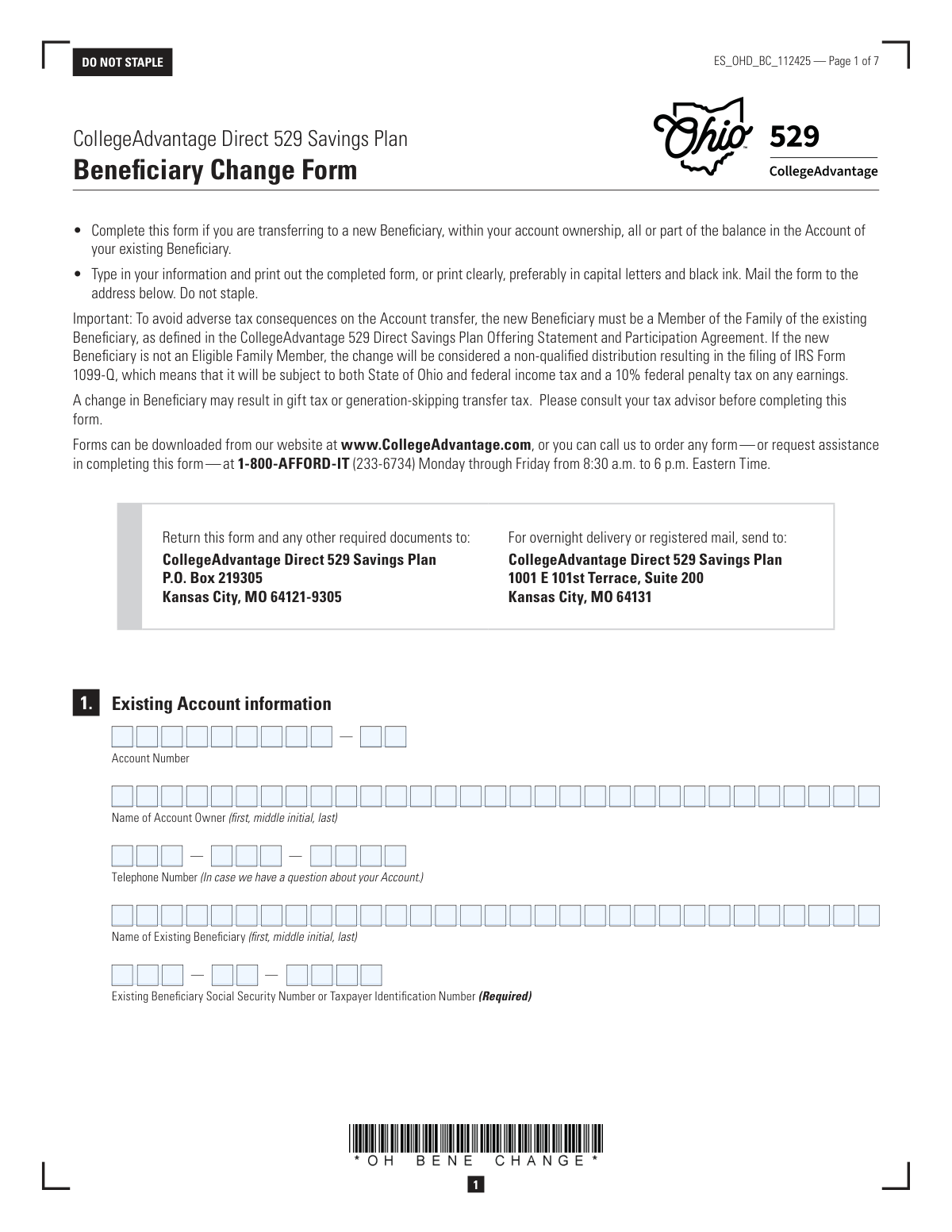
Currently, the primary document in this category is the CollegeAdvantage Direct 529 Savings Plan Beneficiary Change Form. You should select this form if you need to:
- Transfer Funds to a Sibling: If your eldest child has graduated and has a remaining balance, use this form to move those funds to a younger sibling.
- Redirect Savings: If the original beneficiary chooses a path that doesn't require these funds, you can change the name on the account to another eligible family member.
- Execute Partial Transfers: You do not have to move the entire balance at once. This form allows for partial transfers if you want to support multiple students from a single account source.
Key Requirements for Selection
Before you begin filling out the CollegeAdvantage Direct 529 Savings Plan Beneficiary Change Form, ensure your situation meets the following criteria to avoid administrative delays:
- Relationship Status: To maintain the tax-deferred status of the account and avoid a 10% penalty, the new beneficiary must meet the IRS definition of a "member of the family" of the current beneficiary.
- Documentation: Ensure you have the current account number, as well as the Social Security numbers and birth dates for both the current and the new beneficiaries.
Streamlining Your Filing
Managing 529 plans often involves precise financial data. Using Instafill.ai, you can process the CollegeAdvantage Direct 529 Savings Plan Beneficiary Change Form quickly. Our AI-powered tools help you convert static PDFs into interactive, fillable documents, ensuring that your beneficiary updates are handled accurately and your education savings plan remains up to date.
Form Comparison
| Form | Purpose | Who Files It | Key Requirements |
|---|---|---|---|
| CollegeAdvantage Direct 529 Savings Plan Beneficiary Change Form | Transfer account balance to a new eligible family member for education savings. | Account owners of the Ohio CollegeAdvantage Direct 529 Savings Plan. | New beneficiary details and verification of eligible family member relationship. |
Tips for CollegeAdvantage forms
To avoid federal income taxes and penalties, ensure the new beneficiary is a qualifying 'member of the family' of the original beneficiary. This typically includes siblings, children, parents, and other close relatives as defined by IRS 529 plan guidelines.
You are not required to move the entire balance to a new beneficiary. Use the form to specify whether you want to transfer the full amount or a specific dollar portion to help balance educational funding between multiple family members.
One of the most common reasons for processing delays is an incorrect Social Security or Taxpayer Identification Number for the new beneficiary. Always verify these numbers against official documents before finalizing the form to ensure a smooth transition.
Managing college savings paperwork can be tedious, but AI-powered tools like Instafill.ai can complete these forms in under 30 seconds with high accuracy. Your sensitive data stays secure during the process, providing a fast and reliable way to handle beneficiary updates.
While updating the beneficiary, take a moment to review who is listed as the successor owner of the account. Ensuring this information is current protects the account assets and ensures they are managed according to your wishes in the future.
Some 529 plan updates may require a Medallion Signature Guarantee or a notary's seal depending on the account value. Check the form instructions carefully to see if you need to visit a financial institution or notary before submitting your paperwork.
Changing a beneficiary can sometimes have gift tax implications if the new beneficiary is in a younger generation. It is helpful to organize these changes alongside your annual tax planning to ensure you stay within federal gift tax exclusion limits.
Frequently Asked Questions
CollegeAdvantage forms are official documents used to manage Ohio's 529 Savings Plan accounts. They allow account owners to perform essential tasks such as changing beneficiaries, updating contact information, or requesting withdrawals for qualified higher education expenses.
An eligible family member typically includes the original beneficiary's siblings, children, parents, cousins, or even the account owner. Transferring funds to these individuals generally allows the account to maintain its tax-advantaged status without incurring penalties.
You should use this form if the current beneficiary has completed their education with remaining funds, or if you wish to reallocate college savings to another family member. It is a common tool for families who want to keep educational funds within the family while avoiding tax consequences.
Changing a beneficiary to a qualifying family member is generally not a taxable event under federal law. However, if the new beneficiary is in a lower generation than the original beneficiary, there may be gift tax or generation-skipping transfer tax implications to discuss with a tax professional.
Yes, the CollegeAdvantage Direct 529 Savings Plan Beneficiary Change Form allows for either a full transfer of the account balance or a partial amount. This allows account owners to split savings among multiple children or relatives as needed.
Completed forms are typically submitted to the Ohio Tuition Trust Authority via their secure online portal or by mail to the address provided on the form. Ensure that all required signatures are present to avoid processing delays.
You will need to provide the new beneficiary's full legal name, date of birth, and Social Security or Taxpayer Identification Number. This information is necessary for the plan administrator to track the funds and maintain compliance with IRS regulations.
Yes, AI tools like Instafill.ai can fill these forms in under 30 seconds by accurately extracting data from your source documents and placing it into the appropriate fields. This technology can also convert static, non-fillable PDFs into interactive documents for easier completion.
While manual entry might take 10 to 15 minutes, using an AI-powered service allows you to complete CollegeAdvantage forms in less than 30 seconds. These tools ensure that data is mapped correctly from your records to the official form fields.
Federal regulations typically allow for one beneficiary change per 12-month period for the same account. However, you can change the beneficiary more frequently if the new beneficiary is a qualifying family member of the current one.
Glossary
- Form Complexity Index
- Instafill’s 0–100 measure of how much effort a form takes to complete, calculated deterministically from the form’s own structure rather than estimated. It combines the number of fillable fields (the largest factor), how difficult those fields are to complete based on their type, the number of pages that contain fields, the amount of conditional “fill-only-if” logic, and how many sections the form is divided into, then adds modifiers for tables and repeating lists, bundled instruction pages, and dense page layouts. A higher score means the form is harder to fill out by hand. The forms in this category have a median Form Complexity Index of 52/100 (Moderate). See exactly how it is calculated.
- 529 Plan
- A tax-advantaged savings plan designed to encourage saving for future education costs, named after Section 529 of the Internal Revenue Code.
- Beneficiary
- The individual designated on the account whose education expenses will be paid for using the funds in the 529 plan.
- Eligible Family Member
- A specific relative of the original beneficiary, such as a sibling, spouse, or child, who can be named as a new beneficiary without triggering federal tax penalties.
- Account Owner
- The person who opens the account and maintains control over the investments, beneficiary designations, and distribution of funds.
- Direct Plan
- A 529 plan, like the Ohio CollegeAdvantage Direct Savings Plan, that is sold directly to the consumer rather than through a financial advisor.
- Qualified Higher Education Expenses (QHEE)
- Costs including tuition, fees, books, and certain room and board expenses that are required for enrollment at an eligible post-secondary school.
- Medallion Signature Guarantee
- A specialized certification stamp provided by a financial institution that confirms the authenticity of a signature for high-value account changes.
- Successor Account Owner
- The person designated to take over the management and ownership of the 529 account if the original owner passes away or becomes incapacitated.