Fill out construction insurance forms
with AI.
Construction insurance forms are critical documents used to mitigate financial risk and ensure comprehensive coverage throughout the lifecycle of a building project. These forms facilitate the underwriting process for various policies, such as builders' risk and installation floaters, which protect property, materials, and equipment from the moment they arrive on-site until project completion. By documenting specific details about project values, job site security, and potential hazards, these forms help insurers assess risks accurately and provide the necessary safeguards against unforeseen events like fire, theft, or natural disasters.
By continuing, you acknowledge Instafill's Privacy Policy and agree to get occasional product update and promotional emails.
About construction insurance forms
These documents are primarily used by general contractors, developers, and insurance producers who need to secure specialized coverage for residential or commercial construction. Whether you are starting a new build or installing high-value equipment, having the correct paperwork—such as the ACORD 147 for installation risks—is essential for compliance and financial protection. Providing precise data on these forms ensures that coverage limits are appropriate for the project’s scale and that all parties involved are adequately shielded from liability.
Managing the paperwork for multiple job sites can be a significant administrative burden. To simplify this process, tools like Instafill.ai use AI to fill out construction insurance forms in under 30 seconds, ensuring data is handled accurately and securely so you can focus on the project at hand.
Every form on this page can be completed without typing. Instafill is form filling software that reads a PDF and fills it for you — including flat and scanned documents that carry no fillable fields at all.
Forms in This Category
The forms in this category have a median Form Complexity Index of 64/100 (Complex), measured across 5 forms by field count, input difficulty, length, conditional logic and structure. See how it is calculated.
| Form Name | Pages | FCI | |
|---|---|---|---|
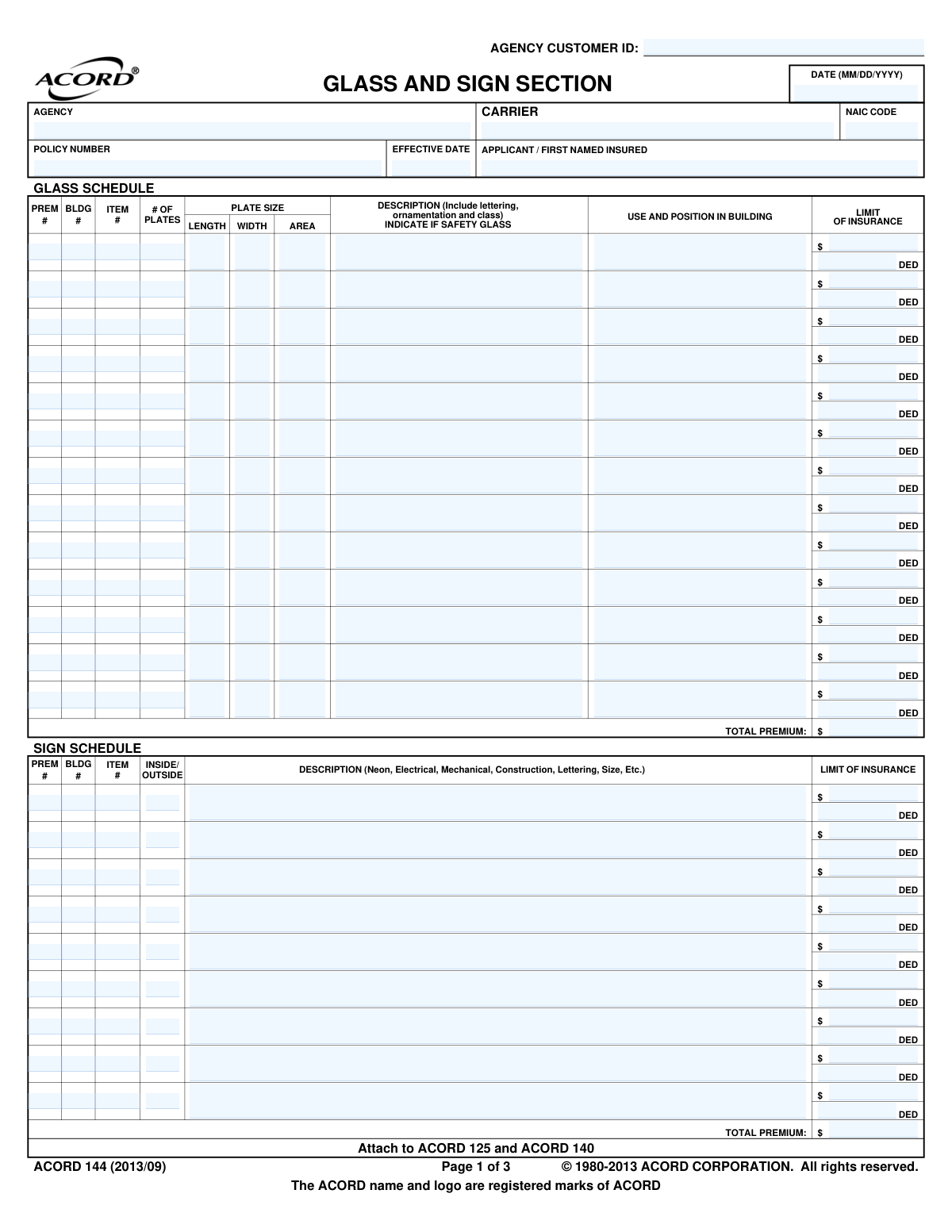
| 1. | ACORD 144, Glass and Sign Section | 3 | Complex 66 |
| 2. | ACORD 145, Accounts Receivable / Valuable Papers | 3 | Complex 63 |
| 3. | ACORD 146, Equipment Floater Section | 2 | Complex 64 |
| 4. | ACORD 147 (2001/02), Installation/Builders Risk Section | 2 | Complex 76 |
| 5. | ACORD 147, Installation / Builders Risk Section | 3 | Complex 64 |
- Enterprise-grade security & data encryption
- 99%+ accuracy powered by AI
- 1,000+ forms from all industries
- Complete forms in under 60 seconds
How to Choose the Right Form
Understanding Construction Risk Coverage
Selecting the right construction insurance documentation depends on whether you are protecting a completed structure or property that is currently under construction or being installed. Because construction sites are dynamic and high-risk environments, generic insurance forms often lack the detail required by underwriters to provide accurate quotes.
When to Use ACORD 147
The primary form in this category is ACORD 147, Installation/Builders Risk Section. This is a supplemental insurance application designed to provide granular detail for property coverage during the construction phase. You should choose this form if your project fits the following criteria:
- Builders Risk Policies: Use this form when you need to document the value of a building under construction, including materials on-site and the specific job site security measures (like fencing or lighting) used to mitigate risk.
- Installation Floaters: If your work involves installing specific high-value equipment—such as HVAC units, industrial machinery, or complex electrical systems—ACORD 147 helps cover those items while they are in transit to the site or waiting to be installed.
- Specific Peril Coverage: If the project is located in an area prone to natural disasters, use this section to define desired coverage limits for perils like floods or earthquakes.
Key Information for Your Application
To complete ACORD 147 effectively, ensure you have the following details ready for the underwriting process:
- Project Values: Both the total completed value and the limits for property in transit.
- Transportation Risks: Detailed information on how materials are moved and the maximum value of any single shipment.
- Job Site Security: Descriptions of watchman services, site enclosures, and fire protection protocols.
Using Instafill’s AI-powered platform, you can quickly convert these complex requirements into a professional, fillable document, ensuring your construction project is protected from the ground up.
Form Comparison
| Form | Primary Purpose | Key Information Captured | Who Files It | Coverage Focus |
|---|---|---|---|---|
| ACORD 147, Installation/Builders Risk Section | Provides detailed underwriting data for property insurance during construction or installation projects. | Includes project values, job site security, transportation risks, and specific peril limits. | Insurance producers and applicants such as contractors or property owners. | Covers property, materials, and equipment against loss during transit and installation. |
Tips for construction insurance forms
When filling out construction insurance forms, always provide the full completed value of the project rather than just the current phase. Under-reporting values can lead to coinsurance penalties, meaning you might not be fully reimbursed in the event of a partial loss.
Underwriters heavily weigh site security when determining premiums for builders risk and installation forms. Clearly document the presence of fencing, lighting, security patrols, or fire protection systems to potentially lower your rates and ensure coverage approval.
Many construction projects involve materials stored at a warehouse or in transit to the job site. Ensure your forms specifically request coverage for these floaters so that expensive equipment or materials are protected before they are officially installed.
Filling out complex insurance sections can be tedious, but AI-powered tools like Instafill.ai can complete these forms in under 30 seconds with high accuracy. This technology ensures your data stays secure while significantly reducing the administrative burden of managing multiple construction documents.
Be prepared to separate physical construction costs from non-physical expenses like architectural fees, permits, and interest. Accurately listing these soft costs helps ensure your policy covers the full financial impact of a project delay caused by a covered loss.
If your project is located in a high-risk area, pay close attention to the flood and earthquake sections of the form. Do not assume standard coverage applies; you may need to specify higher sub-limits to protect against these specific environmental risks.
Frequently Asked Questions
These forms are essential documents used by contractors and developers to apply for coverage that protects property, materials, and equipment during a construction project. They provide underwriters with the specific details needed to assess risks related to theft, damage, or natural disasters at a job site.
Generally, the general contractor, property owner, or developer is responsible for initiating these forms to ensure the project is adequately covered. Insurance producers often assist in the process to ensure all technical details regarding site security and project values are accurate.
These forms should ideally be completed and submitted before construction begins or materials are delivered to the site. Having the policy in place early ensures that the project is protected from the moment work starts, covering potential losses during the initial phases.
While both cover property during construction, a Builders Risk form typically covers the entire structure, whereas an Installation Floater is often used by subcontractors to cover specific materials or equipment they are installing. Choosing the right form depends on whether you are insuring the whole project or just a specific portion of the work.
Underwriters typically look for information on how the site will be protected, such as fencing, lighting, security patrols, or alarm systems. Providing thorough details in this section can influence the premium and the willingness of the insurer to provide coverage for theft or vandalism.
Yes, modern AI tools like Instafill.ai allow users to fill out complex documents such as ACORD forms by automatically extracting data from project contracts or previous applications. These tools can accurately place information into the correct fields, reducing the risk of manual entry errors.
Using AI-powered services, most construction insurance forms can be completed in under 30 seconds. The technology quickly scans your source documents and populates the necessary fields, making the application process significantly faster than traditional manual typing.
While not always legally mandated by the state, most lenders and project owners require proof of specific insurance coverage before funding is released or work commences. Completing these forms is a standard industry practice to mitigate financial risk for all parties involved in a build.
Completed forms are usually submitted to an insurance broker or directly to the underwriting department of an insurance company. Once reviewed, the insurer will provide a quote or request additional information to finalize the policy.
If the scope of work or the value of materials significantly changes, you should update your insurance provider immediately. This often involves submitting a revised form or an endorsement to ensure the coverage limits reflect the new project valuation.
Glossary
- Form Complexity Index
- Instafill’s 0–100 measure of how much effort a form takes to complete, calculated deterministically from the form’s own structure rather than estimated. It combines the number of fillable fields (the largest factor), how difficult those fields are to complete based on their type, the number of pages that contain fields, the amount of conditional “fill-only-if” logic, and how many sections the form is divided into, then adds modifiers for tables and repeating lists, bundled instruction pages, and dense page layouts. A higher score means the form is harder to fill out by hand. The forms in this category have a median Form Complexity Index of 64/100 (Complex). See exactly how it is calculated.
- ACORD
- The Association for Cooperative Operations Research and Development, which provides the standardized forms used by the insurance industry to ensure consistency in data collection.
- Builders Risk Insurance
- A specialized form of property insurance that protects buildings and structures while they are under construction or major renovation.
- Installation Floater
- Coverage for specific machinery, equipment, or materials that a contractor is installing, protecting the items from the time they leave the warehouse until the job is complete.
- Soft Costs
- Non-physical expenses associated with a construction project that can be insured, such as interest on loans, legal fees, and architectural designs.
- Hard Costs
- Direct costs for the physical construction of a project, including the tangible materials and labor used to build the structure.
- Inland Marine Insurance
- A broad category of insurance that covers property in transit or mobile equipment; builders risk policies are typically classified under this category.
- Peril
- The specific cause of a potential loss, such as fire, flood, or theft, which must be identified to determine coverage limits in a builders risk policy.
- Producer
- An insurance agent or broker who helps the applicant complete the form and submits the risk details to the insurance company for underwriting.